Cimabue
Cimabue, born Cenni di Pepo (or possibly Bencivieni di Pepo) around 1240 in Florence, emerged as the most influential painter of the third quarter of the thirteenth century and the pivotal figure bridging Byzantine tradition and Proto-Renaissance innovation. The precise circumstances of his birth remain obscure, with contemporary documents providing no definitive record of his parentage or exact birthdate, though scholarly consensus places his nativity circa 1240 based on stylistic chronology and the documented trajectory of his career. The name “Cimabue,” by which he became universally known, appears to be a nickname rather than a family surname, possibly deriving from the Florentine dialect “cima bue” (ox head) or from a corruption of an earlier patronymic, though its exact etymology remains contested among scholars.
His baptismal name, Cenni di Pepo, appears in the earliest documentary references, including a 1272 document from Rome where he is identified as “Cimabove pictor de Florentia,” establishing both his professional identity and his Florentine origins. The Pepo family, though not among Florence’s great noble houses, appears to have belonged to the artisan or mercantile class that was transforming the social and political landscape of thirteenth-century Florence, providing sufficient economic resources to support artistic apprenticeship and guild membership.
The environment of mid-thirteenth-century Florence, still rebuilding from the devastations of factional warfare between Guelph and Ghibelline parties, provided the formative context for Cimabue’s early development. The city’s parish of San Lorenzo, where many artisan families congregated, would have offered exposure to the workshops of goldsmiths, textile workers, and painters who served the city’s growing merchant class and its ambitious religious foundations.
Florence in the 1240s and 1250s was experiencing significant architectural expansion, with the construction of new mendicant churches—Santa Maria Novella for the Dominicans, Santa Croce for the Franciscans—creating unprecedented demand for large-scale religious imagery. The city’s competitive artistic environment, characterized by the presence of established masters like Coppo di Marcovaldo and the influx of Byzantine models through trade and diplomatic contacts, created a crucible of stylistic experimentation that shaped Cimabue’s artistic formation. His early training, though entirely undocumented, likely followed the standard pattern of medieval apprenticeship, with a young boy around age ten or twelve entering a master’s workshop to learn the technical foundations of panel preparation, pigment grinding, gold leaf application, and the complex procedures of tempera painting that characterized Tuscan practice.
The question of Cimabue’s early artistic education has generated extensive scholarly speculation, with various masters proposed as his formative influences or direct teachers. The presence of Coppo di Marcovaldo in Florence during Cimabue’s youth makes that master a plausible candidate for influence, particularly given the stylistic connections observable between Coppo’s dramatic chiaroscuro modeling and emotional intensity and similar qualities in Cimabue’s mature work.
The debate over whether Cimabue trained directly in Coppo’s workshop or absorbed his influence through independent study of his works remains unresolved, with some scholars arguing for direct master-pupil relationship while others suggest more complex patterns of influence operating through observation and emulation rather than formal apprenticeship. The equally plausible alternative hypothesis positions Cimabue’s formation within the context of Byzantine painters active in Florence, either immigrant Greek masters or Italian painters deeply steeped in Maniera Greca conventions, an interpretation supported by the profound understanding of Byzantine compositional principles and iconographic systems evident throughout his oeuvre. The synthesis of Byzantine formal vocabularies with emerging naturalistic tendencies that characterizes Cimabue’s work suggests exposure to multiple artistic traditions rather than formation within a single workshop lineage, perhaps indicating a more cosmopolitan training that involved observation of diverse models and experimentation with varied stylistic approaches.
No documents record Cimabue’s marriage or family life, though the absence of such records reflects the incomplete nature of thirteenth-century archival preservation rather than necessarily indicating celibacy or social isolation. Unlike some later artists whose domestic circumstances are well documented through property transactions, dowry contracts, and testament records, Cimabue’s personal life remains entirely obscure, with his identity preserved solely through his artistic achievements and the few documentary references to professional activities.
The question of whether Cimabue maintained a traditional family workshop, training sons or relatives in his craft as was customary among medieval artisans, cannot be answered definitively given the documentary void. The absence of any recorded “Cimabue dynasty” comparable to the Berlinghieri or Memmi families suggests either that he had no children who followed his profession or that such familial continuation remained unrecognized in historical records. This biographical obscurity stands in striking contrast to his artistic celebrity, demonstrating the medieval distinction between professional reputation and personal historical preservation.
Patrons and Commissions
The Servite order’s church of Santa Maria dei Servi in Bologna provided Cimabue with one of his most significant early commissions, the monumental Madonna and Child altarpiece traditionally dated to the 1270s. This commission connected Cimabue to one of the rapidly expanding mendicant orders and demonstrated his early reputation beyond Florence, as Bologna represented a major ecclesiastical and commercial center whose artistic patronage attracted masters of recognized ability.
The Servites, formally known as the Order of Servants of Mary, had been founded in Florence in the 1230s and maintained strong institutional connections with Florentine artistic workshops, making their selection of Cimabue a natural extension of these established networks. The scale and liturgical importance of the commission—a monumental altarpiece intended for prominent placement within one of Bologna’s major churches—indicates that by the 1270s Cimabue had established sufficient reputation to be entrusted with prestigious commissions requiring both technical virtuosity and iconographic sophistication. The work’s subsequent influence on Bolognese painting, particularly on the development of local schools that absorbed Cimabue’s synthesis of Byzantine monumentality and emerging naturalism, testifies to its impact on regional artistic development and the dissemination of Florentine innovations through important commission centers.
The Franciscan order became Cimabue’s most significant patron, commissioning multiple works that secured his historical reputation and positioned him as the visual interpreter of Franciscan spirituality for the late thirteenth century. The commission to execute frescoes in the Upper Basilica of San Francesco in Assisi, likely initiated in the 1280s, represented the culmination of his career and placed him at the center of the most important artistic enterprise in Italy.
The Franciscan investment in Assisi as a pilgrimage destination and institutional headquarters created unprecedented demand for monumental fresco cycles depicting biblical narratives, Franciscan hagiography, and apocalyptic visions that would inspire devotion and assert the order’s theological legitimacy. Cimabue’s assignment to decorate portions of the transept and apse, including the dramatic Crucifixion in the left transept and scenes from the lives of the Virgin and Saint Peter in the vault, demonstrated the order’s confidence in his ability to execute works of supreme spiritual and artistic ambition.
The Assisi commissions functioned as a kind of international artistic workshop, bringing together masters from diverse regional traditions—Roman, Florentine, Sienese, and Umbrian—to create a comprehensive visual program that would influence Italian painting for generations. Working within this collaborative but competitive environment, Cimabue absorbed influences from his contemporaries while establishing his own distinctive synthesis of Byzantine grandeur and Proto-Renaissance emotional intensity.
The commission for the Santa Trinita Maestà, executed for the Vallombrosan church of Santa Trinita in Florence and now preserved in the Uffizi Gallery, represents Cimabue’s most iconic and influential Florentine work. The Vallombrosan order, a Benedictine reform congregation with headquarters at Vallombrosa in the Tuscan mountains, maintained significant properties and religious houses throughout Tuscany and commissioned art that emphasized traditional monastic values while incorporating contemporary stylistic innovations.
The choice of Cimabue for this major altarpiece commission reflects both his established reputation in Florence by the 1280s and the Vallombrosans’ desire to create a work rivaling the great altarpieces being produced for the mendicant orders. The Maestà’s subsequent canonical status, becoming the definitive model for enthroned Virgin compositions throughout the late thirteenth and early fourteenth centuries, validated the Vallombrosans’ investment in hiring Florence’s preeminent master. The work’s liturgical function, serving as the focal point for Marian devotion in one of Florence’s most important churches, required both iconographic orthodoxy and aesthetic innovation, a dual demand that Cimabue’s synthesis of tradition and experimentation perfectly satisfied.
The Dominican order provided patronage through multiple commissions, including works for Santa Maria Novella in Florence and possibly for Dominican establishments elsewhere in Tuscany. The great Crucifix in Santa Croce, Florence, though commissioned by the Franciscans rather than Dominicans, exemplifies Cimabue’s engagement with both major mendicant orders and his capacity to create works meeting the distinct devotional emphases of different religious communities.
The Dominicans, with their emphasis on preaching, theological scholarship, and urban pastoral care, required imagery that communicated complex theological concepts while remaining accessible to lay congregations, a challenge that Cimabue’s narrative clarity and monumental figure style effectively addressed. His understanding of how to adapt compositional strategies and emotional registers to suit different patronage contexts—the more austere intellectualism of Dominican spirituality versus the emotionally engaged poverty mysticism of Franciscan devotion—demonstrates sophisticated awareness of institutional cultures and their distinct visual requirements.
The papal court provided episodic but significant patronage, with documentary evidence placing Cimabue in Rome in 1272, presumably executing commissions for ecclesiastical authorities or participating in decorative programs for papal residences or major Roman churches. The 1272 Roman document identifying “Cimabove pictor de Florentia” establishes his presence in the papal city during a period of significant artistic activity, with multiple churches undergoing renovation and decoration under papal sponsorship.
The Roman sojourn, whether brief or extended, would have exposed Cimabue to the monumental mosaic traditions of early Christian Rome, the classical sculptural fragments preserved in the city’s ancient ruins, and the contemporary work of Roman masters like Pietro Cavallini whose innovations in spatial representation and architectural illusionism paralleled developments occurring in Tuscany. This exposure to Roman artistic traditions, combining ancient classical heritage with Byzantine mosaic techniques and emerging naturalistic tendencies, enriched Cimabue’s stylistic vocabulary and may have catalyzed some of the spatial innovations visible in his mature Assisi frescoes. The patronage networks connecting the papal curia with Florentine mercantile and banking families, many of whom maintained Roman business operations and ecclesiastical connections, likely facilitated Cimabue’s access to Roman commissions and created opportunities for professional advancement through papal or curial patronage.
The Pisan cathedral chapter commissioned works from Cimabue, including the monumental apse mosaic depicting Christ in Majesty with the Virgin and Saint John, executed around 1301-1302 and representing one of his final major commissions. This work, though extensively restored and partially reconstructed in subsequent centuries, demonstrates Cimabue’s continued artistic relevance in the early fourteenth century and his capacity to work in the demanding medium of mosaic, which required distinct technical procedures and aesthetic adjustments compared to panel painting or fresco.
The Pisan commission connected Cimabue to one of Italy’s most important maritime republics and its ambitious cathedral building program, placing his work in dialogue with the sculptural innovations of Nicola and Giovanni Pisano whose pulpits for the cathedral and baptistery had revolutionized Italian sculpture through their integration of classical forms and dramatic narrative energy. The mosaic’s prominent placement in the cathedral’s apse, visible to all who entered the church and serving as the visual culmination of the liturgical axis, testified to the Pisan canons’ confidence in Cimabue’s ability to create works meeting the most demanding standards of technical excellence and devotional efficacy.
Artistic Innovations
Cimabue’s revolutionary synthesis of Byzantine formal grandeur with emerging naturalistic tendencies created the visual vocabulary that would define the transition from medieval to Proto-Renaissance painting. His fundamental innovation lay in recognizing that Byzantine compositional principles—the hieratic organization of figures, the symbolic deployment of color and gold, the theological sophistication of iconographic programs—need not preclude observation of natural phenomena and the representation of emotional and psychological states.
This synthesis manifested most dramatically in his treatment of the human figure, where he retained the monumentality and dignity of Byzantine models while introducing subtle modeling that suggested volumetric presence and weight. The elongated proportions, elegant gestures, and stylized drapery patterns characteristic of Byzantine art persisted in Cimabue’s work, but these conventional elements were inflected with a new attention to anatomical structure, the play of light across surfaces, and the expressive potential of facial features and bodily postures. This careful calibration—preserving enough Byzantine convention to maintain devotional decorum while introducing sufficient naturalistic observation to create psychological engagement—positioned Cimabue’s work as simultaneously traditional and revolutionary, satisfying conservative patrons while inspiring younger artists toward greater naturalism.
The development of chiaroscuro modeling, building upon innovations pioneered by Giunta Pisano and Coppo di Marcovaldo, represents one of Cimabue’s most significant technical contributions to thirteenth-century painting. His systematic deployment of graduated tonal transitions to suggest three-dimensional form, particularly visible in the modeling of faces and hands, moved beyond the sharp linear highlighting characteristic of Byzantine practice toward softer, more integrated transitions between light and shadow.
This technique, achieved through careful layering of translucent tempera glazes over carefully prepared underdrawings, created the illusion that figures possessed actual volume and that light fell upon them from identifiable sources rather than emanating mystically from within or remaining ambiguously sourceless as in earlier Byzantine works. The integration of chiaroscuro with traditional Byzantine golden backgrounds created productive tension between planar and volumetric effects, with figures seeming to emerge from the transcendent golden realm while maintaining sufficient material presence to appear tangible and immediate. This technical innovation had profound implications for narrative painting, as figures rendered with convincing volumetric presence could interact spatially with one another and with architectural or landscape elements in ways that flat, iconic figures could not, opening possibilities for more complex and psychologically engaging narrative compositions.
Cimabue’s approach to architectural representation within painted compositions anticipated many developments that Giotto would perfect in the Arena Chapel frescoes. Rather than treating architecture as purely decorative framing or as symbolic indicators of setting, Cimabue began to depict buildings with attention to structural logic, spatial recession, and the integration of figures within architectural spaces. The Assisi frescoes demonstrate this innovation most clearly, with architectural elements rendered in oblique projection suggesting depth and creating boxes or rooms within which narrative action unfolds.
While Cimabue never achieved the systematic perspectival consistency that would characterize Renaissance spatial construction, his experimental approaches to representing architecture established crucial precedents for his students and followers. The recognition that pictorial space could function as a stage upon which figures enacted narratives, rather than as an abstract golden void signifying the transcendent realm, transformed the possibilities for religious storytelling and created the conceptual foundation for Renaissance spatial illusionism.
The emotional intensity and dramatic power characteristic of Cimabue’s work represents perhaps his most influential innovation, establishing a model for religious art that engaged viewers’ affective responses rather than simply commanding reverent contemplation. His crucifixes, particularly the great example in Santa Croce (tragically damaged in the 1966 Florence flood), depicted Christ’s suffering with unprecedented pathos, the body contorted in agony, blood flowing in visceral detail, facial features registering profound physical and spiritual pain.
This emotionally engaged approach to the Passion, influenced by Franciscan spirituality’s emphasis on meditating upon Christ’s suffering as a path to spiritual transformation, created images intended to provoke tears, prayers, and emotional identification rather than purely intellectual contemplation. The expressive potential Cimabue discovered in exaggerating facial expressions, emphasizing gesture, and manipulating drapery to suggest emotional states provided a vocabulary that subsequent painters would develop with increasing sophistication. His influence on the development of emotionally engaged religious imagery extended beyond direct stylistic imitation to establish a fundamental principle: that great religious art should move the viewer’s heart as well as instruct the mind.
The decorative richness and chromatic sophistication of Cimabue’s work demonstrated that Byzantine heritage of precious materials and elaborate ornamentation remained compatible with emerging naturalistic tendencies. His extensive use of gold leaf, not merely for backgrounds but for elaborate tooled patterns, decorative borders, and highlights on drapery and architecture, created works of extraordinary visual splendor that satisfied patrons’ desires for manifest expenditure and devotional magnificence.
The chromatic intensity of his palette, employing expensive ultramarine blue derived from lapis lazuli, rich vermillion reds, and carefully modulated earth tones, created color harmonies of great sophistication that influenced Tuscan painting’s development toward the jewel-like colorism of later Sienese and Florentine masters. This embrace of decorative richness distinguished Italian painting from some Northern European developments toward greater austerity and established a tradition wherein visual splendor functioned as appropriate expression of divine glory rather than as distraction from spiritual contemplation.
Artistic Influences
The Byzantine artistic tradition provided the fundamental grammar of Cimabue’s visual language, supplying compositional formulas, iconographic conventions, and technical procedures that he would transform but never entirely abandon. His formation occurred during a period when Byzantine models enjoyed enormous prestige in Italy, with Greek icon painters active in major cities and portable Byzantine artworks—icons, illuminated manuscripts, carved ivories—circulating through trade networks and diplomatic exchanges. The Byzantine Maestà composition, depicting the enthroned Virgin surrounded by angels and saints in strict hierarchical arrangement, provided the template for Cimabue’s great altarpieces, while Byzantine Passion iconography informed his crucifix compositions.
The elongated proportions, stylized drapery with its characteristic curvilinear folds, and the frontality and hieratic dignity of Byzantine figure types remained evident throughout his career, demonstrating that his innovations built upon rather than rejected this tradition. The subtle modifications he introduced—the slight turning of heads to suggest psychological interaction, the gentle modeling that suggested volume without destroying decorative pattern, the humanization of facial features through more naturalistic proportions—accumulated to create works that felt simultaneously traditional and innovative, Byzantine and proto-Florentine.
Giunta Pisano’s revolutionary Christus patiens iconography, developed earlier in the thirteenth century, profoundly influenced Cimabue’s approach to crucifix composition and the representation of divine suffering. Giunta’s transformation of the crucifix from a triumphant Christ (Christus triumphans) to a suffering, dying figure whose body curves under gravitational weight and whose face registers agony established the emotional template that Cimabue would develop with even greater intensity.
The technical innovations Giunta pioneered—the use of green underpainting to suggest death’s pallor, the careful rendering of blood flowing from wounds, the dramatic curvature of the body—provided technical procedures that Cimabue adopted and refined. However, Cimabue’s crucifixes moved beyond Giunta’s achievements through more sophisticated anatomical understanding, more dramatic scale (his crucifixes are among the largest produced in the thirteenth century), and more complex integration of narrative scenes in the terminals and along the cross’s arms, creating works that functioned simultaneously as devotional focus and as visual instruction in Christian theology.
Coppo di Marcovaldo, the generation of Florentine painters immediately preceding Cimabue, provided crucial precedents for the synthesis of Byzantine tradition with emerging naturalism. Coppo’s powerful chiaroscuro modeling, his attention to psychological expression, and his successful adaptation of Byzantine compositional formulas to serve Western religious sensibilities demonstrated pathways that Cimabue would follow and expand. The scholarly debate over whether Cimabue trained directly in Coppo’s workshop reflects recognition of profound stylistic connections between the two masters, with Coppo’s Madonna del Bordone (1261) anticipating many qualities that would characterize Cimabue’s great Maestà panels. The temporal overlap of their careers—Coppo active until the mid-1270s, Cimabue emerging to prominence in the 1270s and 1280s—creates possibilities for direct interaction, mutual observation, and perhaps competitive emulation that shaped both artists’ development. Whether through formal apprenticeship, collegial observation, or study of completed works, Cimabue absorbed from Coppo an understanding of how to maintain Byzantine dignity while introducing emotional intensity and volumetric presence.
Roman monumental traditions, encountered during Cimabue’s documented presence in Rome in 1272, enriched his artistic vocabulary and may have catalyzed some of his spatial innovations. The great early Christian mosaic cycles in churches like Santa Maria Maggiore and Santa Pudenziana demonstrated possibilities for monumental narrative painting integrated with architectural spaces, while contemporary work by Pietro Cavallini and his circle showed how Roman artists were developing spatial illusionism and architectural representation beyond achievements visible in contemporary Tuscan painting.
The classical sculptural fragments preserved throughout Rome—reliefs from triumphal arches, statuary in various states of preservation, sarcophagus panels with their densely populated narrative scenes—provided models of figural naturalism, anatomical understanding, and narrative density that influenced painters seeking to move beyond Byzantine abstraction. The Roman experience, though brief and incompletely documented, appears to have functioned as a catalyst for Cimabue’s mature style, with the Assisi frescoes executed in the following decade showing spatial ambitions and architectural sophistication that may reflect Roman precedents.
French Gothic illuminated manuscripts, circulating in Italy through the cosmopolitan networks connecting mendicant orders, royal courts, and ecclesiastical institutions, provided models of elegant linearity, decorative sophistication, and chromatic refinement that influenced Cimabue’s developing style. The elongated figure proportions, the sinuous drapery patterns, and the interest in decorative borders and marginalia visible in French manuscripts of the mid-thirteenth century found echoes in Cimabue’s work, suggesting either direct exposure to such manuscripts or absorption of Gothic aesthetic principles through intermediary sources. The Gothic emphasis on creating emotionally engaging religious imagery through expressive gesture, dramatic composition, and attention to narrative detail aligned with Franciscan and Dominican spiritual emphases on affective devotion, creating a cultural context wherein Italian artists like Cimabue found Gothic innovations useful for their own purposes even while maintaining distinct Italian formal characteristics.
Travels and Career
Cimabue’s documented presence in Rome in 1272, attested by a contract identifying “Cimabove pictor de Florentia,” establishes his professional activity beyond Florence and suggests participation in the vibrant artistic environment of the papal city. The circumstances bringing him to Rome—whether a specific papal commission, work for one of Rome’s great churches, or participation in ongoing decorative programs—remain unknown, though the designation as “Florentine painter” in the Roman document suggests his professional identity remained tied to his native city even while he sought opportunities elsewhere. Rome in the early 1270s, under the pontificate of Gregory X and his successors, was experiencing renewed artistic activity after periods of political instability, with the papal curia’s return to the city (following periods of residence in Viterbo and other locations) stimulating demand for artistic services. The presence of Pietro Cavallini and other Roman masters executing major mosaic and fresco cycles in churches like Santa Cecilia in Trastevere and Santa Maria in Trastevere created an environment wherein artistic exchange and competitive innovation flourished. Whether Cimabue’s Roman sojourn lasted weeks, months, or longer cannot be determined from surviving evidence, though the impact of Roman monumental traditions and classical precedents on his subsequent work suggests meaningful engagement rather than brief passage.
The Assisi campaigns, likely beginning in the early 1280s and continuing through the decade, represent the culminating achievement of Cimabue’s career and positioned him at the center of the most ambitious artistic enterprise in late thirteenth-century Italy. The commission to execute frescoes in the Upper Basilica of San Francesco brought him to Umbria, where he worked alongside masters from diverse regional traditions—including possibly the young Giotto, the anonymous Master of the Isaac Stories, and various Sienese and Roman painters—in a collaborative but competitive environment that encouraged innovation while demanding coordination with an overall iconographic program. The Franciscan patrons, led by the order’s General Minister and influenced by theological advisors who determined the complex typological relationships between Old Testament, New Testament, and Franciscan hagiographic narratives, created an intellectually demanding context wherein artists functioned not merely as technicians executing predetermined designs but as visual theologians capable of translating abstract concepts into compelling imagery. Cimabue’s assignment to decorate the transept areas, including the powerful Crucifixion in the left transept that dominates that section of the church, and vault scenes depicting the Evangelists and apocalyptic visions, demonstrated the Franciscan leadership’s confidence in his capacity to execute the most theologically and technically demanding portions of the program.
The physical experience of working at Assisi—living in proximity to the basilica, ascending scaffolding daily to execute frescoes in the demanding buon fresco technique that required completing each section while the plaster remained wet, coordinating with multiple other workshops executing adjacent sections—created unprecedented opportunities for artistic exchange and the dissemination of technical innovations. The communal nature of the Assisi campaigns, with masters observing each other’s working methods, discussing technical challenges, and responding to each other’s compositional innovations, functioned as an informal academy wherein the most advanced developments in Italian painting were simultaneously generated and disseminated. Cimabue’s presence at this epicenter of artistic innovation positioned him to influence younger artists, including most significantly Giotto, who absorbed his master’s achievements while beginning to formulate the even more radical naturalism that would define early fourteenth-century painting. The relationship between Cimabue’s Assisi achievements and Giotto’s subsequent Arena Chapel frescoes, executed two decades later, demonstrates how the Assisi workshops functioned as mechanisms for transmitting and transforming artistic innovations across generations.
The return to Florence following the Assisi campaigns found Cimabue at the height of his reputation, commanding major commissions from the city’s most important religious institutions. The Santa Croce Crucifix, executed for the Franciscan’s principal Florentine church, demonstrates how his Assisi experience influenced his Florentine production, with increased monumentality and emotional intensity reflecting the ambitious scale and spiritual intensity of the basilica frescoes. The Santa Trinita Maestà, probably executed in the 1280s for the Vallombrosan church, represents the consolidation of his mature style, synthesizing Byzantine compositional grandeur with the naturalistic and emotional innovations developed through decades of experimentation. Florence in the 1280s and 1290s, experiencing rapid economic growth, population expansion, and ambitious building programs including the construction of the new cathedral (Santa Maria del Fiore) and the extension of the city walls, created extraordinary demand for artistic services and positioned successful masters like Cimabue as cultural figures of significant social standing. His professional success, reflected in the scale and prestige of his commissions, would have brought economic prosperity and social recognition that elevated successful artists above the status of mere craftsmen toward positions as respected intellectuals and visual authorities.
The final documented commission, the Pisa cathedral apse mosaic executed around 1301-1302, brought Cimabue to one of Italy’s most important maritime republics in the final years of his life. This late work, undertaken when the artist was approximately sixty years old, demonstrates his continued technical versatility and professional relevance in the early fourteenth century even as a younger generation led by his former pupil Giotto was beginning to transform Italian painting through even more radical naturalism. The mosaic medium, requiring distinct technical procedures including the selection, cutting, and setting of tesserae (small colored glass and stone cubes) within prepared plaster beds, demanded skills different from panel painting or fresco and connected Cimabue to the ancient tradition of monumental mosaic decoration that had characterized early Christian and Byzantine art. The Pisan commission brought him into contact with the Pisano family’s sculptural achievements, including Giovanni Pisano’s cathedral pulpit with its dramatic narrative reliefs and expressive figural intensity that paralleled developments in painting. This late-career engagement with mosaic tradition suggests Cimabue’s awareness of the historical continuities connecting contemporary artistic practice to early Christian precedents and his desire to demonstrate mastery across multiple media.
Death and Legacy
Cimabue’s death, occurring in Pisa around 1302, concluded a career spanning approximately four decades and marking the transition between medieval Byzantine tradition and emerging Renaissance naturalism. The absence of detailed documentary evidence regarding his final years and the circumstances of his death reflects the incomplete preservation of fourteenth-century records rather than indicating lack of contemporary recognition. The fact that he died while executing the Pisa cathedral mosaic commission suggests he remained professionally active until the end, undertaking demanding technical and physical work despite advancing age. His burial place remains unknown, with no tomb or memorial identified that might have preserved additional biographical information or contemporary assessments of his achievement. This biographical obscurity, contrasting with the detailed documentation surrounding later Renaissance artists, demonstrates the still-incomplete emergence of the artist as an individualized cultural figure worthy of biographical commemoration in the manner reserved for princes, saints, and scholars.
The immediate impact of Cimabue’s death on Italian painting cannot be overstated, as his innovations and the precedents he established shaped the trajectory of Tuscan art throughout the early fourteenth century. His most significant legacy operated through his influence on Giotto di Bondone, whose revolutionary achievements in spatial naturalism, emotional expressiveness, and narrative clarity built directly upon Cimabue’s foundations while transcending them through even more radical rejection of Byzantine convention. The traditional account, preserved in Vasari’s Lives and earlier chronicles, that Giotto trained in Cimabue’s workshop and accompanied his master to Assisi establishes a direct lineage of master-pupil transmission whereby Cimabue’s synthesis of Byzantine tradition and emerging naturalism provided the immediate precedent for Giotto’s revolutionary innovations. Whether this traditional account accurately reflects historical reality or represents a retrospective construction designed to create satisfying narrative continuity between the two greatest pre-Renaissance painters, the stylistic connections between Cimabue’s late works and Giotto’s early achievements demonstrate profound influence operating either through direct teaching or through careful study of completed works.
The transformation of Cimabue’s reputation in subsequent centuries illuminates changing assessments of medieval versus Renaissance achievement and the construction of art historical narratives privileging naturalism over abstraction. Dante’s famous lines in the Divine Comedy’s Purgatorio, written shortly after Cimabue’s death, establish his contemporary celebrity while simultaneously announcing his supersession: “Cimabue thought to hold the field / In painting, but now Giotto has the cry, / And the fame of the former is obscure” (Purgatorio XI, 94-96, Longfellow translation). This early assessment, positioning Cimabue as the great master of the previous generation eclipsed by his pupil’s even greater achievements, established a narrative framework that would persist through centuries of art historical scholarship. Vasari’s sixteenth-century account, though filled with legendary embellishments and factual inaccuracies, preserved Cimabue’s position as the crucial transitional figure who “began to give the art of painting a better drawing and a better style,” thereby initiating the recovery from medieval decline that the Renaissance would complete. This narrative of progressive improvement, though problematic in its devaluation of medieval artistic achievement on its own terms, ensured Cimabue’s continued historical visibility and established his canonical position as the founder of the Florentine school.
Modern art historical scholarship, developing from the late nineteenth century through sophisticated formal analysis, technical investigation, and archival research, has substantially revised and enriched understanding of Cimabue’s achievement. The recognition that Byzantine art represented a sophisticated and internally coherent artistic tradition rather than mere decline from classical standards has allowed more nuanced appreciation of Cimabue’s Byzantine inheritance and his creative transformation of that tradition. Technical studies examining panel construction, pigment analysis, underdrawing techniques, and the material evidence of working procedures have revealed the extraordinary technical sophistication underlying his works and established more secure attributions by distinguishing Cimabue’s hand from workshop assistants and later copyists. The tragic damage inflicted on the Santa Croce Crucifix by the catastrophic 1966 Florence flood, paradoxically, generated intensive conservation studies that revealed previously hidden aspects of Cimabue’s technique, including his use of incised underdrawings, his layering strategies for achieving subtle chromatic effects, and his working method for the large-scale crucifix format. This scientific investigation has complemented traditional connoisseurial analysis to create more comprehensive understanding of Cimabue’s artistic procedures and aesthetic intentions.
The enduring influence of Cimabue’s innovations extends beyond direct stylistic imitation to establish fundamental principles that would govern Italian painting’s subsequent development. His demonstration that Byzantine compositional grandeur and decorative richness could coexist with naturalistic observation and emotional engagement established a model for artistic synthesis that characterized Tuscan painting throughout the fourteenth century. The spatial ambitions visible in his Assisi frescoes, though still far from the systematic perspectival consistency of Renaissance spatial construction, established precedents for treating pictorial space as a stage upon which narrative action unfolds. His emotional intensity and expressive treatment of religious subject matter, particularly his revolutionary approach to depicting Christ’s suffering, created a tradition of affectively engaged religious imagery that would reach its culmination in Renaissance altarpieces and devotional panels. The decorative richness and chromatic sophistication characteristic of his work influenced the development of Sienese colorism and Florentine attention to ornamental detail, ensuring that Italian painting would continue to value visual splendor and material richness even as it pursued increasing naturalism.
The preservation of Cimabue’s major works—the Santa Trinita Maestà in the Uffizi, the Assisi frescoes despite deterioration and restoration, the damaged but partially recovered Santa Croce Crucifix, and the Pisa cathedral mosaic—ensures his continuing accessibility to scholars and general audiences, allowing direct engagement with his achievements rather than requiring reconstruction from documentary evidence alone.
The display of the Santa Trinita Maestà in the Uffizi’s medieval galleries, positioned near Giotto’s Ognissanti Madonna and Duccio’s Rucellai Madonna, creates visual dialogue between the three greatest masters of the crucial transitional period and allows viewers to perceive simultaneously the shared Byzantine heritage and the distinct innovations each master contributed. Modern tourism’s transformation of Assisi into one of Italy’s most visited sites ensures that thousands of visitors annually encounter Cimabue’s frescoes in their original architectural and devotional context, experiencing the spatial relationships and lighting conditions for which they were designed. This continued physical presence and accessibility distinguishes Cimabue from many medieval masters known only through fragmentary remains or documentary references, allowing his achievement to speak directly across seven centuries.
Major Works and Masterpieces
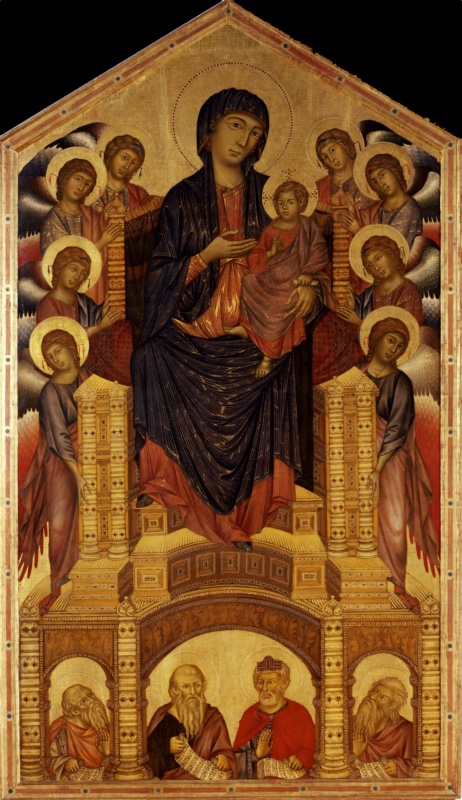
At the center stands the figure of the Madonna in Majesty, seated on a slender ivory throne decorated with carvings, gemstones, and mosaic motifs that evoke the religious architecture of Tuscany from that era. The throne is depicted in “herringbone” perspective, with curved and diagonal steps that create an effect of depth innovative for Italian art, guiding the gaze toward the interior of the sacred space.
The gold background, stamped to simulate light reflections, isolates the scene within a divine dimension, while the axial symmetry—emphasized by the central column—organizes the elements into an ideal mandorla formed by the angels. This perspective structure, combined with the monumentality of the figures, reflects Byzantine influence but introduces elements of volumetric plasticity, paving the way for Giotto. The Virgin, wearing a blue mantle and a red robe adorned with gold, holds the Child on one knee, turning her head toward him in an affectionate gesture; Jesus, adult in features but childlike in body, blesses with his right hand and holds a book with his left.
The Madonna and Child form the theological focal point: Mary points to her Son with her right hand, recalling the Byzantine icon of the Hodegetria (“she who shows the way”), while Jesus turns his gaze toward his Mother, with one leg bent so that the sole of his right foot is visible. Eight angels, four on each side, are arranged symmetrically around the throne: the outer and central ones look toward the viewer or toward Christ, serving as devotional mediators and accentuating the emotional realism with colorful wings and flowing robes.
In the lower band, beneath the throne, four Old Testament prophets are depicted in half-length portraits, identified by scrolls bearing biblical quotations that foreshadow the Incarnation and the Virginity of Mary: from the left, Jeremiah (with Jeremiah 31:22), Abraham (Genesis 22:18), David (Psalms 131:11), and Isaiah (Isaiah 7:14). Jeremiah and Isaiah, on the sides, look upward in a prophetic posture; Abraham and David, in the center, turn toward one another in a serene and solemn pose, revealing an innovative psychological attention to detail in their expressions and gestures.
Painted in tempera on wood (dimensions approximately 385 x 223 cm, with slight variations in sources), the work comes from the high altar of the Vallombrosan church of Santa Trinità in Florence, from which it was transferred to the Uffizi in 1565. Cimabue uses agemina for the drapery, creating luminous reflections, and models the faces with shading that suggests volume, breaking with the flatness of Byzantine iconography. Dated between 1280 and 1300, it embodies the Gothic transition in Italy, with an attention to movement and space that anticipates the Renaissance.
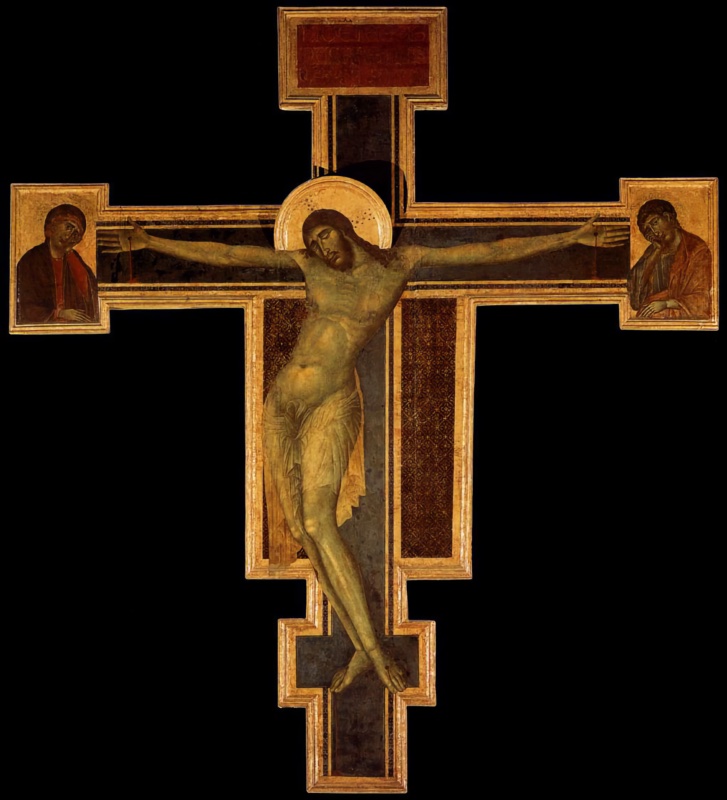
The work, executed in tempera on wood and of monumental dimensions, depicts Christ as Christus patiens—that is, a dead and suffering Christ—rendered in a far more human and dramatic manner than in the preceding Byzantine tradition. It is a large, sculpted wooden crucifix, designed to be suspended or placed in a prominent position within the liturgical space. Its dimensions are imposing: approximately 448 x 390 cm according to various sources, with slight variations in measurements reported in modern catalogs. The mass of the cross and the figure of Christ occupy almost the entire surface, so that the image does not appear as a simple devotional panel, but as a physical and solemn presence within the church space.
Christ is depicted with his body bent and tilted, his head resting on his chest and his eyes closed—unmistakable signs of death. His arms are outstretched horizontally, and his torso is not rigid; on the contrary, the body appears weighed down by the actual burden, with a curve that reveals the effort and suffering. This is one of the decisive aspects of the work: Cimabue abandons the frontally abstract and immobile figure typical of much Byzantine-style painting to construct a body that seems to belong to a real man.
The modeling of the body is achieved through a more nuanced chiaroscuro than in previous works, so that the chest, abdomen, shoulders, and limbs acquire volume. The shadows are not uniform but vary according to the position of the limbs and the angle of the light, giving the figure a more convincing three-dimensional presence. Even the loincloth is rendered with great care: the fabric is thin, almost transparent, and its drapery serves not only to cover the body but to reveal its underlying structure.
One of the most modern aspects is the color of Christ’s flesh, conceived as the true color of death, and thus more subdued and realistic than the more conventional canons of Eastern art. The contrast between the pale body, the gold of the background, and the brighter tones of certain details heightens the emotional tension of the image. The overall effect is not one of triumphant glory, but of physical pain and compassion, inviting the faithful to meditate on the Passion.
The work is seminal because it illustrates the transition from a more abstract and symbolic representation of the cross to a new conception—one that is more narrative, corporeal, and emotional. Cimabue does not abandon sacred solemnity, but introduces a keen observation of reality, capable of giving the figure of Christ an almost sculptural quality. For this reason, the Crucifixion is considered a seminal masterpiece: it retains its medieval devotional function, yet paves the way for a sensibility that would prove decisive for subsequent Italian painting.
The work is linked to the Franciscan Basilica of Santa Croce and clearly reflects the mendicant spirituality, which placed great emphasis on meditating on the suffering of Christ. It has also become a symbol of Florence’s history due to the damage it sustained during the 1966 flood, an event that enhanced its civic value as well as its artistic one. Today, the crucifix is viewed not only as a testament to Cimabue’s greatness, but as one of the most important steps toward the naturalism and expressiveness of 14th-century painting.
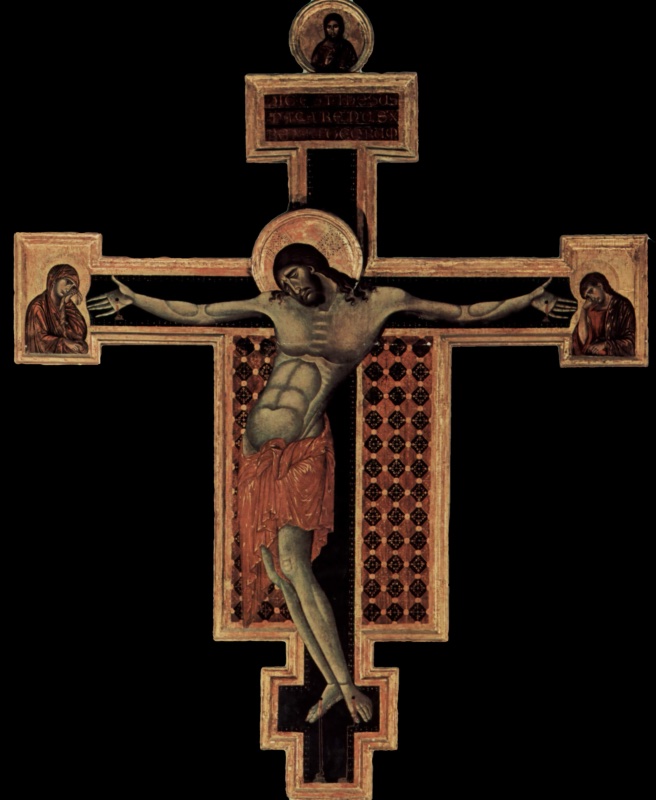
The work is a painted cross with the dying Christ at the center, leaning to the left in dramatic agony, while on either side of the horizontal beam appear half-length figures of the Virgin Mary on the left and Saint John the Evangelist on the right, both in a gesture of mourning with their hands over their faces. Above Christ’s head is the titulus crucis bearing the Latin inscription Hic est Iesus Nazarenus Rex Iudeorum, and a small medallion depicts Christ blessing with his hand raised. The contoured structure emphasizes the volume of Christ’s body, which occupies the entire width of the cross, breaking with Byzantine rigidity to achieve greater anatomical dynamism.
Christ is depicted with closed eyes, his head tilted to his right shoulder and his body unnaturally arched toward the left side, suggesting the convulsions of pain and impending death. The red-gold loincloth, with realistic folds and decorated edges, covers his private parts and accentuates the movement; it dominates a palette of greens to evoke decay and human suffering, rather than the abstract divinity typical of Eastern icons. The open hands pressed flat against the wood of the cross, the taut muscles, and the prominent veins lend three-dimensionality and pathos, with touches of chiaroscuro shaping the torso, innovating the 13th-century pictorial tradition.
The Madonna and Saint John, stylized yet expressive, bow their heads in a sign of profound grief: their golden robes with luminous streaks create lighting effects that harmonize with the gold background, typical of medieval churches rich in frescoes and stained-glass windows. Their static poses contrast with the dynamism of Christ, balancing the composition and inviting the viewer to a shared empathy—an element that Cimabue draws from Pisan models such as Giunta but reworks with greater humanity.
Executed in oil tempera on a wooden panel, with gold leaf for the backgrounds and details, the Crucifix features drapery adorned with colorful cloths suspended along the arms and a vividly polychrome background to blend with the liturgical setting. It underwent restoration in 1917 and 2005, which preserved its fragile structure despite wear and tear; these interventions revealed Cimabue’s mastery of modeling and realism, marking the transition from Byzantine to Italian Gothic.
This work, among the first attributed with certainty to Cimabue, anticipates the expressive style that influenced Giotto, emphasizing the suffering humanity of Christ as a bridge between sacred icon and individual portrait.
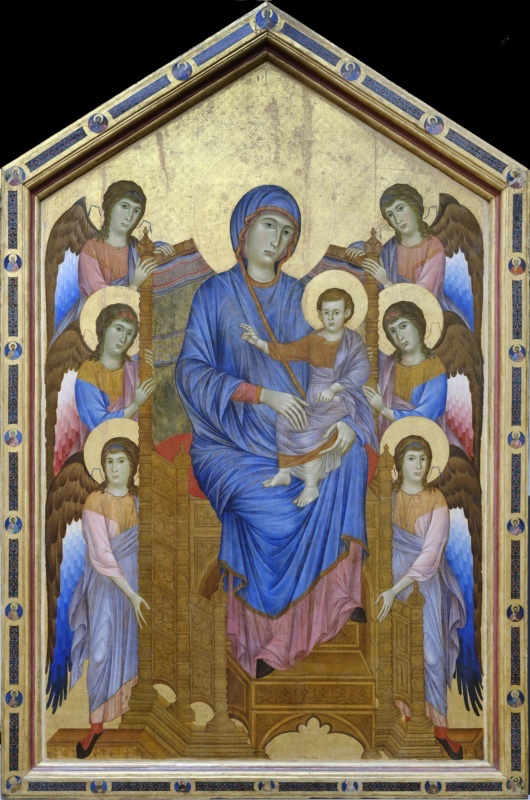
At the center of the composition stands the figure of the Madonna, seated on a throne tilted at an angle in an intuitive perspective that suggests spatial depth without resorting to true Renaissance perspective. Mary wears a deep blue mantle—revealed in all its vivid cobalt hue following the recent restoration—with angular, linear folds that hint at a barely perceptible volume, while she holds the Infant Christ in a protective gesture, slipping her slender fingers into his robe; the Virgin’s face appears serious and pensive, turned toward the viewer, lacking the seraphic sweetness of the artist’s later works.
The Child, with the features of a small adult typical of medieval iconography, blesses with his right hand raised in an authoritative gesture, seated on Mary’s left leg, which emerges three-dimensionally beneath the folds of the cloak, creating a first hint of anatomical solidity.
On either side of the throne are two choirs of angels, arranged vertically from bottom to top according to the perspective of overlapping and height, without a true spatial order but with a hierarchical effect that emphasizes celestial majesty. The angels’ wings alternate bright colors—blue, red, and gold—with delicate, linear drapery, devoid of strong chiaroscuro, which recall the Byzantine iconographic tradition but introduce a dynamic tension in the profiles and expressions. This symmetrical arrangement, similar to that of the Maestà of Assisi, underscores the Virgin’s regality as Queen of Paradise, with the carved throne serving as a structuring element to illusionistically push the space forward.
The tempera-on-gold-ground technique enhances the work’s sacredness, with saturated, luminous colors that, thanks to the 2024 restoration, have regained their original brilliance: the lapis lazuli blue of Mary’s mantle and the vivid red of the throne contrast with the shimmering gold, creating an effect of celestial light. The drapery is stylized, with undercut folds that appear paper-like, but Cimabue introduces innovations such as Mary’s raised knee and the solid leg beneath it, which impart a sense of weight and three-dimensionality that was innovative for the time. The absence of pseudo-perspective and the two-dimensional composition reflect a stylistic stage preceding other Maestà by Cimabue, while anticipating Giotto’s achievements.
Originally from the church of San Francesco in Pisa, the work was looted by Napoleon in 1813 and taken to the Louvre, where it is preserved as one of the highlights of the medieval collection. Recent exhibitions at the Louvre (2025) have placed it at the center of a critical re-examination, highlighting its foundational role in Western painting for the humanization of the figures and the spatial experiment of the throne in foreshortening. Cimabue, active in Florence, Pisa, and Assisi, breaks here with rigid Byzantine icons, introducing more intense expressions and an illusion of reality that foreshadow the Renaissance.
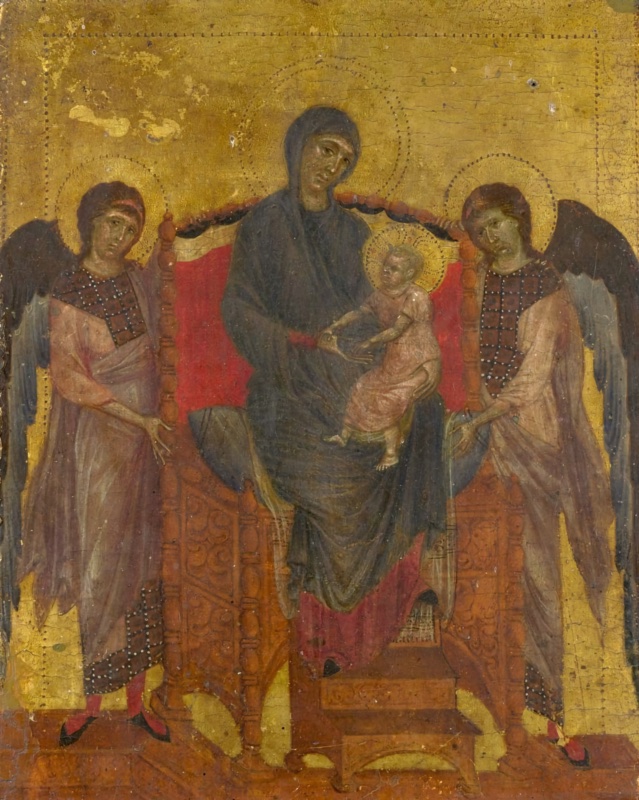
At the center of the composition, the Virgin Mary is seated on a curved, three-dimensional throne that rises from the golden background with a sense of depth that is innovative compared to traditional Byzantine models. On her left knee, she holds the Baby Jesus, dressed in a sheer white tunic over a pink gown, while her right hand tenderly supports him, creating an intimate and human gesture that emphasizes the mother-child bond. On either side of the throne, two angels (likely Michael and Gabriel) with long feathered wings and pink-and-gold robes adorned with imperial loiri (brown squares with pearly black borders) present the sacred couple to the viewer, turning their heads slightly toward her in a gesture of offering and reverence.
The scene of the Maestà recalls the Byzantine Maestà regis, but Cimabue adapts it to Western tastes by introducing elements of naturalism: the throne, resembling a Eucharistic altar with a cloth alluding to Christ’s sacrifice, symbolizes the impending Passion. This panel was part of a larger diptych or polyptych dedicated to the Passion of Christ, as confirmed by comparison with The Flagellation at the Frick Collection in New York and The Mocking of Christ at the Louvre, both from the same cycle and of the same dimensions (25.6 x 20.8 cm). The gold ground, typical of medieval painting, evokes the celestial realm, while the chromatic details—golds, pinks, and whites—accentuate the sacredness and tenderness.
Executed in egg tempera on poplar panel, the work displays volumetric modeling in the figures, with delicate shadows on the faces and drapery suggesting movement, marking the transition from the Byzantine-influenced style to the Proto-Renaissance. Cimabue, documented from 1272 and who died in 1302, demonstrates here his mastery in balancing Eastern solemnity and expressive vitality, influencing Duccio and his contemporaries; the Virgin’s face, elongated and solemn, contrasts with the Child’s lively gaze. Rediscovered in 2000 and accepted in lieu of Inheritance Tax, the work is located in Room 65 of the National Gallery.
This small Maestà, rare for Cimabue (known for large altarpieces such as those in Pisa and Florence), dates to around 1280–1285 and stylistically bridges the frescoes of Assisi (1277–80) and the major Maestà works, preceding that of Santa Trinita (Uffizi). Definitively attributed to Cimabue by scholars such as Bellosi and Boskovits, it likely depicts a Franciscan patron, given its iconography and connection to Passionist cycles. Its rediscovery has reinforced the attribution of the diptych, shedding light on Cimabue’s role as a bridge between the Byzantine 13th century and the Italian Gothic 14th century.
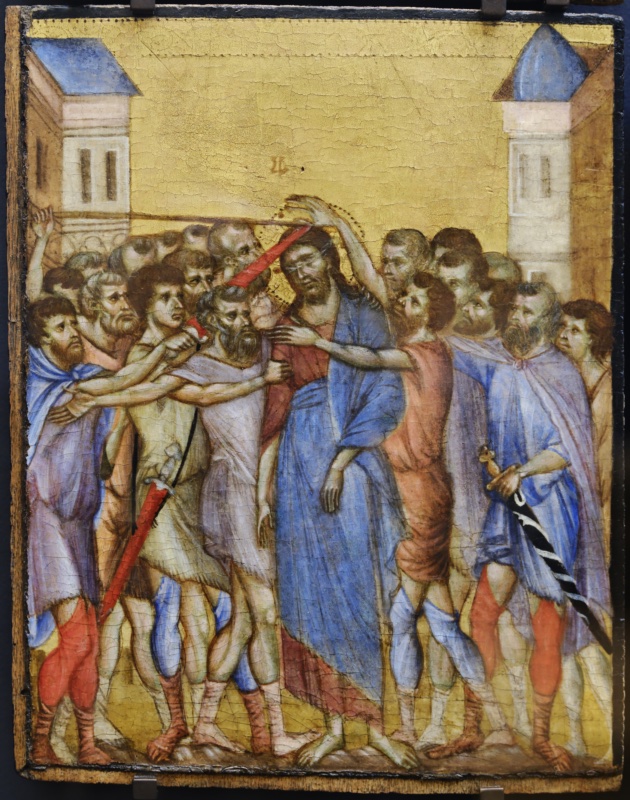
Christ stands at the center of the scene, wrapped in a red robe and a blue cloak, his eyes uncovered in the Byzantine style—unlike contemporary Northern European depictions, which show him seated and blindfolded—conveying an expression of serene and passive suffering. Around him, a compact group of tormentors in colorful robes and armor crowds together in a whirlwind of intertwined gestures: one strikes him with a long cane from the left, another is poised to slap him, pulling his arm back, while anonymous hands pull at his shoulder, cross his chest, and feign tearing off his halo. Two sheathed swords, symmetrically positioned on the left and right, serve as compositional elements that guide the gaze toward Christ’s sorrowful face, accentuating the dynamic chaos of the group through tangled chains of limbs that invite the viewer to decipher roles and actions.
This panel is part of a devotional diptych known as the Devotion Diptych, originally composed of eight panels (four for each wing), of which three have survived: in addition to the Mocked Christ at the Louvre, the Flagellation of Christ at the Frick Collection in New York, and the Madonna and Child with Two Angels at the National Gallery in London.
Discovered in 2019 in a private home in Compiègne (France) hanging above a stove, it was declared a French National Treasure, sold at auction for 24 million euros, and finally acquired by the Louvre in 2023 after restoration, which revealed vivid chromatic details and subtle modeling on the gilded ground prepared with plaster and embedded canvas. A Florentine origin is hypothesized, perhaps due to a very clear context near Florence, linked to a devotional tradition of the Poor Clares that favored meditative immersion in episodes of the Passion, parallel to texts such as the Meditations on the Life of Christ.
This image faithfully captures the post-restoration scene, highlighting the narrative vitality and inventive freedom of Cimabue, a precursor to Duccio in 14th-century Sienese painting.
Here, Cimabue excels at condensing a choral crowd into a tiny format, with dense movements, intersecting gazes, and a multitude of focal points converging on the dominant Christ, breaking with Byzantine staticity toward a more human and dramatic expressiveness. The restoration confirmed the use of electric ultramarine and surface decorations, while the composition—with towers in the background—evokes Byzantine models in certain gestures (such as the staff or the slap), but reworks them into a unique and innovative interweaving. For an enthusiast of illuminated manuscripts like yourself, this work evokes the transition from book miniatures to panel painting, with the gold ground amplifying the sacredness and inviting close contemplation, similar to the private devotion of medieval codices.
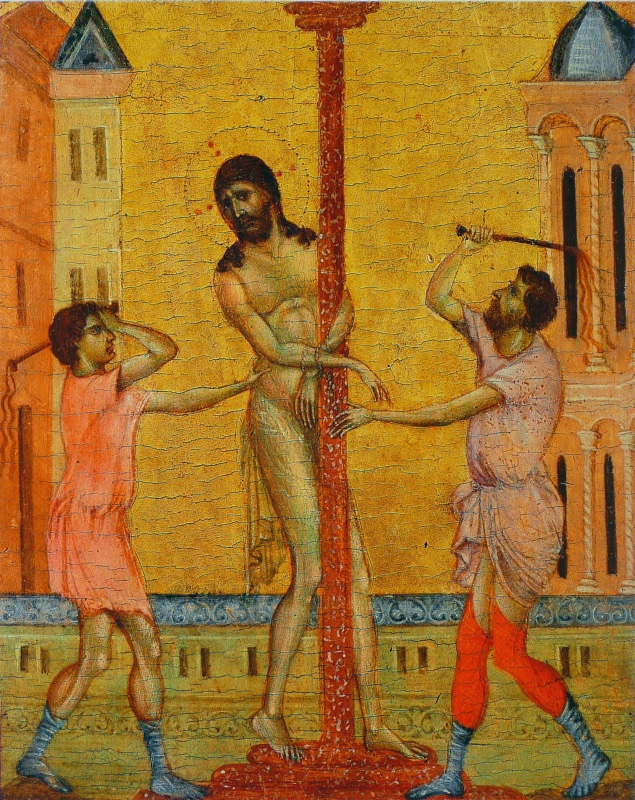
The scene is small in scale and highly symmetrical: at the center stands a marble column that runs vertically across the entire panel, dividing the image into two mirror-image halves. Behind this column rise two tall urban buildings on either side and, lower down, a shorter structure, which function as a sort of architectural “backdrop” framing the flagellation. The space is constructed with a reverse perspective typical of Byzantine iconography, yet already showing an attention to a certain three-dimensionality, with volumes and shading that depart from purely frontal models.
In the center stands Jesus, bound and naked save for a loincloth, slender and elongated in proportion, with a body marked by a certain linear nobility and a solemn gravity reminiscent of the Christ figure in the great crucifix of Santa Croce. His face is turned directly toward the viewer, with an expression of moderate pain yet intensely contemplative, establishing a direct and devotional connection with the observer. On either side of the column stand two Roman soldiers flogging him with whips; their figures are more dynamic, with slightly curvilinear movements and emphatic gestures, while they wear colorful garments in vivid, garish tones that contrast with the neutrality of the gold background.
The painting is executed in egg tempera on poplar panel, with a generous application of gold leaf for the background, typical of Italian Byzantine iconography but already open to a greater fluidity of form. The soldiers’ garments are painted in vivid hues and chromatic contrasts, with iridescent effects and reflections that convey a sense of materiality and movement, while Christ’s naked body is rendered with softer shading and more subdued tones, emphasizing the sacredness and physical vulnerability of the Redeemer.
The skillful use of small, layered brushstrokes produces an effect of extremely fine detail and a lively rhythm in the folds of the cloth and the anatomical features, a sign of a quest for expressiveness and naturalism that anticipates Giotto’s breakthrough.
The theme is drawn from the Passion narrative (John 19:1): After his trial, Jesus is condemned to be flogged by Roman soldiers before his crucifixion. The choice of such an intensely painful scene, condensed into a very small format, suggests an original personal or family devotional purpose, perhaps as an image for meditation prior to the crucifixion, to be placed in a diptych or a small domestic altar. The image focuses on the emotional response and shared suffering of the faithful, combining Byzantine solemnity with a new sense of humanity and the physical presence of Christ, a concept that Giotto himself would later take to its extreme consequences.