Deodato Orlandi
( 25% )
Deodato Orlandi, also known as Deodato di Orlando and documented in some sources as Deodato Orlandi Bentivegna, stands as one of the most significant transitional painters operating in Tuscany during the late thirteenth and early fourteenth centuries. Born in Lucca around 1260, this dating is established through documentary evidence placing him among the participants of the Consiglio generale del popolo of Lucca in 1284, an assembly restricted to citizens who had attained their eighteenth year. His birthplace in the city of Lucca, a thriving commercial and artistic center of medieval Tuscany, provided the foundational environment for his artistic development.
The approximate birth year of 1260 situates Orlandi within the generation of artists who would witness and participate in the revolutionary transformation of Italian painting from Byzantine conventions toward the naturalistic innovations of the early Trecento. This chronological positioning proves crucial for understanding his artistic trajectory, as he matured during the very decades when Cimabue was executing his monumental works and when the young Giotto was beginning to reshape the visual language of Western art.
The cultural milieu of mid-thirteenth-century Lucca, with its established traditions of panel and fresco painting, offered abundant opportunities for an aspiring artist to observe and absorb the dominant stylistic currents. Orlandi’s active career, spanning from at least 1284 through 1315 according to documented records, encompasses more than three decades of continuous artistic production. He died sometime before October 16, 1331, when a Lucchese document refers to him as deceased, though a subsequent 1332 document curiously mentions him as a rebel and exile, suggesting possible political complications surrounding his final years.
Family Background and Social Position
The documentary evidence concerning Deodato Orlandi’s family remains frustratingly sparse, a situation typical for artists of this period who were considered craftsmen rather than intellectuals worthy of biographical attention. The surname “Orlandi” or the patronymic “di Orlando” suggests his father bore the name Orlando, a common appellation in medieval Tuscany that carried no particular indication of noble status. Recent scholarship has identified him in some sources as “Deodato Orlandi Bentivegna,” with “Bentivegna” possibly representing either a family surname or a nickname, though the exact nature of this designation remains uncertain.
The fact that Orlandi achieved citizenship status in Lucca and participated in civic governance by 1284 indicates his family possessed sufficient social standing to qualify for these privileges, suggesting they were not among the city’s poorest classes. Medieval Lucca maintained strict regulations regarding citizenship and political participation, requiring not only residence but also property ownership and good social standing, thereby implying that Orlandi’s family background provided adequate resources for his artistic training. No records survive identifying his mother, siblings, or other immediate family members, an absence that characterizes documentation for most artists of this era who were not born into established artistic dynasties.
Unlike the Berlinghieri family of Lucca, who established a recognized workshop tradition spanning multiple generations, Orlandi appears not to have founded a family workshop or trained identifiable descendants as artists. This absence of an artistic dynasty named Orlandi in subsequent generations suggests either that he produced no male heirs who pursued painting or that any such descendants failed to achieve recognition sufficient to survive in historical records. The 1332 reference to him as a “rebel and exile” raises intriguing questions about possible political entanglements that might have affected his family’s position in Lucchese society, though the specific circumstances remain obscure. Whether this political designation reflected genuine opposition to the governing faction or merely represented posthumous administrative classification cannot be determined from surviving evidence.
The social position of painters in late thirteenth-century Lucca occupied an intermediate status between manual craftsmen and respected professionals, with successful artists like Orlandi capable of achieving comfortable economic circumstances through ecclesiastical and civic commissions. Orlandi’s participation in the Consiglio generale del popolo demonstrates his integration into Lucca’s civic structure and suggests his family had successfully navigated the complex social hierarchies of the medieval commune. The absence of any documented connection to established artistic families such as the Berlinghieri, despite evident stylistic debts to their tradition, implies that Orlandi’s entry into the artistic profession occurred through apprenticeship arrangements that have left no archival trace.
Medieval workshop practices typically involved young boys entering apprenticeships around age ten to twelve, suggesting that Orlandi would have begun his training around 1270-1272, precisely the period when Berlinghiero Berlinghieri’s influence dominated Lucchese painting. The economic requirements for such apprenticeships, which often involved payments to the master and provision of materials, again suggest Orlandi’s family possessed moderate means. No evidence survives regarding whether Orlandi himself married or produced children, though marriage was common among successful artisan-class individuals in this period.
The complete silence of documents regarding his personal life reflects the general disinterest of medieval record-keeping in such matters for individuals outside the nobility or ecclesiastical hierarchy. Had Orlandi established a significant workshop with multiple assistants and apprentices, as did more prominent masters like Giotto, one might expect some documentary traces of these professional relationships, yet such evidence remains elusive. The geographical range of his known commissions, concentrated primarily within the Lucca-Pisa axis, suggests he maintained a relatively localized practice rather than the peripatetic career that characterized some contemporary masters. This regional focus may indicate family or property ties that anchored him to the Lucchese territory throughout his working life.
Ecclesiastical and Civic Patrons
The patronage networks that sustained Deodato Orlandi’s career centered primarily upon ecclesiastical institutions, with churches and religious orders commissioning the vast majority of his documented works. The earliest firmly attributed commission, the Crucifix executed in 1288 for the church of San Cerbone near Lucca, establishes his relationship with local ecclesiastical authorities who entrusted him with creating one of the most important liturgical furnishings for their sanctuary.
This commission, which resulted in a signed and dated work now preserved in the Museo Nazionale di Villa Guinigi in Lucca, demonstrates that by his late twenties Orlandi had achieved sufficient reputation to secure significant religious commissions. The church of San Cerbone, though not among Lucca’s most prominent religious establishments, represented a typical rural parish of the sort that constituted the backbone of ecclesiastical patronage for regional artists. Religious orders, particularly the Franciscans and Dominicans, emerged as important patrons during Orlandi’s active years, as these mendicant communities were constructing and decorating churches throughout Tuscany in the late thirteenth century.
The fresco depicting the Madonna with Child, Saint Francis, and a donor in the lunette above the tomb of Bonagiunta Tignosini1 in the cloister of San Francesco in Lucca, datable to after 1274, may represent Orlandi’s earliest surviving work and demonstrates his connection to Franciscan patronage networks. The inclusion of a donor figure in this composition indicates the complex arrangements typical of medieval religious patronage, where individual wealthy laypersons funded specific artworks within ecclesiastical spaces. The Tignosini family, prominent in Lucchese society, exemplifies the type of elite lay patrons who mediated between artists and religious institutions, commissioning commemorative works that served both devotional and dynastic purposes.
The most significant and prestigious patron identified in Orlandi’s career was the powerful Caetani family, who commissioned the extensive fresco cycle at the church of San Piero a Grado near Pisa for the Jubilee year of 1300. The Caetani, one of medieval Italy’s most influential noble families, achieved the pinnacle of ecclesiastical power when Cardinal Benedetto Caetani was elected Pope Boniface VIII2 in 1294, and their patronage of the San Piero a Grado project reflected their wealth, prestige, and political ambitions. This commission represented an extraordinary opportunity for Orlandi, as the Jubilee year attracted pilgrims from across Christendom, and the Caetani intended the decorative program to commemorate both the apostolic origins of Christianity in Italy and their own family’s devotion.
The choice of Orlandi for this prestigious project, rather than more famous masters from Florence or Siena, suggests he had established a strong regional reputation and possibly possessed connections to the Caetani through ecclesiastical or civic networks in Pisa. The iconographic program, depicting portraits of popes from Saint Peter through John XVIII, stories from the lives of Saints Peter and Paul, Constantine and Sylvester, and representations of the Celestial City, required sophisticated theological knowledge and careful coordination with learned advisors from the Caetani circle.
The unprecedented nature of the papal portrait gallery, extending through more than a thousand years of pontifical history, indicates the patron’s desire to emphasize apostolic succession and papal authority at a moment when Boniface VIII was asserting expansive claims for papal supremacy. The substantial financial resources required for such an extensive fresco cycle, involving teams of assistants working over several years, demonstrates the Caetani’s commitment to creating a monument that would enhance both divine worship and family prestige.
The basilica’s location near Pisa, where tradition held that Saint Peter himself had preached upon landing in Italy, gave the site particular significance for pilgrims and enhanced the value of the Caetani’s patronage investment. Whether Orlandi received this commission through personal connections, competitive selection, or recommendation from ecclesiastical officials remains unknown, though the latter seems most probable given the scale and importance of the project. The successful completion of the San Piero a Grado frescoes, despite whatever limitations modern critics perceive in their execution, evidently satisfied the Caetani patrons, as the cycle remained largely intact and was considered significant enough to warrant later restorations.
Dominican patronage appears in Orlandi’s 1301 altarpiece, now in the Museo Nazionale di San Matteo in Pisa, which depicts the Madonna and Child flanked by Saints Dominic3, James, Peter, and Paul. The prominence of Saint Dominic in this composition indicates it was commissioned by or for a Dominican institution, reflecting the order’s active patronage of altarpieces during their period of institutional expansion. This work, signed and dated, represents one of Orlandi’s most accomplished panel paintings and demonstrates his capacity to satisfy the aesthetic and devotional requirements of sophisticated monastic patrons.
The inclusion of Saints James, Peter, and Paul alongside Dominic suggests specific devotional emphases within the commissioning community, though the precise Dominican house that ordered the work remains unidentified in surviving documents. The Dominicans, like the Franciscans, maintained extensive patronage networks throughout Tuscany and preferred artists who could combine traditional iconographic formulae with contemporary stylistic innovations, a balance Orlandi demonstrably achieved. Another significant ecclesiastical commission, the Crucifix dated 1301 for the church of the Conservatorio di Santa Chiara in San Miniato, again demonstrates his appeal to female religious communities who required devotional images appropriate for their contemplative practices.
Poor Clare communities, following the rule established by Saint Clare4 of Assisi, typically commissioned painted crucifixes for their choir areas, where the nuns would meditate upon Christ’s sacrifice during their liturgical observances. The choice of Orlandi for this commission indicates his reputation extended beyond Lucca and Pisa to the smaller centers of Tuscany where religious houses sought competent artists capable of producing emotionally affecting devotional images. The fact that both this Crucifix and the Pisan altarpiece date to 1301 suggests Orlandi may have maintained a workshop with assistants capable of executing multiple projects simultaneously, a common practice among successful medieval painters. Such workshop organization would have been necessary to fulfill the various commissions that sustained a professional artist’s livelihood and reputation throughout the year.
The cathedral of Lucca, one of Tuscany’s most important ecclesiastical institutions, commissioned from Orlandi a mosaic depicting the Madonna with Child and Two Angels for the lunette above a lateral entrance portal, completed in 1314. This commission represents a significant honor, as cathedral chapters typically reserved their most visible commissions for artists of established reputation and proven reliability. The choice of mosaic technique, relatively rare in Tuscan panel and fresco tradition, indicates Orlandi’s technical versatility and willingness to work in media beyond his primary specialization in tempera painting.
Cathedral officials who controlled such commissions constituted a conservative patronage group, preferring artists whose work demonstrated orthodox iconography and stylistic dignity appropriate for the city’s principal church. The placement of this mosaic over a public entrance ensured high visibility, making it a prestigious showcase for Orlandi’s artistry and simultaneously an important statement of the cathedral’s commitment to contemporary artistic developments. Unfortunately, this mosaic was removed and replaced with a relief sculpture in 1786, though eighteenth-century drawings preserve some record of its appearance and confirm the 1314 date and Orlandi’s authorship. The cathedral commission demonstrates that even late in his career, Orlandi maintained his position within Lucca’s ecclesiastical patronage networks and could secure major public commissions.
The loss of this work deprives modern scholarship of a significant example of early fourteenth-century mosaic work in Tuscany and of evidence regarding Orlandi’s mature style. Beyond these major identified commissions, numerous smaller works suggest a steady stream of patronage from parish churches, private chapels, and individual donors seeking devotional panels for domestic or ecclesiastical use. The survival rate of medieval panel paintings and frescoes remains extremely low, implying that documented works represent only a fraction of Orlandi’s actual production. Civic patronage, which became increasingly important for artists in the fourteenth century, appears less prominently in Orlandi’s documented career, suggesting his practice remained oriented primarily toward ecclesiastical clients rather than communal governments or secular guilds.
Painting Style and Technical Characteristics
Deodato Orlandi’s painting style occupies a pivotal transitional position between the Byzantine-influenced manner that dominated Tuscan painting through the mid-thirteenth century and the revolutionary naturalism inaugurated by Cimabue and Giotto. His earliest works demonstrate clear dependence upon the local Lucchese tradition established by the Berlinghieri family, characterized by linear elegance, hieratic compositions, and conventional Byzantine iconographic formulae. The attributed Crucifix from San Francesco in Pisa, if correctly assigned to Orlandi’s hand, exemplifies this early manner with its stylized anatomy, patterned drapery, and frontal presentation typical of Italo-Byzantine crucifixes of the mid-thirteenth century. However, even in works showing Berlinghieri influence, Orlandi demonstrates a distinctive softness and delicacy of execution that differentiates his hand from the more austere rigidity of pure Byzantine tradition.
The signed Crucifix of 1288 from San Cerbone marks a decisive stylistic shift, revealing Orlandi’s assimilation of Cimabue’s dramatic innovations in representing Christ’s suffering humanity. This work abandons the rigid, architectonic body structure of earlier Italo-Byzantine crucifixes in favor of Cimabue’s approach, showing Christ’s body sagging with naturalistic weight, head falling forward in death, and anatomical forms modeled with subtle chiaroscuro. The emotional intensity of Cimabue’s vision, which transformed the crucifix from an iconic representation into a vehicle for empathetic meditation on divine suffering, finds attenuated but genuine expression in Orlandi’s interpretation. The terminal figures of the Virgin and Saint John in this Crucifix display the flowing draperies and expressive gestures characteristic of Cimabue’s figural style, rendered by Orlandi with a gentler, more lyrical quality. The technical execution reveals Orlandi’s competence in tempera technique, with careful preparation of the wooden support, precise application of gesso ground, skillful gilding of backgrounds and decorative elements, and systematic layering of pigments to achieve modeling and depth.
By 1301, when Orlandi executed both the San Miniato Crucifix and the Pisan altarpiece, his style had evolved to incorporate proto-Giottesque elements, demonstrating remarkable responsiveness to the latest developments in Florentine painting. The San Miniato Crucifix shows direct awareness of Giotto’s revolutionary crucifix at Santa Maria Novella in Florence, particularly in the treatment of Christ’s body as a coherent three-dimensional form occupying measurable space. Orlandi’s interpretation of Giottesque innovation remains characteristically moderate, adopting the general principles of greater naturalism without fully embracing Giotto’s radical reduction of decorative elements or his profound psychological intensity.
The Pisan altarpiece of 1301, depicting the Madonna and Child with four saints, exemplifies Orlandi’s mature panel painting style with its careful attention to decorative detail, refined color harmonies, and balanced compositional arrangement. The Virgin’s throne in this work, elaborately articulated with architectural details and ornamental punched gold work, demonstrates Orlandi’s delight in decorative embellishment, a consistent feature throughout his career. The four saints flanking the central Madonna display individualized facial features and varied poses, indicating Orlandi’s effort to avoid monotonous repetition while maintaining the symmetrical balance required by altarpiece conventions. The decorative borders and halos feature intricate punched patterns in the gold ground, a technique Orlandi employed with particular finesse to create richly textured surfaces that enhanced the devotional impact of his panels.
Color relationships in Orlandi’s panels typically favor harmonious rather than dramatic contrasts, with carefully modulated transitions between hues creating a gentle, lyrical chromatic atmosphere. His palette, typical of late Duecento and early Trecento painting, included expensive pigments such as ultramarine blue derived from lapis lazuli, vermilion red, and verdigris green, applied according to established workshop practices. The gold backgrounds, tooled with varied decorative patterns, provide luminous surfaces that enhance the sacred character of the represented figures while demonstrating the artist’s technical skill in burnishing and tooling techniques. Technical analysis of surviving panels reveals Orlandi’s systematic approach to construction, with careful joining of wooden supports, application of fabric reinforcement at joins, multiple layers of gesso preparation, and methodical sequence of underdrawing, blocking in of forms, and final detail work.
The frescoes at San Piero a Grado represent Orlandi’s most ambitious stylistic achievement and reveal both his capabilities and limitations when working at monumental scale with extensive workshop assistance. The narrative scenes depicting stories from the lives of Saints Peter and Paul display competent compositional organization, with clearly defined spatial settings and legible arrangement of multiple figures within each episode. The architectural frameworks dividing the individual scenes, derived from Cimabue’s lost frescoes in the atrium of Old Saint Peter’s in Rome and from the Upper Church at Assisi, demonstrate Orlandi’s understanding of how painted architecture could organize complex narrative cycles.
The figure style in these frescoes shows Orlandi’s characteristic soft, rounded forms and gentle expressions, lacking the dramatic power of Cimabue or Giotto but achieving a pleasant narrative clarity appropriate for didactic purposes. The extensive use of workshop assistants in executing this large-scale project results in variable quality across the cycle, with some scenes showing accomplished execution while others appear more routine. The gallery of papal portraits in the lower register demonstrates Orlandi’s capacity for systematic repetition with subtle variations, creating a visually coherent procession while avoiding complete monotony. The decorative details throughout the fresco cycle, including costume ornaments, architectural embellishments, and patterned surfaces, reveal Orlandi’s consistent attention to enriching his compositions with visually engaging minutiae.
The spatial representation in these frescoes remains relatively shallow and additive rather than fully coherent, indicating that Orlandi had not completely absorbed Giotto’s revolutionary understanding of unified pictorial space. Color distribution throughout the cycle demonstrates effective use of varied hues to differentiate figures and create visual interest, though the chromatic relationships lack the structural significance they would achieve in more advanced Giottesque painting. The overall impression created by the San Piero a Grado frescoes combines narrative accessibility with decorative richness, qualities that evidently satisfied the Caetani patrons and the basilica’s liturgical requirements. Orlandi’s late works, including the Madonna panels now in Lucca and the Louvre, show continued evolution toward fuller adoption of Giottesque principles, though they also reveal a certain diminution of creative energy characteristic of his final years.
Artistic Influences and Cultural Context
The artistic formation of Deodato Orlandi occurred within the rich and complex cultural environment of thirteenth-century Lucca, where multiple stylistic currents converged and interacted. The dominant influence on Lucchese painting throughout the thirteenth century emanated from the workshop tradition established by Berlinghiero Berlinghieri and continued by his sons Barone, Marco, and especially Bonaventura Berlinghieri. This local school had developed a distinctive variant of the Italo-Byzantine manner, characterized by linear refinement, elegant proportions, and a certain accessibility that differentiated Lucchese painting from the more austere Byzantine work of Venice or the more monumental style developing in Florence.
Orlandi’s presumed early training in this tradition provided him with solid technical foundations in panel painting, including preparation of wooden supports, application of gesso grounds, gilding techniques, and systematic tempera painting methods. The Berlinghieri approach to religious imagery, emphasizing clarity of narrative, devotional accessibility, and decorative appeal, remained influential throughout Orlandi’s career even as he incorporated more modern stylistic elements. The conventional iconographic types developed by the Berlinghieri workshop for representing Christ, the Virgin, and saints provided Orlandi with a repertoire of established formulae that he could adapt and modify according to changing artistic fashions. However, unlike some conservative artists who remained imprisoned within traditional conventions, Orlandi demonstrated remarkable receptivity to stylistic innovations originating in Florence and Assisi. This openness to external influences distinguishes him from more provincial contemporaries and explains his successful navigation of the rapidly changing artistic landscape of late thirteenth and early fourteenth century Tuscany.
The geographic proximity of Lucca to Pisa, Florence, and Siena facilitated artistic exchange and allowed painters working in smaller centers to observe and absorb developments from more dynamic artistic capitals. Lucca’s position along major pilgrimage routes and its commercial connections throughout the Mediterranean world ensured regular contact with diverse artistic traditions and exposure to portable works from various regional schools. The presence in Pisa of major works by Cimabue, including the Madonna in Maestà for San Francesco executed around 1274, provided Orlandi with direct access to one of the most influential painters of the late Duecento.
Cimabue’s revolutionary transformation of Byzantine conventions into a more emotionally powerful and naturalistically convincing style exercised profound influence on Orlandi’s artistic development from the mid-1280s onward. The dramatic intensity of Cimabue’s crucifixes, particularly the great cross at Santa Croce in Florence, offered a compelling alternative to the more restrained Italo-Byzantine tradition, and Orlandi’s 1288 Crucifix demonstrates direct engagement with Cimabue’s innovations.
Cimabue’s approach to modeling figures with subtle chiaroscuro, creating the illusion of three-dimensional form emerging from two-dimensional surface, represented a technical advancement that Orlandi adapted to his own more delicate sensibility. The expressive potential of gesture and posture, dramatically exploited by Cimabue to convey emotional states and narrative relationships, found gentler but genuine application in Orlandi’s figures. The monumental fresco cycles executed by Cimabue in the transept and apse of the Upper Church at San Francesco in Assisi provided models for large-scale narrative painting that directly influenced Orlandi’s approach to the San Piero a Grado commission.
The architectural settings employed by Cimabue to organize narrative scenes and create spatial context appear in modified form throughout Orlandi’s Pisan fresco cycle. Cimabue’s palette, richer and more varied than earlier Byzantine tradition, expanded the chromatic possibilities available to painters like Orlandi who sought to modernize their manner without completely abandoning established practices. The emotional accessibility of Cimabue’s religious imagery, which invited viewers into empathetic relationship with depicted sacred events, aligned with the pastoral goals of late medieval religious reformers and found ready adoption among artists serving ecclesiastical patrons. However, Orlandi consistently tempered Cimabue’s dramatic intensity, preferring gentler, more lyrical interpretations appropriate to his personal temperament and perhaps to the devotional preferences of his patrons. This selective appropriation of Cimabue’s innovations while maintaining certain traditional qualities characterizes Orlandi’s intelligent navigation between conservation and innovation.
The emergence of Giotto as the dominant artistic personality of early fourteenth-century Italy profoundly affected Orlandi’s stylistic evolution during the first decade of the Trecento. Giotto’s radical reconceptualization of pictorial space, figure construction, and narrative representation created a new paradigm that artists throughout Italy confronted and attempted to assimilate. Orlandi’s 1301 Crucifix at San Miniato reveals awareness of Giotto’s revolutionary crucifix at Santa Maria Novella, particularly in the treatment of Christ’s body as a coherent volumetric form rather than a linear pattern. The psychological depth and human pathos that Giotto brought to religious imagery challenged traditional iconic approaches and required artists like Orlandi to reconsider the emotional content of their work.
Giotto’s systematic exploration of how figures occupy and move within measurable space represented a conceptual breakthrough that Orlandi could only partially comprehend and incorporate into his own more conventional spatial understanding. The simplified, monumental figure types developed by Giotto, stripped of excessive decorative detail and rendered with powerful sculptural solidity, contrasted sharply with Orlandi’s continued delight in ornamental embellishment. Nevertheless, Orlandi’s work from 1301 onward shows genuine effort to incorporate Giottesque principles of greater naturalism, clearer spatial definition, and more convincing figural volume.
The Arena Chapel5 frescoes in Padua, executed by Giotto between 1303 and 1305, established new standards for narrative fresco cycles that would have reached Orlandi through reports from travelers and possibly through his own observation if he visited Padua. The increasing dominance of Giottesque style throughout Tuscany during the first decades of the fourteenth century created pressures for artists trained in earlier traditions to adapt or risk obsolescence. Orlandi’s late works, including the Madonna panels now in Lucca and Paris, demonstrate his continued efforts to assimilate Giottesque innovations into his established manner. However, these late works also reveal the limitations of attempting to graft revolutionary innovations onto fundamentally conservative artistic foundations, resulting in somewhat awkward hybrids that lack both the decorative charm of his earlier work and the structural conviction of genuine Giottesque painting.
Beyond Cimabue and Giotto, Orlandi’s artistic development reflects awareness of broader currents in late Duecento and early Trecento Italian painting. The Roman school of painting, particularly the work of Pietro Cavallini in Santa Maria in Trastevere and other Roman churches, appears to have influenced Orlandi’s approach to certain compositions, suggesting possible direct knowledge of Roman monuments. The monumental mosaic cycles in Roman basilicas provided models for organizing extensive pictorial programs that may have informed Orlandi’s conception of the San Piero a Grado frescoes.
Sienese painting, which developed a distinctive style emphasizing linear refinement, rich color, and decorative elaboration, shows some affinity with Orlandi’s sensibility, and his 1308 Madonna panel reveals awareness of Sienese developments. The international Gothic style that would dominate European painting later in the fourteenth century was beginning to emerge during Orlandi’s final years, though his work shows little engagement with these incipient tendencies. The broader cultural context of late medieval Italy, with its complex interactions between Byzantine, Islamic, and Western European artistic traditions, created an extraordinarily fertile environment for artistic development.
The revival of interest in classical antiquity, which would culminate in the full Renaissance of the fifteenth century, was beginning to manifest in subtle ways during Orlandi’s lifetime, though his work shows minimal engagement with specifically classical motifs or principles. The theological and devotional currents of the period, including the enormous influence of Franciscan and Dominican spirituality, shaped the content and emotional tone of religious imagery in ways that affected all practicing artists. The increasing importance of individual patronage and the growing sophistication of lay audiences for religious art created demands for imagery that combined traditional devotional efficacy with contemporary aesthetic appeal. Orlandi’s successful career, sustained over more than three decades through periods of rapid stylistic change, demonstrates his ability to satisfy these evolving expectations while maintaining recognizable artistic identity.
Travels and Geographical Range
The geographical scope of Deodato Orlandi’s documented activity centered primarily upon the cities of Lucca and Pisa, with these two major Tuscan urban centers providing the principal markets for his artistic services. Lucca, his birthplace and home base throughout his career, appears repeatedly in documentary records from 1284 through 1315, confirming his continuous residence or at least regular presence in the city. The 1284 document recording his participation in the Consiglio generale del popolo establishes Lucca as his civic home, where he possessed the rights and obligations of citizenship. His execution of multiple commissions for Lucchese churches and institutions, including the 1288 Crucifix for San Cerbone, the fresco in San Francesco, and the 1314 mosaic for the cathedral, demonstrates sustained engagement with local patronage networks throughout his active years.
The environs of Lucca, including rural parishes such as San Cerbone located in the countryside near the city, fell within Orlandi’s normal working territory and required no significant travel. Lucca’s position as a prosperous commercial city with extensive artistic traditions provided sufficient patronage opportunities to sustain a competent professional painter without requiring extensive travel to seek commissions elsewhere. However, the presence of works by Orlandi in Pisa and its territory indicates regular travel between these two cities, separated by a distance of approximately twenty-five kilometers that could be covered in a day’s journey. Pisa, with its magnificent cathedral complex, numerous churches, and wealthy merchant families, offered attractive commission opportunities for artists from throughout Tuscany.
The execution of the San Piero a Grado frescoes, located approximately six kilometers southwest of Pisa near the coast, required Orlandi to establish a temporary workshop at or near the site during the years of the project’s execution. Such extended residence away from home base was typical for fresco painters undertaking major commissions, as the technical requirements of buon fresco demanded continuous presence during the painting campaign. The 1301 altarpiece now in the Museo Nazionale di San Matteo in Pisa, regardless of its original location within the city or nearby territory, documents Orlandi’s continued activity in the Pisan market at precisely the moment when he was likely completing the San Piero a Grado frescoes.
The commission for the Crucifix dated 1301 at the Conservatorio di Santa Chiara in San Miniato extends Orlandi’s documented geographical range into the Valdarno, the territory of the lower Arno valley between Pisa and Florence. San Miniato, located approximately forty kilometers from Lucca, represented a modest journey that would have required overnight accommodation but no extraordinary travel logistics. The Poor Clare community at San Miniato who commissioned this Crucifix may have learned of Orlandi through recommendations from ecclesiastical networks connecting female religious houses throughout Tuscany.
The simultaneous dating of both the San Miniato Crucifix and the Pisan altarpiece to 1301 raises interesting questions about Orlandi’s working methods and workshop organization, suggesting either remarkably efficient simultaneous production or imprecise dating conventions. The scattered locations of other works attributed to Orlandi, including panels that have migrated to various museums and private collections, provide limited evidence for his original geographical range since provenance documentation for medieval paintings often remains incomplete or uncertain.
The Madonna panel dated 1308, formerly in the Hurd Collection in New York, lacks documentation of its original Italian location, preventing firm conclusions about where Orlandi executed this work or for which patron. The absence of documented commissions from Florence, Siena, or other major Tuscan artistic centers suggests Orlandi’s reputation remained primarily regional rather than achieving the broader recognition that brought the most successful artists commissions from distant cities. This geographical limitation, while indicating less than supreme artistic status, was typical for competent professional painters whose careers served local and regional markets rather than commanding international attention. The concentration of Orlandi’s activity within the Lucca-Pisa-Valdarno triangle reflects both the practical realities of medieval travel and communication and the sufficient density of patronage within this prosperous region to sustain a successful artistic career.
The question of whether Orlandi traveled to Rome occupies significant importance in scholarly discussions of his artistic development, particularly regarding the San Piero a Grado frescoes. Roberto Longhi’s influential 1948 analysis of the relationship between these frescoes and Cimabue’s lost cycle in the atrium of Old Saint Peter’s Basilica in Rome led him to propose that Orlandi must have visited Rome to study these prototypes directly. The iconographic parallels between the two cycles, including the specific selection and arrangement of narrative scenes from the lives of Saints Peter and Paul, appear too precise to result from indirect transmission through drawings or verbal descriptions.
Similarly, the compositional structures and architectural frameworks employed in the San Piero a Grado frescoes closely follow Roman models in ways suggesting direct observation rather than secondhand knowledge. The fresco of the Madonna with Child, Saint Francis, and donor in the cloister of San Francesco in Lucca shows affinities with Pietro Cavallini’s mosaics in Santa Maria in Trastevere in Rome, again suggesting possible direct knowledge of Roman monuments. Travel to Rome for artistic purposes was common among ambitious painters of this period, as the Eternal City offered unparalleled opportunities to study both ancient monuments and contemporary works by leading masters. The pilgrimage routes connecting Tuscany with Rome facilitated such journeys, and artists could travel in relative safety along these well-maintained and frequently traveled roads.
The Jubilee year of 1300, proclaimed by Pope Boniface VIII (Benedetto Caetani), attracted pilgrims from throughout Christendom and would have provided an ideal occasion for Orlandi to visit Rome if he had not done so earlier. The Caetani family’s prominence in Rome and their patronage of the San Piero a Grado project might have facilitated Orlandi’s Roman visit through letters of introduction or other forms of support. However, no documentary evidence confirms such a journey, and the entire argument rests on stylistic analysis and logical inference rather than archival proof. The possibility that Orlandi obtained knowledge of Roman prototypes through intermediate sources, such as drawings circulated among artistic workshops or verbal descriptions from travelers, cannot be entirely excluded, though direct observation seems more probable.
A hypothetical journey to Assisi to study Cimabue’s frescoes in the Upper Church of San Francesco would have been both feasible and artistically profitable for Orlandi. Assisi, located in Umbria approximately 150 kilometers from Lucca, was readily accessible via established routes connecting Tuscany with the Adriatic regions. The pilgrimage church of San Francesco, housing the tomb of Saint Francis and decorated with frescoes by the most accomplished artists of the late thirteenth century, attracted visitors from throughout Italy and beyond. Artists seeking to study recent developments in fresco technique and narrative composition would have found Assisi an essential destination, comparable to Rome in artistic significance.
The Upper Church frescoes by Cimabue in the transept and apse provided models for monumental religious painting that directly influenced the San Piero a Grado project’s conception and execution. However, as with the Roman journey, no documentation confirms Orlandi’s visit to Assisi, and the question remains one of scholarly hypothesis rather than established fact. The alternative possibility that Orlandi knew Florence, located only about seventy kilometers from Lucca, appears virtually certain given the proximity and the importance of Florentine artistic developments during his active years. The Crucifix by Giotto at Santa Maria Novella, which directly influenced Orlandi’s 1301 San Miniato Crucifix, would have required personal observation to produce the specific formal relationships visible in Orlandi’s interpretation.
Florence’s position as the dominant artistic center of late thirteenth and early fourteenth-century Tuscany made it an essential point of reference for any ambitious painter working in the region. The relatively short distance between Lucca and Florence enabled day trips or brief visits that would have left no documentary trace but were surely a regular feature of artistic life in this period. The absence of documented commissions from Florentine patrons, despite Orlandi’s evident knowledge of Florentine artistic developments, suggests he visited as an observer rather than competing successfully for commissions in that highly competitive market. The overall pattern of Orlandi’s geographical activity reveals a painter whose career remained primarily anchored in his native Lucca while extending into the nearby Pisan territory and maintaining awareness of developments in more distant but accessible artistic centers through observation visits.
Major Works and Their Detailed Analysis
Crucifix with the Sorrowful (1288)
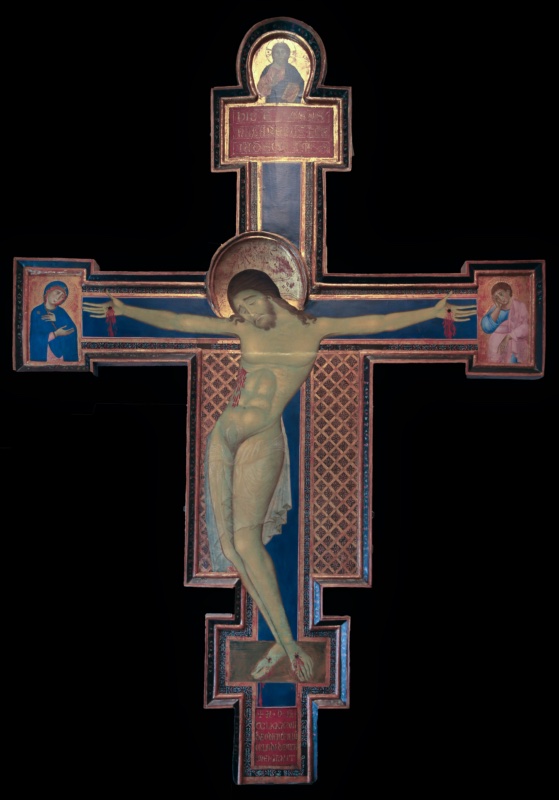
At the center stands the figure of the crucified Christ, depicted lifeless with a poignant and intense expression; his body is arched in a dramatic pose that accentuates the pathos of the Passion, reflecting the influence of Cimabue. On the side panels of the horizontal arm of the cross, the sorrowful Virgin Mary on the left and Saint John the Evangelist on the right express deep sorrow, with gestures and gazes turned toward the Redeemer; in the upper frieze, God the Father reigns supreme, blessing the scene, a symbol of divine authority. This composition derives from the Lucca tradition of crosses painted on a damascened gold background, but Orlandi simplifies the scheme by eliminating complex Gospel scenes to focus on the emotional intensity of the mourners.
The work is executed on a panel assembled in the shape of a cross, with a hammered gold background that creates a sacred and luminous aura, typical of 13th-century Italian medieval painting. The tempera is applied with meticulous attention to anatomical details and drapery, revealing an emerging volumetric modeling that foreshadows Gothic innovations, while the incisions in the gold simulate a richly textured damascene effect. Originally from the church of San Cerbone near Lucca (or perhaps from Marlia), it is signed and dated, making it the first chronologically certain work by Orlandi.
Deodato Orlandi emerges as a Lucca painter sensitive to Central Italian trends, a bridge between the local Berlinghieri tradition and Cimabue’s naturalism, as evident in comparison with the Crucifix of Santa Croce in Florence. This Crucifix from 1288 provides a terminus ante quem for dating Cimabue’s works and marks the beginning of Orlandi’s mature phase, influenced by Florentine models but rooted in 13th-century Lucca culture. Its importance lies in the innovative pathos of the dead Christ (as opposed to the traditional Christus triumphans), which anticipates 14th-century trends toward a greater humanization of the sacred figure.
Madonna col bambino tra i ss. Pietro, Paolo, Jacopo e Domenico
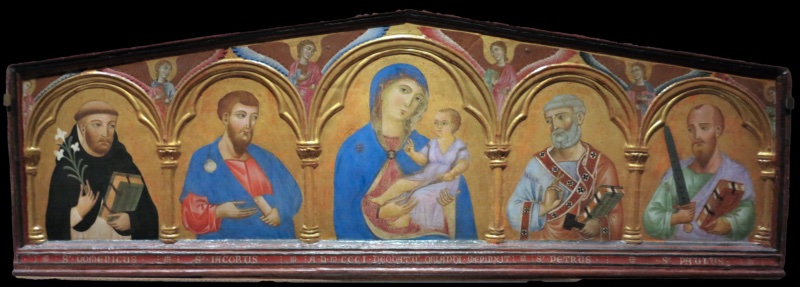
At the center stands the Madonna in Majesty, seated on a Gothic throne with a pointed backrest and embossed decorations, holding the blessing Child in her lap. The infant Christ, wrapped in rich, flowing drapery, blesses with his right hand while holding a scroll in his left, gazing at his mother in an affectionate and serene exchange. On either side of the Virgin are the four saints: on the left, Saint Peter with the keys and the book, and Saint Paul with the sword and the volumen; on the right, Saint James the Greater (Jacopo) with the pilgrim’s staff and the tau staff, and Saint Dominic with the book and a branch of lilies, a symbol of his purity. The ensemble reflects Dominican and Petrine iconography, with a devotional emphasis on hierarchical and patronal figures, typical of ecclesiastical commissions from Lucca.
The composition is symmetrical and balanced, organized on two registers: the lower one dedicated to the saints standing within simulated architectural niches, and the upper one dominated by the enthroned Madonna. The saints emerge from gilded backgrounds stamped with floral and geometric motifs, which amplify the luminosity and sense of celestial sacredness, while the heavy, rippled drapery creates a sculptural rhythm within the two-dimensional space.
Executed in oil tempera on wood, the work makes extensive use of gold leaf applied with bolus and burnished, which serves as a luminous background and lends an effect of liturgical preciousness. Deodato Orlandi adopts a linear and decorative style inherited from the Byzantine tradition as mediated through Lucca, with Cimabuean influences but without the more advanced proto-Giottesque echoes. The faces are oval and idealized, with large, slender eyes that express mystical introspection; the hands are elegant and slender, while details such as the gilded edges of the cloaks (hatched in liquid gold) and the inscriptions on the books add a refined calligraphic virtuosity.
This altarpiece, signed and dated 1301, marks a mature phase in the artist’s career, in which he balances narrative grace with solemn monumentality, making it suitable for a convent altar such as that of the Pisan Dominicans. The gilding is not merely decorative but structural, creating illusory depth through gradients of light and shadow modeled with agate on different layers of gilding.
The work likely comes from the Convent of San Matteo in Soarta in Pisa.
Madonna col bambino
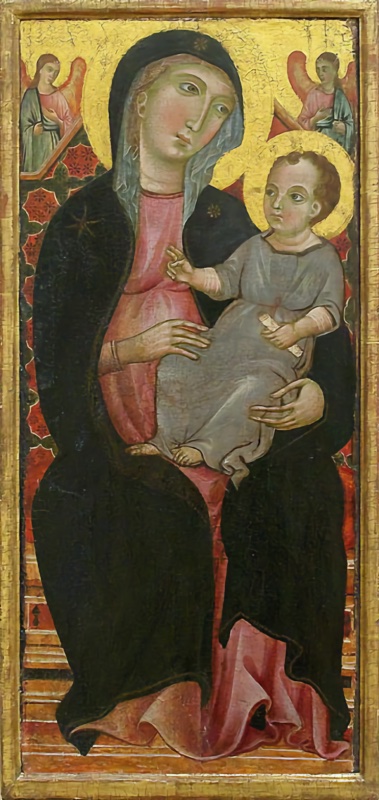
The painting depicts the Madonna in a half-length portrait, seated on a throne adorned with subtle Gothic elements, while holding the infant Christ, who blesses with his right hand and holds a small sacred book in his left. The background is dominated by a sumptuous gold ground, typical of the Italo-Gothic style, which symbolizes the celestial and divine realm, creating an aura of sacredness and familial intimacy. The Virgin’s face is gentle and idealized, with a transparent veil softening her features, while the Child appears more mature and regal, reflecting the Byzantine influence filtered through the Lucca school.
This composition derives from the Madonna in Majesty of the Cimabuean tradition, but Orlandi introduces a more tender and decorative touch, with flowing drapery and affectionate gestures between mother and son that foreshadow Giotto’s later developments. There are no obvious side figures in this narrow panel, suggesting it may have been part of a larger altarpiece or polyptych, perhaps as a central or side panel.
Egg tempera on poplar panel, embellished with beaten and stamped gold leaf, is the standard technique of Italian religious painting of the period, which allowed for luminous and precious effects suitable for the liturgy. The gilding on the edges of the throne and on the halos is engraved with floral and geometric motifs, highlighting the goldsmithing skill of Orlandi, a master from Lucca known for his exquisite decorative work. The colors are vivid—ultramarine blue for the Virgin’s mantle, intense reds for the drapery—with delicate shading that lends volume without abandoning the Byzantine flatness.Deodato Orlandi was a painter from Lucca trained in the local tradition, influenced by Cimabue and the mosaics of Pietro Cavallini, as seen in his Crucifix of 1288.
This work in the Louvre, attributed to the first decade of the 14th century, marks a transitional phase: it softens the tragic Cimabue-style of his earlier works (such as the Pisan altarpiece of 1301 in the Museum of San Matteo) and introduces proto-Giottesque elements, with greater naturalness in gestures and facial expressions. The date of 1301 is controversial—some sources place it around 1320 or the third decade—but it reflects Orlandi’s stylistic evolution toward a more modern, Florentine-Sienese idiom.
This Madonna exemplifies the role of sacred painting as a devotional tool, inviting the faithful to contemplate the humanity of Christ through maternal tenderness, a central theme in the Franciscan and Dominican spirituality of the time. Its presence at the Louvre attests to 19th-century collecting of medieval Italian works, while for scholars it represents a bridge between Byzantine rigidity and Giotto’s naturalism, with a particular focus on the ornamentation characteristic of Lucca art. Similar works, such as the Madonna from the Hurd Collection (dated 1308), confirm Orlandi’s serial production for altars and private devotees.
Crucifix with the Sorrowful (1301)
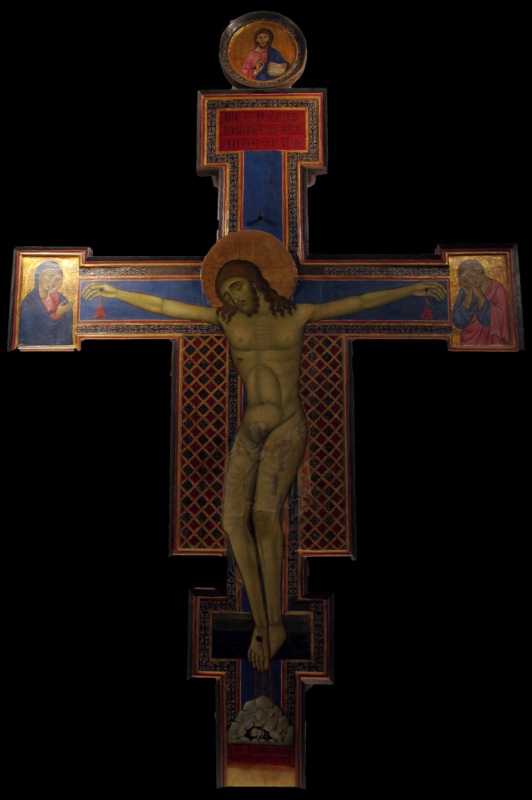
This painted, sculpted cross follows the typical style of the 13th-century Croce dolorosa, with Christ depicted as dead on the cross, his body slumped in a poignantly dramatic pose that reflects the innovative trends of late 13th-century Central Italian art, influenced by masters such as Cimabue. On either side of the horizontal beam, in the side panels, are the sorrowful Virgin Mary on the left and Saint John the Evangelist on the right, both in poses expressing suffering; in the upper frieze is God the Father giving his blessing (or, in some accounts, Christ the Judge), while decorative elements such as red and white phytomorphic arabesques on a blue background frame the central composition. The cross is adorned at the center with geometric lozenge motifs; Christ wears a relief halo and a diaphanous white loincloth, and the background is rich in gold, enhancing the devotional solemnity typical of late 13th-century Lucca production in transition toward the 14th century. This work is considered Orlandi’s first reliably dated piece, essential for determining the development of his style and for chronological comparisons with contemporary crosses, such as Giotto’s cross in Santa Maria Novella.
The brush-painted inscription in Latin, visible on the finial or at the base of the cross, bears the signature “Deodato Orlandi” followed by the date “MCCCII” (equivalent to 1301 in the medieval Gregorian calendar6), a common practice in painted Tuscan crosses to attest to the authenticity and completion of the work. This work was likely commissioned by the nascent monastery of Santa Chiara, founded around the first half of the 13th century by the Franciscan Poor Clares in the diocese of San Miniato al Tedesco (today San Miniato in the province of Pisa), a female conventual setting linked to the Franciscan Order that fostered devotion to the suffering Christ and to the afflicted.
Painted crosses such as this one were typically commissioned by religious communities for altars, processions, or interior devotional spaces, yet without dedicatory inscriptions or references to lay or ecclesiastical donors that would identify the specific patron. The absence of commissioning details is common in Orlandi’s Lucca works intended for smaller Tuscan churches, where collective monastic patronage prevailed over individual patronage, in line with the Franciscan spirituality of the time, which emphasized devotional anonymity.
Scholars hypothesize a patronage originating within the monastery or from local noble nuns, given the presence of embroidered textiles created by Poor Clares from noble families of San Miniato and the Livorno bourgeoisie in the same convent, though there is no direct evidence for this specific cross. Compared to other works by Orlandi, such as the 1288 Crucifix for San Cerbone in Lucca or the one in Pisa for San Francesco, the patronage there too remains unspecified (parishes or Franciscan convents), suggesting a network of Tuscan religious patrons who appreciated his Cimabue-Giotto style. For further research, one could consult the diocesan archives of San Miniato or notarial records from Lucca, but at present, the Cultural Heritage records do not list any specific names.