Arnolfo di Cambio
( 25% )
Family background
Arnolfo di Cambio, also known in documents as Arnolfo di Lapo, was born in Colle di Val d’Elsa in Tuscany around the years 1240 to 1245. The principal Italian and international reference works concur on this Tuscan birthplace, even if they differ slightly on the exact year. Italian archival tradition, summarized in modern scholarship, identifies his father as Messer Cambio, a notary active in Colle, and his mother as a woman referred to as domina Perfetta, suggesting a family of some local standing and education.
The alternative patronymic “di Lapo,” emphasized in Vasari’s account, probably reflects either an earlier ancestor or a confusion between related branches of the family, and it has contributed to later uncertainty about his genealogy. Vasari further embellished the family narrative by portraying Arnolfo as the son of a German master builder, a detail that modern historians treat with caution while acknowledging possible transalpine connections in the wider kin group. What can be stated with reasonable confidence is that Arnolfo grew up in an environment where literacy, legal practice, and knowledge of building techniques coexisted within the domestic sphere.
This conjunction of notarial culture and practical craftsmanship would have introduced him very early to the contractual and institutional mechanisms that governed large ecclesiastical and civic commissions. The family’s social position, situated between the professional classes and the artisan world, helps to explain the breadth of Arnolfo’s later activity as sculptor, architect, and urban planner. Such a milieu likely facilitated his access to reputable masters rather than confining him to purely manual labor in anonymous workshops. In this sense, Arnolfo’s family context can be located within the minor urban elites of mid thirteenth century Tuscany, a stratum that mediated between communal government, religious orders, and the emerging professional status of artists.
Artistic education
The cultural setting of Colle di Val d’Elsa also contributed to Arnolfo’s early formation, for the town stood at a crossroads between Siena and Florence and participated in the wider artistic dynamics of the region. The presence of notaries, jurists, and merchants in the local ruling class fostered a climate in which documentary practices and visual representation were closely intertwined. Within this environment, the young Arnolfo would have experienced the ceremonial life of confraternities, parishes, and mendicant communities, all of which relied heavily on images and architecture to shape devotional experience.
The family’s probable involvement in civic affairs, through Messer Cambio’s notarial work, must have familiarized him with communal statutes, building ordinances, and the rhetoric of public memory. Such exposure to civic documentation later resonates in his monumental inscriptions and carefully structured epigraphic fields on tombs and façades. The toponymic pride of Colle, celebrated by Dante in connection with the battle there, further indicates the strong sense of local identity that surrounded Arnolfo’s childhood. It is plausible that family narratives linked their own fortunes to the conflicts and alliances that defined the Valdelsa in the decades around 1250. These stories, situated at the intersection of local pride and wider political upheaval, may well have sharpened Arnolfo’s awareness of history as something that could be inscribed in stone. In this way, the family background contributed not only to his social advancement but also to his conception of architecture and sculpture as instruments of civic memory.
The relative scarcity of primary documents about Arnolfo’s immediate relatives has invited considerable historiographical speculation, yet a few structural features of his family life can still be reconstructed. The identification of his father as a notary implies an education in Latin formulae, exposure to Roman legal tradition, and habitual engagement with written contracts. Such a profession required mobility between ecclesiastical and secular patrons, which may have given the household a broad network of acquaintances among clergy, merchants, and communal officials.
Within this milieu, discussions at home would have revolved around disputes over property, jurisdiction, and communal works, all of which have analogues in the large projects Arnolfo later directed. The figure of domina Perfetta, although shadowy in the sources, signals the presence of a respected matron able to manage household affairs while kin moved between different Tuscan centers. It is conceivable that maternal kin from Colle or nearby countryside brought with them a more traditional devotional culture, rooted in local shrines and rural churches, which complemented the more professional orientation of the paternal line. The combination of these elements created a family environment that was neither purely artisanal nor strictly patrician, but one well suited to generating an artist capable of negotiating both worlds. Modern scholarship has therefore tended to emphasize the hybridity of this familial background, rather than attempting to force it into rigid social categories. The complexity of Arnolfo’s later career strongly suggests that such hybridity was a source of strength rather than of inconsistency.
Vasari’s biography of Arnolfo, written some two and a half centuries after the artist’s death, played a decisive role in shaping the perceived image of his family, even when it conflicted with contemporary documents. By presenting him as the son of a German master builder named Lapo, Vasari inserted Arnolfo into a narrative of foreign technical expertise that supposedly revitalized Italian architecture. This literary strategy reflected sixteenth century preoccupations more than thirteenth century realities, but it nevertheless influenced the way Florentines imagined their own artistic genealogy.
Later writers vacillated between the figure of the native Tuscan notary and that of the immigrant architect, sometimes attempting to reconcile them by positing mixed ancestry. Modern archival research, especially the studies collected in Italian encyclopedic entries and municipal publications, has reasserted Colle di Val d’Elsa as the primary point of origin, while often retaining Vasari’s anecdotal material as a reflection of later reception rather than factual record. In this sense, the family legend became as important as the family facts, since it determined how later generations appropriated Arnolfo as either a Florentine or a Colle-born master. The coexistence of these narratives reflects the broader competition between Tuscan centers for the symbolic capital attached to eminent sons. The family background, whether described in documentary or legendary terms, thus operates on two levels in the historiography, as social reality and as a constructed heritage. Both levels have deeply marked the modern understanding of Arnolfo’s position within the artistic and civic history of central Italy.
Beyond the immediate household, the notion of an extended family of collaborators and followers formed an important part of Arnolfo’s lived experience. By the end of his career, he directed significant workshops in both Rome and Florence, involving assistants, stonecutters, bronze workers, and younger sculptors who shared in his commissions. These workshop circles often included relatives by blood or marriage, reinforcing the porous boundaries between kinship and professional affiliation.
Contracts for major undertakings, such as the ciboria in Roman basilicas or the façade of Santa Maria del Fiore, were typically granted to a named master but executed collectively, creating a corporate identity around the figure of Arnolfo. In this sense, the “family of Arnolfo” extended far beyond biological ties to encompass the social body of his workshop. The survival of stylistically varied works attributed to his circle confirms that he tolerated and perhaps even cultivated a certain degree of internal diversity. Such diversity may echo the plural voices and experiences present within his household and kin.
The late medieval practice of referring to master and followers through shared names and epithets further blurred the distinction between personal authorship and family legacy. Modern scholars, when attempting to isolate the “hand” of Arnolfo himself, are thus often confronting the historical reality of a family-like collective that signed and executed works under his leadership. This broader understanding of family helps to contextualize both his production and the transmission of his style across generations.
Patronage
The trajectory of Arnolfo’s career is inseparable from the evolving constellation of patrons who recognized and exploited his talents. His earliest documented activity took place within the workshop of Nicola Pisano, where the older master functioned simultaneously as teacher, employer, and intermediary with powerful ecclesiastical clients. In this context, Arnolfo participated in the realization of the pulpit for Siena Cathedral between 1265 and 1268 and in the Arca of Saint Dominic at Bologna, both of which were commissioned by cathedral chapters and mendicant orders.
These collective patrons sought sculptural programs that could articulate the theological and liturgical ambitions of reforming religious communities. Working under Nicola’s direction, the young Arnolfo became accustomed to negotiating iconographic demands with institutional expectations and financial constraints. The workshop environment also introduced him to the practice of securing sequential commissions from the same patrons, thereby building long term relationships. Even at this early stage, patrons did not relate to him merely as a subordinate, for his contributions to major sculptural ensembles began to attract individual recognition. The prestige of these early ecclesiastical projects prepared the ground for his later emergence as an independent master in Rome and Florence.
A decisive shift in Arnolfo’s patronage occurred when he entered the orbit of Charles I of Anjou1, king of Sicily and a central figure in the politics of the papal court. Around 1276 or 1277 he moved to Rome to work for Charles, receiving a commission for a monumental portrait statue that portrayed the monarch enthroned with regalia. The sculpture, originally installed in the Roman basilica of Santa Maria in Aracoeli and now preserved in the Capitoline Museums, is often considered the first fully realistic post classical portrait of a living ruler in Europe.
By granting such a commission to a relatively young sculptor trained in Tuscany, Charles demonstrated confidence in Arnolfo’s ability to translate royal ideology into marble form. The king’s patronage also placed him at the intersection of Angevin dynastic ambitions and papal politics, a position that opened doors to further high level commissions. In the Roman context, royal favor often translated into influence within curial circles and among cardinal dynasties. The portrait of Charles thus served as both a political statement and a professional calling card, advertising Arnolfo’s mastery of monumental representation. Through this royal patron, he gained access to a range of projects that spanned sepulchral monuments, liturgical furnishings, and urban interventions.
The papal curia and its cardinals soon emerged as another crucial group of patrons, entrusting Arnolfo with some of the most innovative funerary monuments of the late thirteenth century. In Viterbo he is associated with the tomb of Pope Adrian V in the church of San Francesco, a work that aligns papal authority with a new sculptural language indebted to both antique prototypes and Gothic forms. In Rome he designed and signed the tomb of Cardinal Riccardo Annibaldi, originally installed in San Giovanni in Laterano, and he later created the elaborate monument of Cardinal Guillaume de Braye2 in the Dominican church of San Domenico at Orvieto.
These commissions came from families deeply embedded in the politics of the curia, who sought to memorialize their members through architectonic structures that combined effigies, narrative reliefs, and rich decorative programs. Arnolfo’s ability to integrate portraiture, allegory, and liturgical functionality made him particularly attractive to such patrons. The papal court, moreover, offered a transregional platform from which his fame spread across the Italian peninsula. As a result, cardinals and popes began to perceive him as a sculptor capable of articulating the grandeur and spiritual authority of the Church in durable and persuasive forms.
Monastic and basilical institutions in Rome also played a significant role in sustaining Arnolfo’s activity, commissioning him to devise complex liturgical structures for prominent sanctuaries. For the Benedictine abbey of Saint Paul Outside the Walls he created in 1285 a monumental ciborium of marble and porphyry, whose pointed arches, polychrome inlays, and ascending pinnacles translate French Gothic solutions into a Roman context. A few years later he designed a second ciborium for the church of Santa Cecilia in Trastevere, again fusing Cosmatesque decorative techniques with an architectonic canopy that framed the altar and the saint’s relics. These commissions reveal the desire of Roman monastic communities to align themselves with the latest artistic developments while preserving traditional forms of veneration. At Santa Maria Maggiore he carved a group of figures representing the Nativity and the Magi, which later tradition identified as the first fully sculptural crib to be installed in a major basilica. The basilicas thus functioned not only as patrons but also as prestigious stages for the display of his technical virtuosity and iconographic inventiveness. Their support ensured that his works became part of the daily liturgical and devotional life of Rome, reinforcing his reputation among pilgrims and clergy alike.
The civic and religious institutions of Florence constituted the final and perhaps most enduring constellation of patrons in Arnolfo’s career. Around 1294 or 1295 he moved to Florence to serve the commune and the cathedral chapter in an ambitious program of architectural and urban renewal. The Florentine authorities entrusted him with the design of the new cathedral of Santa Maria del Fiore, the expansion of the city walls, and probably the construction of Santa Croce and the Palazzo della Signoria, even if the latter attributions remain debated. These projects required close collaboration with lay magistracies, religious orders, and confraternities, all of whom invested resources and symbolic capital in the transformation of the cityscape. The patrons valued in Arnolfo not only his sculptural skill but also his ability to conceive buildings and urban spaces that articulated Florentine communal identity in monumental terms. His statuary for the original façade of the cathedral, including images of the Virgin and local saints, was commissioned and financed by a complex network of ecclesiastical and civic bodies, whose expectations he had to balance. Through these patrons, Arnolfo’s work became inseparable from the emerging myth of Florence as a new Christian and civic Jerusalem.
In addition to these major groups, Arnolfo’s career intersected with a constellation of smaller patrons, including lay confraternities, local elites, and perhaps foreign merchants. The documentation is fragmentary, but the breadth of his activity in cities such as Perugia, Orvieto, and Bologna implies negotiations with municipal governments and local religious communities. In Perugia, where he provided sculpture for the so called Fontana Minore, the commission came from the commune, which sought a fountain that combined practical utility with a sophisticated iconographic program about thirst, illness, and civic charity.
In Orvieto the monument of Cardinal de Braye involved not only the cardinal’s heirs but also the Dominican community that hosted the tomb, each with its own expectations concerning imagery and placement. Such patrons, although less individually famous than kings and popes, collectively contributed to the diffusion of Arnolfo’s style across central Italy. They also reveal his capacity to adapt monumental formulas to local needs and resources. From workshop contracts and stylistic analysis, scholars infer that he cultivated enduring relationships with certain families and institutions, returning to them for additional commissions or for adjustments to earlier works. Patronage in his case thus appears as a dense web of personal, institutional, and regional connections that underpinned his artistic authority.
Painting style and sculptural language
Although Arnolfo di Cambio is known primarily as a sculptor and architect rather than as an easel painter, his works manifest a deeply “pictorial” sense of composition that justifies speaking of a painting like style in his sculptural language. His early formation in the workshop of Nicola Pisano exposed him to a revival of antique relief conventions, particularly the dense narrative fields of Roman sarcophagi, which he translated into his own idiom.
The Siena pulpit, where he collaborated as chief assistant, already reveals his sensitivity to the distribution of figures within framed scenes, the modulation of depth, and the interplay of foreground and background. In these reliefs, the arrangement of episodes across the faceted structure of the pulpit anticipates the kind of visual sequencing more commonly associated with painted cycles. Arnolfo absorbed this approach and later applied it to the reliefs and statuary on tombs and façades, where figures are orchestrated in carefully balanced groupings. The emergent Gothic taste for linear elegance and attenuated silhouettes further shaped his way of drawing contours in stone. As a result, his sculptural surfaces often read as carved paintings, with rhythms of line and mass comparable to the brushstrokes of contemporaneous panel painters.
The Roman phase of Arnolfo’s career brought him into direct contact with ancient sculpture and with the sophisticated ornamental language of the Cosmati workshops. In the tomb of Cardinal de Braye at Orvieto, he famously modeled the enthroned Madonna on a Roman statue of the goddess Abundantia, transferring the classical pose and drapery into a Christian context. This act of quotation reveals not only antiquarian interest but also a painterly concern for the interplay between volume, surface pattern, and symbolic attributes.
The tiara and jewels of the Madonna reproduce antique models, yet they are orchestrated with a refined attention to light effects that parallels contemporary research in panel painting. In Rome, moreover, Arnolfo observed the Cosmatesque technique of marble and glass inlay, which creates polychrome designs across architectural surfaces. When he designed the ciboria for Saint Paul Outside the Walls and Santa Cecilia in Trastevere, he incorporated bands of colored intarsia and glass that function almost like luminous borders framing sculptural scenes. This fusion of structural clarity and decorative brilliance gives his works an optical richness akin to that of painted altarpieces. The result is a sculptural style in which architectural structure and surface coloration collaborate to produce a visual experience that is at once spatial and pictorial.
In his funerary monuments, Arnolfo developed a distinctive dramaturgy of the body that combines classical gravitas with Gothic expressivity. The recumbent effigies of Adrian V, Riccardo Annibaldi, and Guillaume de Braye are rendered with a solemn stillness that recalls antique sarcophagus portraits, while the accompanying mourners and clerics display more animated gestures. This contrast between the repose of the dead and the movement of the living invests the sculptural ensemble with a narrative tension similar to that found in painted lamentations.
The canopies and architectural frameworks of these tombs function as stage sets, organizing the viewer’s gaze and creating zones of visual emphasis. Reliefs in the dado often depict processions of clergy or allegorical figures, arranged in continuous bands that evoke the frieze like structure of Roman reliefs and the register system of Gothic wall painting. Arnolfo’s command of foreshortening and overlapping, although relatively restrained, reveals an awareness of spatial construction comparable to that of contemporaneous painters. His funerary monuments thus may be described as three dimensional pictorial compositions, in which sculpted figures, inscriptions, and ornamental motifs are orchestrated according to principles that transcend medium specific boundaries.
The statuary and reliefs planned for the original façade of Santa Maria del Fiore in Florence offer a particularly revealing instance of Arnolfo’s pictorial imagination. Archaeological evidence and surviving fragments preserved in the cathedral museum show that he conceived the façade as a vast narrative field dedicated to the Virgin, with scenes such as the Nativity of Mary, the Madonna enthroned, and the Dormition distributed across portals and gables.
The so called Madonna of the Nativity, whose pose recalls reclining figures on Etruscan sarcophagi, demonstrates his ability to adapt funerary prototypes to joyful themes by subtly adjusting facial expression and gesture. The Dormitio Virginis relief, now in Berlin, organizes apostles and angels around the bier of Mary in a carefully graded hierarchy that leads the eye from horizontal bed to ascending heavenly sphere. In these works, Arnolfo’s control of compositional diagonals, gaze directions, and drapery lines creates visual pathways analogous to those used by painters in altarpieces and frescoes. The relatively shallow carving of figures, calibrated for frontal viewing from below, reinforces the sense that the façade functioned as a carved painting stretched across the church front. By privileging clear silhouettes and rhythmic repetition, Arnolfo ensured that the sculptural ensemble communicated effectively even at a distance.
Architectural space in Arnolfo’s churches also reveals an affinity with contemporary explorations in pictorial representation. The interior of Santa Croce, commonly attributed to him by many scholars despite documentary debates, is organized as a vast hall like space with high walls, slender piers, and a luminous clerestory, reminiscent of the broad narrative fields of later fresco cycles. The relatively unarticulated wall surfaces, punctuated by large windows, create an impression of an immense screen awaiting figurative decoration. This conception anticipates the later use of Santa Croce as a major site for painted narratives by Giotto and his successors. Similarly, Arnolfo’s design for Santa Maria del Fiore privileges an expansive nave and a clear axial progression toward the choir, creating a spatial sequence that lends itself to processional and visual choreography. Even the Palazzo della Signoria, if rightly attributed to him, may be read as a monumental backdrop whose planar façades frame the civic rituals of the piazza. In all these cases, architecture acquires a quasi pictorial function, serving as a support and frame for images and ceremonies that unfold before its surfaces.
Scholars have long noted that Arnolfo’s sculptural language balances volumetric solidity with an increasingly linear treatment of drapery and contour, reflecting the broader transition from Romanesque mass to Gothic line. In earlier works associated with Nicola Pisano, figures are modeled with robust, rounded forms and heavy folds that cling to the body in classical fashion. Over time, especially in Roman commissions and in the Florentine façade statuary, drapery patterns become more intricate and restless, with angular breaks and fluttering hems that create a dynamic surface rhythm. Faces, too, evolve from generalized ideal types to more individualized physiognomies, sometimes with pronounced noses and sharply defined cheekbones, qualities that Dante may have recognized in the portrait of Charles of Anjou. This stylistic development suggests an increasing interest in psychological characterization and narrative expressivity, qualities that align Arnolfo with the most advanced tendencies of Italian Gothic art. Yet he never abandons the underlying structural clarity inherited from classical models and Cistercian architectural rationalism. The resulting style oscillates between static monumentality and anxious movement, a tension that gives his works their particular emotional charge.
Finally, some sources allude to Arnolfo’s involvement with painting in a more literal sense, either through direct practice or through close collaboration with painters. Vasari, in his biography, emphasizes his study of drawing under Cimabue, a claim that, while not fully verifiable, underscores the perception that he mastered the pictorial arts as well as sculpture and architecture. Later scholarship has explored the possibility that he may have contributed to painted decoration in certain contexts, or at least that his architectural frameworks presupposed specific painted programs. Even if his hand in surviving paintings remains unproven, the convergence of sculptural, architectural, and pictorial concerns in his work supports the idea of a polymath artist for whom the boundaries between media were fluid. His “painting style,” therefore, should be understood not as a matter of panel production but as a pervasive pictorial sensibility that shaped the conception of his sculptures, tombs, ciboria, and façades. This sensibility places him among the key agents in the transformation of Italian visual culture on the eve of Giotto.
Artistic influences
The most powerful and frequently discussed influence on Arnolfo di Cambio’s art is that of ancient Roman sculpture and architecture, which he encountered intensively during his Roman sojourn. His adaptation of a statue of Abundantia as the model for the Madonna in the de Braye monument at Orvieto is the clearest documented instance of direct quotation from a classical figure. The reclining or enthroned attitudes of many of his effigies, as well as the careful modeling of facial features and hands, betray a sustained study of Roman sarcophagi and honorary statues. This classicizing impulse distinguishes his work from that of some other Gothic sculptors in Italy, who relied more heavily on northern prototypes. In addition to formal borrowings, Arnolfo assimilated from antiquity a conception of sculpture as a bearer of public dignity and political symbolism. His portrait of Charles of Anjou consciously evokes the authority of imperial images, while remaining firmly anchored in contemporary regalia. The integration of inscriptions into his monuments further reflects Roman habits of combining text and image in a unified communicative field. Through these classical references, Arnolfo contributed decisively to the reactivation of the ancient heritage within a Christian and communal framework.
French Gothic art provided another decisive source of inspiration, particularly in the realm of architectural forms and decorative systems. The ciborium of Saint Paul Outside the Walls, with its soaring pinnacles, pointed arches, and clustered colonnettes of porphyry, has often been compared to a similar structure in the Sainte Chapelle in Paris, created about fifteen years earlier. Arnolfo seems to have absorbed the principles of vertical emphasis, skeletal framing, and intricate canopy work characteristic of French Gothic tabernacles. At Santa Cecilia in Trastevere, he modified this imported model by lowering the proportions and introducing more horizontal accents, perhaps under the impact of Roman basilican space and ancient monuments. The façade compositions attributed to him in Florence, especially the lost front of Santa Maria del Fiore, also reveal affinities with French cathedrals in their use of gabled portal systems, rose windows, and zones of sculptural colonization. Yet these borrowings are never slavish; Arnolfo systematically adapts foreign motifs to local liturgical practices and structural traditions. Scholars have therefore spoken of an Italian “new style” in Gothic art, of which Arnolfo is a principal architect, mediating between transalpine innovations and Mediterranean classicism.
The influence of his master Nicola Pisano and of the broader Tuscan sculptural milieu is equally fundamental. Working on the Siena pulpit and the Arca of Saint Dominic, Arnolfo absorbed Nicola’s method of drawing upon Roman sarcophagi and late antique reliefs, especially in the treatment of drapery and the arrangement of narrative scenes. From Giovanni Pisano and other contemporaries he learned a greater freedom in carving, a willingness to break the architectural frame and project figures into real space. The balance between Nicola’s compact classicism and Giovanni’s expressive dynamism forms a crucial background against which Arnolfo’s own synthesis should be read. He neither abandons volumetric solidity nor fully embraces the most restless aspects of northern Gothic, instead occupying a middle ground that is both monumental and animated. Tuscan traditions of façade decoration, with their polychrome marbles and geometric inlays, also left a lasting mark on his architectural designs. In this sense, Arnolfo’s language emerges from a dialogue with fellow Tuscan sculptors and architects, even as it extends beyond their achievements.
Cimabue and the world of contemporary painting exerted a more indirect but nonetheless important influence on Arnolfo’s conception of form and space. Vasari’s assertion that Arnolfo studied drawing under Cimabue may be more emblematic than factual, yet it reflects an early modern perception of close interaction between the two masters. Fresco cycles in Roman and Tuscan churches provided paradigms for structuring complex narratives, organizing figures in registers, and coordinating color and line. Arnolfo’s sculptural reliefs and façade programs translate such pictorial strategies into stone by using architectural frames analogous to painted borders and by aligning figures according to spatial and hierarchical logics derived from panel painting. The exchange may also have operated in the opposite direction, with painters learning from Arnolfo’s architectural framings and monumental gestures. Thus, even if direct stylistic dependence cannot always be demonstrated, it is clear that the artistic climate of the late Duecento, characterized by intense cross fertilization between painters and sculptors, shaped his sensibility.
Liturgical practice, theology, and the spirituality of the mendicant orders constitute another layer of influence that guided Arnolfo’s artistic choices. The Dominicans at Orvieto and the Franciscans at Viterbo required tombs and altars that reflected their preaching on death, judgment, and the intercession of the saints. These theological emphases encouraged Arnolfo to develop iconographies that integrate physical likeness, doctrinal symbolism, and eschatological narrative. The arrangement of clerical processions, angels, and allegorical figures in his monuments responds closely to liturgical choreography and to the movement of bodies during rites. The rise of affective piety, with its focus on the humanity of Christ and the Virgin, also influenced his treatment of facial expression and gesture, especially in scenes of the Nativity and the Dormition. The first sculptural crib at Santa Maria Maggiore, with its intimate grouping of figures around the manger, is unthinkable without this new devotional emphasis on the Incarnation. In this way, theological and liturgical currents shaped not only the content but also the emotional tone of Arnolfo’s art.
Arnolfo’s influence
Arnolfo di Cambio’s own impact on later artists and on the visual culture of central Italy has been profound, extending well into the fourteenth century and beyond. His funerary monuments established a typology of wall tomb crowned by an architectural canopy, a form that would dominate Italian sepulchral art up to the Renaissance. The de Braye monument at Orvieto, with its combination of recumbent effigy, enthroned Madonna, and elaborate baldachin, became a model emulated and adapted in countless later tombs. In Florence, the conception of Santa Croce and Santa Maria del Fiore as great luminous halls structured for fresco decoration offered painters like Giotto and his followers an unprecedented spatial framework. Giotto’s ciborium like structures in certain frescoes, for instance in the Scrovegni Chapel, have often been related to Arnolfo’s tabernacles in Rome. The integration of sculpture and architecture in Arnolfo’s works provided a template for later masters who sought to unite different media within coherent ensembles. Through these innovations, Arnolfo may be regarded as a crucial mediator between Gothic sensibility and early Renaissance aspirations.
Beyond individual monuments, Arnolfo’s role as a civic architect and urbanist in Florence exerted a lasting influence on the city’s identity and on the Italian imagination of the medieval commune. The design of the new cathedral, with its colossal scale and central position in the urban fabric, articulated the ambitions of Florence to rival other Italian and European centers. The Palazzo della Signoria, rising over the main square, provided a powerful visual symbol of communal government, whose crenellated tower and robust mass remained paradigmatic for later town halls. Even if some attributions remain debated, the ensemble of works traditionally linked to Arnolfo has decisively shaped the perception of Florence as a city of stone, towers, and broad basilicas. Later architects, from Brunelleschi to Michelozzo, worked in a city whose monumental vocabulary had already been substantially defined by his interventions. The resonance of his urban vision continued to inform civic self representations in chronicles, ceremonies, and visual media.
Arnolfo’s stylistic synthesis also influenced the development of Italian Gothic sculpture in regions beyond Tuscany. In Umbria, where he worked on fountains and collaborated indirectly through pupils and followers, local sculptors adopted his combination of classical modeling and Gothic linearity. The sculptural decoration of civic fountains, portals, and tombs in Perugia, Assisi, and other centers often bears traces of Arnolfian solutions, especially in the treatment of drapery and the integration of figural and architectural elements. In Rome, his ciboria and papal monuments provided standards of splendor and doctrinal clarity that later curial artists could hardly ignore. The very debates among art historians over which works should be attributed to Arnolfo and which to his circle testify to the widespread diffusion of his manner. Through workshops and apprenticeships, his influence radiated outward, blending with local traditions to create a variety of regional Gothic idioms.
Dante Alighieri’s probable admiration for Arnolfo adds a literary dimension to his influence, reinforcing his status as a cultural figure rather than merely a technical master. The allusions in the Purgatorio to the battle of Colle Val d’Elsa and to Charles of Anjou, whose monumental portrait Arnolfo carved, suggest that Dante was aware both of the artist’s origins and of his major patrons. The collaboration between the Florentine commune and Arnolfo on Santa Maria del Fiore coincided with Dante’s tenure as prior, making direct encounters between poet and architect highly likely. In later centuries, humanist and antiquarian writers recalled Arnolfo as a precursor of modern architecture who helped recover the dignity of the ancient art of building. Nineteenth century historicism, culminating in the neo medieval façade of the cathedral, further canonized his role by nostalgically evoking his lost front. Thus, Arnolfo’s influence extends from technical solutions and artistic typologies to the realm of cultural memory and identity formation.
Travels and geographical horizons
Arnolfo’s artistic formation and career unfolded across a wide geographical horizon, beginning in his native Colle di Val d’Elsa and expanding through major centers of central and northern Italy. As a youth, he likely moved between Colle and nearby Siena, where he entered the workshop of Nicola Pisano in the mid 1260s. The collaboration on the Siena Cathedral pulpit between 1265 and 1268 placed him at the center of a thriving artistic milieu connected to one of the most ambitious Gothic churches in Tuscany. Shortly thereafter, he participated in work on the Arca of Saint Dominic in Bologna, thereby encountering the culture of a major university city and the logistical challenges of long distance workshop organization. These early moves between Tuscan and Emilian contexts introduced him to different communal governments, mendicant orders, and local traditions of stone carving. Travel in this period was necessarily arduous, yet workshop structures and patron networks provided the practical framework for such mobility. Thus, from the outset, Arnolfo’s artistic identity was marked by movement across regions rather than confinement to a single city.
The transfer to Rome around 1276 or 1277 marked a turning point, both geographically and professionally. In Rome he entered the sphere of the Angevin king Charles of Anjou and of the papal curia, shifting from regional commissions to projects of European significance. The Roman environment exposed him to antique ruins, early Christian basilicas, Cosmatesque workshops, and the complex ceremonial life of the papal city. His activities there radiated outward to nearby centers such as Viterbo, where he worked on the tomb of Adrian V, and Orvieto, where he created the monument of Cardinal de Braye. He also traveled to Perugia in 1277 to design sculptures for the communal fountain known as the Fontana Minore, a project that required negotiating temporarily with his Angevin patrons for release from court obligations. These movements between Rome, Viterbo, Orvieto, and Perugia articulate a network of papal and communal commissions that positioned Arnolfo as a mobile agent of curial artistic policy. At the same time, the diversity of these sites enriched his visual vocabulary with a range of local idioms and liturgical practices.
Within the Roman phase, Arnolfo’s repeated work for major basilicas implies additional, more localized movements between different quarters of the city and its environs. To execute the ciborium at Saint Paul Outside the Walls, he had to coordinate with a monastic community situated outside the traditional urban core, adjusting his designs to a basilica heavily laden with imperial and papal associations. In contrast, Santa Cecilia in Trastevere stood in a densely inhabited neighborhood with strong local devotional traditions, requiring sensitivity to a different liturgical and social context. His involvement in the sculptural crib for Santa Maria Maggiore led him to engage with a Marian sanctuary that drew pilgrims from across Christendom. These intra urban travels and adjustments, although less spectacular than cross regional journeys, contributed significantly to his understanding of how architecture and sculpture could respond to varying topographies, congregations, and ritual needs. They also fostered a familiarity with the Roman road system and with the logistics of transporting marble and tools between sites. In this way, the geography of Rome itself became a kind of extended workshop and laboratory for Arnolfo.
The final major relocation in Arnolfo’s life occurred when he moved to Florence around 1294 or 1295, bringing with him the experience accumulated in Roman and Umbrian contexts. Florence at that time was undergoing rapid economic expansion and political turmoil, seeking monumental forms equal to its aspirations. The commune and the cathedral chapter engaged Arnolfo not only as a sculptor but also as a master of works and urban planner, tasks that required him to move constantly between building sites, quarries, and administrative offices. The design of the new cathedral, the probable planning of Santa Croce, and the supervision of city walls and possibly the Palazzo della Signoria demanded travel within the Tuscan region to secure materials and labor. Documents and later sources suggest that he also contributed to the founding of new towns in the Valdarno, such as San Giovanni Valdarno, implying journeys across the Arno valley and through recently pacified territories. These movements between Florence, its contado, and more distant Tuscan centers consolidated his role as a regional authority in building matters. The cumulative effect of his travels, from Colle to Siena, Bologna, Rome, Umbria, and back to Florence, thus framed his artistic production within a truly central Italian horizon.
Life course, death, and historical context
Synthesizing the available evidence, modern reference works assign Arnolfo di Cambio a birth around 1240 to 1245 in Colle di Val d’Elsa and a death in Florence between 1302 and 1310, with Italian scholarship often indicating the eighth of March within that interval. The cause of his death is not recorded in surviving documents, and no chronicler attributes it to violence, epidemic, or accident, which suggests a natural end in advanced age by contemporary standards. Catholic biographical tradition, drawing on earlier narrative sources, places his death around the year 1300 and at about seventy years of age, but this dating is now generally regarded as approximate rather than exact. By the time of his death, Arnolfo had already left an indelible mark on the urban and artistic fabric of Florence, Rome, and several Umbrian and Tuscan towns. His passing coincided roughly with the political crisis that would soon drive Dante into exile and with broader tensions in the relationship between papacy, monarchy, and communes. Within artistic history, his death falls at the threshold of Giotto’s mature activity, making him a key transitional figure between earlier Gothic sculptors and the new naturalism of the early Trecento. Later generations, looking back from the vantage point of Renaissance and Counter Reformation Florence, retrospectively inscribed his life into a narrative of continuous progress toward classical harmony. Yet the actual circumstances of his death, like many aspects of his biography, remain veiled, inviting historians to reconstruct his trajectory primarily through the enduring testimony of his works.
Major works
Monument to Charles I of Anjou
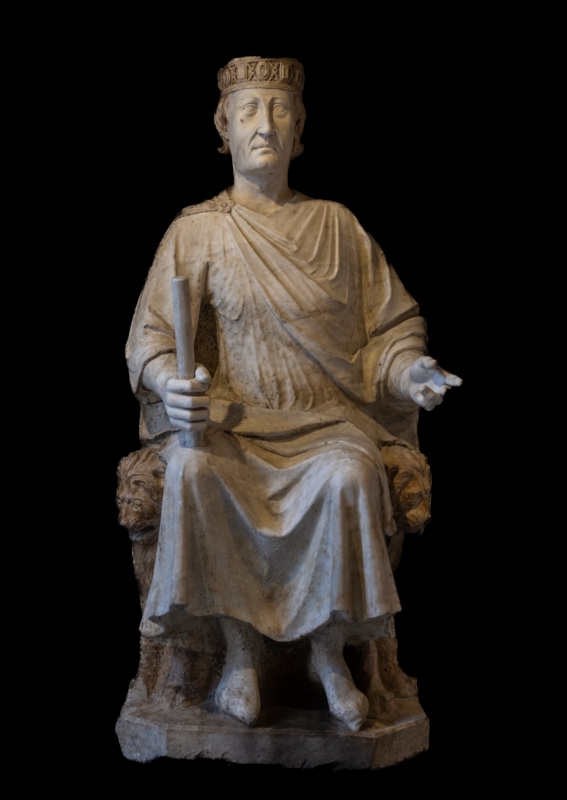
The work was commissioned to honor Charles I of Anjou, King of Sicily and Senator of Rome from 1265 to 1277, a key figure in the struggle against the Swabians and in the consolidation of Angevin power in southern Italy. Originally located in the Basilica of Santa Maria in Aracoeli on the Capitoline Hill—which in the Middle Ages served as Rome’s political and judicial center, almost a “new Forum”—the statue symbolized the imperial authority of the French king, the ideal heir to the Roman Caesars. Arnolfo di Cambio, born around 1245 in Colle di Val d’Elsa and trained in the workshop of Nicola Pisano, created this work during a transitional period between the Romanesque and Gothic styles, influenced by antiquity and the Tuscan tradition, shortly after his return from France and before his major Florentine projects such as the Duomo.
The sculpture depicts Charles seated on a lion-shaped throne—a symbol of royal strength—wearing a jeweled crown, holding a scepter in his right hand and a globe (or book of laws) in his left, in a rigid, frontal pose that evokes classical imperial majesty, like the statues of Roman emperors. The face is rendered with a realism that was innovative for the time: accentuated French features, a straight nose, deep-set eyes, and a forked beard, with an impassive and solemn expression that conveys authority and sobriety. The drapery of the garments—tunic, cloak, and breastplate—is rendered with angular, sharp folds, not fluid as in French Gothic style, but solid and voluminous, derived from Pisan sculpture; the body is massive, with broad shoulders and crossed legs, conveying a sense of monumental stability.
This is not an isolated statue, but part of a monumental honorary complex, perhaps featuring a finial, twisted columns, pinnacles, and angular reliefs, such as the “Trumpeter” (inv. MC0835, h. 141 cm), now fragmentary but originally ascending, symbolizing spiritual elevation. The reverse side reveals that it was carved from a fragment of an ancient Roman architrave (the molding is visible), limiting the depth and resulting in a flattened relief, with details refined only on the front—typical of works designed for tall niches—while the back is roughly sketched. This reuse of Roman spolia underscores Arnolfo’s dialogue with antiquity, evident also in the pose and the throne inspired by imperial models such as Marcus Aurelius.
This work marks the beginning of medieval secular portraiture, breaking with the dominant religious iconography: for the first time, a sovereign is depicted with individual realism, not symbolism, anticipating the Renaissance and influencing sculptors such as Tino da Camaino. It reflects the political context of late 13th-century Rome, with the Capitoline Hill as the seat of the Senate, and Arnolfo’s style—solid, essential, and anti-French Gothic—which prioritizes a compact form and naturalism in visible details, such as the hands and face. Attributed with certainty to Arnolfo due to its stylistic similarity to the Monument to Cardinal de Braye (Perugia, 1281), it was restored over the centuries and re-exhibited in 2013 in the Medieval Hall at the Capitoline Museums.
Monument to cardinal De Braye
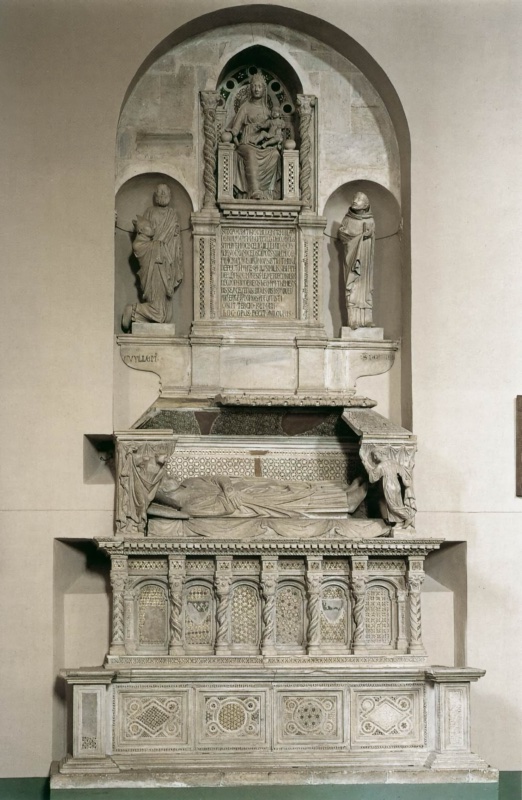
The mausoleum is designed as a wall-mounted Gothic tabernacle, featuring a pointed or trefoil-arched canopy that originally enclosed the sarcophagus containing the cardinal’s recumbent effigy. The composition extends vertically to symbolize spiritual ascent: at the bottom, the base decorated with Cosmatesque mosaics and twisted columns; in the center, the sarcophagus with curtains parted by two clerics revealing the deceased; and at the top, three niches with statues. Although dismantled over time (removed in 1680 and reassembled in 1934 with missing fragments), it retains Arnolfo’s formal simplicity, integrated with Gothic dynamism and decorative lightness.
The recumbent statue of Cardinal de Braye, created by Urban IV in 1263 and who died in 1282 at the court of Martin IV, is depicted on a funeral bed with realistic features derived from a wax death mask, emphasizing Arnolfo’s innovative naturalism. Two acolytes or clerics open the curtains of the sarcophagus, creating a theatrical effect of revelation, while a central tombstone bears the epitaph and the artist’s signature. This portrait, attributed directly to Arnolfo’s hand, depicts a slender and fragile body that accentuates the spirituality of the deceased.
In the apical niche, the high-relief sculptural group of the Madonna and Child Enthroned dominates, accompanied by Saint Mark (patron of the cardinal’s deaconry) and Saint Dominic, who present the prelate kneeling in adoration. The Virgin, whose 1993 restoration revealed her to be a reworked Roman statue, exemplifies the classical reuse typical of Gothic art. The secondary figures in the side niches, such as the slenderly shaped Saint Dominic, lend dynamism and polychromy through mosaic inserts.
This work, commissioned by the executors of the will—including cardinals close to Charles I of Anjou—marks the evolution of 13th-century wall tombs, surpassing Viterbo models in sculptural and decorative richness. It reflects the assimilation by Arnolfo, a pupil of Nicola Pisano, of Roman Cosmatesque and Angevin influences during his service to Charles of Anjou (1277–1280). As his first signed monument, it introduces a new type of wall tomb, blending classical rigor with French Gothic, which was fundamental to Italian sculpture between the 13th and 14th centuries.
St. Peter in the Chair
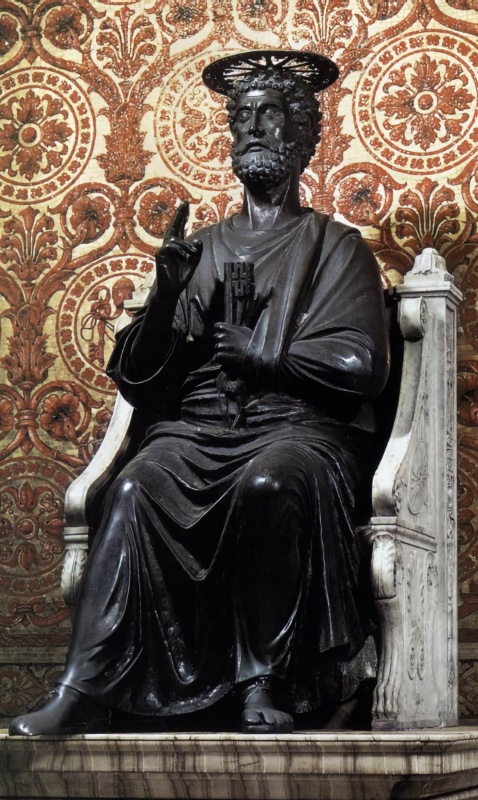
This monumental sculpture depicts Saint Peter seated on a majestic throne, a symbol of his apostolic authority as the first Pope and “Prince of the Apostles.” The apostle is shown in a solemn gesture of blessing with his right hand raised, while his left hand holds the keys to Paradise, an emblem of the power conferred upon him by Christ (Matthew 16:19). His face is grave and pensive, with hair and beard rendered through dense, spiral curls (“coiled”), an archaic feature evoking ancient classical models, typical of the 13th-century classicism prevalent in European sculpture.
The figure wears a close-fitting tunic, a heavy cloak draped in a naturalistic manner with deep folds, and sandals, accentuating a sense of monumentality and solemn dignity. The garments, carefully modeled to follow the contours of the body, create a dynamic contrast between the smooth surfaces of the face and the rippled textures of the drapery, revealing Arnolfo’s skill in blending Gothic tradition with classical echoes, as seen in other works such as the tomb of Charles of Anjou.
Positioned at the last right pillar of the central nave, the statue serves as a focal point for pilgrims, visually engaging with the Constantinian architecture of the basilica (now incorporated into Bernini’s structure).
The statue’s right foot appears significantly worn and polished: for centuries, the faithful have touched or kissed it in a gesture of devotion, believing they would obtain indulgences or protection for their pilgrimage. This wear, visible since the Middle Ages, testifies to the sculpture’s role as an object of living worship, not merely an artistic one.
During the feast of Saints Peter and Paul (June 29), the statue is draped in pontifical vestments (amice, alb, tiara, red cope), bringing it to life liturgically and evoking the Petrine continuity of the Church.
Although once thought to date from the 5th century (perhaps due to the casting of ancient bronzes), the work is unanimously attributed to Arnolfo di Cambio (c. 1245–1310), a Tuscan master trained at the court of Charles I of Anjou, due to its archaizing stylistic elements and the context of the Constantinian Basilica, where Arnolfo worked on tabernacles and chapels. This statue survives as a rare example of medieval monumental bronze, embodying the transition from the Romanesque to the Gothic with a conscious return to antiquity, essential for understanding the evolution of sacred portraiture in 13th-century Italy.
Madonna with Glass Eyes
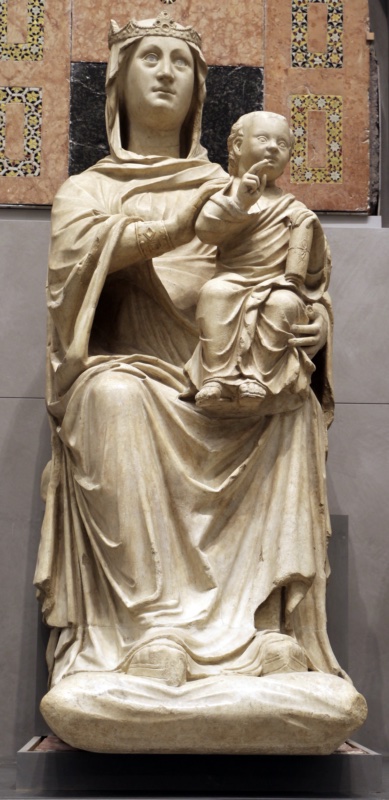
The work was part of the grand sculptural cycle on the Arnolfi façade of the Duomo, designed to narrate the story of the Virgin Mary, the church’s patron saint, and to emphasize the centrality of the Marian tradition in Florentine civic ideology. Situated in a commanding position above the main portal, the Madonna was conceived to be viewed “from below” by the faithful in the square, with proportions and volumes designed to be clearly visible from a certain distance. When Arnolfini’s façade was demolished (1587), the sculpture was moved inside the Duomo and then, during the Baroque-Counter-Reformation period, transferred to the museum, where it also became the object of miraculous devotion.
The group is a Maestà on the throne: the Virgin is seated on a monumental throne, with the Infant Jesus seated on her lap, in a configuration reminiscent of the “Regina coeli” tradition and the Byzantine-Apulian iconographic type. The Madonna faces forward, her gaze sweeping the space before her, and occupies the center of the compositional axis, while the Child is positioned higher than her body, almost as a sculptural “second plane,” accentuating the hierarchical and theological significance of the pair. Originally, Saint Reparata and Saint Zanobi, co-patrons of Florence, were placed on either side, along with adoring angels and curtain-holding angels raising a drape, evoking theatrical liturgy and processions.
Arnolfo depicts Mary as a queen of the early 14th century, that is, with clothing and a demeanor that blend ceremonial solemnity and human warmth. The Virgin is wrapped in a long cloak and a richly decorated sleeved robe, which Arnolfo renders through incisions and subtle modeling of the marble, suggesting broad folds and internal volumes without descending into late-Gothic naturalistic realism. The body is massive, with a bull-like neck, a round face, full breasts, and a belly still slightly swollen, alluding to the recent Incarnation and physical motherhood: this “heavy” and carnal physicality, typical of Arnolfo’s late style, serves as a bridge between Pisan-classical monumentality and Gothic humanization.
The Virgin’s head is veiled and crowned with a royal crown, which underscores her role as Queen of Heaven but also as patroness of Florence. The face is of great expressive sobriety: the lines are broad, the eyebrows barely hinted at, the lips shaped with a slight smile, conveying serenity and benevolence rather than drama or intimacy. The most famous technical and iconic feature is the insertion of glass paste (or stained glass) into the eye sockets, which made the eyes remarkably vivid and luminous, especially in outdoor sunlight, creating an almost “liquid” and intensely engaging effect. This technique, worthy of a precious tradition of miniature painting and statuary, aimed to give the Virgin a gaze that “anticipates” and welcomes the visitor, making the sacred image credibly present and interactive.
The Christ Child is presented not as a tender infant, but as a small Roman legislator seated on a throne, with a posture that reinforces the “civil” and legal significance of his figure. He sits on his mother’s lap, gazing directly at the observer, while in his left hand he holds a scroll of the law and with his right he makes the gesture of blessing, a classic motif in Italian sculpture of the 14th and 15th centuries. This iconographic choice links the group to the tradition of Norman-Apulian Maestà and to the Roman repertoire, where Christ the Lawgiver is a symbol of spiritual and civilizing power, and not merely of mystical tenderness.
Arnolfo does not carve the marble “on the surface” but constructs the volumes with a very strong plastic synthesis, favoring the continuity of the masses and the interplay of solids and voids rather than minute detail. The figure of the Virgin is “heavy” and inscribed within an almost obelisk-like block, but within this block Arnolfo introduces hints of torsion in the torso, variations in the depth of the folds, and passages of light that suggest a body that breathes and physically rests upon the throne. Even the shod foot, resting on a cushion or pulvino, is rendered with a certain attention to fashionable detail (a shoe typical of northern Italy in the early 14th century), while remaining within a severe, non-anecdotal stylistic register.
Behind the Virgin, the throne’s back panel remains visible, decorated with mosaic-style marble inlays in which light and dark marble tiles alternate in star motifs; this is a clear reference to the Marian title Stella Maris (“Star of the Sea”), which presents the Madonna as a guide for the faithful, just as the stars guide sailors. The repeated, geometric star motif introduces a cosmic and celestial order around the figure of the Virgin, emphasizing her role as mediator between earth and heaven, without, however, imposing excessive decorative elaboration that would distract from the monumental character of the whole.
The work is carved from white marble (likely Apuan marble) and measures 174 cm in height, 71 cm in width, and 94 cm in depth, thus presenting itself as an image of great presence, yet still compatible with a tympanum niche or relief. The presence of glass eyes, combined with the solid, almost “architectural” rendering of the body, lends the Virgin an intense vitality: the marble is “humanized” by a textural detail that simulates the effect of a real gaze, while the volumetric monumentality evokes the grandeur of a sacred image intended for a public space.
Dormitio Virginis
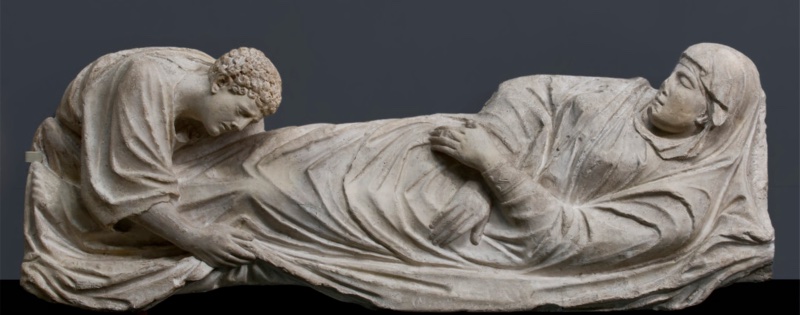
At the center of the relief, the Virgin Mary lies on a funeral bier, veiled, her serene face evoking a peaceful sleep rather than death, her arms crossed over her chest in the typical pose of Christian mourners. At her feet, a young apostle—identified as Saint John—bends dramatically to embrace her legs, with curly hair and a composed yet intense gesture of mourning, creating an emotional contrast with the Mother’s tranquility. In the foreground, a mature apostle, bearded and with long hair, advances, leaning his body forward, his bewildered gaze turned outward, while in the background two apostolic figures—one elderly and bearded—express mourning with heartbroken poses, despite the gaps.
Among the authentic pieces on display in Florence, the hieratic head of Christ welcoming Mary’s “animula”—depicted as an infant in his arms, a symbol of the childlike soul welcomed into Paradise—and the fragment of the grieving Saint Andrew, approximately 118 cm tall, reacquired in 2015 from a private Florentine collection, stand out. This iconography of the Dormitio Virginis, rooted in Eastern apocryphal legends, concludes the Marian cycle of Arnolfini’s façade, an alternative to the bodily Assumption, which became dogma only in the 20th century. The sculptures, removed in 1587 due to the demolition of the medieval façade, were scattered, but the group retains a trompe-l’œil effect thanks to its limited yet volumetric depth, designed for viewing from below.
Arnolfo di Cambio and his workshop imbue the work with extraordinary naturalism combined with psychological expressionism, featuring simplified yet deeply plastic forms: St. John recalls Hellenistic sculpture in the treatment of the head and hair, while the facial expressions capture pain, bewilderment, and solemnity. Measuring approximately 60x177 cm for the main section, the bas-relief employs high relief to accentuate the drama, integrating itself into the Cathedral’s devotional program dedicated to its titular Virgin. This makes the Dormitio a pinnacle of Florentine Gothic sculpture, a precursor to 14th-century realism.