Maestro di Rosano
( 25% )
The artist known to modern scholarship as the Maestro di Rosano stands as one of the most enigmatic and historically significant figures in the panorama of early medieval Italian panel painting. He is identified solely through his masterwork — the Croce dipinta con storie della Passione preserved in the Benedictine monastery of Santa Maria a Rosano, near Rignano sull’Arno in the province of Florence — a work that predates the famous Cross of Sarzana by several years and thus occupies a foundational position in the evolution of Tuscan Romanesque pictorial art.
Date and Place of Birth
The Maestro di Rosano, as is consistent with the overwhelming majority of anonymous medieval craftsmen, left behind no documentary evidence regarding the circumstances or location of his birth. Scholarly analysis of the stylistic properties and technical characteristics of the Croce dipinta has led modern art historians, including those at the Opificio delle Pietre Dure in Florence who conducted the landmark restoration of 2006, to hypothesize that the artist hailed from the southeastern quadrant of Tuscany, with Arezzo and its surrounding territory representing the most plausible point of origin. Given that the commission is firmly associated with events dateable to March 25, 1130, the artist must have been professionally active no later than the late 1120s, implying a birth date tentatively placed in the final decade of the eleventh century, approximately between 1085 and 1095.
Family and Social Origins
The social matrix from which the Maestro di Rosano emerged cannot be traced through documentary records, as the anonymity that defines his historiographical identity extends to all aspects of his personal and familial life. In the cultural context of twelfth-century Tuscany, painters of panel works occupied an ambiguous social position: they were artisans governed by the conventions of craft guilds and workshop hierarchies, yet their labour was increasingly recognized as a form of intellectual and spiritual service, particularly when it served the devotional needs of powerful monastic communities.
The term maestro, as employed in medieval Italian usage, denoted not merely technical proficiency but also a degree of social authority within the artisan class, implying that the Maestro di Rosano had achieved a recognized status within his professional milieu. It is reasonable to suppose, following the conventions of the period, that the artist acquired his training within a family workshop, as the transmission of craft knowledge in the central Middle Ages was primarily dynastic in character, passing from father to son or from master to apprentice within kinship networks. The pictorial technique revealed by the 2006 restoration — particularly the unusual use of vegetable gum rather than animal glue to bind the fine gesso ground — suggests a highly individualized workshop tradition that may have been inherited from a specific regional lineage of craftsmen. The application of colour in thin, miniature-like strata, a technique that presupposes rigorous workshop training in multiple media simultaneously, further implies that the artist was formed in an environment that cultivated cross-disciplinary expertise in both panel painting and manuscript illumination.
The absence of Byzantine formal conventions in the Croce dipinta constitutes one of the most historically significant features of the work and may suggest that the artist’s family workshop operated within a distinctly Western, Romanesque cultural orbit, oriented more toward Rome and the Carolingian artistic inheritance than toward the Greek monastic traditions prevalent elsewhere in Tuscany at this time. The geographic zone of southeastern Tuscany, and Arezzo in particular, maintained close artistic and ecclesiastical ties with Rome throughout the eleventh and early twelfth centuries, and a craftsman formation in that environment would naturally have produced an artist with the Roman-inflected sensibility evident in the Rosano cross. Should the artist have been Aretine, his family would have lived in a city that was among the most culturally dynamic in central Italy during the Gregorian reform period, a context in which the patronage of major religious institutions generated sustained demand for skilled craftsmen capable of working in stone, fresco, and panel painting simultaneously. The workshop tradition from which the Maestro di Rosano drew his technical formation appears to have been both conservative in its iconographic grammar and innovative in its material choices, a combination that suggests an environment of intellectual independence and technical experimentation, possibly sustained by a learned family context in close dialogue with the monastic schools of the region.
Patronage
The primary and, in all likelihood, the sole documented patron associated with the surviving work of the Maestro di Rosano is the Benedictine monastery of Santa Maria a Rosano, an institution whose fortunes in the twelfth century were inseparably intertwined with the powerful feudal dynasty of the Conti Guidi. The Conti Guidi, one of the most influential comital families of medieval Tuscany, had consolidated their patronal relationship with the monastery of Rosano in the year 1040, when the establishment formally became an allodial possession of the Guidi counts, an event that transformed the abbey into a dynastic sanctuary as much as a place of purely religious observance.
The immediate occasion for the commission of the Croce dipinta appears to have been the convergence of several momentous events on March 25, 1130: the consecration of a young noblewoman named Sofia Guidi as a Benedictine nun, the concurrent consecration of the newly completed church of the monastery, and a generous patrimonial donation by the Guidi family in honour of these occasions. Sofia was the daughter of Guido Guerra of the Guidi counts, a crusader knight who had undertaken the perilous journey to the Holy Land and died there from illness, his body never returned to Tuscany.
The commission of the cross may thus be understood not only as a pious gift to the monastic community but as an ex-voto and memorial offering for a warrior-pilgrim who perished far from his homeland, a theologically charged function that illuminates the choice of the Christus Triumphans iconographic model, with its emphasis on the victory of Christ over death. During the 2006 restoration conducted by the Opificio delle Pietre Dure, conservators discovered within the cavity of the vertical arm of the cross a relic consisting of a fragment of bone and a small stone cross of the type called an encolpion, customarily brought back from the Holy Land by Crusading pilgrims as sacred relics and votive objects.
This discovery strongly corroborates the hypothesis that Guido Guerra himself, or a fellow crusader acting on his behalf, transported these sacred objects from Palestine to Tuscany, where they were incorporated into the painted cross as physical relics connecting the devotional image to the holy geography of Jerusalem. The broader political context of the Guidi family’s patronage must also be considered: Count Guido Guerra, father of Sofia, was a close political ally of the Countess Matilda of Canossa, the most powerful secular ruler in central Italy during the late eleventh century and a figure of immense cultural and religious significance in the Gregorian reform movement. Matilda’s circle was deeply invested in the production and patronage of sacred art as an instrument of piety, dynastic legitimacy, and ecclesiastical alliance, and the commission of the Rosano cross should be situated within this broader political-religious economy of aristocratic patronage.
The relationship between the Guidi family and the monastery continued to evolve after the commission of the cross: in 1143, Florentine forces sacked the monastery during the military conflicts between the commune and the Guidi counts, and in 1147, the same family funded its reconstruction, demonstrating the persistent investment of the comital dynasty in the symbolic and spiritual capital represented by their patronage of Rosano.
The abbess who presided over the monastery immediately prior to the commissioning of the cross was Berta, herself a daughter of Count Guido and therefore a blood relative of Guido Guerra, a circumstance that underscores the degree to which the institution had become a dynastic sanctuary in which the spiritual and temporal interests of the Guidi family were continuously and deliberately intertwined.
Abbess Berta had herself initiated the ambitious construction of a larger church — the very building that was consecrated on March 25, 1130, though she died in 1129, a year before its completion — and her abbatiate represents a period of extraordinary investment in the architectural and artistic enrichment of the monastery. The decision to commission a large-format painted cross for the newly consecrated church reflects the ambitions of a community that sought to position itself among the most artistically distinguished Benedictine establishments of Tuscany, aspirations fully consonant with the broader cultural programme of the Guidi family, whose patronage extended to several of the region’s most important ecclesiastical foundations.
The commission awarded to the Maestro di Rosano was thus a high-prestige undertaking, entrusted to a craftsman of demonstrable accomplishment whose ability to produce a monumental devotional image of the requisite iconographic complexity and technical refinement was beyond question. The Croce dipinta was conceived as the visual and devotional centrepiece of the new church’s presbytery, placed at the terminus of the main nave where it would have been immediately visible to the assembled community during the celebration of the Divine Office and the Mass. This liturgical function determined many of the work’s formal properties: the large scale of the central figure of Christ, the hieratic frontality of the Christus Triumphans pose, and the narrative economy of the surrounding Passion scenes all served the needs of a community engaged in regular contemplative encounter with the image.
Painting Style
The pictorial language of the Maestro di Rosano is remarkable, above all, for its programmatic departure from the Byzantine formal conventions that dominated much of Tuscan panel painting in the twelfth century, a departure so thoroughgoing and self-consistent as to suggest not merely a stylistic preference but a consciously formulated aesthetic and theological programme. Where Byzantine-influenced crosses of the period typically rendered the body of Christ with a highly schematized, almost dematerialized elegance derived from the conventions of Constantinopolitan icon painting, the Rosano Master chose to engage with the figural tradition of Western Romanesque sculpture and manuscript illumination, producing a Christ whose physical presence is defined by volume, weight, and a carefully observed anatomical structure.
The figure of Christ occupies the centre of the cross-shaped panel, nude save for a blue loincloth with gilded decorations (perizoma), and is depicted with open eyes gazing directly and serenely at the viewer, according to the Christus Triumphans iconographic formula that presents the crucified Christ not as a suffering victim but as the triumphant King of Glory, reigning from the Cross over death and the cosmos. This iconographic choice carries profound theological significance: the Christus Triumphans, derived ultimately from Carolingian ivory carvings and widely diffused in the artistic culture of central Italy during the eleventh and twelfth centuries, communicates the doctrine of redemption through a register of sovereign dignity rather than pathos, a formal decision entirely appropriate to the dynastic and devotional context of the Guidi commission.
The face of Christ is rendered with an unusual degree of psychological animation: the slightly inclined head, the dark hair falling in careful locks upon the shoulders, the large gilded halo that crowns the composition, and the calm yet searching gaze directed at the faithful all create an image of extraordinary devotional authority. The body is modelled with a subtle but unmistakable use of chiaroscuro, particularly evident in the treatment of the legs, where contrasting light and shadow create a suggestion of three-dimensional volume that is entirely foreign to the flat, ornamental approach characteristic of Byzantine workshop practice.
The ochre-toned incarnate of Christ is rendered with deliberate restraint, rising from a warm base tone through carefully graduated shadows toward lighter highlights, a technique whose disciplined economy recalls the miniaturist tradition more than the broad, confident modelling of contemporary Romanesque fresco painting. The triptych of colours dominant in the narrative scenes — brilliant blues, deep reds, and vivid greens set against a lustrous gold ground — creates a chromatic ensemble of exceptional richness and internal coherence, demonstrating a mastery of pigment selection and layering that situates the Maestro di Rosano at the highest level of early twelfth-century Italian panel painting.
The gold ground itself, achieved through a doratura a guazzo process notably lacking the usual preparatory layer of bole, is one of the most technically distinctive features of the work: the absence of bole imparts a cooler, paler quality to the gold surface, subtly different in luminosity and tone from the gilding practices of both Byzantine and contemporary Western workshops. Within the tabellone — the rectangular field surrounding the central figure — the artist arranged six narrative scenes with a compositional clarity that reflects a sophisticated understanding of hierarchical pictorial space: four scenes devoted to events following the death of Christ (three funerary scenes and one depicting the Limbo, the realm of the patriarchs awaiting resurrection) and two depicting the Passion narrative itself, with flanking figures of Saints occupying the terminals of the horizontal arms.
The overall structural composition of the cross is governed by a strict bilateral symmetry, with the body of Christ aligned on the central vertical axis and the flanking figures and narrative scenes arranged in mirroring correspondence on either side. This formal symmetry is not merely decorative but theological: it embodies the ordered, hierarchical vision of the cosmos as understood within the Benedictine intellectual tradition, in which the crucified Christ constitutes the literal and symbolic centre of all created reality.
The compositional sophistication of the Croce dipinta is also apparent in the management of spatial depth within the narrative panels: while the figures move against an emphatically flat gold ground, the artist introduced modest architectural and environmental details that create a minimum of spatial recession without undermining the essential surface unity of the image. The Christus Triumphans iconographic type, as deployed by the Rosano Master, occupies a pivotal position in the history of Italian panel painting: it precedes the great thirteenth-century elaborations of this formula by Bonaventura Berlinghieri, Coppo di Marcovaldo, and Cimabue, and the Rosano cross constitutes one of the earliest and most fully realized examples of this tradition in existence. The technical examination conducted during the 2006 restoration by Roberto Bellucci and Cecilia Frosinini of the Opificio delle Pietre Dure revealed that the painted surface retains its original varnish layer almost entirely intact, an extraordinary circumstance attributable to the absence of any prior restoration intervention, which makes the Rosano cross one of the best-preserved early medieval panel paintings in Europe.
Artistic Influences
The figural style of the Maestro di Rosano has been variously interpreted by scholars, but the consensus that has emerged from the scholarly debates following the 2006 restoration situates the artist’s formation within the artistic environment of southeastern Tuscany, with particular attention to the cultural milieu of Arezzo and its connections to the broader Roman artistic and intellectual tradition.
The Roman dimension of the artist’s formation is visible above all in the Romanesque quality of the Christ figure: the treatment of the body as a physically coherent, volumetrically plausible entity, even when schematized, reflects the inheritance of the Carolingian and Ottonian figurative traditions as mediated through the workshops of Rome and Lazio during the eleventh century. The influence of Carolingian ivory carving on the Christus Triumphans iconography is well-established in the scholarly literature, and the Rosano Master’s adoption of this formula suggests familiarity with the carved ivory diptychs and reliquary panels that circulated in the ecclesiastical treasuries of central Italy as objects of both devotion and artistic prestige.
The cross-fertilization between panel painting and manuscript illumination is one of the most striking formal characteristics of the Croce dipinta: the application of colour in extremely thin, translucent layers, the precise linearity of the figure outlines, and the miniaturistic attention to decorative detail in the loincloth all point to an artist thoroughly conversant with the techniques of book illumination, a tradition that in early twelfth-century Tuscany was still largely cultivated within monastic scriptoria. The Aretine connection hypothesized by scholars would explain the artist’s combination of Romanesque sculptural sensibility — evident in the plastic treatment of Christ’s body — with the refined, precious technique of the miniaturist: Arezzo was a center where multiple craft traditions intersected under the aegis of powerful ecclesiastical patronage, and the workshops associated with its cathedral and major abbeys would naturally have produced craftsmen capable of operating across several media simultaneously.
It is also significant that the Croce dipinta displays no formal debt to the Byzantine workshop tradition so prominent in Pisa and Lucca during the same period: the contrast with the slightly later Croce di Sarzana (1138), attributed to Guglielmo, is instructive, as the Sarzana cross deploys a much more conspicuously Byzantinizing formal vocabulary, with schematized facial features, calligraphic line, and a dematerialized physicality entirely foreign to the Rosano Master’s approach. The absence of Byzantine influence in the Croce dipinta thus aligns the Rosano Master with the more Western, proto-Romanesque current of central Italian painting, a tradition that drew more directly on the sculptural and fresco-painting production of Rome than on the imported formal conventions of the Greek East.
The pictorial aesthetic of the Rosano cross anticipates by several decades certain formal innovations — particularly the use of subtle chiaroscuro to suggest bodily volume and the integration of narrative scenes within a monumental liturgical image — that would later be fully developed in the great painted crosses of the thirteenth century; in this respect, the Maestro di Rosano deserves recognition as an early protagonist in the long trajectory that leads toward the pictorial revolution of Cimabue and Giotto. The influence of Matilda of Canossa’s court culture and its patronage of religious art should also be considered as a formative force in the artist’s intellectual environment: the Canossian milieu was deeply invested in the production of liturgical art as an instrument of the Gregorian reform programme, and the theological clarity and devotional authority of the Croce dipinta reflect values entirely consonant with this reformed, Western-orientated religious culture. The cross also shows awareness of the contemporaneous tradition of Anglo-Norman Romanesque art, particularly in its handling of drapery and in certain details of the narrative scenes, which suggests that the artist may have had direct or indirect contact with the trans-Alpine artistic currents that flowed into central Italy through the pilgrimage routes and monastic networks of the Via Francigena.
Travels
The travels of the Maestro di Rosano, like every aspect of his personal biography, cannot be reconstructed from documentary sources, and any account of his movements must be understood as scholarly inference based on the stylistic and technical evidence preserved in the Croce dipinta. The most compelling hypothesis advanced by recent scholarship situates the artist’s primary geographical orbit within the triangle formed by Arezzo, Florence, and the upper Valdarno, a zone that encompassed some of the most important Benedictine and Camaldolese monasteries of Tuscany and that generated sustained demand for skilled craftsmen capable of producing high-quality liturgical art.
The journey from his presumed place of origin in southeastern Tuscany to the monastery of Rosano, which lies on the left bank of the Arno at the southern edge of the Pratomagno massif, would have been a relatively manageable undertaking along the ancient road network of the Valdarno, and it is plausible that the artist had previously executed commissions for other religious establishments in the same valley before receiving the prestigious Guidi commission. The Roman connection hypothesized by scholars raises the possibility that the Maestro di Rosano undertook, at some point in his formation, a journey to the city of Rome, where the basilical decoration of the major pilgrimage churches — San Clemente, Santa Maria in Trastevere, San Paolo fuori le Mura — provided unrivalled models of large-scale religious painting in the Western Romanesque tradition.
The presence of the crusader’s encolpion and bone relic within the cavity of the cross introduces a further dimension of possible mobility: while there is no direct evidence that the artist himself travelled to the Holy Land, the discovery of these objects implies that he was working within a devotional culture deeply shaped by the experience and aftermath of the First Crusade, and that he may have had personal contact with returning crusaders who brought not only relics but also visual impressions of the sacred geography and artistic traditions of the Christian East.
The monastery of Santa Maria a Rosano, as a Benedictine community in the orbit of the Guidi family, would have maintained active connections with the wider Benedictine world through the regular movement of monks, manuscripts, and liturgical objects between affiliated houses, and an artist working under Guidi patronage in the 1120s would inevitably have been exposed to the artistic models circulating within this transnational monastic network. The proximity of Rosano to Florence, situated approximately fifteen kilometres to the southeast of the city centre, raises the question of whether the artist had knowledge of the artistic developments underway in Florence itself during the early twelfth century, including the ongoing construction and decoration of San Miniato al Monte, the great Benedictine basilica that stands as the most architecturally refined Romanesque monument of Florentine religious culture.
The structural parallels between the crypt of the monastery of Rosano and that of San Miniato al Monte, noted in the scholarly literature, suggest close institutional and perhaps artistic ties between the two establishments, and it is not unreasonable to hypothesize that the Maestro di Rosano was familiar with the marble inlay decoration and the sculptural programme of San Miniato, both of which exemplify the same Roman-inflected Romanesque aesthetic visible in his own painted work. The possibility that the artist also travelled within the broader zone of central Italian Romanesque culture — including Umbria, Lazio, and the March of Spoleto, all regions where the Western Romanesque figural tradition was vigorously cultivated in the early twelfth century — is supported by the eclecticism and synthesis visible in his technique, which draws on sources too diverse to have been encountered within the confines of a single regional workshop. Whatever the precise itinerary of his travels, the Maestro di Rosano demonstrates, through the formal and technical evidence of his single surviving work, the capacity to absorb, synthesize, and transcend multiple artistic traditions, a capacity that implies not only exceptional natural talent but also the broad cultural horizon that only sustained travel and intellectual exchange could have produced.
Date and Cause of Death
As with the date and circumstances of his birth, the death of the Maestro di Rosano is entirely undocumented and can only be approached through inferential reasoning. The Croce dipinta of Rosano is the sole surviving work attributable to this master, and no further commissions, documentary references, or attributions connect him to any subsequent artistic enterprise. The absence of further activity in the record may suggest that the artist completed his career in the years immediately following the execution of the Rosano cross, with his death plausibly occurring in the second or third decade of the twelfth century. Given the biographical parameters sketched by the stylistic evidence — an artist born approximately between 1085 and 1095 and professionally active by the late 1120s — a death sometime between 1140 and 1160 would be consistent with a normal lifespan for the period. The cause of death, in the complete absence of any documentary record, is entirely unknown, though the epidemiological and demographic conditions of twelfth-century rural Tuscany would suggest the customary range of infectious diseases, endemic fevers, and occupational hazards attendant upon a life of craft production. It is impossible, on the available evidence, to determine whether the artist died peacefully within his own workshop or perished in the violent disruptions — including the Florentine sack of the monastery of Rosano in 1143 — that afflicted the Valdarno during the first half of the twelfth century.
Principal Works
Painted Cross with Passion Scenes
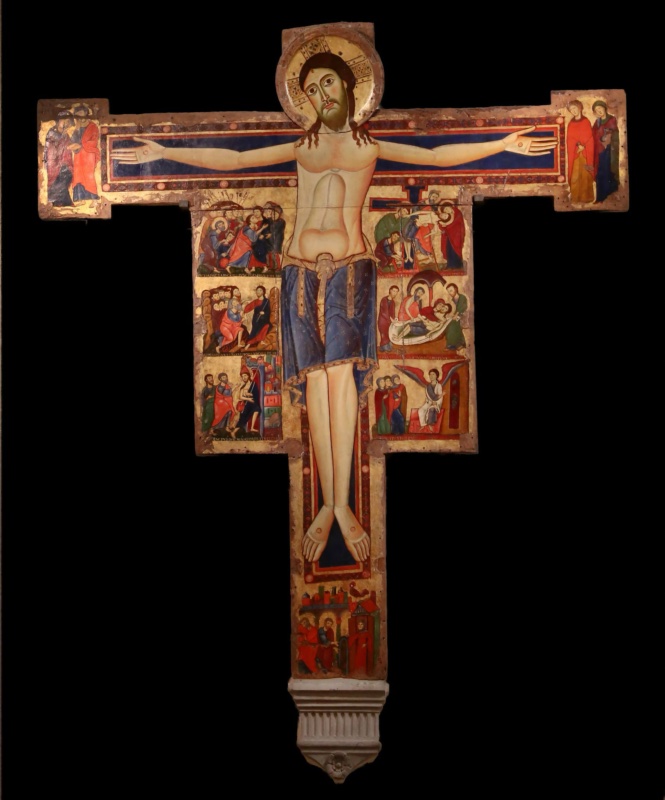
This monumental shaped cross, executed in tempera and gilding on robust panels of chestnut wood with an extraordinary breadth of formal invention and technical refinement, constitutes not only the sole surviving work attributable to the Maestro di Rosano but also one of the earliest and most significant examples of Tuscan panel painting in existence, antedating the Cross of Sarzana — long regarded as the oldest Italian painted cross — by approximately eight years. The work was commissioned almost certainly in connection with the events of March 25, 1130: the consecration of the young Sofia Guidi as a Benedictine nun at the monastery of Rosano, the consecration of the newly completed church of the same establishment, and a major patrimonial donation by the Conti Guidi family in memory of Guido Guerra, Sofia’s father, who had died in the Holy Land during the First Crusade. The cross was thus simultaneously a commemorative offering for a fallen crusader, a dynastic votive image, and a liturgical furnishing for a newly consecrated Benedictine church — a convergence of devotional, political, and institutional functions entirely characteristic of the culture of comital patronage in twelfth-century Tuscany.
The iconographic programme of the cross is organized around the central figure of Christ rendered according to the Christus Triumphans formula: nude except for a blue loincloth adorned with gilded decorations (perizoma), the body of Christ is depicted with open, serenely gazing eyes and a slightly inclined head from which dark hair falls in careful locks upon the shoulders, the whole crowned by a large gilded halo that communicates the royal dignity and eschatological authority of the crucified Redeemer. The choice of the Christus Triumphans iconography is theologically precise and liturgically appropriate: at a moment when the monastery had just welcomed a young noblewoman of distinguished lineage into the religious life, and when the community was also mourning the death of her crusading father, the image of Christ triumphant over death offered both consolation and theological reassurance, situating the personal sacrifices of the Guidi family within the broader economy of Christian redemption.
Within the tabellone surrounding the central figure, the artist arranged six narrative scenes with exemplary compositional clarity and narrative economy. Four of these scenes illustrate events following the death of Christ: three represent funerary episodes — the Descent from the Cross (Deposizione), the Lamentation over the dead Christ (Compianto), and the Entombment (Sepoltura) — while the fourth depicts Christ’s descent into Limbo (Discesa al Limbo), the underworld realm of the Hebrew patriarchs awaiting resurrection, a subject of profound theological significance in the context of a cross functioning simultaneously as memorial for the recently deceased. The remaining two scenes depict episodes from the Passion narrative itself, completing an iconographic cycle that encompasses the full arc of Christ’s suffering, death, and ultimate triumph over death. The figures in these narrative scenes are disposed against the luminous gold ground with an attention to gestural clarity and emotional communication that, while still operating within the conventions of Romanesque schematization, demonstrates a capacity for expressive naturalism that would not be surpassed in Tuscan panel painting until the great innovations of Cimabue a century later.
The terminals of the horizontal arms of the cross bear representations of four Saints, whose identities have been partially obscured by the modifications made to the cross in the seventeenth century, when the titulus crucis bearing the inscription INRI and the upper narrative field were excised in order to adapt the work to a new liturgical setting, and a gilded frame was added that significantly altered the original visual format of the composition. The technical examination carried out during the 2006 restoration by Cecilia Frosinini and Roberto Bellucci of the Opificio delle Pietre Dure revealed a sequence of preparatory layers of unusual sophistication and material originality: the chestnut wood panels were covered with a double layer of very fine fabric, over which multiple coats of extremely fine gesso bound with vegetable gum — rather than the animal glue standard in contemporary workshop practice — were applied to create a surface of exceptional smoothness and receptivity. The gold was applied by a doratura a guazzo technique without the usual preparatory bole, imparting to the gilded ground a distinctive cooler luminosity that sets the Rosano cross apart from all comparable works of the period and constitutes one of the most original technical contributions of the Maestro di Rosano to the history of Tuscan panel painting.
The discovery, made during the 2006 restoration, of a cavity within the lower vertical arm of the cross containing a fragment of bone and a small stone encolpion of the type commonly brought back from the Holy Land by Crusading pilgrims is among the most historically significant material findings associated with this work. This discovery provides direct physical evidence for the interpretation of the cross as an ex-voto commissioned in memory of Guido Guerra dei Conti Guidi, whose death in Palestine is recorded in the documentary sources associated with the monastery, and confirms that the painted cross was conceived from the outset as a reliquary as well as a devotional image — a dual function consistent with the broader liturgical and devotional culture of the early Crusading period. The Croce dipinta of Rosano remains today in the presbytery of the monastery church of Santa Maria a Rosano, where it was placed following the landmark restoration of 2006, in a conservation environment that ensures the long-term preservation of a work of incalculable importance for the understanding of the origins of Italian panel painting and the religious culture of twelfth-century Tuscany. The principal scholarly publications arising from the 2006 restoration — La Croce dipinta dell’Abbazia di Rosano: Visibile e invisibile, edited by Marco Ciatti, Cecilia Frosinini, and Roberto Bellucci (Florence, 2007), and Pittura su Tavola del Secolo XII: Riconsiderazioni e Nuove Acquisizioni a seguito del restauro della Croce di Rosano, edited by Cecilia Frosinini, Alessio Monciatti, and Gerhard Wolf (Florence, 2012) — have established the Rosano cross as one of the most intensively studied and richly documented works of early medieval Italian art, and the scholarship generated by these volumes continues to shape the discipline’s understanding of the artistic culture of twelfth-century Tuscany.