Maestro Guglielmo
( 25% )
Maestro Guglielmo, also known as Guillielmus or Mastro Guglielmo, represents one of the most enigmatic yet significant figures in the history of twelfth-century Italian painting, whose identity remains shrouded in mystery despite the survival of his most celebrated work. The only secure documentation of his existence derives from a Latin inscription on the Sarzana Crucifix, which reads Anno milleno centeno ter quoque deno octavo pinxit Guillielmus et hec metra finxit, establishing 1138 as the date of the work’s execution and identifying its creator simply as “Guillielmus”. Neither the exact date nor place of his birth has been preserved in any surviving document, leaving scholars to speculate based on stylistic analysis and the technical sophistication evident in his work. The artist’s familiarity with Latin hexameter verse, demonstrated in both the inscription and the now-illegible captions accompanying the Passion narratives on the cross, suggests an ecclesiastical background and education unavailable to most laypeople of the period.
Art historian Marco Ciatti has proposed that Guglielmo was likely a religious figure working within a monastic workshop, where he would have had access to both the literary training necessary for composing Latin verse and the artistic instruction required for manuscript illumination and panel painting. This hypothesis gains support from the attribution to Guglielmo, on stylistic grounds, of several miniatures whose execution demonstrates the same technical proficiency and aesthetic sensibility visible in the Sarzana Cross.
The combination of literary erudition and artistic skill suggests that Guglielmo belonged to the educated monastic elite of Tuscany, where scriptoria and painting workshops flourished during the first half of the twelfth century. Regional analysis of his style has led scholars, beginning with Edward Garrison in 1953, to conclude that Guglielmo originated from the Lucca area, a hypothesis supported by the stylistic relationship between the Sarzana Cross and later painted crosses from Lucca. The absence of any further documentary evidence regarding his birth, training, or early career reflects the general scarcity of biographical information about artists working in this period, when individual artistic identity was only beginning to emerge from the anonymity of collective workshop production. Despite these uncertainties, the survival of his name on the Sarzana Cross represents a remarkable exception to the prevailing pattern of artistic anonymity in the early twelfth century. The fact that Guglielmo signed his work and composed its inscription in sophisticated Latin verse indicates an unusual degree of self-awareness and pride in authorship.
Family Origins and Background
No documentary evidence has survived regarding Maestro Guglielmo’s family origins, parentage, or genealogical connections, a situation typical for artists working in the early twelfth century when biographical documentation remained exceedingly rare. The absence of any patronymic or toponym in the Sarzana inscription suggests either that such identifiers were deemed unnecessary in the context of the work’s original commission, or that Guglielmo belonged to monastic orders where family ties were formally renounced. If Guglielmo was indeed a religious figure, as Marco Ciatti’s hypothesis proposes, his entry into monastic life would have occurred during childhood or adolescence, following patterns common throughout medieval Europe. Monastic recruitment typically drew from multiple social strata, ranging from aristocratic families seeking to establish religious connections to peasant families offering younger sons to the church.
The level of education evident in Guglielmo’s command of Latin versification suggests that his family, whether noble or bourgeois, possessed sufficient resources to provide preliminary instruction before his entry into religious life. Alternatively, his education may have been entirely monastic, acquired through years of study within the scriptorium and school of a major Tuscan monastery. The Lucchese origin proposed by scholars would place his family within one of Tuscany’s most prosperous and culturally vibrant regions, where commercial wealth supported both ecclesiastical institutions and artistic production. Without specific documentary evidence, speculation regarding his family’s socioeconomic status or their role in Lucchese society remains purely conjectural. The silence of the historical record may itself be significant, suggesting that Guglielmo’s family did not belong to the aristocratic or prominent mercantile classes whose genealogies were more frequently preserved. Whether he had siblings, what their occupations might have been, or how his family responded to his evident artistic achievements cannot be determined from surviving sources.
The cultural environment of early twelfth-century Lucca, however, can be partially reconstructed, providing context for understanding the milieu in which Guglielmo’s family would have lived. Lucca maintained strong commercial connections with other Italian cities and served as an important center of religious devotion and artistic production. Families in this region participated in networks of patronage that supported both ecclesiastical construction and the creation of liturgical furnishings. If Guglielmo’s family contributed to his initial training or facilitated his entry into a monastic community, they would have been participating in well-established patterns of social and religious investment.
The decision to dedicate a son to religious life often reflected family strategy, seeking spiritual merit while potentially advancing social connections through monastic affiliations. Guglielmo’s subsequent achievement in creating one of the most important painted crosses of the twelfth century would presumably have brought honor to his family, though no evidence survives of how they responded to his accomplishment. The relationship between artistic talent and family background in this period remains poorly understood, as the mechanisms of artistic training and the identification of promising students occurred largely within institutional contexts that left few records. Whether Guglielmo demonstrated early artistic ability that influenced his family’s decisions regarding his education, or whether his talents emerged only after entering monastic life, cannot be established. The intersection of family expectations, personal vocation, and institutional opportunity that shaped Guglielmo’s path toward becoming an accomplished painter and illuminator remains obscured by the passage of nearly nine centuries. This biographical lacuna reflects broader historiographical challenges in studying twelfth-century artistic production, when documentation focused on institutions and patrons rather than individual craftsmen.
Ecclesiastical and Secular Patronage
The patronage circumstances surrounding Maestro Guglielmo’s Sarzana Cross remain partially obscure, though recent scholarship has established probable connections to ecclesiastical institutions in the Lunigiana region during the second quarter of the twelfth century. Research by Piero Donati has convincingly argued that the cross was likely commissioned for the church of Sant’Andrea in Sarzana, which had been recently constructed and required appropriate liturgical furnishings, rather than for the cathedral of Luni, which was reportedly in significant decay by 1138. This hypothesis suggests that the patron was either the clergy of Sant’Andrea or, more likely, the bishop of the diocese of Luni-Sarzana, who would have had both the authority and financial resources to commission such an ambitious work.
The choice of the Christus Triumphans iconography, representing Christ victorious over death with open eyes and upright head, reflected theological emphases that resonated with ecclesiastical patrons seeking to communicate messages of redemption and divine sovereignty. The inclusion of extensive Passion narratives in the lateral panels of the cross demonstrates a sophisticated iconographic program that would have required patron input and approval, suggesting active collaboration between Guglielmo and his ecclesiastical commissioners. The substantial dimensions of the cross and the technical complexity of its execution indicate that the patron provided considerable financial support, enabling Guglielmo to work with high-quality materials and dedicate substantial time to the project.
The decision to include a lengthy Latin inscription in hexameter verse, composed by Guglielmo himself, suggests that the patron valued both artistic excellence and literary sophistication. This emphasis on learned display indicates a patron who participated in the intellectual culture of the reformed church and who sought to demonstrate erudition through commissioned artworks. Whether the patron specified particular iconographic elements or allowed Guglielmo considerable creative freedom remains unknown, though the complexity of the program suggests sustained dialogue during the design phase. The relationship between monastic workshops and episcopal patrons in twelfth-century Tuscany typically involved negotiation between artistic tradition, theological requirements, and patron preferences.
Beyond the Sarzana Cross, no other works have been securely attributed to Guglielmo through documentary evidence, though several miniatures have been proposed as his work based on stylistic analysis. These potential attributions raise questions about whether Guglielmo worked for multiple patrons throughout his career or maintained a sustained relationship with a single monastic institution. The Passionary P+ manuscript in the Capitular Library of Lucca, which Edward Garrison related to the Sarzana Cross in 1953, shares sufficient stylistic characteristics to suggest either direct authorship by Guglielmo or production within the same workshop. If this manuscript connection is valid, it would indicate that Guglielmo’s primary patron was likely a Lucchese ecclesiastical institution, possibly the cathedral chapter itself.
Manuscript illumination in this period typically occurred under the patronage of bishops, monasteries, or cathedral chapters who maintained scriptoria for producing liturgical books. The production of both manuscript illuminations and painted panels within the same workshop was not uncommon, as artists moved fluidly between these related media. Guglielmo’s apparent facility in both domains suggests that his patron or patrons valued versatility and employed him on diverse projects. The commissioning process for the Sarzana Cross would have involved preliminary discussions regarding iconography, dimensions, materials, and payment, though no contracts or financial records have survived. Payment may have taken various forms, including monetary compensation, gifts in kind, or, if Guglielmo was indeed a monk, contributions to his monastic community. The patron’s satisfaction with the completed work can be inferred from its prominent placement in Sant’Andrea and its subsequent preservation, though direct testimony does not exist.
The broader context of ecclesiastical patronage in twelfth-century Tuscany illuminates the circumstances under which Guglielmo likely worked. This period witnessed intensive church construction and renovation throughout the region, creating sustained demand for painted crosses, altarpieces, and manuscript illuminations. Bishops competed to beautify their cathedrals and associated churches, while monastic orders sought to establish their spiritual authority through artistic magnificence. The reform movements associated with the Gregorian Reform had emphasized the importance of proper liturgical practice and appropriate sacred furnishings. Guglielmo’s Sarzana Cross participated in this broader cultural movement, providing a focal point for devotion and a visual representation of theological doctrines.
The patron who commissioned this work was engaging in a widespread pattern of investment in sacred art that characterized the religious culture of the period. Whether this patron also commissioned other works from Guglielmo, creating a sustained relationship, or whether the Sarzana Cross represented a single commission, remains unknown. The absence of documented later works by Guglielmo may reflect either the artist’s death shortly after 1138, the loss of other works over subsequent centuries, or the failure of later generations to recognize his authorship. Patronage relationships in this period often remained undocumented unless disputes arose requiring legal intervention, and the typical pattern of collaboration between artist and patron left few traces in the historical record. The Sarzana Cross thus represents both an exceptional survival and a fragment of a larger pattern of artistic production that has been substantially lost. Understanding Guglielmo’s patrons requires extrapolating from this single documented commission to hypothesize about his broader career, a methodological challenge that affects all scholarship on early medieval artists.
Artistic Style and Technical Approach
Maestro Guglielmo’s painting style, as manifested in the Sarzana Cross, demonstrates a distinctive synthesis of Byzantine iconographic traditions and emerging Romanesque sensibilities characteristic of Tuscan painting in the first half of the twelfth century. The Christus Triumphans representation adheres to established Byzantine conventions in depicting Christ with open eyes, upright head, and a frontal posture that emphasizes divine sovereignty rather than human suffering. However, within this traditional framework, Guglielmo introduced elements that Italian art historian Piero Torriti has characterized as demonstrating “an expanded grandeur, a strong search for life and freedom of movement that seems to dissolve the rigid oriental forms”.
This interpretation suggests that Guglielmo was consciously working to adapt Byzantine models to new aesthetic preferences emerging in Italian painting. The recent restoration conducted by the Opificio delle Pietre Dure in Florence revealed that the visible figure of Christ represents a complete repainting executed approximately fifty years after the original 1138 date, complicating direct analysis of Guglielmo’s original style. X-ray examination has permitted partial reconstruction of the original appearance, revealing “more pronounced frontality of the head, the terribleness of the large wide-open eyes, the ‘camused’ structure of the nose,” features that closely resemble the mourning figures flanking Christ, which were not substantially altered in the later repainting. These characteristics indicate that Guglielmo’s original approach emphasized dramatic emotional intensity through exaggerated facial features, a technique consistent with Romanesque expressive tendencies. The body of Christ, according to the restoration findings, apparently differed little between the original and the repainting, suggesting that Guglielmo’s treatment of anatomical forms was already sufficiently refined to satisfy later aesthetic standards. The tempera technique employed on the wooden panel demonstrates mastery of traditional Byzantine painting methods, involving careful preparation of the wooden support, application of gesso ground, and successive layers of pigment.
The Passion narratives depicted in the lateral panels of the Sarzana Cross reveal additional dimensions of Guglielmo’s stylistic approach and his capacity for narrative composition. Art historian Miklós Boskovits, in comparing the Sarzana Cross with the earlier Rosano Cross, noted that Guglielmo demonstrated greater sophistication in arranging figures within compositional space, particularly in the Kiss of Judas panel where characters are positioned around Christ with increased naturalism. The Deposition scene likewise exhibits enhanced realism in depicting the removal of Christ’s body from the cross, suggesting that Guglielmo was attentive to spatial logic and narrative clarity. These compositional choices indicate that Guglielmo was responding to evolving demands for more accessible and emotionally engaging religious imagery.
The inscriptions accompanying each narrative panel, though now almost completely illegible, originally provided Latin verse captions that would have guided viewers’ understanding of the depicted scenes. This integration of text and image demonstrates Guglielmo’s comprehensive approach to artistic communication, combining visual and verbal elements to create multilayered devotional experiences. The calligraphic quality of the inscriptions themselves constitutes an additional artistic dimension, as the letterforms were carefully designed to harmonize with the painted imagery. The extensive use of gold leaf in the cross, typical of Byzantine-influenced panel painting, created luminous effects that would have been dramatically enhanced by candlelight in the church interior. Guglielmo’s handling of gold leaf required specialized technical knowledge, including proper preparation of the surface, application of adhesive bole, and burnishing to achieve brilliant reflective surfaces. The chromatic palette, dominated by rich blues, reds, and ochres against gold backgrounds, reflects the limited but intense range of pigments available to twelfth-century painters.
Guglielmo’s stylistic relationship to contemporary and near-contemporary painted crosses in Tuscany has been extensively analyzed by scholars seeking to position his work within broader regional developments. The later Lucchese crosses preserved in San Michele in Foro and the National Museum of Villa Guinigi share formal and stylistic characteristics with the Sarzana work, suggesting that Guglielmo’s innovations influenced subsequent local production. These later works demonstrate the dissemination of Guglielmo’s iconographic solutions and compositional strategies throughout the Lucca region during the second half of the twelfth century. The comparison with the Rosano Cross, though complicated by the absence of secure dating for that work, illuminates the trajectory of stylistic development in Tuscan cross painting during this period. Boskovits’s argument that the Rosano Cross may predate Guglielmo’s work rests on the observation that the Sarzana artist demonstrates more evolved spatial awareness and narrative sophistication.
This evolutionary model presumes a progressive development from more rigid, iconic representations toward increasingly naturalistic and emotionally expressive imagery. However, such linear developmental narratives have been questioned by recent scholarship that emphasizes the diversity of regional traditions and the coexistence of multiple stylistic approaches. Guglielmo’s style may reflect not universal evolutionary trends but specific choices shaped by his training, his patron’s preferences, and the devotional requirements of the Sarzana commission. The relationship between the Sarzana Cross and the Passionary P+ manuscript offers additional evidence for assessing Guglielmo’s artistic vocabulary. The similarities in facial types, drapery treatment, and figural proportions between the painted panels and the manuscript miniatures suggest a consistent artistic personality working across different media. The telamon figure in the Passionary exhibits the same charged facial expression and muscular tension visible in the flagellation scene on the cross, reinforcing the attribution.
The technical execution of the Sarzana Cross demonstrates sophisticated workshop practices that Guglielmo had mastered through extensive training. The wooden support, constructed from chestnut panels joined together, required careful selection and preparation to ensure structural stability. The application of canvas to the wooden surface before painting, a technique revealed during restoration, provided an additional layer that helped prevent paint separation and enhanced longevity. The gesso ground applied over the canvas created a smooth, brilliant white surface optimal for receiving pigments. Guglielmo’s command of tempera technique, involving the binding of pigments with egg yolk or other protein-based media, enabled him to achieve both transparent glazes and opaque passages. The successive layering of paint, applied with fine brushes in crosshatched strokes, created modeling effects that suggested three-dimensional form despite the fundamentally flat pictorial surface.
Byzantine painting tradition emphasized such technical discipline, requiring artists to follow established procedures refined over centuries of practice. Guglielmo’s adherence to these methods while introducing subtle innovations in composition and expression exemplifies the creative tension between tradition and innovation characteristic of this transitional period. The incorporation of decorative patterns in the borders and background areas demonstrates attention to ornamental detail that enhanced the cross’s visual richness. The overall effect combines hieratic majesty with emotional accessibility, creating a devotional object that could inspire both awe and personal identification. Guglielmo’s stylistic achievement in the Sarzana Cross lies not in revolutionary departure from established traditions but in the subtle refinement and humanization of inherited Byzantine models, a process that would be continued and amplified by later generations of Italian painters.
Artistic Influences and Cultural Context
The artistic formation of Maestro Guglielmo must be understood within the complex network of Byzantine, Romanesque, and emerging proto-Renaissance influences that characterized Tuscan painting during the first half of the twelfth century. The predominant influence evident in the Sarzana Cross derives from Byzantine icon painting traditions that had been transmitted to Italy through multiple channels, including imported works, traveling artists, and manuscript circulation. The Christus Triumphans iconography itself represents a specifically Byzantine theological and artistic conception, emphasizing Christ’s divinity and victory over death rather than his human suffering. This iconographic model had been developed in Constantinople and other Byzantine centers, where it served as a standard representation in monumental crosses and panel paintings.
Guglielmo’s adoption of this model indicates his participation in broader patterns of artistic exchange between the Byzantine East and the Latin West. However, the specific manner in which he interpreted this Byzantine prototype suggests exposure to intermediary Italian models rather than direct contact with Constantinople. The stylistic connections between the Sarzana Cross and the Passionary P+ manuscript in Lucca point toward a specifically Tuscan interpretive tradition that had domesticated Byzantine forms. Edward Garrison’s 1953 identification of these stylistic relationships established the foundation for understanding Guglielmo’s place within regional artistic networks. The Lucchese painting tradition in the early twelfth century maintained particularly strong connections to Byzantine aesthetics, possibly reflecting the city’s commercial relationships and the presence of Greek artists or works. Whether Guglielmo had direct access to Byzantine models through imported icons, ivories, or manuscripts, or whether his knowledge was mediated through Italian interpretations, cannot be definitively established. The technical procedures he employed, including tempera painting, gold leaf application, and the structural organization of the cross format, all derive from Byzantine workshop practices that had been adopted throughout Italy.
Beyond Byzantine influences, Guglielmo’s work reveals engagement with emerging Romanesque artistic sensibilities that were transforming European art during this period. The emotional intensity visible in the facial expressions of the mourning figures and the narrative dynamism of the Passion scenes reflect Romanesque emphasis on affective engagement and visual storytelling. These characteristics distinguish Guglielmo’s approach from the more austere and hieratic quality typical of purely Byzantine works. The integration of multiple narrative panels into the cross structure demonstrates an interest in didactic communication that aligns with Romanesque concerns for making religious stories accessible to lay viewers. This narrative emphasis may have been reinforced by exposure to Romanesque sculptural programs being developed contemporaneously in Tuscan churches and baptisteries.
The sculptor Guglielmo, active at Pisa Cathedral during the same period, created elaborate narrative reliefs on pulpits that shared formal characteristics with painted narratives. Whether the painter Guglielmo was aware of his sculptor namesake’s innovations cannot be proven, but both artists participated in a broader Tuscan artistic culture that valued narrative complexity and expressive intensity. The influence of manuscript illumination on Guglielmo’s panel painting represents another crucial dimension of his artistic formation. If Marco Ciatti’s hypothesis regarding Guglielmo’s monastic background is correct, he would have been trained first as an illuminator, later applying skills developed in manuscript production to the larger format of panel painting. The miniature paintings in the Passionary P+ exhibit compositional strategies and figure types closely related to those in the Sarzana Cross, suggesting that Guglielmo moved fluidly between these scales and contexts. Manuscript illumination in this period maintained particularly strong connections to Byzantine models, as Italian scriptoria regularly consulted Greek manuscripts for iconographic and stylistic guidance.
The cultural context of ecclesiastical reform movements in twelfth-century Italy significantly influenced the artistic environment in which Guglielmo worked. The Gregorian Reform, which had dramatically reshaped church governance and liturgical practice during the late eleventh century, continued to affect artistic patronage and iconographic choices into Guglielmo’s generation. Reformed ecclesiastics emphasized proper liturgical furnishing and the educational function of sacred art in communicating doctrinal truths to lay believers. These priorities encouraged the production of works like the Sarzana Cross, which combined traditional iconographic authority with narrative accessibility. Guglielmo’s inclusion of extensive Latin inscriptions reflects the reformed church’s emphasis on textual authority and learned interpretation.
The intellectual climate of early twelfth-century Tuscany, characterized by renewed interest in classical learning and theological scholarship, provided context for appreciating Guglielmo’s integration of visual and verbal expression. His composition of hexameter verses demonstrates participation in the literary culture of the cathedral schools and monastic communities where Latin poetry was cultivated. This intersection of visual and literary artistry positions Guglielmo within networks of learned production that extended beyond purely artistic circles. The influence of liturgical practice on artistic choices cannot be underestimated, as the Sarzana Cross functioned within specific ceremonial contexts that shaped its design. The Christus Triumphans iconography particularly suited Easter celebrations emphasizing resurrection and triumph rather than Good Friday focus on suffering. Guglielmo’s artistic choices thus responded to liturgical requirements articulated by his ecclesiastical patrons. The relationship between artistic style and theological content in this period was more direct than in later centuries, as images served explicitly didactic and devotional functions.
The question of whether Guglielmo had contact with artistic developments beyond Tuscany remains speculative but merits consideration. Northern Italian painting centers, particularly Venice with its strong Byzantine connections, developed distinct approaches to panel painting that may have influenced Tuscan artists. The Adriatic coast maintained regular contact with Constantinople through maritime trade, facilitating the movement of artistic models and possibly artists themselves. Whether Guglielmo traveled to see works in other regions or encountered traveling artists and portable objects that transmitted non-Tuscan influences cannot be determined from available evidence. The stylistic consistency between the Sarzana Cross and the Passionary P+ suggests that Guglielmo’s formation occurred primarily within Lucchese artistic circles rather than through extensive travel.
However, the sophistication of his work indicates exposure to high-quality models from multiple sources. The cosmopolitan character of major Tuscan cities in this period, with pilgrims, merchants, and ecclesiastics regularly passing through, ensured that artists had opportunities to encounter diverse visual traditions without traveling extensively. Guglielmo’s achievement lay not in synthesizing disparate influences into entirely novel forms but in refining established Byzantine and Romanesque traditions through subtle innovations in composition, expression, and narrative clarity. His work represents a crucial stage in the gradual Italianization of Byzantine artistic models, a process that would culminate in the revolutionary achievements of Duccio and Giotto two centuries later. Understanding Guglielmo’s influences requires recognizing both the weight of tradition that shaped his artistic vocabulary and the creative agency he exercised in adapting inherited forms to new contexts and purposes. The Sarzana Cross exemplifies this balance between continuity and innovation that characterizes significant artistic achievement in periods of stylistic transition.
Geographical Mobility and Artistic Dissemination
The question of Maestro Guglielmo’s geographical mobility and potential travels represents one of the most challenging aspects of reconstructing his biography, given the almost complete absence of documentary evidence regarding his movements or activities beyond the creation of the Sarzana Cross in 1138. Scholarly consensus, based primarily on stylistic analysis, positions Guglielmo within the artistic culture of Lucca and its surrounding territories, suggesting that this region constituted the primary locus of his training and activity. The stylistic relationship between the Sarzana Cross and the Passionary P+ manuscript in the Capitular Library of Lucca, first identified by Edward Garrison in 1953, provides the strongest evidence for Lucchese connections. If Guglielmo was indeed responsible for illuminations in this manuscript, as stylistic analysis suggests, his activity would have been centered in Lucca itself, where the manuscript was presumably produced for ecclesiastical use.
However, the distance between Lucca and Sarzana, approximately forty kilometers, indicates that Guglielmo must have traveled at least this far to execute or deliver the 1138 commission. Whether this journey represented an exceptional circumstance or was part of a broader pattern of regional mobility remains unknown. The transportation of the completed cross from a Lucchese workshop to its destination in Sarzana would have required careful planning, given the work’s substantial dimensions and fragility. Alternatively, Guglielmo may have traveled to Sarzana to execute the commission in situ, establishing a temporary workshop near Sant’Andrea church for the duration of the project. This practice was not uncommon for major commissions, as it avoided the risks associated with transporting completed works. The absence of documentation regarding the logistics of the commission prevents definitive conclusions about Guglielmo’s working patterns.
If Marco Ciatti’s hypothesis regarding Guglielmo’s monastic identity is correct, his mobility would have been constrained by the requirements of religious life, which emphasized stability and attachment to a particular monastic community. However, medieval monasticism allowed for certain forms of mobility, including travel for administrative purposes, artistic commissions, or the foundation of daughter houses. Illuminators and painters with specialized skills sometimes traveled between monastic communities to fulfill commissions or provide instruction. Guglielmo’s evident expertise in both manuscript illumination and panel painting would have made his services valuable to multiple institutions. The cathedral chapter of Lucca, if it served as his primary institutional affiliation, might have facilitated his travel to Sarzana to execute the cross commission.
The ecclesiastical politics of the diocese of Luni-Sarzana, which encompassed both Sarzana and neighboring territories, may have played a role in bringing a Lucchese artist to work in the coastal town. Episcopal networks regularly facilitated artistic exchanges, with bishops recommending accomplished artists to colleagues in other dioceses. Whether the bishop of Luni-Sarzana in 1138 had prior connections to Lucchese ecclesiastical circles that led to Guglielmo’s commission remains speculative but plausible. The broader pattern of artistic mobility in twelfth-century Tuscany involved complex interactions between stable workshop locations and peripatetic commissions that drew artists to diverse sites. Major construction and decoration projects, such as the ongoing work at Pisa Cathedral where the sculptor Guglielmo was active, attracted artists from throughout the region. Whether the painter Guglielmo participated in this kind of concentrated artistic activity at a major site cannot be established from surviving evidence.
The influence of Guglielmo’s style on later Tuscan painting suggests that his works circulated sufficiently to serve as models for subsequent generations of artists. The painted crosses produced in Lucca during the later twelfth century, including those in San Michele in Foro and originally at Santa Maria dei Servi, demonstrate stylistic debts to the Sarzana Cross. This influence could have been transmitted through several mechanisms: direct viewing of the Sarzana work by traveling artists, the presence of other works by Guglielmo in Lucca that served as models, or the activity of workshop assistants who had collaborated with Guglielmo and subsequently established independent practices.
The first mechanism would require that later artists traveled to Sarzana specifically to study the cross, a practice for which no evidence exists but which cannot be excluded. The second possibility suggests that Guglielmo produced multiple works in the Lucca region, establishing a local reputation that influenced regional stylistic development. The third scenario presumes that Guglielmo maintained a workshop with assistants or students who absorbed his stylistic approach and disseminated it through their own subsequent production. Each of these hypothetical mechanisms implies different patterns of artistic mobility and transmission. The relationship between artistic centers in Tuscany during this period involved both competition and collaboration, with artists and workshops developing distinct local traditions while remaining aware of innovations occurring in neighboring cities. Pisa, Lucca, Florence, and Siena each cultivated characteristic artistic approaches while participating in broader regional artistic dialogues. Guglielmo’s position within these networks, though obscured by documentary silence, can be partially reconstructed through analysis of stylistic relationships and patterns of influence.
The hypothesis that Guglielmo may have traveled beyond Tuscany to study artistic models or execute commissions remains entirely speculative but worth considering. Rome, as the center of papal authority and a repository of Early Christian and Byzantine artistic monuments, attracted artists seeking to study ancient and medieval models. Whether Guglielmo undertook a journey to Rome cannot be established, but such a trip would have provided exposure to a wider range of Byzantine works than were available in Tuscany. Alternatively, pilgrimage routes that passed through Tuscany brought travelers who might have carried portable artistic objects or reported on works seen elsewhere.
The Via Francigena, which connected Northern Europe to Rome and passed through Lucca, facilitated the circulation of both people and artistic ideas. Guglielmo’s stylistic conservatism, however, suggests that his formation occurred primarily within established Tuscan traditions rather than through exposure to diverse external influences. The Byzantine characteristics of his work derive from the general Italianization of Byzantine models rather than from direct contact with Constantinople or other Eastern centers. The question of whether Guglielmo continued to work after completing the Sarzana Cross in 1138, potentially undertaking other commissions in different locations, cannot be answered definitively. The absence of other securely documented works suggests either a brief career terminated by death, the loss of subsequent works, or the failure of later generations to recognize his authorship.
If the stylistic attributions of miniatures in the Passionary P+ are correct, Guglielmo’s activity spanned some period of years encompassing both manuscript and panel production. Whether these different projects occurred in a single location or involved travel between institutions remains unknown. The patterns of artistic mobility reconstructed for better-documented later medieval artists provide analogies that may apply to Guglielmo’s circumstance, though the differences between twelfth-century and later periods counsel caution in such comparisons. The geographic scope of Guglielmo’s influence, extending at minimum from Lucca to Sarzana and affecting subsequent regional development, indicates an artist whose reputation and accomplishment transcended purely local significance. The subsequent history of the Sarzana Cross, which became an object of sustained devotion and was carefully preserved through centuries, ensured that Guglielmo’s masterwork remained visible as a testament to his achievement.
Death and Historical Legacy
No documentary evidence has survived regarding the date, cause, or circumstances of Maestro Guglielmo’s death, leaving this aspect of his biography entirely obscured by historical silence. The absence of dated works after the 1138 Sarzana Cross raises the possibility that Guglielmo died relatively soon after completing this commission, though this remains purely speculative. Alternatively, he may have continued working for many years, producing works that have either been lost or whose authorship has not been recognized. If Guglielmo was a relatively young artist in 1138, capable of executing such a sophisticated commission, he might reasonably have lived into the 1160s, 1170s, or even later.
Conversely, if the Sarzana Cross represented the culmination of a long career, he may have been advanced in age by 1138 and died shortly thereafter. The demographic realities of twelfth-century life, characterized by high mortality rates from disease, accident, and epidemic, mean that premature death was common even for individuals who survived to adulthood. If Guglielmo was indeed a religious figure living in a monastic community, as Marco Ciatti has proposed, his life expectancy might have been somewhat higher than average due to better nutrition and medical care available in such institutions. However, monastic communities were not immune to the plagues and epidemics that periodically devastated medieval populations. The place of Guglielmo’s death is equally uncertain, though the stylistic evidence suggesting Lucchese origins makes it plausible that he died in that city or its environs. If he was affiliated with a monastic community or cathedral chapter, his death would presumably have been recorded in that institution’s necrology, though no such record mentioning an artist named Guglielmo from this period has been identified.
The cause of Guglielmo’s death, whether from natural illness, epidemic disease, accident, or advanced age, cannot be determined from available sources. The biographical silence that surrounds his death reflects the general lack of documentation for artists’ lives in this period, when individual artistic identity was only beginning to emerge as a category worthy of sustained attention. The fact that Guglielmo’s name was preserved at all through the inscription on the Sarzana Cross represents an exceptional circumstance in an era when most artistic production remained anonymous. His death, whenever and however it occurred, would not have been deemed worthy of special commemoration beyond whatever conventional obituary notice might have been recorded in his religious community’s records.
The loss of these institutional records over the subsequent nine centuries has erased traces that might have illuminated this final chapter of his life. Whether Guglielmo witnessed the repainting of the Christ figure on his cross, which restoration analysis suggests occurred approximately fifty years after the original 1138 execution, depends on whether he survived into the 1180s. If he did live to see this alteration, his response to another artist’s substantial modification of his masterwork can only be imagined. The decision to repaint the figure may itself have been prompted by Guglielmo’s death, with a new generation of artists seeking to update the work according to evolved aesthetic preferences. Alternatively, damage to the original paint layer may have necessitated restoration, though the thoroughness of the repainting suggests aesthetic rather than purely conservation motives. The historical memory of Guglielmo as an individual artist appears to have faded relatively quickly after his death, as no medieval sources beyond the inscription itself mention him by name.
The rediscovery of Guglielmo’s significance in modern scholarship began with the work of nineteenth and twentieth-century art historians who recognized the importance of the Sarzana Cross for understanding the development of Italian panel painting. The work’s status as the earliest dated example of painted cross in Italian art history, established by the 1138 inscription, made it a crucial reference point for scholars constructing chronologies of medieval artistic development. Edward Garrison’s 1948 publication “Italian Romanesque Panel Painting: An Illustrated Index” systematically catalogued early Italian painted panels and helped establish the scholarly framework within which Guglielmo’s achievement could be properly assessed. Garrison’s 1953 identification of stylistic relationships between the Sarzana Cross and the Passionary P+ manuscript initiated scholarly efforts to reconstruct Guglielmo’s broader artistic activity beyond the single documented work.
Subsequent scholars, including Miklós Boskovits, Piero Torriti, Piero Donati, Marco Ciatti, Anna Rosa Calderoni Masetti, and Antonino Caleca, have contributed detailed analyses of the cross’s style, iconography, technique, and historical context. The major restoration conducted by the Opificio delle Pietre Dure in Florence between 1991 and 1998 represented a crucial turning point in scholarship on the work, revealing the extent of later repainting and prompting reconsideration of which elements reflect Guglielmo’s original conception. This restoration campaign generated substantial scholarly publication, including technical reports and interpretive essays that have enriched understanding of twelfth-century painting practice. The X-ray analysis conducted during restoration provided unprecedented insight into the original appearance of the Christ figure, partially compensating for the loss caused by repainting. These modern scientific investigations have thus enabled contemporary scholars to know more about Guglielmo’s technique than was visible to previous generations of historians.
The legacy of Guglielmo’s Sarzana Cross in the subsequent development of Tuscan painting represents his most significant historical impact, extending far beyond his individual biography. The Christus Triumphans iconography that he employed became the standard type for painted crosses throughout Central Italy during the twelfth century, though it would eventually be superseded by the Christus Patiens type emphasizing Christ’s suffering. Guglielmo’s compositional solutions, including the arrangement of narrative panels and the integration of text and image, influenced the formal organization of later Tuscan crosses. The stylistic characteristics visible in later Lucchese crosses demonstrate the enduring influence of his aesthetic approach within regional artistic traditions.
The Sarzana Cross thus served as a foundational model that shaped the development of panel painting in Tuscany throughout the remainder of the twelfth century. This influence extended not only to formal and stylistic elements but also to technical practices, as later artists studied and adapted Guglielmo’s methods of panel construction, paint application, and gold leaf decoration. The work’s continuous preservation in Sarzana, despite various relocations within the cathedral and subsequent buildings, ensured that it remained accessible as a reference point for artists and scholars. The eighteenth-century incorporation of the cross into Francesco Solimena’s elaborate painted shrine, while concealing most of the work, paradoxically helped preserve it by protecting it from damage.
The twentieth-century separation of the Solimena canvas from the cross and the subsequent restoration campaign have made Guglielmo’s achievement newly visible to contemporary audiences. The current exhibition of the work in the Co-cathedral of Santa Maria Assunta in Sarzana allows visitors to appreciate both its aesthetic qualities and its historical significance as the earliest dated example of Italian painted cross. The Sarzana Cross has become a standard reference in art history textbooks and courses, ensuring that Guglielmo’s name, preserved through his own foresight in signing his work, continues to be known nearly nine centuries after his death. This posthumous recognition, though it came many centuries late, fulfills the implicit claim to artistic authorship and pride in accomplishment that motivated Guglielmo’s composition of the Latin inscription. His legacy thus transcends his obscure biography, residing in the enduring power of his artistic achievement and its foundational role in the history of Italian painting.
Principal Work
The Sarzana Cross
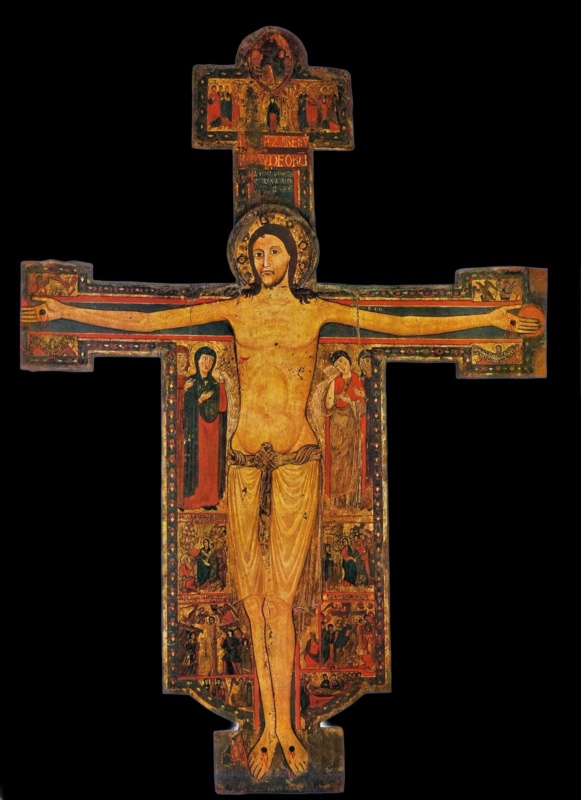
The Crucifix created by Maestro Guglielmo in 1138, preserved in the Co-cathedral of Santa Maria Assunta in Sarzana, represents the earliest securely dated example of Italian painted cross and constitutes one of the most significant works in the history of Western medieval art. This monumental work, executed in tempera on canvas attached to a wooden support constructed from chestnut panels, measures 299 centimeters in height and 214 centimeters in width, dimensions that emphasize its intended function as a commanding focal point for liturgical devotion. The cross employs the Christus Triumphans iconographic type, depicting Christ with his head upright, eyes open, and body positioned frontally to emphasize his divine nature and victory over death rather than his human suffering.
This iconographic choice reflects Byzantine theological emphasis on Christ’s divinity and resurrection, presenting him as the triumphant redeemer who has conquered sin and mortality. The figure of Christ dominates the composition, his body carefully proportioned according to conventions derived from Byzantine icon painting. Although the visible paint layer representing Christ’s body dates from a repainting conducted approximately fifty years after the original 1138 execution, restoration analysis suggests that the repainted version closely follows the original composition in terms of pose and general treatment. However, X-ray examination has revealed that the original face exhibited more pronounced frontality, larger and more intense eyes, and a distinctive nose structure that created a more dramatically expressive countenance than the softer, more refined features visible in the current state. These original characteristics, which closely resemble the unaltered mourning figures flanking Christ, indicate that Guglielmo’s initial conception emphasized powerful emotional and spiritual intensity. The body of Christ, with its careful attention to anatomical structure visible beneath the loincloth, demonstrates Guglielmo’s mastery of figure painting and his ability to suggest three-dimensional form on the flat panel surface.
The mourning figures positioned at the terminals of the horizontal arms of the cross, representing the Virgin Mary and Saint John the Evangelist, provide crucial evidence for understanding Guglielmo’s original style, as these elements were not substantially altered in the later repainting campaign. These figures exhibit intense emotional expression through exaggerated facial features, dramatic gestures, and body language that communicates profound grief. The Virgin’s face, turned toward her crucified son, displays the same large, wide-open eyes and distinctive nose structure that X-ray analysis has revealed in Christ’s original face. Saint John, positioned on the opposite side, mirrors this emotional intensity while maintaining the formal symmetry characteristic of Byzantine compositional practice.
The drapery of these figures’ garments demonstrates sophisticated understanding of how fabric falls and folds around the body, with careful attention to linear patterns that enhance both decorative richness and volumetric suggestion. Above Christ’s head, in the upper terminal of the cross, small figures of ascending angels or prophets participate in the celestial drama of redemption. Below Christ’s feet, the suppedaneum or foot support provides a platform that anchors the figure within the pictorial space. The extensive use of gold leaf throughout the background creates a luminous, transcendent atmosphere that lifts the sacred scene beyond earthly reality into the eternal realm of divine presence. This gold ground, applied to the carefully prepared gesso surface and subsequently burnished to achieve brilliant reflectivity, would have been dramatically enhanced by candlelight during liturgical ceremonies. The interaction between the painted figures and the shimmering gold background creates spatial ambiguity that characterizes Byzantine and Byzantinizing painting, simultaneously suggesting both flat surface pattern and infinite sacred space.
The narrative panels flanking Christ’s legs represent scenes from the Passion, providing detailed visual storytelling that complements the central iconic image. Though these panels have suffered damage over the centuries and the accompanying Latin verse inscriptions have become almost entirely illegible, sufficient imagery remains to identify the depicted scenes and appreciate Guglielmo’s narrative sophistication. The Kiss of Judas panel demonstrates Guglielmo’s ability to organize multiple figures within a confined space, arranging the crowd of soldiers and apostles around the central embrace between Christ and Judas. The compositional organization of this scene, which art historian Miklós Boskovits identified as evidence of evolved artistic awareness, shows figures positioned at varied depths and angles, creating a convincing sense of spatial recession.
The Flagellation scene depicts Christ bound to a column while tormentors raise their whips, their faces charged with the same intense expression visible in the telamon figure from the Passionary P+ manuscript. This stylistic consistency between the cross and the manuscript reinforces the attribution of both works to Guglielmo’s hand. The Deposition panel shows the removal of Christ’s body from the cross, with figures carefully arranged around the central action in a composition that Boskovits noted for its enhanced realism compared to earlier examples. The Way to Calvary, the Crucifixion (distinct from the main image above), and other Passion scenes complete the narrative cycle, providing a comprehensive visual catechism of Christ’s suffering and death. These narrative panels serve multiple devotional and didactic functions, allowing viewers to meditate on specific moments of the Passion while simultaneously beholding the triumphant risen Christ in the central image. This combination of iconic presence and narrative detail characterizes the sophisticated devotional programming of Romanesque crosses.
The extensive Latin inscriptions that Guglielmo composed for the cross represent a distinctive feature that elevates the work beyond purely visual expression into the realm of literary artistry. The primary inscription, located immediately below the titulus crucis, states in hexameter verse: Anno milleno centeno ter quoque deno octavo pinxit Guillielmus et hec metra finxit, establishing both the date of 1138 and identifying Guglielmo as author of both the painting and the verses. This inscription serves multiple functions: it documents the work’s creation, asserts Guglielmo’s authorship, and demonstrates his literary erudition.
The composition of Latin hexameter verse required sophisticated knowledge of classical prosody and substantial literary training, reinforcing Marco Ciatti’s hypothesis that Guglielmo received monastic education. Additional verses, now largely illegible, originally accompanied each narrative panel, providing textual commentary that guided viewers’ interpretation of the depicted scenes. These inscriptions transformed the cross into a multimedia devotional object that engaged both visual and verbal faculties. The careful integration of text and image demonstrates Guglielmo’s comprehensive approach to artistic communication, ensuring that viewers of varying literacy levels could access the work’s meaning through either visual or verbal channels. The calligraphic execution of the inscriptions, with letterforms carefully designed to harmonize with the painted imagery, constitutes an additional artistic achievement. The titulus crucis itself, bearing the inscription “Iesus Nazarenus Rex Iudeorum” in full rather than the abbreviated form often employed, emphasizes textual completeness and readability. This attention to textual detail parallels the visual refinement evident throughout the painted surfaces.