Benedetto Antelami
( 25% )
Benedetto Antelami, born around 1150 in Val d’Intelvi, in the Lombard pre‑Alps, is one of the most important Italian sculptors and architects of the late twelfth and early thirteenth centuries, active primarily in Emilia‑Romagna and the wider Po valley. He died around 1230 in Parma, probably in the same city that hosted his most celebrated projects and became the center of his long artistic career. His work stands at the threshold between a mature Romanesque idiom and the first incursions of a proto‑Gothic language, and he is traditionally grouped with Nicola Pisano as a foundational figure in the renewal of Italian monumental sculpture.
Family background and early milieu
Very little can be stated with certainty about Benedetto Antelami’s immediate family, but the name “Antelami” points to his belonging to the wider Lombard community of stone‑masons and builders known as the magistri Antelami. This guild, rooted in the Val d’Intelvi and active from the later twelfth century onward, brought its members to major building sites across northern Italy, including Genoa, Liguria, and Emilia–Romagna, often functioning as small dynasties of “master stonemasons” who trained their sons and nephews in the craft. It is therefore plausible, though not proven by documentary evidence, that Benedetto was born into a family of stone‑workers for which architecture and sculpture were hereditary professions rather than merely individual trades. His early exposure to quarrying, laying, and carving would have been situational: he likely grew up amidst quarries, scaffolds, and the “parlance” of craft, absorbing the technical and aesthetic norms of Lombard Romanesque construction before any formal apprenticeship abroad. Given the mobility of the magistri Antelami, his parents or elder relatives may have already traveled to the city‑states of Liguria and Emilia, exposing the young Benedetto to diverse regional styles and urban architectural projects.
The social world of the Antelamian stoneworkers was marked by a strong sense of local identity and corporate solidarity, which allowed the group to negotiate rights and contracts collectively rather than as isolated individuals. Within this framework, masters of the guild often entrusted their sons to other sculptors or architects for more advanced training, ensuring that the boy learned not only the local Lombard repertoire but also foreign influences circulating in major ecclesiastical centers. Benedetto may thus have been consciously prepared from a young age to move beyond the purely local, even if his family remained rooted in the cultural and juridical customs of the Val d’Intelvi. At the same time, the fact that the name “Antelami” appears in several generations of builders suggests that Benedetto’s artistic personality was shaped within a broader familial and professional network, in which style, workshop practices, and patronage channels were transmitted as part of a shared heritage. His later ability to command both large sculptural programs and complex architectural projects can therefore be read as the culmination of a family‑oriented education deeply embedded in the masonry traditions of Lombardy.
Ultimately, the family milieu to which Benedetto Antelami belonged was neither aristocratic nor clerical, but artisanal, and this social position conditioned both his mobility and his visibility in the written record. Unlike high‑ranking ecclesiastics or noble patrons, craftsmen of his status rarely appear in chronicles or charters except in relation to specific contracts, dues, or disputes, which is why the documentation around his early life is so sparse. Nevertheless, the existence of a dense, multi‑generational network of Antelamian masons enabled Benedetto to navigate the ecclesiastical and communal institutions of Parma, Fidenza, and Vercelli, where he would secure his most important commissions. His family background thus represents a crucial, if largely invisible, matrix that underpinned his technical mastery and his capacity to operate on the scale of major cathedrals and baptisteries.
Patrons and ecclesiastical networks
The most significant early patronage for Benedetto Antelami came from the bishopric of Parma, particularly from Bishop Bernardo II, who led the diocese from 1169 until his death in 1194 and played a central role in aligning the city with the Roman papal party after a period of schism and imperial leaning. It was under Bernardo that Parma’s cathedral underwent a series of important renovations and embellishments, including the completion of the Romanesque façade in 1178 and the reorganization of the presbytery area, projects that provided the context for Antelami’s first documented intervention. Bernardo’s commitment to monumental art can be interpreted as part of a broader effort by reform‑minded bishops to assert Rome‑centric orthodoxy through visually powerful sculptural narratives, especially around the altar and the episcopal seat. In this setting, Antelami’s relief of the Deposition from the Cross (1178) served not only as a devotional image but also as a statement of ecclesiastical authority aligned with the Gregorian–Roman current. The bishop’s patronage thus laid the foundation of Antelami’s reputation as a major ecclesiastical sculptor capable of combining doctrinal precision with emotional gravity.
A second major ecclesiastical patron was the cathedral chapter of Parma, which, in conjunction with the bishop, oversaw the construction and decoration of the cathedral complex and later the adjoining baptistery. The chapter represented the communal interests of the city’s clergy and often acted as a bridge between the episcopal hierarchy and the emerging civic authorities, making it a powerful sponsor of large‑scale architectural projects. Around 1196, it was through this chapter that Antelami received the commission to design and decorate the Parma Baptistery, a building that would become one of the most celebrated Romanesque monuments in Italy. Here, the chapter’s patronage entailed both financial responsibility and theological oversight, as the baptistery’s iconographic program was intended to reinforce the sacramental theology of baptism and the unity of the Christian community. Antelami’s ability to respond to these demands with a rich sequence of portal reliefs, prophets, and allegorical figures suggests that he enjoyed considerable trust and artistic latitude from the clerical patrons who managed the project.
Beyond Parma, the bishops and cathedral chapter of Borgo San Donnino (modern Fidenza) commissioned Antelami and his workshop to reshape the cathedral façade in the early thirteenth century, shifting it from a simpler, earlier Romanesque typology toward a more articulated and sculpturally rich elevation. The façade reliefs, centered on the martyrdom and miracles of Saint Donninus, the local patron, were conceived as a visual narrative intended to strengthen the cult of the city’s saint and to affirm the ecclesiastical identity of the diocese. This commission, executed in the first decades of the thirteenth century, reflects the growing influence of Parma’s sculptural school in the surrounding region, as well as the interconnectedness of episcopal sees that shared similar liturgical and political concerns. The fact that parts of the Fidenza façade were later interrupted or completed by other hands underscores the fragile nature of such patronage, which could be disrupted by local conflicts, changes in bishopric leadership, or the artist’s own movements between cities. Even so, the surviving Antelamian elements remain a testament to the sustained, if punctuated, support he received from the bishops of Fidenza.
In the context of Vercelli, the most prominent patron linked to works associated with Benedetto Antelami was the cardinal‑legate Guala Bicchieri, who played a key role in the foundation and construction of the basilica of Sant’Andrea between 1219 and 1227. Guala, a high‑ranking papal diplomat with close ties to the English crown, used the church as a political and spiritual monument, aligning the city of Vercelli with the broader networks of the papal curia. The architectural ensemble of Sant’Andrea, which combines Lombard Romanesque massiveness with early Gothic elements such as pointed arches and ribbed vaulting, was intended to project both local pride and participation in wider European developments. Although the precise nature of Antelami’s involvement in the overall design remains debated, several scholars have attributed the portal lunette depicting the martyrdom of Saint Andrew on the X‑shaped cross to him or his immediate workshop, suggesting that his sculptural language was co‑opted by patrons eager to imbue their foundations with a sense of monumental dignity.
Urban communes and civic elites also functioned as indirect patrons of Antelami’s work, particularly in Parma, where the cathedral and baptistery were central to the city’s self‑image as a major Lombard city. The façades facing the cathedral square were not only ecclesiastical but also civic spaces, and the elaborate sculptural programs on the baptistery and the cathedral façade communicated shared religious values and communal identity to a broad audience. The famous cycle of the Months on the Parma Baptistery, for example, offered a didactic, almost encyclopedic vision of the liturgical and agricultural year that resonated with both clerical and lay viewers. In this respect, the city’s citizens and civic officials, though not named as individual patrons, can be considered a collective audience whose expectations and resources shaped the scale and ambition of Antelami’s projects. His work thus straddled the spheres of episcopal, chapter, and civic patronage, allowing him to operate at the intersection of religious doctrine, urban display, and local political ideology.
Finally, the continuity of Antelami’s commissions over several decades suggests that he built lasting relationships with the institutions that employed him, rather than serving as a one‑time visitor. Repeated engagements with the Parma bishopric and the cathedral chapter, from the 1178 Deposition to the later phases of the baptistery and possibly the cathedral’s sculptural decoration, indicate that his patrons valued both his technical skill and his capacity to integrate sculpture into larger architectural visions. Even when subsequent phases of the same buildings were carried out by other hands, the persistence of Antelamian motifs and compositional schemes attests to the enduring influence of his initial interventions. In this way, Benedetto Antelami’s biography is inseparable from the network of ecclesiastical and civic patrons who, across several cities, defined the conditions under which he created his most significant works.
Style of sculpture and architectural language
Benedetto Antelami’s sculptural style is characterized by a powerful synthesis of Lombard Romanesque monumentality and a renewed interest in classical, Byzantine, and Provençal forms, which he distilled into a highly personal idiom. His figures are typically elongated and volumetric, carved with a sense of weight and gravity that emphasizes their physical presence within the architectural frame, yet they are also articulated with a subtle sense of movement and psychological interiority. This combination of corporeal mass and expressive finesse distinguishes his work from the more rigid, schematic decoration typical of earlier north Italian Romanesque sculpture, and places him among the first northern Italian masters to approach the human body as a vehicle of both theological and emotional meaning. Drapery, in particular, became a key expressive device in Antelami’s hands, as he used deeply cut folds and sinuous lines to model the body beneath and to direct the viewer’s gaze across the relief surface.
In architectural terms, Antelami’s contribution lies in the way he integrated relief and sculpture into the very fabric of the building, rather than treating them as superficial ornaments. At the Parma Cathedral, his Deposition from the Cross originally formed part of a pulpit or ambo, positioning the scene at the liturgical center of the church and binding the narrative closely to the preaching of the Word. The composition is compact and frontal, with Christ’s body suspended between the supporting figures, and the vertical axis of the cross is echoed in the upright stance of the surrounding mourners, creating a dense, almost hieratic grouping that concentrates the viewer’s attention on the moment of Christ’s removal from the cross. The faces of the figures are rendered with a restrained emotional intensity that avoids overt theatricality, yet their slightly upturned or downcast gazes and the asymmetries in their poses suggest a carefully calibrated psychological drama. This balance between formal order and affective resonance is a hallmark of Antelami’s sculptural style and recurs across his later works.
On the portals of the Parma Baptistery, Antelami’s style manifests in a more explicitly narrative and didactic register, where the reliefs function as a visual theology of salvation and sacramental life. The exterior lunettes of the three portals depict the Adoration of the Magi, the Last Judgment, and an allegorical scene of life, each structured through a series of layered registers and interlocking figures that guide the viewer’s eye from earthly realms toward celestial visions. The figures of the Magi, for instance, are arranged in a processional rhythm that both recalls earlier Roman sarcophagi and anticipates the narrative clarity of later Gothic sculpture, while the Last Judgment lunette compresses a vast eschatological panorama into a compact frieze, using scale and posture to distinguish the saved from the damned. Within these compositions, Antelami employed a refined sense of proportion and spatial hierarchy, ensuring that the most important figures—such as Christ in Majesty or the Virgin with the Child—dominate the visual field without destabilizing the overall balance of the relief.
The use of inscriptions and polychromy further enhances the didactic and liturgical function of Antelami’s sculptural style, bridging the gap between image and text. In the Deposition at Parma, the Latin inscription not only records the artist’s name and date but also orients the viewer toward the theological significance of the scene, embedding the work within a broader ecclesiastical discourse. Recent technical studies have shown that this relief retains traces of polychrome lettering, with alternating red and dark pigments, suggesting that color was not an afterthought but an integral part of the original conception. At the Baptistery, inscriptions and painted details likely played a comparable role in guiding the viewer through the iconographic program, reinforcing the sacramental themes of baptism and divine judgment. Such attention to the integration of text, color, and carving underscores Antelami’s conception of sculpture as a total visual and intellectual environment rather than a mere decorative episode.
Antelami’s architectural imagination extended beyond the scale of individual reliefs to the design of entire façades and buildings, where he sought to coordinate sculptural programs with the rhythms of arches, columns, and cornices. The façade of Fidenza Cathedral, for example, demonstrates how he rethought an earlier, simpler elevation into a more complex, sculpturally articulated front, using niches, pilasters, and portal framing to create a layered visual field. Similarly, at the Parma Baptistery, the sculpted bands of prophets, apostles, and allegorical figures are embedded within the architectural orders, so that the building itself becomes a kind of “sculpted wall” whose surface is animated by a continuous narrative and didactic program. This synthesis of architecture and sculpture anticipates later developments in Italian Gothic and early Renaissance design, where the boundary between structural and decorative elements becomes increasingly fluid.
A recurring feature of Antelami’s style is his interest in allegory and personification, which he deploys alongside literal narrative scenes to convey abstract theological concepts in tangible form. At the Baptistery, allegorical figures of life and the months are integrated into the program, allowing viewers to grasp the cyclical nature of time and the intersection of liturgical and agricultural calendars. The celebrated Months cycle on the external façade of the baptistery, carved between 1196 and the early 1210s, exemplifies this approach, as each month is given a distinct figure engaged in characteristic labors, often surrounded by symbolic animals or zodiac signs.
Each figure is carved with a notable sense of individuality, yet they remain integrated into a larger symbolic system that links human labor to cosmic order through the zodiac and the liturgical calendar. The style of these months is marked by a restrained idealization, with figures dressed in garments that suggest nobility and composure rather than peasant roughness, thus presenting work as a dignified, even courtly activity rather than a divine curse. This subtle shift in representation reflects Antelami’s broader ambition to reconcile the everyday with the sacred, embedding the rhythms of the agrarian year within a framework of baptismal purification and eschatological hope.
Antelami’s style also reveals a sophisticated grasp of architectural setting, as he composed his reliefs and freestanding figures in explicit relation to light, viewing angles, and the viewer’s movement through space. The placement of the Months on the internal loggias of the baptistery, for instance, requires the spectator to walk around the octagonal interior, gradually assembling a visual narrative of the year as a continuous, cyclical experience. Light enters through the high windows and arches, emphasizing certain panels over others and underscoring the theatricality of the sculptural program without flattening its didactic clarity. Such attention to the behavior of light and the pace of the viewer’s progress through the building suggests that Antelami thought in terms of an extended visual pilgrimage, where theological truths are revealed gradually rather than in a single frontal tableau. This approach anticipates later developments in Italian Gothic and early Renaissance architecture, where movement and sequence become central to the experience of sacred space.
Artistic influences and stylistic geography
Benedetto Antelami’s style emerges from a complex interplay of local Lombard Romanesque traditions and broader Mediterranean currents, particularly those emanating from Provence and southern France. It is widely believed that Antelami either trained or spent time in Provence, especially at the basilica of Saint‑Trophime in Arles, a site whose sculptural program and architectural layout left a strong imprint on his later works. The Provençal heritage manifests in his use of deep, rhythmic folds in drapery, the compact, frontal composition of his figures, and the integration of sculpture into the architectural portal, all features that parallel the façades of Arles and other Provençal churches. These elements, however, are not slavishly copied but reinterpreted through the heavier, more tectonic sensibility of Lombard masonry, so that Antelami’s work occupies an intermediate zone between the southern, more linear idiom and the northern, more mass‑oriented tradition.
Classical and Byzantine influences also play a significant role in shaping his artistic language, particularly in the modelling of the human body and the handling of facial expression. Antelami borrowed from ancient Roman sarcophagi and late antique reliefs both compositional devices and typological schemes, such as the Adoration of the Magi and the Deposition from the Cross, which had long served as vehicles for Christian narrative. At the same time, certain Byzantine features—such as the hieratic frontality of Christ in Majesty, the iconographic repertory of the Last Judgment, and the use of halos and symbolic gestures—appear adapted to a more dynamic, narrative context than in strictly Byzantine icons. This synthesis allowed Antelami to present familiar theological themes in a visually richer and more psychologically nuanced form, bridging the gap between iconic stillness and narrative drama.
Equally important is the influence of early Tuscan and Lombard architectural models, which Antelami encountered through his own travels and through the circulation of Lombard masters across the Peninsula. The Lombard Romanesque tradition, rooted in the region around Lake Como and the Po plain, provided him with a robust vocabulary of piers, arches, and decorative bands that he could transpose into the design of cathedrals and baptisteries. Tuscan examples, such as the cathedral and Baptistery of Florence, may have reinforced his interest in tall, vertical façades and in the use of multiple portals to frame elaborate sculptural programs. These regional repertoires, however, were not simply aggregated; they were filtered through Antelami’s own sense of proportion and his desire to create unified, legible sequences that could guide the viewer through complex theological narratives.
Germanic and proto‑Gothic currents, transmitted via the broader network of Lombard builders and ecclesiastical channels, also left traces in his work, particularly in the later stages of the Parma Baptistery. The use of pointed arches, ribbed vaults, and a more pronounced verticality in the articulation of the façade suggests that Antelami was aware of emerging Gothic tendencies, even if he did not adopt them wholesale. Instead of abandoning the Romanesque blockiness he had inherited from Lombard practice, he combined it with Gothic elements in a manner that preserved the monumentality of the earlier style while introducing a sense of upward movement and spatial differentiation. This cautious, selective absorption of new forms marks his position as a transitional figure who helped integrate continental Gothic innovations into the regional idioms of northern Italy.
The influence of Antelami himself can be seen in later works that echo his Months cycle and compositional strategies, indicating that his idiom traveled beyond his own workshop. For example, the portal figures of the cathedral in Ferrara, attributed to Niccolò and a certain “Antelami,” appear to respond directly to the Parma Baptistery’s combination of personified months and allegorical figures, suggesting that his style was studied and imitated by younger generations. More broadly, the sculptural oeuvre of the magistri Antelami in Liguria and Lombardy shows recurring formal and iconographic motifs—such as the treatment of drapery, the composition of narrative reliefs, and the placement of figures in architectural niches—that can be traced back, at least in part, to Benedetto’s innovations. In this way, his artistic influence radiates outward from Parma, Fidenza, and Vercelli, inscribing his personal style into the wider fabric of northern Italian Romanesque sculpture.
Travels and itinerant practice
Benedetto Antelami’s career reflects the highly mobile character of the Lombard stonemasons’ guilds, whose members frequently moved between cities in response to major building campaigns. Documentary and stylistic evidence suggests that he worked not only in Parma and Fidenza but also in Ligurian and possibly Tuscan centers, carrying the methods and motifs of his school across regional boundaries. His early training may have taken him beyond the Val d’Intelvi, possibly to Genoa or Luni, where other Antelamian masters were active and where the nexus of maritime trade and pilgrim routes facilitated the exchange of sculptural styles. These Ligurian sites, in turn, were connected to the broader Mediterranean world, including Provence and the south of France, which would have exposed him to the sculptural idiom of the Rhône valley and the Spanish marches. Such itinerant experience not only broadened his visual vocabulary but also accustomed him to the varied expectations and resources of different ecclesiastical patrons.
The shift from Liguria to Emilia–Romagna is best documented in his interventions at the cathedral of Parma, where he appears in the late 1170s as the author of the signed Deposition from the Cross of 1178. By this date he had already established a reputation as a master capable of executing complex narrative reliefs integrated into liturgical furniture, and his work in the cathedral’s transept suggests that he was brought to Parma from outside the city, likely via the networks of Lombard stoneworkers active along the Via Francigena. The transition from Parma to neighboring Fidenza, where he worked on the cathedral façade from about 1188 to 1218, reflects the ease with which a successful sculptor could move between closely linked episcopal sees, sharing motifs and workshop practices across a relatively small territorial radius. In this context, his travels were not merely physical displacements but acts of cultural transmission, as he carried ideas about sculptural composition, iconographic program, and architectural articulation from one city to the next.
Further evidence of Antelami’s mobility comes from the association, albeit debated, with the basilica of Sant’Andrea in Vercelli, where the architectural and sculptural language of the portals recalls his earlier work in Emilia. Although the direct attribution of the entire church to him remains uncertain, the project fits within the broader pattern of a master sculptor‑architect whose services were in demand across several Lombard and Piedmontese cities. Cardinal‑legate Guala Bicchieri, who oversaw the foundation of Sant’Andrea between 1219 and 1227, needed a builder who could reconcile Lombard Romanesque massiveness with emerging Gothic elements, and Antelami—or a close follower—appears to have been such a figure. This suggests that his travels extended westward into the territory of the future Duchy of Savoy, where he encountered both local traditions and the broader currents of French Gothic architecture.
Finally, stylistic parallels between Antelami’s Months cycle and later cycles in Ferrara and other northern Italian cities indicate that his personal itinerancy helped crystallize a wider regional taste for personified labors and allegorical figures. As younger masters and local workshops encountered his works in Parma, they absorbed both formal solutions—such as the arrangement of figures in niches and the alternation of months and seasons—and iconographic conceptions, such as the association of baptism with the agricultural and liturgical year. In this way, Antelami’s travels created a network of visual references that outlived his own lifespan, embedding his style into the collective memory of Lombard and Emilian sculpture.
Death and legacy
Benedetto Antelami is believed to have died around 1230, most likely in Parma, where he spent the greater part of his later career and where his works left a lasting imprint on the city’s monumental landscape. The exact cause of his death is unknown, as medieval sources do not record such details for craftsmen of his status, but his passing coincides with the suspension or slowing of several major projects associated with his workshop, including the final phases of the Parma Baptistery’s sculptural cycle. The fact that the Months cycle and other elements of the baptistery remained incomplete suggests that his death, or at least the dispersal of his immediate workshop, marked a significant break in the continuity of Antelami’s program. Even so, his influence persisted in the hands of younger Lombard and Emilian sculptors, who continued to draw on his compositional models and iconographic repertory into the later thirteenth century.
Major works and detailed descriptions
Deposition from the Cross
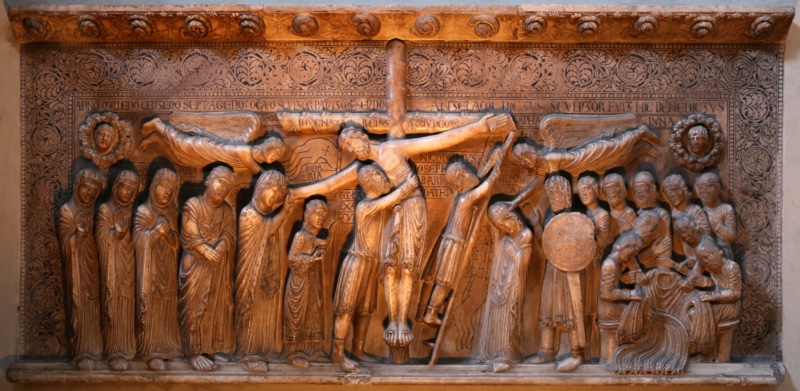
The Deposition from the Cross executed in 1178 for Parma Cathedral represents Antelami’s earliest signed and dated work, constituting both a technical masterpiece and a pivotal monument in the transition from Romanesque to Gothic sculpture in northern Italy. This marble relief panel, measuring approximately 110 x 230 centimeters, was originally integrated into a liturgical structure—most likely a rood screen (pontile) or pulpit—that separated the cathedral’s nave from the choir, functioning as an architectural element defining sacred space while serving as a vehicle for sophisticated theological imagery.
The composition depicts the moment when Christ’s body is lowered from the cross, with Joseph of Arimathea supporting the torso from below while a figure on a ladder traditionally identified as Nicodemus removes the nails from Christ’s hands, capturing the precise instant of transition between crucifixion and entombment. The cross itself serves as the dominant vertical axis dividing the composition into two balanced halves, with the Virgin Mary and Saint John positioned to the left expressing controlled grief through eloquent gestures, while Roman soldiers on the right cast lots for Christ’s garments in fulfillment of scriptural prophecy.
The theological sophistication of the iconographic program encompasses multiple layers of meaning: the division into two halves represents the Old and New Covenants; personifications flanking the cross symbolize Ecclesia (the Church) and Synagoga; the budding cross evokes the Tree of Life linking Christ’s death to redemption; and sun and moon medallions mark the cosmic significance of the event. The background features elaborate decorative patterning resembling niello metalwork, creating a non-naturalistic spatial environment that emphasizes sacred transcendence over empirical observation and connects the sculptural relief to traditions of precious metalwork and manuscript illumination.
The drapery treatment employs deeply carved parallel folds creating strong linear rhythms across the composition, defining volumes through directional flow rather than naturalistic modeling and demonstrating the influence of Provençal Romanesque sculpture where Antelami had trained. The Latin inscription identifies both artist and date with unusual specificity: “ANNO MILLENO CENTENO SEPTUAGESIMO OCTAVO SCULTOR PATUIT MENSE SECUNDO ANTELAMI DICTUS SCULPTOR FUIT HIC BENEDICTUS” (In the year 1178, in the second month, the sculptor became known; this sculptor was called Benedetto Antelami), asserting individual artistic identity rare in the twelfth century.
The patron was the cathedral chapter of Parma, the corporate body of canons responsible for liturgical functions and cathedral administration, whose resources enabled commissioning sophisticated sculptural decoration for liturgical furnishings that enhanced worship while demonstrating the chapter’s cultural sophistication. The relief currently occupies the south transept of Parma Cathedral, having been moved from its original location during post-medieval renovations that dismantled the rood screen, altering its liturgical context and viewing conditions but preserving the panel as an autonomous masterpiece accessible for close study.
The Deposition’s significance resides in its demonstration of Antelami’s mature synthesis of diverse influences at the beginning of his documented career, establishing stylistic principles—volumetric clarity, linear precision, theological sophistication, and architectural integration—that would characterize his entire oeuvre while introducing to northern Italy sculptural approaches derived from Provençal and emergent Gothic traditions.
King David
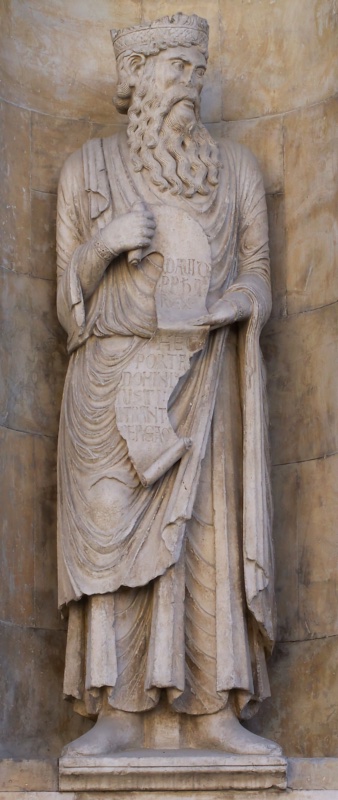
The statue of King David by Benedetto Antelami on the façade of the Cathedral of San Donnino in Fidenza is one of the few statues in the round in Italian Romanesque art and represents a key moment in the development of monumental sculpture in the early 13th century.
The figure of David is placed in a niche to the left of the main portal, in a mirror-image alignment with the statue of Ezekiel on the right, creating a symmetrical arrangement typical of the Romanesque facades of the Po Valley. The king is depicted standing upright, his body contained within an austere stone cylinder, yet with a growing attention to anatomy and volume that foreshadows Gothic developments.
His face bears a grave and meditative expression, with features sharply defined by the chisel, while his cloak and tunic fall in vertical, orderly folds, still closely carved in the Romanesque style, yet with a certain search for movement and depth. In his right hand, David holds a cartouche bearing the inscription “David Propheta, Rex,” which underscores his dual identity as king and prophet, while his left hand was likely resting on his hip or perhaps originally held an attribute (harp, scepter) that has not survived intact.
The statue is integrated into the Romanesque façade of the cathedral, rich in reliefs and narrative scenes linked to the cycle of Saint Donnino and biblical themes, and is immediately visible to pilgrims approaching the central portal. David, as a figure of the prophet-king, also functions as a precursor to Christ and Solomon, assuming a typological significance within the facade’s theological program. His lateral position relative to the main portal and his alignment with Ezekiel create an alternation of prophetic and royal figures that mark the threshold of the sacred.
Prophet Ezechiel
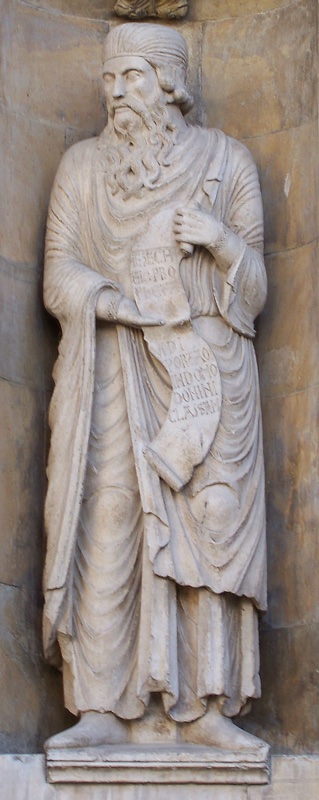
The statue of the Prophet Ezekiel by Benedetto Antelami is located on the façade of the Cathedral of San Donnino in Fidenza, in a niche to the right of the main portal, symmetrically aligned with the statue of David on the left. Like David, it is also a rare full-length figure in the Romanesque art of the Po Valley and serves as a key element of the facade’s didactic program, facing the pilgrim and the faithful.
Ezekiel is depicted in full figure, facing forward, with his body contained within a stone cylinder that allows his form to emerge, yet still anchored to an internal columnar structure typical of Romanesque statues. He wears a tunic and a toga that fall in vertical, orderly folds, with a rendering of the folds that reveals a certain search for movement and depth, although the design remains rigid and schematic according to Romanesque conventions.
The head is covered by a molded cap, while the gaze is turned to the left, in a slight twist that introduces a first hint of bodily dynamism. The prophet holds with both hands an open scroll, bearing the inscription in capital letters: “EZECHI / EL:PRO / PHETA / VIDI / PORTAM / INDOMO / DOMINI / CLAUSAM”, in a formula recalling Ezekiel 44:1–2, “I saw the door of the house of the Lord closed”, emphasizing his prophetic role and the typological reference to the closing and opening of the Temple door, a symbol of the transition between the Old and New Testaments.
The statue of Ezekiel is carved from soft Vicenza stone, a material also used for other works on the Fidenza façade and consistent with the pre-Lame tradition. Some sources refer more generally to stone or marble on the façade, but the description specifies “soft Vicenza stone” for this figure, consistent with the posture and finish of the sculpture.
Absalom on horseback and the Queen of Sheba
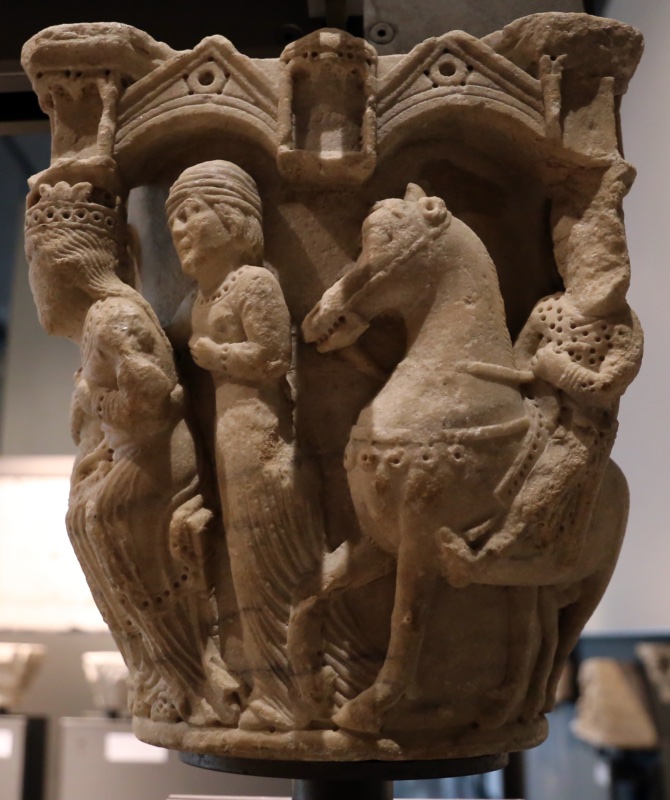
The capital depicts at least two distinct scenes: on one side, Absalom on horseback, recalling David’s son’s rebellion against his father, with dramatic and gestural elements typical of pre-Lame-style narrative art; on the other, the Queen of Sheba coming to meet Solomon, a symbol of the wisdom and glory of the King of Israel, but also a figure foreshadowing the Adoration of the Magi and the gathering of the nations who recognize true messianic kingship. This iconographic choice is not accidental: together with other episodes from the Book of Kings and other prophetic texts, the capital serves as a didactic lesson in marble, in which the history of Israel is presented as a prelude to the history of Christian salvation.
The style is highly dramatic, with figures overlapping beneath a shared architectural frame, suggesting a thoughtful use of space even within the confines of a small capital. The folds of the drapery, the horses, and the characters’ gestures are rendered with a blend of restrained realism and classical formalism, already tending toward more dynamic and profound solutions that would be fully realized later in the Baptistery door and the Deposition. The quality of the carving in the marble attests to Antelami’s mastery as a schoolmaster, capable of condensing narrative, gesture, and symbolism into an architectural element intended to be viewed from multiple angles.
The capital belongs to the same workshop as the Deposition from the Cross of 1178, which is the first work definitively dated and signed by the sculptor and located in the cathedral’s transept, as well as in the Baptistery’s later works (zoomorphic capitals, portals, and the Virtues). In this context, the capitals depicting biblical stories are part of a unified sculptural program aimed at transforming the cathedral and the Baptistery into a “book of stone,” where the Bible is made visible and accessible even to those who cannot read.
The Original Sin
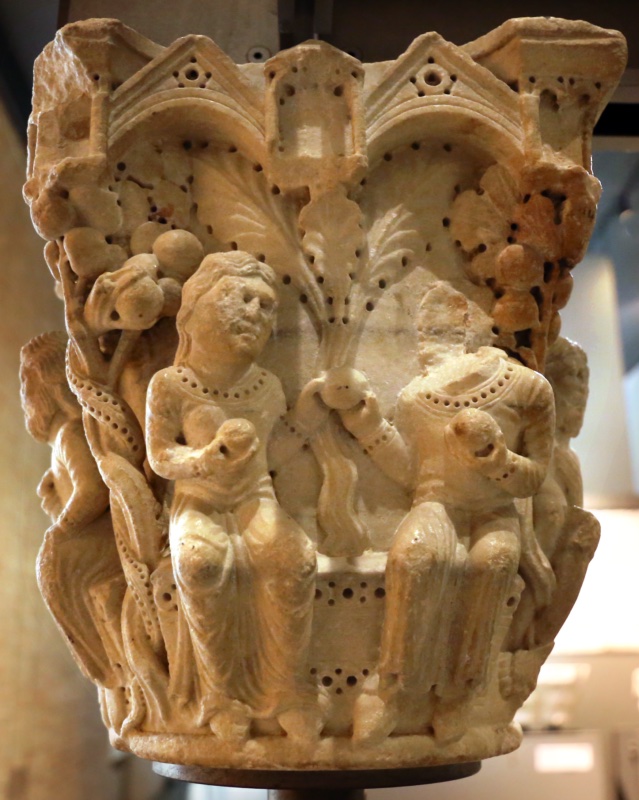
This capital is part of the grand decorative program of Parma Cathedral, carried out in the second half of the 13th century, when Benedetto Antelami was working in the city as a master sculptor and architect. Originally, the ambo, of which it was a part, was located at the center of the nave—a privileged place for the proclamation of the Word of God—and thus the biblical scenes, including the Original Sin, had a clear pedagogical and liturgical significance. The work was later redistributed, and today the relief is visible on the capitals and panels of the transept and the interior walls of the cathedral.
The scene of the Original Sin traditionally depicts Adam and Eve in the Garden of Eden, with the serpent encouraging Eve to pick the forbidden fruit, while Adam is often represented in a passive pose or about to yield to temptation. Antelami structures the capital narratively, with clear and distinct figures, framed by a phytomorphic decoration that separates the figurative register from the rest of the architectural frame, a sign of strong compositional awareness. The iconography aims to emphasize the fall from the state of grace, man’s responsibility, and, consequently, the necessity of the redemption wrought by Christ, which is then illustrated in other panels and cycles within the building (such as the Deposition).
Antelami employs Verona red marble with great mastery, achieving a balance between the material weight and the plastic fluidity of the folds, which anticipates certain Gothic values while remaining firmly anchored in the Romanesque tradition. The figures on the capital are constructed with volumetric bodies and marked poses: the hands, arms, and heads are designed to convey a gesture of rejection, temptation, or shame, while the sketched folds impart movement and drama without excessive naturalism. The scene is rendered in raised bas-relief, with well-defined planes (background, figure, decoration) that allow the narrative to be clearly read even from a distance, in a liturgical context where iconographic clarity was a priority.
The capital depicting the Original Sin serves an intensely catechetical function, as it portrays humanity’s first betrayal and the resulting breaking of the covenant with God—a necessary prerequisite for understanding the meaning of the Cross and Redemption. In this sense, the scene is not isolated but symbolically linked to the Deposition and other stories of Christ, forming a narrative arc that extends from Original Sin to Easter.
The Expulsion from the Garden of Eden
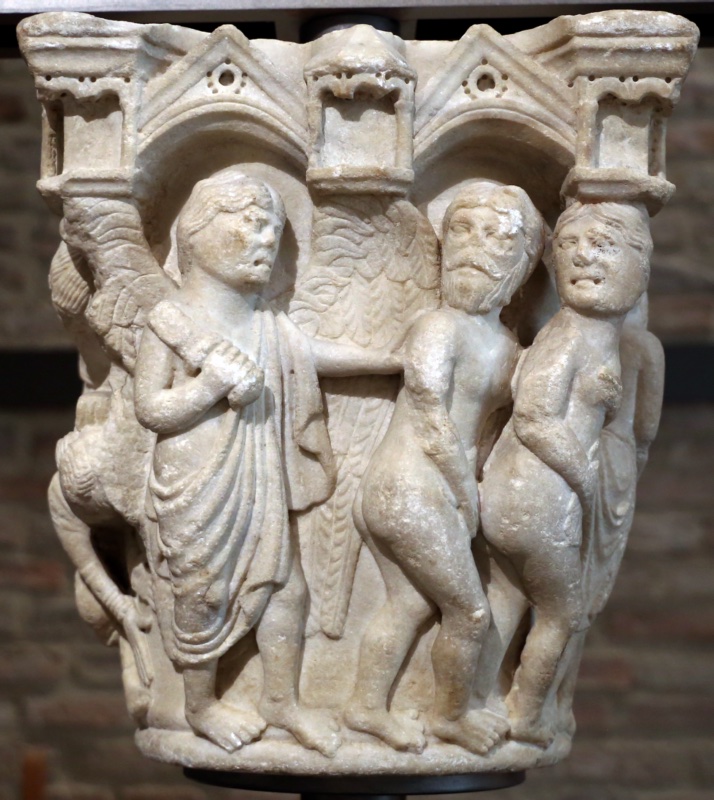
In the capital depicting the scene of the Expulsion from the Garden of Eden, Antelami translates the drama of guilt and expulsion into stone, while retaining a typically Romanesque structure: the figures are framed within a compressed space, defined by a strong architectural geometry (the cross-section of the capital itself). Adam and Eve are rendered in monumental forms, with bodies marked by a strong sense of weight and gravity, in which nudity is rendered with a linear, taut, and almost obsessive stroke that highlights the muscular tension and the shame of the gesture. The Angel’s gesture as he pushes them out of Eden is rendered with an almost physical energy, in which the outstretched arm and flowing robe create a diagonal movement that breaks the initial rigidity of the composition.
The iconography closely follows the biblical narrative, but with a symbolic reworking typical of medieval thought: the expulsion becomes not only a story but also an image of humanity’s alienation from the Kingdom of God. The Tree of Knowledge, sometimes reduced to a simple stylized trunk, serves as a visual and theological focal point, while the posture of Adam and Eve, with their hands covering their bodies, evokes the dual condition of humanity after the Fall: doomed yet still aware of their guilt.
Furthermore, Antelami places these biblical figures within a broader decorative program of the cathedral, where scenes from the Old and New Testaments intertwine to tell the story of salvation, from the fallen Eden to the redemption wrought by Christ. In the capital depicting the Expulsion, the distinctive traits of the Antelami style are clearly recognizable: a “tension-filled” realism, in which the bodies are heavy, almost carved against the material, yet marked by meticulous attention to anatomical details and drapery. The depth of the high relief allows for the creation of marked areas of shadow that give volume to the masses, while the outline is sharp and incisive, almost drawn into the stone. Alongside this “realist” style, however, a strong symbolic framework persists: the figure of the Serpent, when present in the iconographic variations, is often rendered in a hybrid and monstrous form, in continuity with the bestiary and moralistic vein also found in the zoophore of the Baptistery of Parma.
The scene of the Expulsion, when included among the carved decorations of the Cathedral, must be read in dialectic with the stories of the Passion and the Resurrection that Antelami treats in other works, such as the Deposition and, later, the cycles of the Baptistery. In this context, the capital is not merely an isolated narrative episode, but a prelude to the story of redemption: the man expelled from Eden is the same one who, through Christ, will one day be able to return there as a welcome guest. This intertwining of sin, the Fall, and hope is the theological axis that runs through all of Antelami’s sculptural work in Parma, making the capital depicting the Expulsion a key element for understanding his conception of sacred art deeply committed on both doctrinal and dramatic levels.