Anselmo da Campione
Little is known of Anselmo da Campione’s private life, yet the available evidence situates him firmly within a tightly knit, multi‑generational community of stone masons and sculptors originating from the small Lombard enclave of Campione d’Italia, near Lake Lugano. His precise date of birth remains unrecorded, though scholars generally place his birth in the second quarter of the twelfth century, likely between 1130 and 1145, in the village of Campione itself, then part of the diocese of Como. His family background is typically described as that of a local lapideus or tagliapietre, embedded in the long‑established tradition of itinerant stone‑working workshops that roamed northern Italy during the Romanesque period.
Family background
Documentary references to his sons Alberto, Jacopo, and Ottavio, and to his grandson Enrico, suggest that artisanal skill and professional identity were transmitted hereditarily, with successive generations signing contracts and working side by side in the same cathedral “fabbrica.” This pattern points to a family in which the workshop was effectively a domestic institution, with the home at Campione functioning less as a fixed residence than as a node in a network of sites stretching from Provence to Emilia–Romagna. The broad social stature accorded to such sculptors in the twelfth century—often treated as learned magistri rather than mere laborers—indicates that Anselmo’s family occupied a modest but respected position within the local hierarchy of free stone‑masons, operators, and minor gentry.
Although the names of his parents are not preserved, the recurring appearance of close kin within the documentation of Modena’s cathedral works implies that kinship ties both legitimized his authority and reinforced the loyalty of his helpers. The fact that his heirs continued to sign “perpetual” contracts linking their posterity to Modena’s cathedral strongly suggests that membership in the Campionese circle was defined as much by blood as by craft, making the family an almost dynastic institution spanning several generations. Within this context, Anselmo’s own lineage appears less as an isolated family unit and more as the central branch of a wider clan‑like structure in which apprentices who were not biologically related could still be absorbed as quasi‑kin under the umbrella of the master’s authority. Consequently, the family of Anselmo da Campione should be understood not only through genealogical labels but also through the practical and symbolic function of kinship, which structured workshop discipline, ensured continuity of style, and provided a stable framework for the long‑term projects undertaken by the Campionesi in Emilia–Romagna and beyond.
Patronage
Patronage shaped Anselmo da Campione’s career at least as much as any individual artistic impulse, and the most consistent and influential of his patrons was the ecclesiastical administration of Modena Cathedral, particularly the series of capomaestri or “massari” who oversaw the fabbrica from the 1160s into the early thirteenth century. The earliest and most formative patronage relationship appears to have been with the massaro Alberto, who directed the works from 1190 to 1208 and whose name figures in the same foundational contract that later Enrico di Ottavio would renew in 1244; this document binds Anselmo and his descendants to work perpetually on the cathedral, a status that reflects both the prestige of the site and the institutional longevity expected of a Campionese master.
This perpetual contract implies more than a simple employer–artisan relationship; it institutionalizes Anselmo as the architect‑sculptor to whom the cathedral’s sculptural and decorative program was entrusted, giving him a quasi‑familial bond with the ecclesiastical body that governed the church. The patronage of the cathedral chapter itself—comprising canons, bishops, and local clerical dignitaries—was crucial, since it was they who approved the iconographic program and allocated the financial resources for the extensive sculptural campaigns on the façade, interior chapels, and choir. Additional patrons appear in the form of named individuals such as the massaro Bozzalino, active from 1208 to 1225, who commissioned the elaborately decorated ambone constructed on the left side of the pontile and to which Anselmo and at least one of his sons are credited. Bozzalino’s patronage exemplifies the importance of administrative intermediaries in the cathedral fabric: although he was not a bishop, his role as overseer of the building works allowed him to act as a direct client, commissioning specific sculptural elements that would visibly enhance his own legacy while serving the liturgical needs of the chapter.
The presence of such figures in the documentation underscores the layered nature of patronage, where bishops set the overall theological tone, massari translated it into practical commissions, and individual donors might fund specific altars, portals, or pulpits. Anselmo’s workshop also benefited from the broader patronage culture of Modena’s urban elite, whose contributions—often recorded in gifts of land, money, or building materials—helped finance the embellishment of the cathedral as a civic monument. The city’s communal authorities, eager to associate Modena’s prestige with the grandeur of its cathedral, effectively became indirect patrons by supporting the funding structures and legal frameworks that enabled extensive sculptural projects. This combination of ecclesiastical, administrative, and civic patronage created a stable environment in which Anselmo could operate over several decades, aligning his artistic choices with the didactic and devotional agendas of multiple stakeholders. The patronage of the cathedral, in particular, transformed his role from that of a peripatetic stone‑carver into a semi‑resident master of the works, whose family and workshop would in turn produce several generations of sculptors linked by contract and by blood to Modena Cathedral.
The patronage of Modena Cathedral not only provided Anselmo with steady employment but also shaped the thematic and spatial coherence of his sculptural program across the church’s façade, interior, and tower. The bishops of Modena, from Guglielmo III onward, were instrumental in expanding the original thirteenth‑century building campaign initiated by the Lombard architect Lanfranco, a project that gradually incorporated the Campionesi into the fabric of the cathedral as the primary agents of its later Romanesque decoration. Under episcopal oversight, Anselmo and his collaborators were entrusted with the redesign of sections that were still incomplete or only partially adorned, such as the Porta Regia opening onto Piazza Grande, which became one of the most prestigious and symbolically charged portals of the cathedral. The patronage of the chapter can also be detected in the careful selection of iconographic themes, such as Passion scenes on the pontile, apostolic figures on internal surfaces, and narrative reliefs, meant to instruct the faithful and reinforce the cathedral’s role as a “Bible in stone.”
Each of these programs was tailored to the specific liturgical and spatial functions of the areas where Anselmo’s sculptures were placed, reflecting the close coordination between master sculptor and clerical patrons. The construction of the rosone, or large rose window on the façade, is another instance where the patron’s will and the master’s craft intersected; while the design and technical execution were Anselmo’s, the decision to insert such a monumental fenestration into the existing façade was likely made in consultation with the chapter and with the massari responsible for the cathedral’s finances. Similarly, the expansion of the choir and the reworking of the presbytery, where sculptural articulation was essential, were almost certainly conceived as part of a broader ceremonial and liturgical reform promoted by the cathedral’s patrons.
The Ghirlandina, whose later completion and decorative elements were handled by Anselmo’s successors, also bears traces of the same patronage mechanisms, since the tower’s construction and adornment were closely tied to the city’s communal identity and the prestige of the bishopric. The patronage of urban elites, often expressed through votive donations or through the commissioning of specific altars and chapels, further diversified the scope of Anselmo’s work, allowing him to respond to both private devotional needs and public ceremonial functions. Ultimately, the patronage of Modena Cathedral functioned as a cumulative rather than episodic force, ensuring that Anselmo’s contributions were not isolated interventions but integrated components of a continuous, evolving project that spanned several papal and episcopal administrations. This long‑term patronage environment enabled the Campionesi, under Anselmo’s leadership, to develop a distinctive sculptural language that responded consistently to the expectations of the cathedral’s ecclesiastical and civic patrons while leaving room for stylistic experimentation within clearly defined theological and architectural boundaries.
Beyond the immediate circle of Modena’s cathedral, Anselmo’s patrons included other ecclesiastical institutions and possibly noble or civic entities in Lombardy and the wider Lombard–Emilian region, though the surviving documentation for these secondary commissions is fragmentary. The presence of Apostles sculpted for the north aisle of the cathedral of Milan and of an ark or arca under the high altar of the cathedral of Parma has been associated with his workshop, implying that other episcopal sees recognized the Campionese style as suitable for prestigious liturgical settings. In these cases, local bishops or chapters would have acted as patrons similar to those at Modena, commissioning works that balanced didactic clarity with sculptural grandeur.
The attribution of such projects to Anselmo or his immediate followers points to a broader patronage network in which cathedral chapters competed for the services of well‑regarded workshops, often sustaining long‑term relationships that extended beyond a single commission. This pattern suggests that Anselmo’s reputation as a master of Romanesque sculpture had spread beyond Modena, so that his workshop was sought after by other bishops who wished to emulate the richly decorated interiors of the Modenese cathedral. The patronage of these other churches, while less well documented than that of Modena, still reveals a common pattern: the emphasis on apostolic, Passion, and Marian themes, the integration of sculpture with architectural elements, and the use of marble reliefs to demarcate sacred and liturgical spaces.
Such patronage networks were not only religious but also political, as bishops and chapters sought to enhance their own authority and prestige through the visual rhetoric of their buildings. The involvement of Anselmo’s workshop in multiple episcopal sites therefore indicates that his patrons were not limited to a single urban center but spanned a regionally significant ecclesiastical sphere in which sculpture served as a material expression of spiritual and communal power. The patronage landscape surrounding Anselmo thus resembled a constellation of overlapping spheres—local, regional, and ultimately ecclesiastical—each contributing to the demand for monumental sculptural programs that his workshop was well equipped to fulfill. This multiplicity of patrons, combined with the continuity of patronage from one generation to the next, ensured that the Campionese style, as shaped by Anselmo, would deeply influence the artistic identity of several Lombard and Emilian cathedrals.
Anselmo’s patronage relationships were also mediated through the broader culture of cathedral chapters and urban communes, which often framed commissions in terms of civic pride as much as religious devotion. The cathedral of Modena, for example, was the centerpiece of a communal project to distinguish the city from neighboring centers such as Bologna and Ferrara, and Anselmo’s sculptural contributions were visibly integrated into this urban self‑representation. The Porta Regia and the Porta dei Principi, for which the Campionesi were responsible, were sited in relation to Piazza Grande, the city’s main civic space, making them legible to both pilgrims and local citizens as symbols of Modena’s ecclesiastical and political stature. In this sense, the civil authorities and local notables acted as indirect patrons, even when they did not sign contracts directly, because their concerns about urban identity and public image shaped the placement and content of Anselmo’s work. The patronage of the cathedral thus operated at the intersection of ecclesiastical, civic, and communal interests, with Anselmo’s workshop positioned as a privileged agent through which these overlapping agendas were translated into stone.
The contract‑based relationship extending from Anselmo to his descendants, renewed in the mid‑thirteenth century for his great‑grandson Enrico, further institutionalized this pattern of patronage, binding the Campionesi to the city and its cathedral over several generations. Such long‑term arrangements were characteristic of northern Italian cathedral building, where patrons sought continuity of style and expertise rather than episodic, one‑time commissions. The patronage of Modena’s cathedral, in particular, allowed Anselmo to develop a distinctive visual language that became a recognizable brand associated with the Campionese workshop. This brand, in turn, attracted further patronage from other institutions, reinforcing the symbiotic relationship between artist and patron in which Anselmo’s reputation was both a product and a resource. The cumulative effect of these patronage structures was to embed Anselmo firmly within the institutional and spatial fabric of Modena, making his work inseparable from the city’s ecclesiastical and civic identity, while also enabling the diffusion of his stylistic traits to other Lombard and Emilian sites through the networks of bishops, chapters, and communes that commissioned his workshop.
The patronage of Anselmo and his family can also be understood in the context of the broader cultural milieu of the late twelfth and early thirteenth centuries, when Romanesque sculpture was becoming an increasingly sophisticated medium of theological and political expression. The patronage of Modena Cathedral, in particular, was shaped by the post‑Gregorian church’s emphasis on doctrinal clarity and visual didacticism, which favored sculptural programs that could communicate complex theological ideas to largely non‑literate audiences. Anselmo’s reliefs of the Passion, the Apostles, and other narrative scenes thus responded to a patronal agenda that privileged scriptural fidelity, typological coherence, and emotional engagement with sacred history.
At the same time, patrons were also attentive to the aesthetic and symbolic power of form, so that Anselmo’s work had to balance didactic clarity with compositional elegance and expressive intensity. The patronage of the cathedral chapter, therefore, cannot be reduced solely to financial sponsorship; it was also an interpretive framework that guided the selection of themes, the arrangement of figures, and the integration of sculpture with architecture. The same patronal sensibilities appear in the commissions attributed to his workshop in Milan and Parma, where apostolic and liturgical imagery was tailored to the specific devotional and ceremonial needs of each cathedral. Through these various patron‑artist relationships, the Campionesi became conduits for a shared ecclesiastical culture that sought to articulate orthodoxy, reinforce communal identity, and project spiritual authority through the material language of stone. The patronage of Anselmo da Campione thus emerges as a multi‑layered phenomenon, encompassing bishops, chapters, massari, urban elites, and civic institutions, all of whom sought to harness his sculptural skill for purposes that were simultaneously religious, political, and aesthetic. Over time, this dense web of patronage ensured that Anselmo’s work was not only materially preserved within the fabric of several cathedrals but also symbolically inscribed within the broader cultural memory of the Lombard–Emilian region.
Artistic style
Anselmo da Campione’s painting style is not documented in the strict sense, since he is primarily known as a sculptor and architect rather than as a painter, but his work had a profound influence on the visual language of Romanesque and early Gothic painting in northern Italy. Nevertheless, the sculptural idiom he developed can be described in terms that closely parallel contemporary painting, particularly in its handling of line, volume, and narrative composition. His figures are characterized by a robust, almost tectonic sense of mass, in which drapery is treated as a series of bold, incised folds that articulate the underlying anatomy while remaining clearly subordinate to the architectural framework within which they are placed.
This concern for architectural integration has a direct equivalent in the painting of the period, where backgrounds were often schematized and figure groups were organized along vertical and horizontal axes that echoed the proportions of the surrounding masonry. The style evinces a careful balance between naturalism and stylization: individual features are rendered with enough precision to communicate psychological differentiation, yet they are subordinated to a rhythmic seriality that makes groups of apostles, saints, or prophets read as coherent ensembles rather than as isolated portraits.
The same tendency appears in the way narrative sequences are structured, with each scene framed by a clear architectural boundary that isolates the action while maintaining continuity with adjacent episodes through shared gestures, repeated motifs, and consistent scale. In this way, the sculptural style of Anselmo anticipates the compositional strategies of later Romanesque and early Gothic fresco cycles, in which discrete scenes are linked by a unifying visual grammar rather than by continuous spatial illusion. The emphasis on frontal poses and confrontational gazes, especially in the Apostles and Passion scenes, further reinforces a didactic mode of address that parallels the directness and immediacy cultivated in contemporary wall painting.
The interplay between figure and ground in Anselmo’s reliefs—where crowded groups emerge from a shallow, often striated field—mirrors the way painters of the period juxtaposed dense clusters of figures against minimal backgrounds, focusing attention on gesture and expression rather than on atmospheric depth. The sculptor’s use of diagonals, contrapuntal hips, and overlapping bodies also contributes to a dynamic pictorial rhythm that resembles the sequential movement often found in processional fresco cycles. Finally, the stylistic synthesis of Lombard ruggedness with Provençal linear elegance, which critics have identified in Anselmo’s work, finds close parallels in the hybrid painting styles of Emilia–Romagna in the late twelfth century, where looser Byzantine models coexisted with more linear and arabesque‑inflected idioms. Anselmo’s style, therefore, can be understood less as a discrete sculptural manner and more as part of a broader regional visual culture in which the boundaries between sculpture and painting were porous and mutually constitutive.
Within the domain of narrative relief, Anselmo’s style is particularly marked by its capacity to compress complex theological ideas into tightly structured scenes without sacrificing legibility. The Passion cycle on the pontile of Modena Cathedral, for example, unfolds in a series of tightly packed episodes that are organized along a clear temporal axis while remaining legible as discrete tableaux. Each scene is characterized by a compact composition in which figures are arranged in shallow space, often pressing against the borders of the panel, yet the clarity of gesture and gaze ensures that the viewer can easily follow the sequence of Christ’s trial, crucifixion, and resurrection.
The treatment of the figures in these reliefs combines a concern for individual facial types with a generalized, almost schematic patterning of bodies, so that recognizable types—Christ, Pilate, Roman soldiers, apostles—serve as visual anchors that guide the spectator through the narrative. The drapery in these scenes is rendered with a mixture of naturalistic folds and rhythmic, almost decorative ridges, producing a visual texture that complements the emotional intensity of the subject matter without overwhelming it. The use of accompanying inscriptions, albeit in a limited number of surviving examples, further underscores the didactic intention of this style, aligning word and image in a way that mirrors the didactic strategies of contemporary manuscript and mural painting.
The sculptor’s handling of landscape elements is equally economical: vegetation, architecture, and terrain is reduced to a minimal repertoire of schematic forms—rocks, low horizons, and arches—so that spatial setting never competes with the narrative core of each scene. This compression of information into a clear, hierarchically organized field is analogous to the “picture‑plane” approach of Romanesque painting, where atmospheric depth is subordinated to a legible, frontal image. The figural style also reveals a pronounced interest in emotional expression, conveyed through exaggerated gestures, parted lips, and furrowed brows, which prefigures the more psychologized figures that would appear in early Gothic fresco cycles. At the same time, Anselmo’s figures retain a certain solemnity and frontality, aligning them with the iconographic conventions of Byzantine and early medieval models rather than with fully naturalistic Italian Gothic painting.
The interplay between expressive intensity and formal restraint produces a distinctive tension that characterizes much Lombard sculpture of the late twelfth century and that can be seen in the fresco programs of nearby sites where the Campionese idiom influenced local painters. Moreover, the sculptor’s use of repeated compositional formulas—Christ seated in judgment, the apostolic college arranged in a semicircle, the crucifixion flanked by mourning figures—creates a recognizable visual syntax that would be echoed in painted programs, reinforcing the coherence of the cathedral’s overall theological message. In this way, Anselmo’s sculptural style functions as a kind of crystallized painting, providing a durable, three‑dimensional model for the composition and iconography of later two‑dimensional cycles within the same ecclesiastical and regional context.
The stylistic continuity between Anselmo’s sculpture and the painted decoration of Modena Cathedral is also visible in the treatment of ornament and architectural detailing. The acanthus leaves, rosettes, and interlacing patterns that frame his reliefs and adorn the arches of the Porta Regia and the Ponta Reggia closely resemble the vegetal and geometric motifs found in Romanesque frescoes and manuscript illuminations of the period. These decorative elements are not merely incidental; they serve to articulate the hierarchical structure of the façade and interior, drawing the eye upward toward Christ in Majesty or the Virgin and Child while reinforcing the sacred status of the surfaces they inhabit.
The same visual logic appears in painted programs, where borders and frames are used to demarcate sacred scenes and to separate them from more mundane or secular motifs. Anselmo’s use of zoomorphic and monstrous figures, particularly in the capitals and corbels of the porticoes and internal arcades, similarly anticipates the hybrid creatures and grotesques that populate the margins of Romanesque manuscripts and frescoes, suggesting a shared vocabulary of symbolic and apotropaic imagery. The integration of these motifs into the architectural surface—rather than their presentation as isolated images—reflects a conception of style in which ornament functions as an extension of structure, much as in the painting of the period, where backgrounds and architectural frames are conceived as integral parts of the pictorial field. The rhythm of these decorative bands, with their alternation of plant forms, animal heads, and human masks, creates a pulsating visual field that parallels the rhythmic arrangement of painted panels and medallions in contemporary fresco cycles. In this respect, Anselmo’s sculptural style may be seen as a three‑dimensional counterpart to the painted surface, where the boundaries between figure, ornament, and architecture are deliberately blurred in order to produce a unified visual rhetoric suited to the didactic and ceremonial aims of the cathedral.
Anselmo’s style also displays a marked concern for the legibility of individual figures against a crowded background, a quality that is closely comparable to the demands placed on Romanesque painters who had to make narrative scenes legible from a distance. This concern is evident in the way he projects figures outward from the relief, exaggerating proportions and gestures so that key protagonists can be easily identified even when embedded within dense groups. The Apostle reliefs on the pontile, for example, are carved with sufficient depth to give them a sense of bodily presence, while their facial features and attributes are clearly delineated so that each can be read as a distinct type—Peter with his keys, Paul with his scroll, John with his youthful profile.
This emphasis on typological clarity resonates with the painted apostolic cycles found in contemporary ambones, triumphal arches, and apses, where standardized iconographic attributes are used to distinguish the Twelve despite uniformity of pose and costume. The sculptor’s use of scale and placement further reinforces this didactic function, since larger figures placed at strategic intervals punctuate the sequence and guide the viewer’s eye along the narrative axis. The same principles appear in Romanesque painting, where scale hierarchy and axial organization are employed to maintain narrative coherence even when multiple episodes are compressed into a single register. Anselmo’s relief compositions thus function as proto‑paintings, offering a durable, stone‑carved model that painters could adapt to the more fluid medium of fresco. The interplay between sculptural and painted forms in the cathedral—where marble reliefs frame frescoed walls and where painted figures echo the poses and attributes of sculpted apostles—creates a synesthetic effect that blurs the distinction between the two media, allowing Anselmo’s style to permeate the entire visual environment of the building. This synthesis of sculpture and painting is particularly evident in the choir and presbytery, where carved console figures and corbels are aligned with painted medallions and figures arranged along the same vertical and horizontal axes, producing a seamless transition from stone to pigment.
In addition to narrativity and ornament, Anselmo’s style is characterized by a pronounced interest in architectural articulation, which again parallels the concerns of contemporary painters who sought to frame their images within clearly defined spatial boundaries. The archivolts, lintels, and tympana of the Porta Regia and the Ponta Reggia are carefully structured as layered fields of imagery, with each zone obeying its own internal logic while contributing to an overarching theological program. Lower registers focus on Christological and Passion cycles or apostolic figures, while upper levels move toward visionary imagery—Christ in Majesty, the Virgin Enthroned, or the elect gathered around the saved soul—so that the vertical progression of the façade mirrors the ascent from temporal history to eternal salvation.
This typological arrangement is closely aligned with the compositional schemes of contemporary Romanesque fresco cycles, where the lower walls host earthly narratives and the upper zones or vaults are reserved for heavenly visions. The sculptor’s use of alternating bands and concentric zones creates a visual rhythm that echoes the register systems common in painted programs, reinforcing the coherence of the building’s iconographic program. The integration of architecture into the composition—through the use of arches, pilasters, and entablatures that frame the scenes—parallels the way painters incorporate architectural elements into their backgrounds, using them to delimit scenes and to guide the viewer’s gaze. Even the treatment of the rose window, whose tracery and sculpted rondels are organized around a central Christ figure, can be read in terms analogous to a painted mandorla or aureole, where the geometry of the frame reinforces the theological centrality of the figure it encloses. In this way, Anselmo’s style bridges the gap between sculpture and painting by treating the architectural surface as a shared canvas, on which narrative, ornament, and structure are fused into a single, unified image.
Anselmo’s style also reflects a broader regional sensibility shaped by the encounter between Lombard, Lombard–Romanesque, and Provençal traditions, a fusion that is mirrored in the contemporary painting of Emilia–Romagna and Lombardy. The sculptor’s figures combine the solid, volumetric presence typical of Lombard Romanesque sculpture with the more linear, almost calligraphic treatment of drapery and anatomy associated with Provence, producing a hybrid idiom that was both visually striking and theologically authoritative. This synthesis is visible in the way the apostles on the pontile are carved with broad, blocky torsos yet articulated with fine, tightly incised folds that suggest a northern Italian sensitivity to surface pattern and line. The same tension between mass and line appears in the painted apostolic cycles of nearby churches, where figures are rendered with bodily weight but framed by expressive, arabesque‑like drapery.
The Campionese style thus occupies an intermediate position between the heavier, more monumentally austere traditions of Lombardy and the more fluid, decorative currents emanating from southern France and Tuscany, a position that is analogous to the hybrid painting styles that emerged in the Po Valley during the late twelfth and early thirteenth centuries. This intermediate quality made Anselmo’s idiom particularly adaptable to a range of contexts, both sculptural and painted, so that local workshops could adopt and modify his figures without losing the clarity and solemnity required by ecclesiastical patrons. The stylistic flexibility of the Campionese manner, evident in the variations found across different parts of Modena Cathedral and in the works attributed to his workshop in Milan and Parma, also parallels the variability seen in contemporary fresco programs, where core iconographic schemes were adapted to different spaces and audiences. Through this shared vocabulary of forms, gestures, and compositional principles, Anselmo’s sculptural style became an integral component of the broader regional visual culture, shaping the way painters conceptualized the relationship between figure, ornament, and architecture in the generation that followed.
Artistic influences
Anselmo’s artistic influences are best understood as a complex constellation of regional, stylistic, and conceptual currents that converged in his work rather than as a simple sequence of direct borrowings. At the core of his formation lies the long‑established Lombard Romanesque tradition associated with the maestri comacini, an earlier guild of stone workers whose sculptural style emphasized rhythmic repetition, compact composition, and a strong sense of architectural integration. Anselmo’s handling of apostolic cycles and of narrative reliefs clearly echoes the typological conventions and compositional strategies of this Lombard heritage, particularly in the way figures are arranged in dense, frontal groups that adhere closely to the architectural frame.
The Campionesi, considered a later branch of the Comacine tradition, inherited this concern for seriality and didactic clarity, transforming it into a more refined and expressive idiom suited to the evolving demands of late twelfth‑century ecclesiastical art. At the same time, Anselmo’s exposure to Provençal and south‑French Romanesque sculpture, probably through the networks of itinerant workshops and the circulation of sculptural models, introduced a greater emphasis on linearity, drapery movement, and decorative detail. The sinuous, almost calligraphic treatment of folds in some of his apostolic figures, as well as the more elaborate floral and zoomorphic motifs that adorn his archivolts, point to the influence of Provençal reliefs and portals, where surface pattern and rhythmic ornament play a central role in the overall composition. This Provençal inflection moderates the more austere Lombard massiveness, producing a style that is both monumental and ornamental, capable of balancing emotional intensity with decorative refinement. The resulting synthesis reflects the broader cultural exchange between Lombardy and southern France in the late twelfth century, as cathedral chapters and ecclesiastical patrons sought to align their buildings with the most prestigious artistic currents circulating in northern and central Italy.
Anselmo’s style also bears the imprint of the larger Romanesque and early Gothic currents that shaped Italian sculpture in the decades around 1200. The influence of the Cluniac revival and the broader reforming agenda of the twelfth‑century church can be detected in the increasing emphasis on didactic clarity, emotional resonance, and theological coherence that characterize his Passion reliefs and apostolic cycles. The way in which each scene is carefully framed, labeled with inscriptions in some cases, and organized into a coherent narrative sequence reflects a growing concern with scriptural accuracy and typological consistency, themes that were central to the reforming ecclesiastical culture to which his patrons belonged.
At the same time, the heightened expression of grief, authority, and divine judgment in his figures suggests contact with the more emotive tendencies of late Romanesque art, particularly the French and Rhenish styles that emphasized dramatic gesture and psychological intensity. The Campionese treatment of the crucified Christ, for example, with his elongated body, opened eyes, and outstretched arms, recalls the expressive Christ figures found in French Romanesque portals and crucifixion scenes, indicating that Anselmo’s workshop was attentive to the evolving visual rhetoric of the Passion in northern Europe. This north‑European influence is balanced, however, by a continued adherence to certain Byzantine and early medieval conventions, particularly in the frontal posture of enthroned figures and in the hierarchical arrangement of celestial and apostolic ranks. The fusion of these diverse impulses—Lombard Romanesque, Provençal, French Gothic, and Byzantine—produces a style that is both regionally specific and cosmopolitan, reflecting the multiple artistic centers that Anselmo and his contemporaries encountered as they moved between cities and dioceses.
The influence of architectural theory and liturgical practice also played a crucial role in shaping Anselmo’s artistic language, particularly in the way he integrated sculpture with the spatial and ceremonial logic of the cathedral. The Romanesque cathedral as conceived in the late eleventh and twelfth centuries was not merely a container for images but a complex machine of symbolic meaning, where axis, light, and movement were carefully orchestrated to guide the worshipper’s experience. Anselmo’s work exemplifies this integration, as his reliefs and architectural elements are positioned so as to direct the pilgrim’s gaze along specific routes—through the portals, across the façade, and into the interior—while reinforcing key theological themes at each stage of the journey.
The placement of the Porta Regia opening onto Piazza Grande, for example, aligns the sculptural program with the city’s main civic space, so that the viewer encounters the cathedral’s iconographic agenda at the threshold of the city as well as at the threshold of the church. This spatial thinking is analogous to the way contemporary painters organized fresco cycles along the longitudinal and vertical axes of the nave and apse, ensuring that each register contributed to a unified visual narrative. The influence of liturgical practice is further evident in the way Anselmo’s figures are oriented to the ritual functions of the space: apostolic reliefs face the congregation, Passion scenes are placed along the processional path, and Christological images are concentrated over the altar and choir. These decisions reflect not only the artist’s own sensitivity to ceremony but also the pressure of ecclesiastical patrons who expected the visual program to align with the structure of the liturgy itself. The interplay between architectural planning, liturgical movement, and iconographic content thus represents a powerful formative influence on Anselmo’s style, one that distinguishes it from more isolated or purely decorative approaches.
Another important dimension of Anselmo’s influences lies in the broader intellectual and theological currents of the late twelfth and early thirteenth centuries, particularly the increasing emphasis on scholastic theology and the visual articulation of doctrine. The Campionese style, with its carefully organized sequences and typological coherence, reflects the influence of scholastic methods of categorization and logical ordering, in which sacred history was broken down into discrete episodes and arranged according to a clear theological schema.
Anselmo’s Passion reliefs, for example, are not simply a chronological sequence of events but a carefully constructed argument about the significance of Christ’s suffering and redemption, where each scene is selected and framed to reinforce a particular aspect of the doctrine of salvation. This concern with doctrinal precision parallels the way scholastic theologians organized their commentaries and summae, using diagrams, tables, and linear sequences to make complex ideas legible. The interplay between text and image, evident in the occasional use of inscriptions and in the clear alignment of visual motifs with scriptural and patristic sources, further underscores the influence of a culture in which the visual and the verbal were increasingly integrated. The sculptor’s work thus participates in the broader cultural project of the post‑Gregorian church, which sought to render theology visible and accessible to both learned and lay observers. At the same time, the emphasis on hierarchy, order, and typological coherence in his style reflects the broader reforming agenda of the church, which aimed to restore clarity and discipline to both doctrine and practice. In this sense, Anselmo’s artistic influences extend beyond the immediate realm of visual art and touch the wider intellectual and theological currents that shaped the late medieval church.
Anselmo’s workshop also absorbed the influence of earlier sculptural campaigns on Modena Cathedral, particularly those associated with the Lombard architect Lanfranco, whose mid‑eleventh‑century building campaign laid the foundations for the later Campionese interventions. The earlier phases of the cathedral, characterized by simpler, more austere sculptural programs, provided a baseline against which the elaborate reliefs and architectural details of Anselmo’s period could be measured, creating a dialogue between older and newer styles that enriched the cathedral’s visual complexity. The Campionese expansion and reworking of Lanfranco’s façade, for example, involved both the reuse of earlier elements and the insertion of new sculptural programs that responded to changing theological and aesthetic priorities.
This interaction with pre‑existing structures meant that Anselmo’s style was shaped not only by contemporary models but also by the material history of the building itself, which he had to interpret and extend rather than create from scratch. The influence of Lanfranco’s architectural framework—its axial symmetry, its emphasis on the central portal, and its integration with the adjacent bell tower—left a lasting imprint on the way Anselmo organized his sculptural program, ensuring that his innovations remained legible within the original compositional scheme. At the same time, the Campionese intervention introduced a greater degree of narrative density and ornamental richness, transforming the earlier Lombard austerity into a more elaborate and expressive visual language. This layering of styles—Lombard Romanesque, early Campionese, and later Campionese—creates a palimpsestic effect that is characteristic of many Italian cathedrals, where successive generations of artists added to and reinterpreted the work of their predecessors. Anselmo’s position at the intersection of these temporal and stylistic layers makes his style particularly responsive to the accumulated history of the cathedral, allowing him to draw on both its architectural structure and its earlier sculptural programs as sources of inspiration.
Finally, Anselmo’s style reflects the influence of the broader “campionesi” school, a network of workshops that shared common training methods, iconographic repertoires, and technical practices. Within this milieu, standardised figure types, compositional formulas, and ornamental motifs circulated among different members of the family and their associates, ensuring a recognizable stylistic continuity across multiple sites. The Campionese workshop, under Anselmo’s leadership, appears to have functioned as a semi‑institutional center of training, where apprentices and younger relatives learned not only carving techniques but also the conventions of iconographic program and architectural integration.
This internal transmission of style within the family and workshop meant that Anselmo’s work was shaped by a shared visual language that had been refined over several generations, even as it was also responsive to external influences from Lombardy, Provence, and beyond. The Campionese emphasis on rhythmic repetition, architectural integration, and didactic clarity thus represents a cumulative achievement rather than a single sculptor’s invention, with Anselmo serving as a key node in a larger network of artistic production. The workshop’s frequent relocation between sites such as Modena, Milan, and Parma reinforced this shared style, as each new project required the adaptation of a standard repertoire to different architectural and patronal contexts. This mobility both disseminated the Campionese idiom and allowed it to absorb local preferences, so that Anselmo’s style can be read as the product of a dynamic exchange between core workshop traditions and the specific demands of individual commissions. The result is a body of work that is at once locally grounded and regionally influential, shaped by the confluence of Lombard heritage, Provençal refinement, northern Italian Romanesque conventions, and the broader intellectual currents of late twelfth‑century ecclesiastical culture. Through this complex web of influences, Anselmo da Campione emerges not as an isolated genius but as a synthesizer whose work crystallizes the artistic priorities of his time.
Travels
Anselmo’s travels and geographic mobility are central to understanding both the dissemination of his style and the integration of regional influences into his work. Though the documentation is sparse, the surviving evidence points to a career that moved between several key centers in Lombardy and Emilia–Romagna, with Modena serving as the primary and most enduring base of operations. His earliest documented activity centers on the cathedral of Modena, where he appears to have been active from the 1160s onward, but the nature of his commissions suggests that his presence there was not continuous in the modern sense; instead, he likely coordinated teams of assistants while shuttling between Modena and other sites where sculptural programs were underway. The presence of apostolic reliefs associated with his workshop in the cathedral of Milan implies at least one substantial sojourn in the city, where he and his collaborators would have engaged with the Lombard–Romanesque traditions of the region while adapting their own idiom to a different liturgical and architectural context. Similarly, the attribution of an arca under the high altar of the cathedral of Parma indicates that Anselmo’s workshop maintained a presence in the Po Valley beyond the immediate confines of Modena, reinforcing the idea of a semi‑peripatetic mode of working typical of the Campionesi. In these travels, the sculptor and his assistants would have encountered local workshops, patrons, and building traditions, creating opportunities for stylistic exchange and adaptation that are visible in the variations found within his oeuvre.
The movement of Anselmo and his family between Modena, Milan, and Parma was part of a broader pattern of itinerant workshop activity that characterized Romanesque stone‑masonry in northern Italy. The Campionesi, like earlier “maestri comacini,” were not tied to a single urban center but operated as a network of closely related families who moved between cities in response to commissions and opportunities. This pattern of travel facilitated the circulation of standardized figure types, iconographic programs, and technical methods, ensuring that the Campionese style remained coherent across different sites while also absorbing local peculiarities. The need to transport not only workers but also tools, drawings, and possibly even small-scale models meant that travel was an integral part of the workshop’s logistical structure, embedding mobility into the very fabric of the artistic process. For Anselmo personally, such movement would have entailed prolonged stays in foreign cities, where he negotiated with local chapters, adapted to different building materials, and responded to regional aesthetic preferences. The experience of working in different urban milieux—each with its own architectural layout, patronal culture, and theological emphases—would have sharpened his ability to translate a core Campionese vocabulary into multiple visual registers, from the austere Lombard Romanesque of Milan to the more elaborately decorated Emilian style of Modena. The cumulative effect of these travels was to position Anselmo at the intersection of several regional traditions, allowing his workshop to function as a node in a broader network of artistic exchange.
Beyond the immediate Lombard and Emilian context, Anselmo’s travels may also have exposed him to artistic currents emanating from Provence and southern France, regions that exerted a strong influence on late twelfth‑century Italian sculpture. The stylistic affinities between his work and Provençal Romanesque portals—particularly in the handling of drapery, ornament, and narrative composition—suggest that either Anselmo himself or members of his workshop spent time in the south of France, or at least had access to Provençal models transported as drawings, fragments, or small reliefs. Documentary evidence for such direct travel is lacking, but the presence of Provençal motifs in Lombard and Emilian sculpture of this period indicates that visual ideas circulated widely along trade and pilgrimage routes connecting northern Italy with the Mediterranean coast. The Via Francigena, which passed through Lombardy and Emilia–Romagna on its way to Rome, provided a natural conduit for the movement of artists, pilgrims, and patrons, all of whom carried with them images, stories, and expectations that could influence local artistic production. In this context, Anselmo’s travels may have taken him not only between Italian cities but also along this broader trans‑regional network, enabling him to absorb the linear elegance and decorative richness characteristic of southern French Romanesque art. The Campionese synthesis of Lombard massiveness with Provençal linearity thus reflects the physical and conceptual mobility of the sculptor and his workshop, whose geographic reach extended well beyond the immediate confines of northern Italy.
Even within a single city, Anselmo’s working life would have involved frequent movement between different parts of the cathedral complex, as his workshop coordinated the sculptural programs on the façade, interior, and bell tower. The construction and decoration of the Ghirlandina, for example, required ongoing collaboration between the cathedral chapter, the massari, and the Campionesi, whose members were sometimes called upon to complete sections that had been left unfinished by earlier masons. This internal “travel” within the cathedral—shifting focus from the façade to the choir, from the porticoes to the vaults—necessitated a flexible approach to style and composition, as each area demanded different spatial and narrative solutions. The need to adapt figures and reliefs to varying scales, sightlines, and lighting conditions meant that Anselmo and his assistants had to move constantly between different vantage points, testing their compositions against the changing perspectives of the worshipper. This constant repositioning within the building parallels the broader mobility of the workshop across cities, reinforcing the idea that Anselmo’s art was shaped as much by movement as by stasis. The Campionese approach to ornament and architectural articulation, which is carefully calibrated to the viewer’s path through the cathedral, reflects this intimate familiarity with the rhythms of liturgical movement and the physical experience of the sacred space. In this way, Anselmo’s travels were not only geographic but also bodily, as he and his assistants navigated the cathedral’s architecture in order to align their sculptural programs with the rituals that would unfold within it.
Death
Anselmo’s death is conventionally dated to the mid‑thirteenth century, around 1235, though the precise circumstances of his passing are not recorded in the surviving documentation. The absence of detailed biographical information suggests that he died in relative obscurity compared to his later fame, and that his death occurred after a long period of activity centered on Modena Cathedral and its associated projects. The causes of his death are unknown, as medieval sources rarely specify medical details for artisans, even those of Anselmo’s stature.
It is likely that he succumbed to age‑related illness or to the physical toll of a career spent in stone‑working, but this remains speculative. The most reliable indication of his passing is the gradual emergence of his sons and grandchildren—Alberto, Jacopo, Ottavio, and Enrico—as the primary figures in the Campionese workshop by the 1240s, a transition that suggests Anselmo had either retired or died by that time. The renewal of the “perpetual” contract linking the Campionesi to Modena Cathedral in 1244, signed by his great‑grandson Enrico, marks the formal transfer of responsibility from one generation to the next and effectively closes the chapter begun by Anselmo at the end of the twelfth century. Despite the lack of biographical detail, Anselmo’s legacy persisted in the form of the sculptural programs he initiated and the workshop traditions he helped to institutionalize, ensuring that his influence extended well beyond his own lifetime.
Important works
Reliefs on the parapet (The image depicts four separate scenes: The Last Supper, Judas’ kiss and the arrest, Jesus before Pontius Pilate, and Jesus carrying the cross)
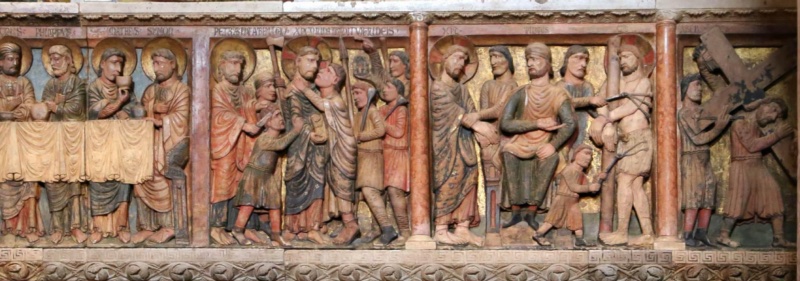
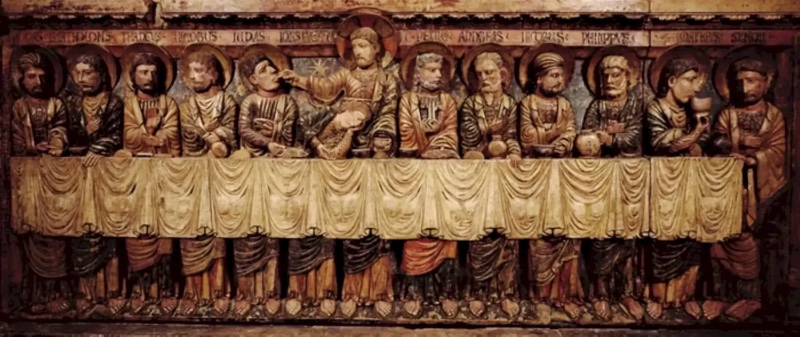
Anselmo da Campione’s pylon in Modena Cathedral is one of the great narrative masterpieces of Emilian Romanesque sculpture: carved in marble and dating from between 1175 and 1184, it depicts four continuous scenes from the Passion of Christ, to be viewed from left to right. The sequence includes the Last Supper, Judas’s kiss and the arrest, Christ before Pontius Pilate, and finally Jesus carrying the cross.
The relief unfolds beneath a series of small arches, which visually organizes the narrative and simultaneously unifies it into a single grand narrative episode. The division into successive scenes is not merely chronological: it also serves to guide the viewer’s eye along a theological path, from the initial communion to the condemnation and the sacrifice.
The Last Supper
The first scene depicts the central moment of the institution of the Eucharist, with the disciples gathered around the table and Judas placed in a particularly significant position, close to Christ. This iconographic choice accentuates the dramatic tension: Judas is not just another character among the others, but the one who already brings the seed of betrayal into the scene. The composition emphasizes the communal dimension of the banquet, but the presence of the traitor disrupts the group’s harmony from within. From a theological perspective, the scene juxtaposes two planes: sacramental communion and the future breaking of the covenant. The artist does not seek everyday naturalism, but rather immediate clarity, conveyed through the figures’ gestures and hierarchy.
The Kiss and the Arrest
The second scene condenses the episode in the Garden of Gethsemane: Judas’s kiss and Jesus’s arrest. Here, betrayal becomes a physical and visible gesture, transforming an act of false intimacy into the ultimate sign of moral dissimulation. The choice to unite the kiss and the capture in a single image intensifies the rapidity of the action and its dramatic charge. Narratively, the scene is constructed as a sudden shift from calm to conflict. The relief emphasizes the contrast between Christ, who appears as a stable and self-aware figure, and the figures involved in the arrest, driven by frenzied energy. In this way, the event is not rendered as a simple chronicle, but as a visible manifestation of the drama of salvation.
Christ Before Pilate
The third scene depicts Christ before Pontius Pilate, a moment of earthly judgment and a clash between truth and power. The episode introduces a shift in tone: from the violence of the arrest, the narrative moves to the institutional dimension of the trial. Pilate represents political authority, but the relief shows him in a subordinate position relative to the moral strength of the figure of Christ. Iconographically, this scene reinforces the idea of the Passion as an unjust trial. Christ is not depicted as a passive defendant in a merely narrative sense, but as the utterly innocent one, before whom the human court reveals its own inadequacy. The relief thus translates the theme of justice turned upside down into images.
Jesus Carries the Cross
In the final scene, Jesus carries the cross, that is, he enters the final stage of the Passion and moves toward the fulfillment of the sacrifice. It is an image of great spiritual intensity, because it unites the material weight of the cross with the redemptive meaning of the ordeal. After the betrayal and the trial, the figure of Christ focuses entirely on the salvific dimension of suffering. The scene closes the cycle with intense emotional tension: the movement of the body and the weight of the cross make the fatigue palpable, yet without diminishing the protagonist’s sacred dignity. In this way, the relief does not dwell on pathos, but rather on suffering that holds exemplary and theological value.
The work demonstrates the ability of Romanesque sculpture to blend narrative, symbolism, and religious instruction into an extremely clear language. Anselmo and his workshop organize the scenes with a rapid rhythm, making the narrative sequence a true tool for visual meditation. The result is a relief that does not merely illustrate the Gospel, but constructs a progressive spiritual journey, from the Eucharistic table to the road to Golgotha.
Terracotta pulpit
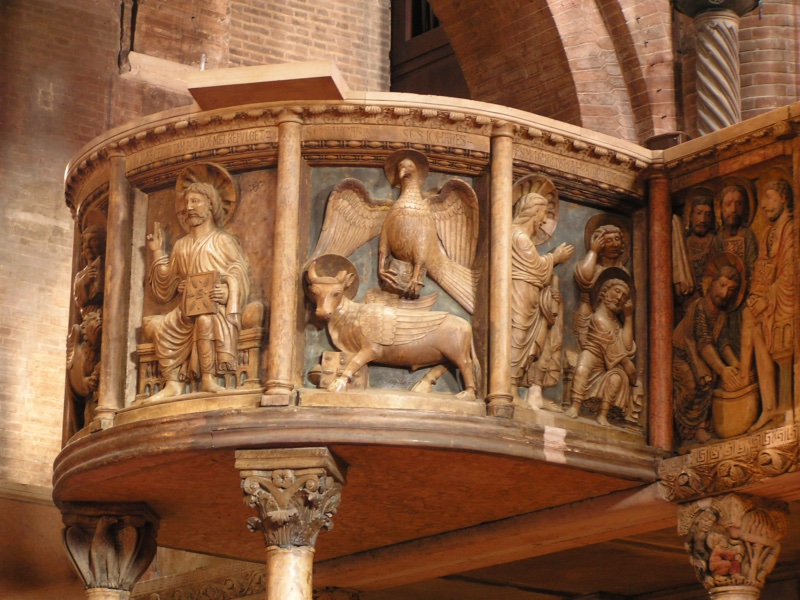
In the left panel, Christ is depicted seated on a throne, set within a slightly concave niche and separated from the other panels by slender columns that define the composition’s rhythm. The figure, depicted in full frontal view, with his right hand raised in a gesture of blessing and a scroll or book in his left, echoes the Byzantine type of the Pantocrator, but rendered with Lombard plasticity, broad volumes, and drapery with deep, rhythmic folds. The architectural throne, with hints of foreshortening, emphasizes Christ’s regal dignity and presents him as judge and teacher, in direct relation to the liturgical space below from which the deacon proclaimed the Gospel.
In the center is a panel dominated by two symbolic figures: an eagle and, beneath it, a winged calf (or ox), set against a smooth background that was once likely vividly painted. The eagle, with its imposing wingspan and arched neck, is the symbol of the evangelist John, while the winged calf alludes to Luke; Anselmo arranges them almost overlapping, creating a vertical composition that fills the space with great energy. The sculptural treatment emphasizes the broad surfaces and the curvilinear lines of the wings and the back, with a naturalism that is still sketchy but capable of a strong presence, in line with Romanesque sculpture from the Po Valley.
The pulpit originally featured the entire tetramorph, that is, the four living creatures of the Apocalypse interpreted as symbols of the four evangelists, placed alongside Christ in Majesty, according to an iconographic formula well attested between the 11th and 12th centuries. The inclusion of these symbols on a pulpit has an eminently theological significance: the Word proclaimed from the pulpit is that of the evangelists, who surround Christ and bear witness to him; their close arrangement makes them almost a heavenly court around the Lord.
On the right side of the image, one can glimpse the continuation of the balustrade, where the symbolic register of the Tetramorph gives way to narrative scenes from the life and Passion of Christ. The transition from Christ enthroned with the evangelists to the stories of his earthly life creates a conceptual progression: from the eternal judge and revealed truth, the narrative descends to the history of salvation, which the faithful contemplated while listening to the liturgical reading.
From a compositional standpoint, Anselmo maintains the modular rhythm marked by columns and arches, but within each panel he shifts from the static monumentality of Christ and the Tetramorph to the livelier bustle of the moving figures. The material is a warm, almost golden marble that interacts with the cathedral’s brick architecture and the interior light, enhancing the relief effect.
Research and restoration work have revealed traces of polychromy: the background was likely uniformly colored, while details such as halos, the outlines of garments, and anatomical features were likely highlighted by areas of color, making the whole more legible and solemn. The skillful use of the architectural framework—molding, columns, capitals—integrates the sculptures into the structural and metrical system of the presbytery, transforming the pulpit into a sort of small suspended sacred building.
Figures of Saints and Apostles
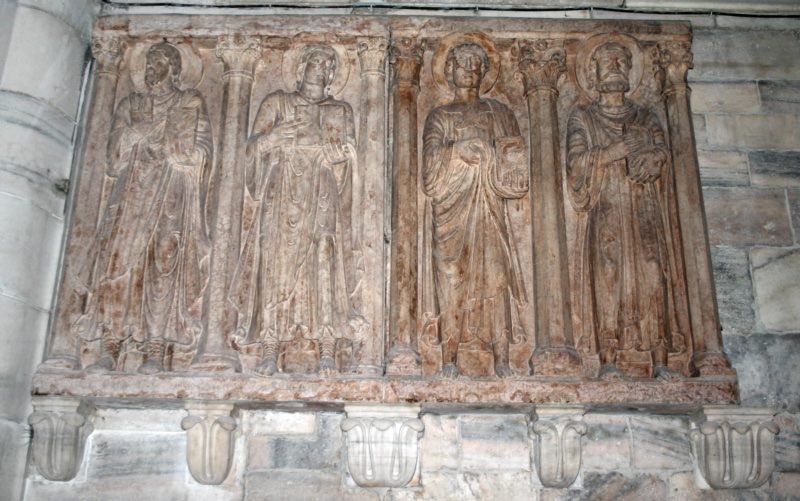
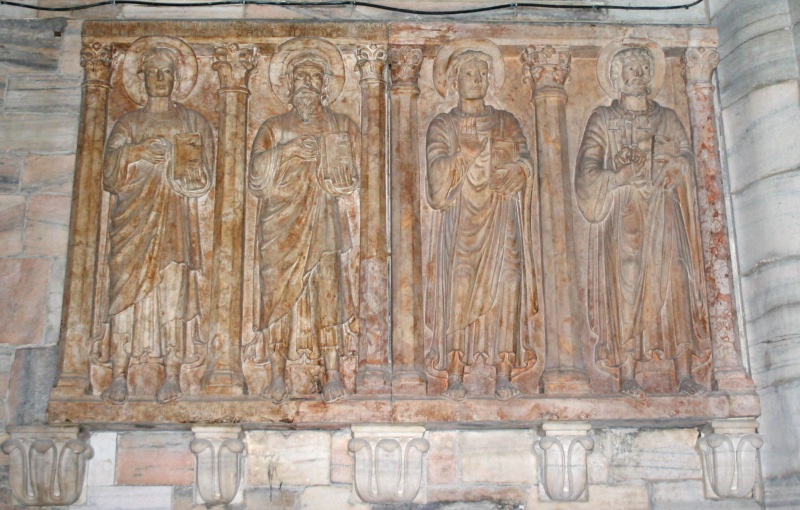
The two images show two rectangular marble reliefs, arranged symmetrically along an interior wall, featuring rows of four standing saints/apostles within architectural niches supported by small columns. Each slab is arranged as a continuous frieze: a base with small plinths, four frontal figures in very shallow high relief, columns with Corinthian or composite capitals, and round arches surmounted by a decorated band.
The panels appear to be carved from a single block of stone for each slab, with a rather shallow relief and largely “smoothed” surfaces, typical of Lombard Romanesque sculpture in the Campione tradition. The warm coloration, tending toward reddish-brown with light veins, suggests a local marble (likely a pinkish Lombard marble) rather than the white-gray Candoglia marble used in the Gothic construction of the Duomo; the use of a single slab for four figures indicates a cohesive project, conceived as a reused pluteus face or as a continuous frieze in its original form.
Each figure is depicted standing, wearing a long tunic and a cloak wrapped around the body, with feet resting on a small base set atop a continuous horizontal band. The proportions are elongated, with slender bodies, relatively large heads, and accentuated hands that emphasize the gesture of presenting a book or an attribute; this lends a solemn, hieratic air, typical of apostolic iconography. The garments feature vertical and diagonal folds that build the volume of the bodies through the overlapping of panels, with a fairly regular rhythm reminiscent of “organ pipes,” attributable to a mature phase of the Romanesque period, close to the culture of Wiligelmo and the Campionesi.
The two slabs originate from the Basilica of Santa Maria Maggiore, and today set into the walls of Milan Cathedral, in the baptismal area.
The Basilica of Santa Maria Maggiore in Milan, the basilica vetus, was the liturgical heart of the city for nearly a millennium before the Gothic Duomo, and its history is intertwined with that of the Romanesque reliefs you are studying. It was a layered cathedral, founded in the early Christian era, renovated in the Carolingian-Romanesque style, and finally sacrificed, beginning in 1386, to make way for the new Visconti cathedral.
Sources refer to Santa Maria Maggiore by its original names of basilica vetus or basilica minor, one of the first urban churches built in the sacred area that would later become Piazza del Duomo. In late antiquity, the area housed an episcopal complex comprising several buildings: the winter cathedral (Santa Maria Maggiore), the summer cathedral (Santa Tecla), and two separate baptisteries, San Giovanni alle Fonti and Santo Stefano. The basilica vetus was thus one of the original seats of the Bishop of Milan, serving as a liturgical and political focal point for the city’s Christian community. Topographically, it stood exactly where the Gothic cathedral stands today, so much so that part of its remains is still visible in the Duomo Archaeological Area.
A major renovation of the ancient basilica was carried out by Bishop Angilbert I (9th century), who promoted a structural renewal befitting the growing prestige of the Ambrosian see. It was during this phase that the church formally assumed the title of Cathedral of Santa Maria Maggiore, abandoning the simple designation of basilica vetus. The work was completed under his successor, Angilbert II, who reconsecrated the building in 836, giving the cathedral an updated layout in a style that sources describe as “Romanesque and Gothic” in the broad sense—that is, featuring more complex structural elements and a renewed decorative scheme. With these transformations, Santa Maria Maggiore became a true cathedral in every sense, the venue for numerous solemn functions and the focal point of the city’s celebrations.
Before the Gothic Duomo, Milan had a “dual cathedral” system: Santa Maria Maggiore served as the winter cathedral, while Santa Tecla functioned as the summer cathedral. This arrangement, common in some late-antique and early-medieval cities, was driven by both liturgical and practical reasons, linked to the seasonal use of spaces and the differing capacities of the basilicas. The two complexes shared the episcopal area and the baptisteries, creating a veritable layered sacred quarter in the city center. It was precisely from this nucleus that the decision arose, in the 14th century, to build a single enormous cathedral that would absorb and surpass both of the ancient churches.
In 1386, the collapse of the bell tower (1353) and the progressive deterioration of the structures made the need for a radical intervention in the cathedral area evident. Archbishop Antonio da Saluzzo, with the political support of Gian Galeazzo Visconti, decided to build a new and larger cathedral, the future Metropolitan Cathedral of the Nativity of the Blessed Virgin Mary. The resolution of May 12, 1386, established that the new building was to be erected exactly where the ancient basilicas of Santa Maria Maggiore and Santa Tecla stood, thus marking the beginning of a gradual demolition of the previous structure.
In this context, Santa Maria Maggiore was “incorporated” into the construction site, used partly as a service structure and partly as a storage area for materials and furnishings, before being definitively sacrificed. The demolition of Santa Maria Maggiore was not immediate: the church continued to coexist for decades with the Duomo construction site, being dismantled in phases. The basilica’s façade, in particular, was used for a long time as a temporary façade for the new cathedral, serving as a temporary closure of the construction site facing the square. Sources note that this “ancient” façade remained in use for decades and was finally demolished in 1638, when a more permanent arrangement of the cathedral’s front was implemented. At the same time, stone elements and liturgical furnishings—such as the Romanesque reliefs depicting saints holding books, now embedded within the cathedral—were reused in the new structure, thus preserving material fragments of the memory of Santa Maria Maggiore.