Maestro di Galliano
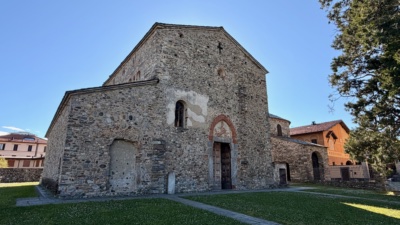
The Maestro di Galliano, known in Italian art historical scholarship also as the Magister Gallianensis, is a conventional designation assigned by modern critics to an anonymous painter of extraordinary accomplishment active in the Lombard region of northern Italy at the very turn of the eleventh century, roughly between the years 995 and 1015 CE. He is known exclusively through the monumental fresco cycle adorning the apse, triumphal arch, and parts of the nave of the Basilica of San Vincenzo at Galliano, a hamlet today forming part of the commune of Cantù in the province of Como, Lombardy. His works constitute the most significant surviving ensemble of Ottonian-influenced monumental painting on Italian soil, and they have attracted sustained scholarly attention since the pioneering studies of Pietro Toesca in the early twentieth century.
Origins and Identity
As is customary with the convention of the nomine artis, the designation “Maestro di Galliano” reflects not a documented biographical fact but a critical construct: the artist’s actual name, lineage, and personal history remain entirely unknown. No notarial records, episcopal registers, or workshop documents of the Milanese Ambrosian church or the pieve of Cantù have been found to identify him. His very existence is known only through the painted surface of the basilica’s walls, and the scholarly literature, from Toesca (1912) to de Francovich (1942–1944), Salvini (1954), and the Treccani Enciclopedia dell’Arte Medievale (1995), has consistently treated him as one of the most accomplished anonymous masters of his era.
Family and Origins
Given the total absence of documentary evidence, the painter’s birth, family background, and personal biography can only be reconstructed through the evidence of his style, his technique, and the historical context within which the Galliano frescoes were executed. What can be inferred with scholarly confidence is that he was born, most plausibly, sometime between approximately 960 and 980 CE, placing his active career squarely within the cultural horizon of Ottonian patronage and trans-Alpine artistic exchange. Scholars have proposed, on the basis of stylistic comparison, that he may have been of Lombard origin, formed in a workshop environment with access to manuscript models connected to the great Ottonian scriptoria of the Rhineland and Lake Constance regions, above all that of Reichenau. The geographical proximity of Cantù and Galliano to the major trans-Alpine routes of northern Lombardy — routes connecting the Lombard plain to the imperial territories of the German kingdom — renders plausible the hypothesis that the painter or his workshop had sustained contact with artists and manuscripts arriving from the north.
Nothing in the frescoes themselves suggests a workshop product of purely local, provincial character; on the contrary, the exceptional command of volumetric modelling, the sophisticated handling of color gradation, and the assured deployment of Ottonian iconographic programs all speak to a painter trained in a milieu of high institutional culture, most likely connected to a cathedral chapter, a monastery, or a court workshop. The artistic culture of Lombardy in the decades around the year 1000 was profoundly shaped by the patronage networks of Archbishop Arnulf II1 of Milan and, subsequently, of Ariberto da Intimiano2 himself, both figures who cultivated direct relations with the Ottonian imperial court and its artistic satellites. Within this network, a painter of the Maestro di Galliano’s calibre would almost certainly have been embedded in an ecclesiastical or courtly structure that provided not only the physical means of patronage such pigments, scaffolding, preparatory drawings, but also the intellectual programs defining the iconographic content of each cycle. The question of whether he led a workshop with apprentices, as was standard practice in the period, cannot be resolved definitively; however, the fact that the nave frescoes at San Vincenzo, though roughly contemporaneous with the apse paintings, betray a markedly inferior hand strongly implies that the Maestro di Galliano did not execute the entire cycle alone, and that lesser-trained collaborators or pupils worked alongside him, at least in the nave.
It is equally plausible that the painter had received his initial formation within the context of a monastic scriptorium, where illuminated manuscripts would have served as primary models for the compositional schemas, figure types, and decorative borders that appear so prominently in his work. The close correspondences between the Galliano frescoes and the manuscript illuminations produced at the Reichenau school — particularly the Gospel Book of Otto III and the Bamberg Apocalypse — suggest a formative exposure to these models, whether through direct knowledge of the manuscripts, through pattern books derived from them, or through an intermediary encounter with painters trained in the Reichenau tradition. The socio-economic status of the artist’s family of origin is, naturally, entirely undocumented; yet the intellectual scope and formal sophistication of the Galliano frescoes imply a painter who had benefited from prolonged and structured artistic education, which in this period was almost exclusively available through ecclesiastical institutions, whether monastic or cathedral. It is tempting to imagine — though it cannot be proven — that the painter may himself have been a cleric in minor orders, as was not unusual for artists working within episcopal and monastic patronage networks of the Ottonian period; such status would have facilitated his engagement with the learned iconographic programs, dense with patristic and liturgical resonances, that characterize the Galliano apse.
The family’s geographical provenance remains equally obscure. Some scholars have suggested a possible formation in the Milanese area, given the cultural hegemony of the Ambrosian metropolis over the entire region of Lombardy in the early eleventh century. Others, noting the parallels with trans-Alpine painting, have proposed a possible period of training north of the Alps, or at the very least an origin in the border regions of the Italian-Germanic cultural continuum, perhaps in the area of the Lombard lakes, the Ticino valley, or the Lake Constance basin, where Ottonian and Lombard traditions interpenetrated most productively. The hypothesis of a Comasco or broadly Lombard origin remains the most widely accepted in the scholarship, consistent with the painter’s likely familiarity with local topography, the Ambrosian liturgical tradition that shaped the apse’s iconographic program, and the probability that his selection for the Galliano commission reflected personal or professional proximity to the patron Ariberto da Intimiano and his circle.
Patronage and the Commission of Ariberto da Intimiano
The frescoes of San Vincenzo at Galliano owe their existence to one of the most powerful and cultivated ecclesiastical patrons of eleventh-century Italy: Ariberto da Intimiano, a figure of towering importance in the political and cultural life of the Ottonian-Salian world.
The consecration of the newly expanded and decorated basilica took place on 2 July 1007, a date recorded in a marble inscription of cipollino stone still preserved in the church and commemorating both the dedication of the building and the translation of the relics of the sub-deacon Adeodato, whose tomb Ariberto had discovered during excavations. The inscription identifies Ariberto explicitly as suddiacono Sanctae Mediolanensis Ecclesiae et custodis istius ecclesiae (subdiakon of the Ambrosian church and guardian of the Galliano pieve) confirming that the fresco commission predates his elevation to the archbishopric of Milan, which occurred only in 1018. The patronage relationship between Ariberto and the Maestro di Galliano must therefore have been established sometime between 998 and 1007, during the years of Ariberto’s custodianship, when the architectural expansion of the basilica’s eastern section — apse, raised presbytery, and crypt — was undertaken as a coherent building campaign.
The long inscription running across the lower register of the apse, partially damaged but still legible in key portions, preserves a phrase — “EGO ARIBERTVS SVBDIACO[NVS] […] AC PINGERE FECIT” — that scholars including Ansaldi and Lampugnani have read as evidence that Ariberto functioned not merely as financial patron but as the intellectual architect of the decorative program, defining its theological content and likely collaborating closely with the painter in shaping the iconographic choices. Such a degree of patron involvement was not unusual in the Ottonian world, where high-ranking ecclesiastics with theological education routinely devised the complex programs of their commissions; the parallel with Archbishop Egbert of Trier or Bishop Bernward of Hildesheim — both documented as active participants in the design of their artistic programs — is instructive. The program Ariberto devised is rich in eschatological imagery centered on death, resurrection, and eternal life, themes with personal urgency given the funerary dimension of the church; the choice of subjects — from the Theophany in the apse calotte to the martyrdom cycle of St. Vincent of Saragossa and the presentation of Ariberto by St. Adeodato to Christ — reflects a coherent theological argument about intercession, sanctity, and the pathway to salvation.
The figure of Adeodato, the fifth-century subdeacon whose relics were translated on the day of consecration, occupies a pivotal role within the patronage narrative: Ariberto, having misread the funerary inscription as “SANCtus Martir” rather than “SANCtae Memoriae”, elevated Adeodato to the status of a local saint and chose him as his personal intercessor, commissioning the painter to depict the saint formally presenting the kneeling Ariberto to the enthroned Christ. This donator portrait showing Ariberto in profile, with tonsured head, large intense eyes, aquiline nose, and fleshy lips, wearing an ochre chasuble over a long white dalmatic, his arms extended to offer the church model, is one of the earliest and most detailed portrait commissions in Lombard art, and it reveals the degree to which the patron shaped the very pictorial agenda of the cycle. The church model held in Ariberto’s hands, viewed from the east and showing a longitudinal body with gabled roof, bell tower, and quadriportico (all now lost), constitutes a remarkable document of the architectural intentions of the patron as well as an act of symbolic self-presentation characteristic of the Ottonian ecclesiastical elite.
Ariberto’s later career — he became Archbishop of Milan in 1018 and held the see until his death in 1045, exercising jurisdiction over approximately twenty bishoprics and acquiring the right to crown the kings of Italy — confirms that the Galliano commission was the product of an exceptionally ambitious patron at an early stage of a career that would place him among the most powerful men in northern Italy. His artistic patronage did not end at Galliano: he is also associated with the celebrated Croce di Ariberto, a processional cross preserved in the Duomo of Milan, and with major interventions at the Cathedral of Milan and the church of Sant’Ambrogio. The selection of the Maestro di Galliano for the apse commission — the most prestigious and theologically charged portion of the decorative program — therefore reflects not a casual or merely local choice but the deliberate engagement of a patron of pan-European cultural ambition with a painter capable of translating that ambition into an image of the highest artistic quality available in northern Italy at the time.
Painting Style
The painting style of the Maestro di Galliano represents one of the most accomplished syntheses of Ottonian and late antique traditions achieved on Italian soil, and its analysis has occupied art historians from Toesca’s foundational La pittura e la miniatura nella Lombardia (1912) to the most recent contributions of the Treccani Enciclopedia dell’Arte Medievale (1995). The defining characteristic of his style is the extraordinary treatment of volume and corporeality: the figures of Christ, the archangels, the prophets, and the martyred saint are rendered with a dynamic volumetric presence — achieved through a system of bold, almost metallic highlights applied over deeply shadowed forms — that sets the Galliano apse entirely apart from the flatter, more linear conventions of contemporary Lombard painting. This technique of violent, contrasting illumination, in which the lights are not softly blended into the darks but applied in sharp, almost sculptural strokes, creates an effect of intense plasticity that de Francovich aptly described as generating a dimension that is simultaneously hyper-real and metaphysical, as if the painted figures inhabit a space beyond ordinary human experience.
The color palette employed by the Maestro di Galliano is bold and architecturally conceived, organized around strong contrasts of deep crimson, ultramarine blue, ochre, and white, with passages of gold-tinged highlights — particularly visible in the treatment of Christ’s mandorla, which radiates polychrome bands of light symbolizing the divine effulgence of the Theophany. The compositional structure of the apse calotte is hierarchically ordered in the manner of Byzantine Pantokrator programs, yet it avoids the static frontality of strict Byzantine convention: the archangels turn slightly toward the viewer, the prophets Jeremiah and Ezekiel prostrate themselves in attitudes of dynamic reverence, and the assembled saints form rhythmically varied groups on either side of the mandorla, creating a sense of ceremonial movement appropriate to the liturgical event being depicted. The Christ figure itself — standing rather than enthroned, enclosed within the polychrome mandorla and holding in his left hand the open book inscribed “PASTOR OVIVM BONVS” while extending his right in a gesture of welcome and blessing — conveys both divine authority and pastoral accessibility, a theologically nuanced combination that reflects the Ambrosian liturgical tradition and its particular reading of the Johannine Good Shepherd image.
In the lower register of the apse semi-cylinder, the narrative scenes of the martyrdom of St. Vincent of Saragossa display a remarkable capacity for dramatic storytelling within the constraints of a highly conventionalized formal language. The figures of the tormentors, executioners, and the suffering saint are depicted with vigorous, if sometimes angular, anatomical conviction, their gestures communicating narrative urgency without sacrificing the solemnity appropriate to a martyr’s passio. The treatment of the architectural setting in these narrative scenes — columns, arches, curtains — reveals a painter familiar with the repoussoir conventions of late antique painting, in which fictive architectural frames create spatial depth and serve as visual metaphors for the sacred space of the narrative. The decorative borders framing each scene — running meanders in perspective, geometric interlace, stylized foliate motifs, and animal figures — demonstrate a mastery of ornamental vocabulary drawn from multiple sources including Roman, Lombard, and Ottonian decorative traditions, and they contribute to the visual richness and formal coherence of the ensemble.
In marked contrast to the exceptional quality of the apse frescoes, the painters responsible for the nave decoration at Galliano — working on a three-register program on both the north and south walls, with scenes from the stories of Adam and Eve, Samson, St. Christopher, and possibly Judith — operate within a more conservative stylistic register, their figures less volumetrically convincing, their compositions more rigidly aligned to earlier Lombard pictorial conventions. This disparity is not merely a question of secondary execution within a single campaign: it reflects the involvement of painters from a different cultural and technical background, likely local Lombard craftsmen working within the broader tradition of the pre-Ottonian Lombard pictorial culture that Toesca associated with the decorations of Sant’Ambrogio and related Milanese monuments. The Maestro di Galliano may have supervised these painters but did not execute their work, focusing his own activity on the apse and triumphal arch — the liturgically and theologically primary spaces — with the result that the Galliano ensemble preserves in miniature the stratification of artistic quality characteristic of large-scale medieval patronage programs.
The proportional system adopted by the Maestro di Galliano for his principal figures is neither classicizing nor abstractly elongated, but rather reflects the Ottonian preference for a monumental, slightly stocky figure type — broad-shouldered, with large heads, strong hands, and feet firmly planted — that communicates physical authority and spiritual weight simultaneously. The drapery folds are rendered with a distinctly linear emphasis overlaid on a volumetric underpinning: deep valley folds articulated by dark lines alternate with broad, light-struck crests, creating a textile surface that is simultaneously descriptive of physical weight and expressive of spiritual grandeur, a convention closely paralleled in the illuminations of the Reichenau school. The inscriptions integrated throughout the frescoes — identifying figures, recording theological statements, and commemorating the patron — are rendered in a fine, controlled capital hand consistent with a painter trained in a scriptorium environment, further reinforcing the hypothesis of a formation within an ecclesiastical center of high literacy.
Artistic Influences
The artistic influences shaping the Maestro di Galliano’s style are multiple and layered, drawing from the most dynamic cultural currents in circulation across northern Italy and the trans-Alpine world in the decades around the year 1000. The most consistently identified source of influence is the Reichenau school of manuscript illumination and monumental painting, centered on the Benedictine island abbey on Lake Constance, which was during precisely this period one of the foremost artistic workshops in Europe, producing for the Ottonian emperors Otto III and Henry II a series of manuscripts, including the Gospel Book of Otto III, the Bamberg Apocalypse, and the Gospel Lectionary of Henry II, of extraordinary formal and iconographic sophistication. The connection between Galliano and Reichenau has been stressed by de Francovich (1942–1944, 1955) and Salvini (1954), both of whom noted the formal parallels in the treatment of the Christ figure, the archangels, and the overall Majestas composition, as well as the shared vocabulary of dynamic highlighting and bold contour work. The frescoes at St. George’s, Oberzell (Reichenau), though dated somewhat earlier (c. 980–1000 CE), represent the closest surviving monumental parallel to the Galliano apse in terms of both figure style and compositional ambition, their scenes of Christ’s miracles rendered with a closely analogous system of plastic modelling and expressive gesture.
A second, equally important current of influence is the Byzantine tradition, mediated through both direct contact with Byzantine artistic production and through the Ottonian manuscripts that had themselves absorbed and transformed Byzantine formal conventions. The hierarchical ordering of the Theophany composition — the enthroned or standing Christ in mandorla surrounded by angelic and saintly hosts — is rooted ultimately in Byzantine Pantokrator programs of the type visible in the great mosaic cycles of Southern Italy, Sicily, and Byzantium itself, and it was precisely through the channel of Ottonian court culture, which had sustained intense diplomatic and artistic relations with Constantinople since the reign of Otto II’s Byzantine wife Theophanu (married 972 CE), that these iconographic models reached northern Italy. The late antique and Early Christian tradition of northern Italy — particularly the monuments of Ravenna, Milan, and the lake region — constitutes a third formative layer; the Galliano frescoes preserve traces of the Ambrosian pictorial tradition in both their use of architectural repoussoir framing and in their treatment of narrative space, which does not entirely abandon the late antique pictorial illusionism visible in Milanese monuments such as Sant’Ambrogio and the early Christian baptisteries.
Alongside these trans-Alpine and Byzantine currents, the painter was clearly conversant with the indigenous Lombard pictorial tradition of the ninth and tenth centuries, a tradition visible in the frescoes of San Salvatore at Brescia, Sant’Ambrogio at Milan, and the related cycles studied by Toesca and Bertelli. While the Maestro di Galliano surpasses his Lombard predecessors in formal achievement, he does not reject their conventions entirely but rather integrates them selectively, retaining certain compositional schemas while elevating them through the infusion of Ottonian volumetric energy. The Maestro di Pedret, a painter active in Catalonia at approximately the same period and showing closely related stylistic characteristics, has often been discussed in connection with the Galliano master (de Francovich, 1955; the academic debate documented by the Academia.edu paper on the Pedret master), and the relationship between these two personalities — whether direct or mediated through shared models — remains one of the most productive questions in early Romanesque painting scholarship. The iconographic program of the Galliano apse also betrays familiarity with the Ambrosian liturgical tradition and its specific readings of scripture and hagiography, suggesting that the painter’s formation included exposure to the textual culture of the Milanese church — the Liber Notitiae Sanctorum Mediolani, the Acta Sanctorum of St. Vincent, and the exegetical tradition surrounding the figures of Elijah and Enoch depicted on the triumphal arch — which in turn influenced the pictorial syntax of the cycle.
The influence of Ottonian goldsmith work and metalwork — a tradition of extraordinary refinement in the early eleventh century, as attested by monuments such as the Croce di Ariberto itself and the altar frontals associated with Emperor Henry II — may also have played a role in shaping the Maestro di Galliano’s distinctive practice of applying highlights with an almost metallic precision, creating luminous passages that recall the visual effect of gilded and engraved metal surfaces. The term “metallic highlights” used by de Francovich and reproduced in the Treccani entry is thus not merely a descriptive metaphor but points to a genuine cross-media influence, reflecting the fact that in the Ottonian court culture gold and ivory, enamel and pigment, were not separate domains but parts of a single visual project of imperial and ecclesiastical glorification. Finally, the decorative vocabulary of the frame borders — interlace, running meanders, geometric patterns, and heraldic animals — reflects the assimilation of Lombard and Carolingian ornamental traditions deeply rooted in the visual culture of northern Italy, connecting the Galliano paintings to the long heritage of Wechselwirkung between Mediterranean and northern European art that had defined Lombard artistic production since the age of the Liutprandic renaissance in the eighth century.
Travels and Cultural Mobility
The question of the Maestro di Galliano’s travels is inseparable from the broader question of how artistic knowledge circulated in the Ottonian-Lombard cultural world of the early eleventh century, a world in which ideas, models, and trained painters moved along the networks of dynastic politics, ecclesiastical administration, and pilgrimage. The formal evidence of the Galliano frescoes strongly implies that the painter had direct or near-direct knowledge of Ottonian monumental painting traditions, most plausibly those associated with the Reichenau atelier and its closest satellites; the question of whether this knowledge was acquired through personal travel to the Rhine-Meuse region, through access to portable models such as illustrated manuscripts, or through contact with painters trained in those traditions is one that the documentary silence of the sources leaves permanently open. The trans-Alpine routes crossing the Lombard plain — the Septimer Pass, the Maloja, the Gotthard, and the Brenner — were in constant use during the Ottonian period by imperial embassies, ecclesiastical legates, and cultural intermediaries of every description, and the area around Como, Lake Maggiore, and the Ticino valley stood directly astride these routes; a painter of the calibre of the Maestro di Galliano working in this geographical context would have had regular access to materials, models, and colleagues arriving from the north.
It is equally plausible that the painter was himself involved in travels connected to the extensive building campaigns and decorative programs that characterized the Ottonian patronage network in northern Italy during the years around 1000 CE. Ariberto da Intimiano’s own later career as Archbishop of Milan involved sustained contact with the imperial court and its artists, and it is not unreasonable to suppose that the painter who executed the Galliano apse may have been part of the broader cultural retinue of ecclesiastical patrons who commissioned works across multiple sites in Lombardy and the adjacent territories. The stylistic parallels between the Galliano frescoes and those at San Pietro al Monte at Civate (near Lecco), where scenes from the Apocalypse, the Samson cycle, and the Theophany are painted in a closely related Ottonian idiom, have led several scholars to suggest that the Maestro di Galliano, or painters trained in his workshop, may have been responsible for at least portions of the Civate cycle — a hypothesis that, if confirmed, would imply a degree of geographical mobility within the Lake Como and Brianza region. The fresco cycles at Sant’Ambrogio in Milan, at San Calocero in Civate, and at related sites in the broader Ambrosian diocese reflect the pervasive activity of high-quality painters working across an interconnected network of episcopal and monastic patrons in the early eleventh century, a network within which the Maestro di Galliano would have been a prominent, if anonymous, figure.
The question of whether the painter undertook longer journeys — to Rome, to Ravenna, to the Byzantine-influenced centers of Southern Italy, or even across the Alps to the Rhine-Meuse heartland of Ottonian culture — cannot be answered with any certainty on the basis of existing evidence. What can be said is that the geographical mobility of court painters and cathedral workshop masters in the Ottonian period was considerably greater than was once assumed by earlier scholarship, and that the circulation of large luxury manuscripts — above all the Gospel books and sacramentaries of the Reichenau and Cologne schools — as diplomatic gifts and episcopal commissions meant that even a painter who never crossed the Alps could gain detailed knowledge of the latest developments in Ottonian painting through the study of portable originals. The evidence of the Galliano apse is ultimately consistent with either interpretation — direct travel or access to portable models — and the scholarly literature has not reached a definitive conclusion on this point, leaving open the tantalizing possibility that the Maestro di Galliano was one of those remarkable trans-Alpine cultural mediators who made the art of the year 1000 one of the most geographically interconnected visual cultures in pre-modern European history.
Death
As with the painter’s birth and family, no documents record the date or circumstances of the Maestro di Galliano’s death. Given the probable chronology of his formation (c. 960–980) and the dating of the Galliano frescoes (c. 995–1007), a date of death somewhere in the first two to three decades of the eleventh century — perhaps between 1010 and 1030 CE — is plausible on purely demographic grounds, consistent with a lifespan of fifty to seventy years. The cause of death is wholly unknown. No other works have been conclusively attributed to this hand after the Galliano commission, though the debated attribution of portions of the Civate and related cycles, if accepted, would suggest continued activity into the second decade of the century. With his death, the particular synthesis of Ottonian and late antique traditions that he had achieved at Galliano appears to have left no direct heir in Lombard painting, marking the close of one of the most brilliant episodes of medieval painting in northern Italy
Principal Works
The Theophany (Christ in Majesty)
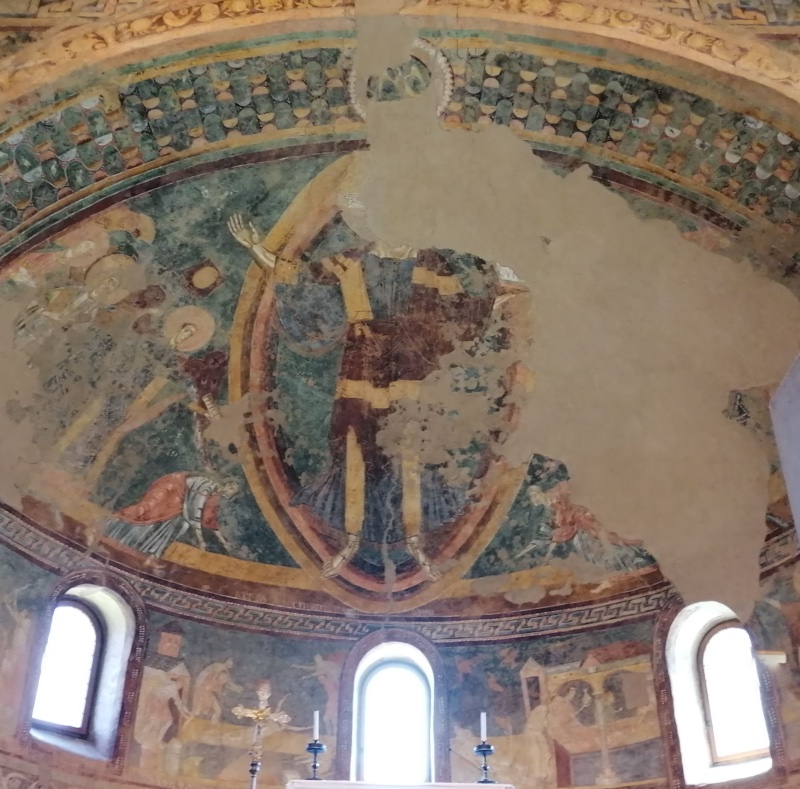
At the center of the apse semicircle, a Maiestas Domini unfolds in commanding fashion: Christ stands frontally within a polychrome mandorla, clothed in imperial robes, his right arm raised in address and his left hand bearing an open book. Converging toward him at diminished scale, the prophets Jeremiah and Ezekiel prostrate themselves in reverence, while behind them the archangels Gabriel and Michael preside over processions of martyr saints bearing crosses and crowns. The fresco’s right portion has been almost entirely lost, along with the Savior’s face and much of the book’s text — details recoverable today only through nineteenth-century watercolor documentation.
The scene’s theological program is articulated through its painted inscriptions. The verses on the open book invoke Christ’s mercy through the image of the Good Shepherd (John 10:2, 11, 14), while the hexameter running beneath the mandorla frames his kingship in explicitly military language, drawing on Psalm 79’s prayer for divine salvation. This invocation is further confirmed by the scrolls carried by the two Archangels. Technically, the cycle was executed in fresco with lime and dry finishing touches, and its original chromatic impact must have been considerable — hematite reds and lapis lazuli blues generating a vibrancy still partially legible today.
Stylistically, the cycle stands among the finest achievements of Romanesque monumental painting. Its monumentality, controlled dynamism, and sensitivity to facial expression reveal master craftsmen deeply conversant with Roman, Northern European, and Byzantine models — an artistic formation entirely consistent with the visual culture of Ottonian imperial patronage. The work’s date, together with that of the architectural fabric itself, can be firmly placed no later than 1007, the year the building was consecrated at the initiative of the custos Ariberto da Intimiano.
The Torture of Saint Vincent with Molten Lead
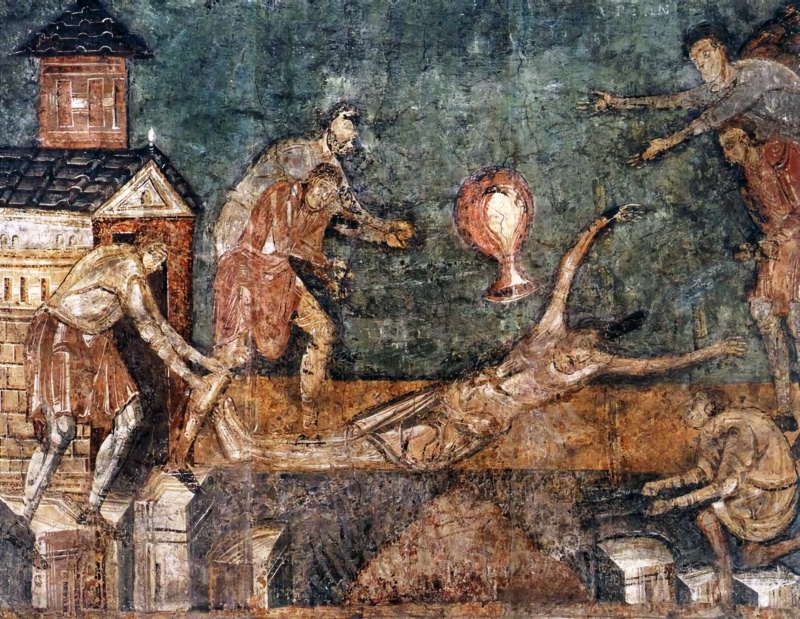
The scene depicting the torture of Saint Vincent with molten lead occupies the entire section between the north and east windows. The composition is dominated by the saint’s recumbent body, with his feet together and arms outstretched, in a typological allusion to the Crucifixion of Christ. Surrounding him are several torturers intent on inflicting his martyrdom, working to hold the protagonist still and to heat a vessel containing molten lead, which is then poured over his body; in the upper right, there was originally a group of Christians, now recognizable as a single figure extending his arms toward the saint. The scene is set within a well-constructed setting, featuring rocks and civil architecture in the background, while an explanatory inscription appears on the frame below.
The narrative nature of the theme allowed the artists working on this entire series to create figures imbued with a strong dynamism, in contrast to the solemn monumentality that characterizes the Maiestas Domini in the apse semicircle, which is nonetheless the work of the same craftsmen. The source that inspired the episode was traced only recently: it is an abridged version of the Life of Saint Vincent preserved in an early medieval codex housed at the Biblioteca Ambrosiana in Milan. Although a considerable portion of the pigments has fallen off, the paintings are in fairly good condition and do not exhibit extensive gaps, thanks in part to the fact that they were not detached, unlike the paintings in the nave.
Ariberto of Intimiano presents the model of the basilica
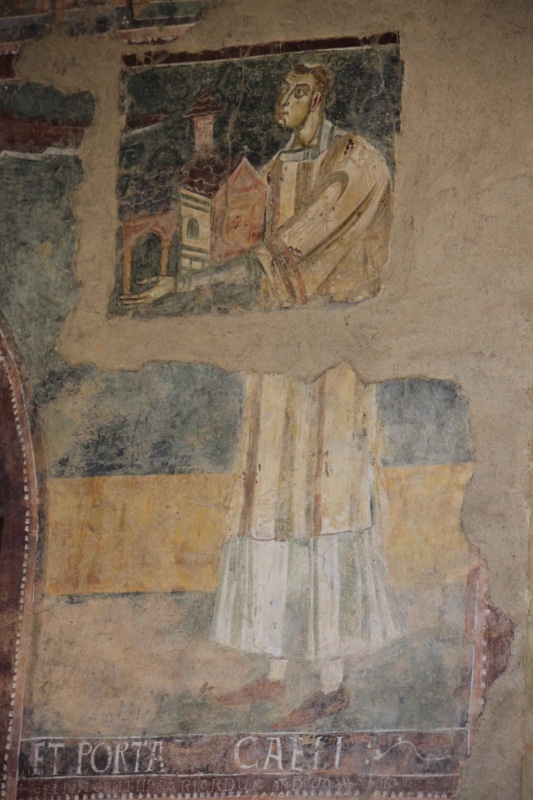
The southernmost section of the fresco cycle, executed no later than 1007 alongside the rest of the program, portrays Ariberto da Intimiano, the basilica’s patron. Originally identified by inscriptions that have since disappeared, he stands in three-quarter profile dressed in the canonical vestments of a subdeacon — a green tunic, yellow dalmatic, and red shoes — turning toward the enthroned Christ in Majesty within the apse semicircle and presenting a model of the building he commissioned.
Note the presence of the bell tower, commissioned by the prelate but no longer standing today, as well as the atrium, which has also been demolished. The fresco bears a caption, on a white band, consisting of a long, fragmentary inscription in red capital letters. It reads, among other things, the statement attributing the work: AD HONOREM DEI EGO ARIBERTUS SUBDIACONUS [FIERI] AC PINGERE FECIT, that is : to the honor of God, I, Aribertus, subdeacon, had [this] made and painted. The upper part of the fresco was detached in 1850 and transported to the Pinacoteca Ambrosiana in Milan.
The fresco’s remarkable state of preservation makes it possible to read both formal and technical details with unusual clarity, revealing the artists’ extensive reliance on a mixed technique. More strikingly, it allows one to appreciate what is arguably the cycle’s finest achievement: the monumental bearing of the figure and the expressive intensity of the face betray painters deeply rooted in the classical tradition yet fully attuned to the broader artistic currents moving through the Western world at the turn of the millennium. Though the painted tituli are lost, several obituary graffiti relating to Ariberto and three of his relatives remain legible on the wall surface.
-
Arnolfo II was born into the noble Lombard family of the Arsagos, a distinguished lineage originating from the area north of Milan, near the Ticino River. He was the son of Dagiberto d'Arsago, and his family played a leading role in both ecclesiastical and political affairs in the region. Two of his brothers also entered the Church: Landolfo d'Arsago became bishop of Brescia, while Lanfranco d'Arsago was the maternal grandfather of the renowned scholar Anselmo di Besate, underscoring the family's deep ties to Lombard intellectual and religious culture.
Arnolfo II was appointed Archbishop of Milan in 998, succeeding Landolfo II of Carcano, and presided over the see for twenty years until his death in 1018. His tenure coincided with one of the most turbulent periods in Italian political history, characterized by the clash between imperial ambitions and local dynastic struggles. As archbishop, he held a position of immense prestige — Milan was the principal metropolitan see of northern Italy, with deep roots in the Ambrosian tradition — and was consequently involved in the highest circles of imperial diplomacy.
In 1001, the Holy Roman Emperor Otto III, who was residing in Rome, entrusted Arnulf II with a mission of exceptional delicacy: a diplomatic journey to Byzantium to negotiate the marriage of a Byzantine princess to the emperor. This mission placed Arnulf II at the crossroads of Latin and Byzantine power at a crucial moment. However, while returning to Rome, he received news of Otto III's sudden death in January 1002, which rendered the betrothal mission futile and plunged the empire into a succession crisis.
When the succession crisis erupted, Arnulf II firmly sided with Henry of Saxony — the future Henry II, Emperor of the Holy Roman Empire — against Arduino of Ivrea, the Italian magnate who had been crowned King of Italy in Pavia. This was a significant political commitment, as Arduino enjoyed substantial support among the Italian nobles who resisted the renewed German imperial presence. After Henry prevailed over Arduino, Arnulf II traveled personally to Pavia to crown Henry as the new King of Italy on May 15, 1004, an act of great liturgical and symbolic importance that publicly affirmed Milan's loyalty to the Ottonian-Salian imperial order.
Arnulf II died in Milan on February 25, 1018. He was succeeded as archbishop by Ariberto da Intimiano (1018–1045), who would become one of the most powerful and controversial figures in Milanese ecclesiastical history. Arnulf II's pontificate is documented in the chronicle Liber gestorum recentium by Arnulf of Milan, the 11th-century historian who — though not the same person as the archbishop — provides valuable eyewitness testimony and an almost contemporary perspective on this era of Milanese history. His archbishopric represents a crucial turning point in relations between the Lombard Church and the Holy Roman Empire on the eve of the Investiture Controversy.
↩ -
Ariberto da Intimiano is one of the most commanding figures in the ecclesiastical history of medieval Milan — a prelate of enormous political energy, theological resolve, and artistic vision who shaped the city's identity for the entire first half of the eleventh century.
Ariberto was born between 970 and 980 in Intimiano, a small locality near Cantù in Brianza, from a noble Lombard family of the capitanei — the highest rank of episcopal vassals — which held land in the Bergamasco territory and took its name from its ancestral curtis at Intimiano. He entered the Milanese clergy and rose to become its most prominent member: a Saxon chronicle, the Annalista Saxo, describes him as praepositus of the Milanese Church, indicating he was its leading cleric even before his election. On 28 March 1018, with the endorsement of Emperor Henry II and the city's great nobles, he was consecrated Archbishop of Milan, succeeding Arnulf II. The historian Yves Renouard judged him bluntly: "Aribert was one of the greatest politicians of 11th-century Italy".
When Conrad II of Germany came to claim the Italian crown, Ariberto traveled to Konstanz in June 1025 to pay homage and secured important privileges in exchange for his support. On 26 March 1026 he personally placed the Iron Crown of Lombardy on Conrad's head at Milan — a ceremony of exceptional symbolic weight, since the traditional venue of Pavia was still in revolt against imperial authority. He then journeyed to Rome in 1027 for Conrad's imperial coronation by Pope John XIX, where he also successfully negotiated the formal precedence of the Archdiocese of Milan over that of Ravenna at a synod in the Lateran.
In 1028, Ariberto demonstrated the harder edge of his episcopate. Having learned of a community holding dualist, proto-Cathar beliefs at the castle of Monforte d'Alba in Piedmont, he ordered the castle seized, deported the entire population to Milan, and had those who refused to abjure their beliefs burned at the stake. This action is one of the earliest recorded episodes of the organized repression of dualist heresy in northern Italy, anticipating the later Cathar controversies of the twelfth and thirteenth centuries by over a century.
Ariberto's alliance with the imperial court eventually fractured. After defending the rights of his capitanei vassals against the lesser valvassori, who had obtained imperial support through the Constitutio de feudis of 1037, he came into open conflict with Conrad's successor, Henry III. The Emperor had him deposed, and Pope Benedict IX excommunicated him in March 1038. In defiance, Ariberto responded with one of his most famous acts: he raised the Carroccio, a great ox-drawn war-wagon bearing the civic banner and a crucifix, as the rallying symbol of Milan's resistance. This invention — half military standard, half sacred object — spread rapidly across Lombard and Tuscan cities and became the defining emblem of the communal movement for generations to come.
After two years of conflict, Ariberto and Henry III reached a settlement at Ingelheim in 1040: the archbishop ceased hostilities, was reconciled with the emperor, and obtained the revocation of his excommunication. He died in Milan on 16 January 1045.
Alongside his political career, Ariberto was a patron of exceptional importance in the history of Lombard art — today considered, as noted in a key academic study, almost a paradigm of medieval ecclesiastical patronage in the Italian context. Before becoming archbishop, he had already commissioned the church of San Vincenzo a Galliano (near Cantù, close to Intimiano), decorated with a magnificent fresco cycle completed by 1007; in the apse he is himself depicted in the act of offering the model of the basilica to Christ — one of the finest donor portraits of the early eleventh century. He commissioned an Evangeliario cover for the cathedral of Santa Maria Maggiore in the first years of his episcopate (1018–1024), an extraordinary example of early Romanesque goldsmiths' work now in the Tesoro del Duomo of Milan. Around 1037–1039, in the darkest years of his conflict with the Emperor, he donated to the church of San Dionigi the celebrated Croce di Ariberto — a monumental processional cross (220 × 168 cm) with a wooden core sheathed in gilded and painted copper, representing the Christus Triumphans — now one of the masterpieces of the Museo del Duomo. A linen embroidered cloth (telo di lino), depicting the coronation of Conrad II, gifted by the emperor to Ariberto in 1026 and now divided between the Castello Sforzesco and the Museo di Sant'Ambrogio, rounds out a corpus of patronage that places him among the most significant art commissioners in the pre-Romanesque and early Romanesque Lombard world.
↩