Adelricus of Korwey
Family and Lineage
The reconstruction of a detailed academic biography for Adelricus, the ninth-century illuminator, is fundamentally constrained by the nature of medieval archival records, which often prioritize institutional affiliation over personal lineage, particularly within monastic contexts. The available documentary sources provide no verifiable information regarding the identity of Adelricus’s parents, siblings, or any children he may have had. Unlike secular nobles whose genealogies were meticulously recorded in charters and chronicles, the family background of a monk like Adelricus, affiliated with the monastery of Korwey1, remains an unrecorded aspect of his life. Monastic vows frequently involved a renunciation of worldly ties and familial connections, a practice that would have discouraged the documentation of a monk’s pre-monastic origins. Consequently, any attempt to trace his ancestry would venture into pure speculation, contrary to the evidentiary requirements of this research. There is no document within the provided corpus that links Adelricus of Korwey to any known noble house or family network of the period. While other historical figures named Adalricus existed contemporaneously, such as a duke mentioned in Merovingian-era texts, there is no documentary evidence to connect them to the artist.
One historical figure described as a dux illustris nomine Adalricus lived during the reign of Emperor Childeric2, where he was also known by the alternative name of Etih, but this individual predates the Carolingian era in which Adelricus worked. Another source mentions “Herzog Adalricus,” a duke who was considered a traitor and whose lands were donated to the monastery of Bèze; again, this event pertains to a different time and region, and no link to the Korwey illuminator has been established. Similarly, a reference to an “Adalricus-Aufstand” (Adalricus Uprising) in the vicinity of St. Gallen relates to events involving counts and abbots, but does not mention an artist or connect to the Korwey scriptorium. These instances demonstrate the commonality of the given name Adalricus/Adelricus in early medieval Europe, making it impossible to attribute them to the painter without further corroborating evidence. The provided materials do not contain any marriage records, wills, or letters that might mention Adelricus’s family, leaving this fundamental biographical detail entirely unknown. The focus of all extant documents concerning the artist is his professional identity as a scribe and illustrator, not his private life or kinship ties. Therefore, the narrative of Adelricus’s life must proceed without any information regarding his family of origin.
The absence of family data is not unique to Adelricus but reflects a broader pattern in the documentation of monastic personnel during the ninth century. The primary function of a monastery was spiritual, and its records, while rich in economic and legal matters, were less concerned with the personal histories of its members. The intellectual and artistic life of a scriptorium was sustained by the collective effort of the community, rather than celebrated through the biographies of individual artists. The name Adelricus appears in various contexts across historical documents, including witness lists for land grants and entries in cartularies, but none of these point to a connection with the artist of Korwey. For instance, one entry in a list of obituaries and donations notes the death of an Acledrudis on the 24th of November, alongside another named Adelricus, but provides no further context that would link this to the illuminator. The scholarly interest in reconstructing the lives of figures like Adalricus often involves piecing together disparate clues, yet in this case, the crucial pieces related to his family are missing from the historical record. His identity is thus securely fixed within his professional role, detached from any known familial framework.
While monasticism could sometimes serve as a vehicle for upward mobility for younger sons of aristocratic families, there is no evidence to suggest this path was taken by Adelricus. The provided sources offer no indication of his social class prior to his entry into the monastery at Korwey. The very act of entering a Columbanian monastery, as some sources discuss in relation to other figures, was often a deliberate choice to embrace a rigorous ascetic life, irrespective of one’s previous status. Without a specific charter or chronicle mentioning his origins, any discussion of his family background remains purely hypothetical. The analysis of early medieval society shows that aristocratic patronage of monasteries was common, with families securing prayers for their ancestors in exchange for land donations. It is conceivable that Adelricus hailed from such a family, but this remains an unproven supposition. The focus of his own work, however, seems directed towards classical antiquity and Christian doctrine, not the commemoration of his own kin, as seen in the Liber Vitae3 manuscripts. His contribution was the creation of sacred and profane texts for the edification of the community and beyond.
Ultimately, the biography of Adelricus must be written against the backdrop of what is not known. The complete lack of documentary evidence regarding his family forces a singular focus on his professional achievements and institutional affiliations. He emerges not as a member of a prominent family, but as a dedicated monastic artisan whose contributions were recognized through his signature on a significant manuscript. The history of art and scholarship in the Carolingian period is replete with anonymous creators, but Adelricus stands out precisely because he broke this anonymity, albeit briefly, leaving behind a name that has allowed for his historical recovery. His story is therefore one of professional identity forged within a powerful institution, the Abbey of Korwey, rather than one rooted in a specific familial tradition. The silence of the archives on this matter is itself a significant piece of information, highlighting the priorities of monastic record-keeping and the challenges inherent in reconstructing the personal lives of individuals from this period. The following sections will build upon this foundation, exploring the patrons who supported his work, the stylistic language he mastered, and the intellectual world that shaped his art.
Patrons and Commissions
The patronage of Adelricus’s work, primarily centered on the illuminated manuscript known as the Vatican Terence4, reveals a multi-layered system of support characteristic of the Carolingian Renaissance. The most immediate and direct patron was the monastic community of Korwey (modern Corvey), in Westphalia, where Adelricus served as a master-illustrator alongside the scribe Hrodgarius. This community provided the institutional framework, material resources, and intellectual environment necessary for the creation of luxury manuscripts. The production of such a work was a collective enterprise, funded by the abbey’s accumulated wealth and donations from lay benefactors. While the specific financial details of the commission are not preserved, the existence of the manuscript itself is testament to the abbot and brethren’s commitment to fostering learning and artistic excellence. The scriptorium at Korwey, founded in 822 as a daughter house of the renowned abbey of Corbie, was situated within a thriving center of Carolingian culture, suggesting it regularly undertook ambitious projects. The patronage of the Korwey community ensured that artists like Adelricus had the tools, parchment, pigments, and time required to produce their work.
Beyond the monastic institution, it is highly probable that the Vatican Terence was commissioned by a high-ranking lay patron whose identity, however, remains unknown from the provided sources. The manuscript’s sophisticated classical content and lavish illumination point to a client of considerable wealth and erudition, likely connected to the imperial court or a powerful ecclesiastical figure. The association of the manuscript with Aachen, the capital of Charlemagne and Louis the Pious, suggests that the original commissioner may have been part of the royal circle. Such patrons were instrumental in driving the Carolingian revival of classical learning and art, and they relied on centers like Korwey to execute their commissions. Although no charter or letter explicitly names the donor of the Vatican Terence, the practice of noble and royal families endowing monasteries with land and money was widespread. These endowments formed the economic bedrock of the scriptorium, indirectly funding projects like Adelricus’s. Therefore, the ultimate patron was likely a combination of the Korwey community and one or more unnamed aristocrats who saw the value in possessing a beautifully illustrated copy of Terence’s comedies. The discovery of the artist’s name, Adelricus, lends strong confirmation to the importance of this work and its patronage context.
Further complicating the picture of patronage is a tantalizing but unconfirmed reference linking the manuscript to Earl Alfgar of Mercia, an Anglo-Saxon nobleman. This connection appears in a glossary associated with the manuscript, but it lacks supporting documentary evidence in the form of a donation note or ownership inscription. If genuine, it could suggest a secondary patron or a later owner, indicating the manuscript’s journey beyond its original Carolingian context. However, attributing this connection definitively to Adelricus’s primary commission would be speculative. The presence of Anglo-Saxon gestures in the manuscript’s miniatures hints at cultural exchange between England and the Continent, but it does not prove the involvement of an English patron in its initial creation. The connection to Alfgar remains a potential lead for future research rather than a confirmed fact. It serves as a reminder that manuscripts often accrued layers of patronage and ownership throughout their long history, separate from their original commission. The primary documentary evidence firmly places the work’s origin in the Korwey scriptorium under Carolingian influence.
The concept of patronage in the ninth century extended beyond simple financial transactions; it was deeply intertwined with religious devotion, political power, and cultural prestige. By commissioning a masterpiece like the Vatican Terence, a patron demonstrated their literacy, their access to elite knowledge, and their piety in preserving great works of literature. The illuminations themselves, serving as prefatory illustrations, would have framed the reader’s engagement with the text, imbuing it with visual meaning and reinforcing the patron’s intended interpretation. The patron’s role was thus that of a cultural entrepreneur, using art to convey status and intellect. Adelricus, as the skilled artisan, translated the patron’s vision into a tangible object. The collaboration between the patron, the monastic institution, and the artist was symbiotic. The patron provided the means and the mandate, the monastery offered the workshop and the expertise, and the artist supplied the creative skill. This dynamic is central to understanding how major artistic projects were conceived and executed in the medieval period. The lack of a named patron for the Vatican Terence is unusual but not unprecedented, especially for works produced within major monastic centers that received broad institutional support.
The transmission of knowledge and artistic models within the scriptorium was itself a form of patronage, ensuring the continuity of craft. Masters like Adelricus trained apprentices, passing down techniques and stylistic conventions. This pedagogical relationship was vital for maintaining the quality and character of the workshop’s output. The use of model books—collections of preparatory sketches was a documented mechanism for this transmission of knowledge, allowing artists to standardize figures and compositions while still exercising creativity. The patronage of the Korwey community would have included providing the materials for these model books, which were essential tools for training new generations of illuminators. While no such book created by Adelricus survives, the practice is well-attested and forms the logical context for his working methods. The patronage network was therefore extensive, reaching from the highest echelons of society down to the daily life of the scriptorium, supporting every stage of the manuscript’s creation. Adelricus’s position as a master-illustrator indicates he was at the apex of this internal hierarchy, entrusted with the most significant decorative elements of the work.
In summary, the patronage of Adelricus’s major work is best understood as a collaborative effort. The Korwey monastery acted as the principal institutional patron, providing the space, resources, and stability for his artistic labor. An anonymous but undoubtedly powerful lay patron commissioned the manuscript, driven by a desire to possess a piece of classical heritage rendered in the finest contemporary artistic style. This patron likely sought to display their wealth, learning, and alignment with the Carolingian ideal of a learned Christian empire. The entire enterprise was underpinned by the broader network of aristocratic and royal donations that sustained the monastic economy. While the specific identity of the primary lay commissioner remains elusive, the structure of Carolingian patronage provides a clear framework for understanding the forces that enabled Adelricus to create his signed masterpiece. The final analysis of his work must always consider this complex interplay of institutional, lay, and religious motivations that defined the cultural landscape of his time.
Artistic Practice and Methodology
The artistic practice of Adelricus, as inferred from the sole surviving signed work, was that of a highly skilled and methodical illuminator working within the structured environment of a ninth-century monastic scriptorium. His profession required expertise in several distinct but interconnected crafts: the preparation of parchment, the mixing of mineral and organic pigments, the cutting of quills for pens, and the meticulous application of paint and gold leaf. The process began with the careful preparation of the writing surface, followed by the layout of the text area by the scribe, in this case Hrodgarius. Once the text was written, the illuminator would then add the decorative elements, including initials, borders, and full-page or half-page miniatures. Adelricus’s work demonstrates a mastery of these technical processes, resulting in vibrant colors and crisp lines that have survived for over twelve centuries. His signature, “Adelricus me fecit,” confirms his authorship not just of the decoration but of the images themselves, marking him as a creator of significant standing within his workshop.
A crucial element of Adelricus’s methodology was the use of preparatory drawings, likely compiled in a model book. Model books were collections of sketches for figures, heads, architectural motifs, and other compositional elements that served as a repository of shared artistic knowledge within a workshop. They allowed for consistency in style across multiple artists and projects while also providing a repertoire of reusable components for new compositions. The repetition of certain poses and facial types in manuscripts from the period strongly suggests the widespread use of such aids. Adelricus almost certainly used a model book containing figures derived from late antique prototypes to inform his depictions of characters from Terence’s plays. This practice was not a sign of mechanical limitation but a sophisticated approach to artistic transmission, allowing the artist to focus on composition and expression rather than on inventing every element from scratch. The discovery of the artist’s name on the Vatican Terence manuscript lends strong confirmation to the role of such workshops and the artisans within them.
The physical execution of Adelricus’s paintings would have followed a standardized procedure. First, he would have drawn the outlines of his figures onto the prepared parchment, likely using a dark pigment like carbon black, as seen in the retouches at f. 3r of the Vatican Terence. Then, he would have filled in the shapes with flat areas of color, applying ground minerals mixed with a binding medium like gum arabic or egg white. Details such as eyes, hair, and clothing patterns would have been added with finer brushes. Gold leaf was applied to backgrounds and decorative elements using a technique where a thin leaf of metal adheres to a special adhesive called size. The precision of the lines and the evenness of the washes in the Vatican Terence miniature indicate a steady hand and years of practice. The miniature on folio 3r, signed by Adelricus, exemplifies this disciplined approach, with each figure clearly delineated and carefully colored. This level of craftsmanship points to an artist who was not only creative but also technically proficient and accustomed to working to a high standard of quality.
The division of labor within the Korwey scriptorium, where Adelricus worked alongside the scribe Hrodgarius, was typical of the period. While the scribe was responsible for the textual content, the illuminator was responsible for its visual enhancement. Their collaboration was essential for the completion of a single codex. The commentary in the margins of the manuscript sometimes overflowed into the space designated for the illuminator, showing the close proximity and interaction between the two roles. Adelricus’s work was not done in isolation; he was part of a team dedicated to producing a unified and beautiful object. This collaborative environment fostered a shared artistic language, with stylistic conventions passed down and refined over generations. The training of an artist like Adelricus would have begun at a young age, progressing from copying model-book drawings to assisting senior masters before eventually becoming a master himself, capable of signing his own work. His signature is the ultimate mark of this successful career progression, a formal recognition of his mastery.
The intellectual milieu of the scriptorium also shaped Adelricus’s methodology. The monks of Korwey were expected to be educated in the liberal arts, a curriculum heavily influenced by the educational reforms championed by Alcuin of York. This meant that artists were not mere craftsmen but were also scholars who understood the literary and classical traditions they were illustrating. Adelricus would have been familiar with the works of authors like Virgil and Terence, whose texts he was tasked with decorating. This understanding informed his artistic choices, allowing him to create images that were both visually appealing and thematically relevant to the text. The goal of Carolingian illumination was often didactic, using images to aid comprehension and enhance the spiritual or moral message of the text. Adelricus’s miniatures, though depicting scenes from a classical play, would have been integrated into a Christian monastic context, potentially carrying allegorical meanings for the contemporary viewer. His methodology was therefore a synthesis of technical skill, workshop tradition, and scholarly knowledge.
Finally, the preservation of Adelricus’s work is a testament to the quality of his materials and techniques. The durability of the pigments and the careful application of the gold leaf have allowed the Vatican Terence to survive in remarkable condition. The manuscript’s journey from the scriptorium of Korwey to the Vatican Library is a long one, but its physical integrity has remained largely intact. This survival is not guaranteed; many manuscripts from the period have not fared as well. The choice of durable pigments and a stable parchment substrate were critical decisions made by the artist and the scriptorium’s leadership. The methodology of Adelricus and his peers was thus geared towards creating objects of lasting beauty and significance. His practice represents a pinnacle of Carolingian artistic achievement, combining technical virtuosity with a deep respect for the intellectual traditions of the past. The discursive analysis of his work must recognize it as the product of a sophisticated and highly organized artistic ecosystem, of which he was a leading practitioner.
Style and Composition
The painting style of Adelricus, as exemplified by the signed miniature in the Vatican Terence, is a quintessential example of early Carolingian illumination, characterized by a synthesis of late antique precedents and a renewed interest in classical clarity and order. His figures are drawn with strong, confident outlines that define their forms with remarkable clarity against the page. The composition on folio 3r, which depicts a scene from Terence’s play Andria, is carefully arranged to balance the figures and guide the viewer’s eye. The perspective is fundamentally two-dimensional; figures are placed on a shallow pictorial plane without attempts at recession or realistic spatial depth. Architectural elements, when present, are stylized and serve more as a decorative backdrop than as a convincing representation of space. This flattened space is a hallmark of the post-Roman artistic traditions that Carolingian artists sought to revive and adapt. The style prioritizes legibility and symbolic representation over naturalistic illusion.
Adelricus’s figures are rendered in a formal, almost hieratic manner. They are elongated but maintain a sense of weight and substance. Facial features are stylized, with large, prominent eyes that convey expression and engagement with the scene, while other features are simplified. The figures in the Vatican Terence are shown in a mix of frontal and profile views, a convention inherited directly from Roman wall painting and manuscript illustration. Their gestures are dramatic and easily readable, designed to communicate the emotional intensity of the dramatic moment being depicted. Drapery is handled with a series of sharp, angular folds that emphasize the underlying form of the body rather than simulating the softness of cloth. The overall effect is one of controlled energy and expressive clarity, perfectly suited to illustrating a narrative text. The style is neither crude nor primitive; it is a sophisticated and deliberate aesthetic choice that values communicative power above photographic accuracy.
Color is used with great vibrancy and purpose in Adelricus’s work. He employed a rich palette of mineral and organic pigments to create bold contrasts and a sense of festive splendor. The garments of the figures are rendered in solid blocks of color—deep blues, reds, greens, and yellows—which stand out vividly against the plain background. The use of gold leaf for halos, backgrounds, and decorative elements adds a luminous quality to the image, elevating the scene from the mundane to the heroic or divine. This opulent use of color is typical of luxury manuscripts produced for wealthy patrons who desired a visual experience that reflected their own status and piety. The careful application of blue for a garment in a later psalter, for example, shows a continued attention to the materiality and cost of pigments, a concern that would have been paramount in Adelricus’s workshop as well. The color scheme in the Vatican Terence miniature is both harmonious and striking, demonstrating a masterful command of the medium.
The composition of the signed miniature on folio 3r is a key to understanding Adelricus’s artistic approach. It depicts three figures engaged in a dramatic confrontation, a moment of high tension from the play Andria. The central figure, holding a scroll, appears to be addressing the other two, who react with visible emotion. The arrangement creates a triangular balance, a compositional device borrowed from classical art and adapted for manuscript illustration. Every element is placed with intention to maximize narrative impact. The figures’ positions and gestures are choreographed to tell the story without words, a primary function of prefatory miniatures in Carolingian manuscripts. The style is restrained yet expressive, avoiding the exaggerated emotions of later periods in favor of a more measured and intellectually satisfying portrayal of drama. This ability to distill a complex narrative moment into a single, powerful image speaks to Adelricus’s profound understanding of both his literary source and his visual medium.
This style cannot be viewed in isolation; it is the product of a specific educational and artistic environment. The artists of the Korwey scriptorium were trained in the liberal arts, which included the study of rhetoric and grammar, skills essential for interpreting the classical texts they were illustrating. Their style represents a conscious effort to emulate the perceived grandeur and clarity of antiquity, filtered through the artistic models available in the early ninth century. The Vatican Terence itself was copied from a now-lost earlier manuscript, indicating a direct line of transmission from the late antique world. Adelricus was not an innovator in the sense of inventing a new style from scratch; he was a restorer and transmitter of a classical idiom, adapting it to the needs of his Christian monastic audience. His work embodies the Carolingian ethos of renovatio, a renewal of culture based on a reverent study of the past.
Furthermore, the style of Adelricus is consistent with other works produced in major Carolingian centers like Aachen, which was a hub for artistic activity and the gathering place for artists and scholars from across the empire. The influence of the Tours school, known for its contributions to liturgical chant and scholarship, may have also played a role in shaping the broader intellectual climate that nurtured his talent. While his style is unique in its execution, it is firmly rooted in a wider movement of cultural revival. The figures, though set in a classical context, exist within a Christian world, and their presentation reflects a worldview that saw the pagan classics as valuable precursors to Christian truth. Adelricus’s style, therefore, is a bridge between two worlds: the ancient Greco-Roman world of Terence and the medieval Christian world of the Korwey scriptorium. His compositions are a visual argument for the enduring relevance of classical learning, beautified and sanctified for a new age.
| Attribute | Description | Supporting Evidence |
|---|---|---|
| Outlining | Figures are defined by strong, clear, confident outlines. | Depicted in the signed miniature of the Vatican Terence. |
| Perspective | Flattened, two-dimensional space with no realistic recession. | Characteristic of late antique and early medieval art styles. |
| Figures | Elongated, formal, stylized faces with large expressive eyes. | Observed in the figures of the Vatican Terence miniature. |
| Composition | Balanced arrangements, often triangular, guiding the viewer’s eye. | Seen in the signed miniature on folio 3r of the Vatican Terence. |
| Color Palette | Vibrant and opulent, using rich mineral pigments and gold leaf. | Demonstrated by the solid blocks of color and gold backgrounds |
| Drapery | Angular, sharp folds emphasizing underlying form. | Consistent with the handling of fabric in early Carolingian art. |
| Gesture | Dramatic and easily readable, conveying clear narrative/emotion. | Key to communicating the story in prefatory miniatures. |
Attributed Works and Iconography
The most significant and securely attributed work of Adelricus is the miniature painting on folio 3r of the manuscript known as the Vatican Terence (Bibliotheca Apostolica Vaticana, Vat. Lat. 3868). This manuscript is a ninth-century illuminated copy of the comedies of the Roman playwright Terence, a cornerstone of the classical education revived during the Carolingian Renaissance. The miniature on this initial page is a prefatory illustration, designed to introduce the reader to the text that follows. Adelricus has signed his name in the gable ornament of the architectural setting, inscribing “ADELRICUS ME FECIT,” which translates to “Adelricus made me”. This explicit attribution makes the Vatican Terence a foundational document for the study of individual artists in the medieval period and allows for a direct analysis of his style and iconographic choices. The manuscript is thought to have been produced in the third decade of the ninth century, placing it squarely within the peak of the Carolingian artistic revival. Its current location in the Vatican Library in Vatican City ensures its accessibility for ongoing scholarly research.
Terentius Comoediae, folio 2r
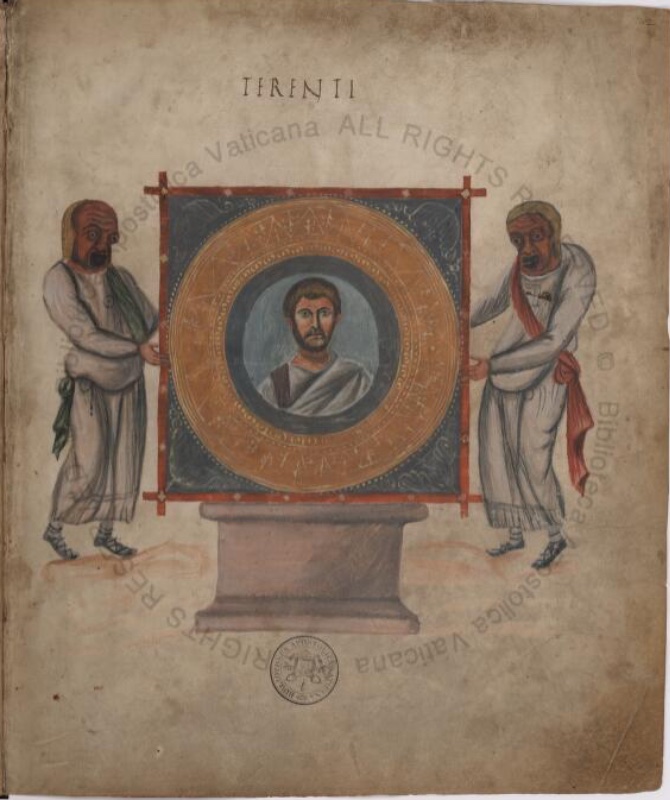
The iconography of the signed miniature from the Vatican Terence depicts a scene from Terence’s play Andria. The composition features three figures locked in a moment of dramatic confrontation. The central figure, holding a scroll, appears to be speaking, while the two figures on either side react with visible emotion, one gesturing emphatically. The scene captures the high drama and intricate plotting that characterize Terence’s work. The figures are dressed in classical garb, identifiable by their tunics and cloaks, situating the scene in the ancient world. The architectural setting, with its archway and columns, is stylized and serves as a frame for the action rather than a realistic depiction of a building. The use of a golden background enhances the timeless, epic quality of the scene. As a prefatory image, its purpose is to establish the tone and thematic concerns of the ensuing play, priming the viewer for the narrative of intrigue and emotion to come. The choice to illustrate Andria specifically may have been significant to the patron or the community at Korwey, though the exact reason is lost to history.
Terentius Comoediae, folio 3r
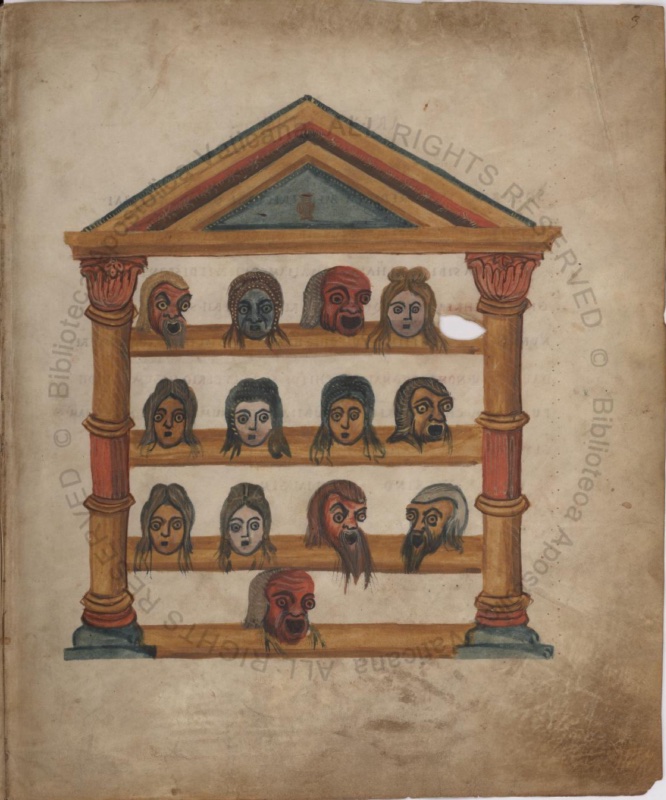
Beyond the Vatican Terence, there are other works that have been tentatively attributed to Adelricus, though with varying degrees of certainty. One such work is a miniature in Cambridge, Corpus Christi College, MS 41, which has been linked by some scholars to the same group of artists responsible for the Vatican Terence. This attribution is based on stylistic similarities, but it lacks the definitive signature of the Vatican manuscript, making it a plausible but unconfirmed connection. Another attribution is to an Evangelist portrait of the Apostle John, dated to the late ninth century and associated with the Loire Valley or Brittany region. This work is stylistically distinct from the Vatican Terence and may represent the work of a different artist named Adelricus, highlighting the challenge of distinguishing between individuals with common names in the medieval period. The existence of these potential attributions underscores the significance of the Vatican Terence as a stylistic touchstone for identifying the work of this particular artist or workshop.
The iconography of Adelricus’s work, while focused on a classical subject, operates within a distinctly Christian monastic framework. The illuminated manuscript was a sacred object, and its decoration was imbued with spiritual meaning. While the story of Andria is secular, its presentation in a monastery would have invited allegorical interpretations. The themes of fate, human folly, and reconciliation could be read as parallels to biblical narratives or the struggles of the human soul. The very act of copying and illuminating a pagan text was a Christianizing act, reclaiming it for a new, sacred purpose. Gregory of Tours, writing in a later period, composed his Liber vitae patrum to commemorate the deeds of saints, and while Adelricus’s work is secular, the monastic impulse to find spiritual meaning in all things would have been present. The illuminations were not merely decorative but were integral to the manuscript’s function as a tool for contemplation and learning.
The transmission of these classical texts and their accompanying illustrations was a key part of the Carolingian educational program. Monasteries like Korwey were the primary guardians of this literary heritage, and artists like Adelricus were the agents of its visual transformation. His task was to make the ancient stories vivid and comprehensible for a medieval audience. The clarity of his lines, the expressiveness of his figures, and the vibrant colors were all employed to achieve this goal. The iconography, therefore, serves a dual purpose: it illustrates the text literally while also reflecting the cultural and intellectual priorities of the Korwey community. The patron who commissioned the work would have appreciated its aesthetic beauty, but the monastic readers would have valued its role in the larger project of preserving and reinterpreting the wisdom of the ancients. Adelricus’s art was thus a bridge between the classical past and the Christian present.
In conclusion, the body of work attributable to Adelricus, though small, is of immense importance. The Vatican Terence stands as a monument to his skill and a rare glimpse into the mind of a ninth-century artist. Its detailed iconography, combined with the explicit signature, provides a firm anchor for his artistic identity. The manuscript’s journey from the scriptorium of Korwey to the heart of Christendom in the Vatican is a fitting trajectory for a work of such universal significance. The discursive analysis of this and other potential works reveals an artist deeply committed to his craft, a master of a demanding style, and a key figure in the cultural flowering of the Carolingian Empire. His legacy is preserved not in annals or chronicles, but in the painted pages of a single, magnificent manuscript.
Artistic Influences and Intellectual Milieu
The artistic style of Adelricus was profoundly shaped by the classical tradition, transmitted to him through the artistic and scholarly networks of the Carolingian Renaissance. His primary influence was the visual language of late antiquity, as preserved in older illustrated manuscripts that served as models for his generation of artists. The Vatican Terence itself was a copy of a now-lost manuscript, indicating a direct chain of artistic descent from the Roman world. Adelricus and his colleagues at Korwey were not inventing a new style ex nihilo; they were engaging in a process of emulation and adaptation, seeking to recapture the perceived dignity and clarity of classical art. This involved studying surviving examples of Roman painting and mosaic, as well as copies made in the preceding centuries, and translating those visual principles into the media of parchment, ink, and tempera. The result is a style that is simultaneously classical in its formal concerns and medieval in its spiritual context.
The intellectual milieu of the Korwey monastery was another critical influence on Adelricus’s work. The Carolingian reform movement, spearheaded by figures like Alcuin of York, placed a strong emphasis on the quadrivium and the trivium—the seven liberal arts that formed the core of a proper education for clergy and nobility. Artists were expected to be more than mere craftsmen; they were to be literate men of learning. Adelricus would have been trained in this tradition, giving him a deep understanding of the literary texts he was illustrating. This scholarly foundation allowed him to create images that were not just decorative but were thematically resonant with the content of Terence’s plays. The influence of the influential Tours school, a center for both liturgical chant and broader theological and philosophical studies, would have contributed to this intellectual environment, fostering a culture of learning that valued the recovery of classical texts. Adelricus’s work is a physical manifestation of this intellectual synthesis, where visual art serves the ends of classical and Christian learning.
Contacts with the imperial center at Aachen also played a role in shaping the artistic landscape in which Adelricus worked. Aachen was not just a political capital but also a vibrant cultural hub, attracting artists, scribes, and scholars from across the empire. Manuscripts were often sent to the palace scriptorium for presentation or correction, and artists from provincial centers like Korwey would have been aware of the styles favored at court. The influence of the court school, which drew upon Italian and Insular artistic traditions, would have circulated through the network of monasteries and bishops loyal to the emperor. While the style of the Vatican Terence is closely tied to its late antique model, it would have been filtered through the tastes and practices of the major Carolingian centers. Adelricus was thus part of a pan-imperial artistic community, exchanging ideas and techniques across vast distances. The Korwey scriptorium was not an isolated backwater but a vital node in this wider web of cultural production.
The influence of the broader European artistic tradition is also evident. The use of model books, for instance, was a widespread practice that facilitated the dissemination of artistic motifs and compositional formulas across regions. An illuminator in Lorraine would have had access to the same repertoire of figures and designs as an artist in southern Italy or Anglo-Saxon England. The stylistic parallels between the Vatican Terence and other contemporary works, such as the Lindisfarne Gospels or manuscripts from the Reims school, suggest a shared pool of artistic knowledge. Adelricus was not working in a vacuum; he was part of a living artistic tradition that looked backward to antiquity while looking forward to the development of Romanesque and Gothic art. His style represents a crucial transitional phase, bridging the gap between the Byzantine-influenced art of the early Middle Ages and the more naturalistic approaches that would emerge in the following centuries.
Furthermore, the influence of the Church as a preserver and interpreter of art was paramount. While classical art was admired for its beauty and formal qualities, it was ultimately judged by its utility in a Christian context. The primary purpose of an illuminated manuscript was to facilitate the reading and understanding of sacred text, and even a classical work like Terence was integrated into this framework. The iconography of Adelricus’s work, therefore, carries a latent Christian meaning. The drama and human emotion depicted in Andria could be interpreted as a reflection of the human condition, fallen and in need of salvation. The monastic community that employed Adelricus would have read his images through a theological lens, finding in the pagan past prefigurations of Christian truths. This interpretive framework, shaped by centuries of Christian thought, was perhaps the most powerful influence on his artistic output, guiding not just what he painted, but how it was understood by its intended audience. His art was a product of this synthesis of classical inspiration and Christian purpose.
Geographic Context and Mobility
The geographic context of Adelricus’s life and work is firmly anchored in the monastic community of Korwey (also spelled Korvei or Corvey) in Westphalia, a region within the Frankish Empire that would become part of Germany. The monastery of Korwey was founded in 822 as a daughter house of the prestigious Abbey of Corbie in Picardy, France, and quickly established itself as a major center of learning and artistic production. Adelricus, along with the scribe Hrodgarius, was a monk at this institution, and it is from here that his career as an illuminator must be understood. The provided archival sources do not specify a smaller town or estate associated with Korwey, so his movements would have been confined to the immediate vicinity of the abbey. Monastic life, with its emphasis on stability, prayer, and communal work, generally restricted the geographical mobility of its members. There is no documentary evidence in the provided sources to suggest that Adelricus traveled extensively or worked at any other scriptorium. His professional identity is inseparable from his affiliation with Korwey.
There is a notable association of the Vatican Terence with Aachen, the former capital of Charlemagne and Louis the Pious. This connection has led some to speculate that Adelricus may have traveled to the imperial center to work on the manuscript or that the work was produced under direct imperial commission. However, the provided sources do not confirm this. The manuscript’s link to Aachen could mean a number of things: it may have been sent there for presentation to the emperor, it may have originated in a workshop with close ties to the Aachen court, or it may simply reflect the fact that manuscripts from major centers like Korwey were highly sought after at court. The lack of travel records or correspondence mentioning Adelricus makes any assertion of physical travel to Aachen purely speculative. It is far more likely that the connection is administrative or political rather than geographical. The manuscript’s style and the known origins of its artists firmly place its production at Korwey.
Similarly, the manuscript’s current location in the Vatican Library in Vatican City is a modern designation that reflects its history of collection and preservation rather than any known activity by Adelricus there. The journey of the Vatican Terence from a Westphalian monastery to the libraries of the papacy is a fascinating chapter in its history, but it occurred long after its initial creation in the first third of the ninth century. No documents suggest that Adelricus ever visited Rome. The monastic scriptoria of the Carolingian period were remarkably self-sufficient units, capable of producing works of extraordinary quality without needing to send their artists on pilgrimages or diplomatic missions to other parts of Europe. The exchange of ideas and artistic models happened through the circulation of manuscripts, not necessarily through the movement of the artists themselves. Adelricus’s world was the scriptorium, the library, and the cloister of Korwey.
The question of whether Adelricus ever traveled to other major centers of learning, such as Tours or Reims, cannot be answered with the available evidence. While these schools were influential in the intellectual life of the period, there is no documentary trail connecting Adelricus to them. The training of an artist typically took place within the walls of his own monastery, under the guidance of senior masters. The Korwey scriptorium, with its direct link to the great abbey of Corbie, would have provided a comprehensive and high-quality education in the arts and humanities. Therefore, there would have been little practical need for Adelricus to leave his home monastery to pursue his vocation. The assumption of extensive travel is anachronistic, projecting a modern notion of the artist’s career onto a medieval monastic reality. His expertise was cultivated and displayed within the confines of his monastic community.
In conclusion, the geographic context of Adelricus’s life is one of relative immobility, centered on the Abbey of Korwey. While his work was part of a wide-ranging cultural movement that spanned the Carolingian Empire, his personal movements appear to have been limited to the environs of his monastery. The connections to Aachen and the Vatican are significant for understanding the reception and provenance of his masterpiece, but they do not imply personal travel on his part. His biography is a testament to the power of a single, well-endowed scriptorium to produce art of international significance without requiring its artists to leave their monastic homes. The constraints of his geography were also the conditions of his success.
-
The Benedictine monastery of Korwey (Corvey) was founded in 822 by order of Emperor Louis the Pious, son of Charlemagne, as a daughter-house of the older Abbey of Corbie in Picardy. It was established on the eastern frontier of the Frankish realm to help Christianise the Saxons and consolidate imperial control over the region. The first stone church was consecrated in 844, and between 873 and 885 the remarkable Carolingian Westwerk (westwork) was built; this three-towered western façade is the oldest surviving example of its type and remains the abbey's defining architectural monument. Corvey quickly became one of the most influential monastic centres of the Frankish Empire, functioning both as a missionary base and a major scriptorium and school. Its cloisters sent out missionaries into Northern and Eastern Europe, and its library and scriptorium helped transmit classical and Christian texts during the Carolingian Renaissance. Among its most famous scholars was the 10th-century Saxon historian Widukind of Corvey, author of Res gestae Saxonicae, which chronicled the history of the Saxon people and the Ottonian dynasty. By the 10th century Corvey had acquired the status of an imperial abbey (Reichsabtei), with its abbots enjoying princely rank and considerable autonomy within the Holy Roman Empire. The abbey participated in broader ecclesiastical reforms and established numerous subsidiary monasteries, becoming a dominant theological and cultural centre in Westphalia well into the 12th century. Over later centuries the complex was repeatedly damaged, especially in the Thirty Years' War, and was rebuilt in a Baroque style in the 17th and 18th centuries; the monastic community was finally dissolved after secularisation in 1803, and the abbey buildings were later transformed into the present Corvey Castle (Schloss Corvey), now the residence of the Princely House of Ratibor-Corvey. Today, the Carolingian Westwork and Civitas Corvey are inscribed as a UNESCO World Heritage Site, recognised for the exceptional survival of the early medieval westwork and the traces of the surrounding monastic town. The site combines the Carolingian western façade with later Romanesque and Baroque elements of the abbey church and castle, making it one of the most important surviving witnesses to the role of monasteries in the political and cultural formation of early medieval Europe. ↩
-
Childeric I was a pivotal Frankish leader and the father of Clovis I, marking the early foundations of the Merovingian dynasty in the fading Roman world of late antiquity. Born around 436 CE, Childeric I succeeded his father, Merovech (or Meroveus), as king of the Salian Franks around 457–458 CE, ruling over territories in what is now northern France and Belgium, centered at Tournai. His reign unfolded amid the collapse of Roman authority in Gaul, where he navigated alliances and conflicts as a semi-Romanized barbarian leader, often described as a rex (king) on his seal ring found in his tomb. Sources like Gregory of Tours portray him as initially dissolute, leading to an eight-year exile in Thuringia due to his seduction of local women, during which the Gallo-Roman general Aegidius briefly claimed kingship over the Franks. Childeric served as a key ally to Roman commanders, fighting alongside Aegidius against the Visigoths at Orléans in 463 CE and later supporting Count Paulus against them in 469 CE near Angers. He also repelled Anglo-Saxon pirates and Saxons along the Loire River, securing Frankish influence in former Roman provinces like Belgica Secunda. These campaigns highlight his dual role as a Frankish chieftain and Roman foederatus (allied warrior), strengthening Salian Frankish power without fully breaking from imperial structures. Childeric married Basina, a Thuringian queen, and their son Clovis I (born c. 466) succeeded him, eventually unifying the Franks and expanding into much of Gaul after victories like the Battle of Vouillé in 507 CE. Childeric died in 481 CE at Tournai, where his lavish tomb was unearthed in 1653, yielding artifacts that confirm his royal prestige and connections to Roman elites. His rule bridged tribal Frankish society to the Merovingian kingdom, laying groundwork for medieval Europe's feudal foundations through military prowess and dynastic continuity. ↩
-
The Liber Vitae (or memoriale) of Corvey is a confraternity-book listing monks, benefactors, and holy personages whose names were commemorated in the liturgy of the monastery. It belongs to the broader family of Carolingian libri memoriales, which served both liturgical and documentary purposes, structuring the community's idea of itself and its network of patrons. Studies of the Corvey Liber Vitae have shown that it preserves the names of many Corvey monks and external figures, and some scholarship explicitly notes that Adelricus appears in the Corvey list, confirming his monastic identity and linking him not only to the Vatican Terence but also to the commemorative culture of the abbey. ↩
-
The Vatican Terence (Codex Vaticanus Latinus 3868) is an illuminated manuscript, dated to around 825, containing the six comedies of Publius Terentius Afer and housed in the Vatican Apostolic Library. Copied from a late-antique model from the 3rd century, it is a masterpiece of Carolingian art that preserves the Roman illustrative tradition. The Vatican Terence was likely produced in the Palatine School at the court of Louis the Pious in Aachen, although hypotheses regarding Corbie or Corvey remain debated; the scribe Hrodgarius signed the colophon, while Adelricus contributed only to some of the 150 miniatures, which are the work of three distinct artists. The text in Carolingian minuscule is enriched with interlinear and marginal commentaries (like the 9th-century Brunsianum and Monacense), with titles in rustic red and black capitals. Its history includes a theft during the Napoleonic era (1797–1816) before its return to the Vatican, where it has been digitized on DigiVatLib. ↩