Cappella Peruzzi
( 25% )
The Peruzzi Chapel in the Basilica of Santa Croce in Florence is one of the earliest and most significant products of Giotto di Bondone’s late phase in the city, embodying the complex interplay of Franciscan spirituality, civic prestige, and private devotion that characterized early fourteenth‑century Florentine art. Commissioned by the Peruzzi family, a powerful banking dynasty, it was conceived as a family memorial chapel dedicated to the two saints, John the Baptist and the Evangelist, whose dual patronage reflects both the name of the primary patron and the overarching devotional and civic identity of Florence. The chapel’s construction was made possible by the wealthy banker Donato di Arnoldo Peruzzi, who provided funds in his will of 1299 to establish a family memorial chapel within the basilica. The pictorial decoration by Giotto, probably executed around 1318–1322, appears to have been commissioned by a later generation of the family, with scholars often attributing the fresco commission to Giovanni di Rinieri Peruzzi, grandson of Donato.
The chapel’s iconographic program, structured in paired narrative cycles on the north and south walls, negotiates the theological themes of baptismal regeneration, prophetic revelation, and communal resurrection within a tightly axially organized space. Giotto’s intervention here constitutes one of his first major works in Santa Croce, predating or overlapping chronologically with the better‑preserved Bardi Chapel and forming a crucial link between the Paduan Arena Chapel and the later Franciscan projects in Florence. The architectural setting of the chapel, an intimate rib‑vaulted space attached to the right arm of the transept, provides a stage for a carefully calibrated system of frontal and lateral views that shape the viewer’s experience of narrative and symbol.
Over the centuries, the chapel’s appearance has been transformed by successive restorations, repainting, and structural interventions, which have both obscured and, in modern times, partially recovered aspects of Giotto’s original conception. Ecclesiastical and civic functions vie in the chapel’s history, as it served simultaneously as a private oratory for the Peruzzi, a site of public veneration associated with the saints John, and an architectural node within the larger Franciscan complex of Santa Croce. The juxtaposition of a banker’s family memory with the imagery of martyrdom, asceticism, and divine vision underscores the chapel’s role as a site where economic power is rhetorically subordinated to religious authority. The decorative scheme of the vault, with the symbols of the Evangelists and the busts of prophets, reinforces the theological framing of the narratives as part of a broader Christian‑historical continuum. Overall, the Peruzzi Chapel stands as a paradigm of early trecento Florentine religious art, in which architectural, narrative, and devotional elements converge under the guidance of one of the period’s most influential masters.
Adjacent to the Bardi Chapel and inserted into the right transept of Santa Croce, the Peruzzi Chapel forms a compact, rectangular space defined by a pointed ribbed vault, slender piers, and a modest apsidal end. The walls, originally constructed of masonry with a thin plaster ground, were prepared to receive wall painting rather than sculptural or mosaic decoration, emphasizing the primacy of the pictorial program in the chapel’s aesthetic and devotional function. Giotto’s decorative scheme extends from the lower dado zone to the upper register, encompassing the main pictorial fields, lunettes, and the vault, with only fragments of the back wall surviving in the form of the Mystic Lamb above the altar.
The vault, articulated by ribs and a central keystone, is adorned with the symbols of the four Evangelists and eight prophetic busts, which together generate a celestial register that mediates between the earthly narratives below and the divine realm above. The architectural framing of the frescoes—pilasters, cornices, and painted arches—creates an illusion of shallow niches and compartments that organize the narrative episodes into a rhythmic, almost typological sequence. Light enters mainly through the chapel’s single window, focused on the east wall and altar area, so that the viewer’s gaze naturally moves from the sacramental space of the altar toward the narrative cycles on the lateral walls.
The spatial relationship between the chapel and the nave, governed by the transeptal axis of Santa Croce, ensures that the Peruzzi Chapel remains partially visible from the main body of the church, reinforcing its role as a semi‑public monument despite its private patronage. The chapel’s modest scale and relatively simple structure contrast with the ornate polychromy and elaborate plasticity of the frescoes, producing a visual tension between understated architecture and dense figural decoration. Structural additions and modifications over the centuries, including later altars and liturgical fittings, have altered the chapel’s proportions and sightlines, sometimes constraining the original viewing experience prescribed by Giotto’s composition. Nevertheless, the surviving documentation and reconstructions allow scholars to reconstruct the chapel’s early spatial and liturgical configuration with considerable confidence, even where the material fabric has been repaired or renewed.
Within the Peruzzi Chapel, Giotto’s materials were largely conventional for early fourteenth‑century Italian fresco, but the execution is distinguished by the decision to work almost entirely in secco rather than in fresco buono. The plaster ground, applied over the masonry walls, was prepared to receive a thin layer of damp lime plaster, yet the main pictorial layers were often painted onto dry plaster, a technique that allowed for greater flexibility in modeling and detail but drastically reduced the durability of the surface. Pigments such as earth tones, azurite, and red lead were employed to achieve the characteristic modeling of flesh, drapery, and architectural elements, with the blue of the vault providing a luminous celestial backdrop that contrasts with the more restrained chromatic range of the narrative scenes.
The artist’s use of the dry technique also facilitated the insertion of fine brushwork and delicate highlights, particularly in the rendering of hair, textiles, and architectural tracery, which appear more incisive and linear than in strictly buon fresco. Gold leaf was almost certainly used in limited areas, especially on halos and decorative elements of the vault, although much of this has been lost or obscured by later interventions. The secco method, however, proved highly vulnerable to environmental factors, including humidity, soot deposition, and physical abrasion, which have contributed to the extreme deterioration of the painted surfaces over the centuries.
Flooding from the nearby Arno, in addition to general atmospheric pollution within the basilica, has caused flaking, discoloration, and loss of detail, particularly in the lower zones of the frescoes. The repeated application and removal of overpainting, especially during the eighteenth and twentieth centuries, further compromised the original pigment layers, so that what is visible today is often a composite surface rather than a pure autograph work. Modern scientific analysis has revealed underdrawing and earlier compositional layers, indicating that Giotto and his workshop adjusted figure placement and architectural details during the painting process, a flexibility that is more easily achieved in secco than in buon fresco. The technical challenges posed by the Peruzzi Chapel’s materials and execution have made it a key case study for understanding the long‑term behavior of thirteenth‑ and fourteenth‑century pictorial techniques, especially in large ecclesiastical spaces.
Giotto’s approach to the Peruzzi Chapel demonstrates a highly developed sense of architectural integration, where figure composition and spatial construction are calibrated to the chapel’s specific volumes and sightlines. The scenes are arranged in a vertical sequence on the north and south walls, each episode framed by painted pilasters and cornices that mimic classical architectural orders while subtly distorting perspectival depth to emphasize frontal legibility. In the narrative fields, Giotto employs a kind of compressed, shallow space in which architectural elements overlap and recede, creating a dynamic sense of movement without sacrificing clarity for the viewer standing at a relatively short distance.
The use of foreshortening is selective rather than systematic, appearing most prominently in the vault and in certain interior scenes, such as the Feast of Herod, where receding tables and floor planes intensify the drama. Modeling of figures relies on tonal gradations rather than strict linear perspective, with light interacting with volumetric forms to give the figures a sculptural presence that aligns them with the surrounding masonry. The artist’s handling of drapery is particularly expressive, with heavy folds cascading across torsos and limbs in rhythms that both articulate anatomy and contribute to the overall compositional balance.
Giotto’s palette, dominated by ochres, reds, and blues, is modulated to distinguish ecclesiastical, civic, and narrative spaces, so that the ecclesiastical scenes around the altar are more solemn and restrained than the animated episodes of martyrdom and prophecy. The vault frescoes, in contrast, employ a more schematic and decorative language, with the Evangelists’ symbols and the prophets’ busts treated as emblematic rather than naturalistic elements. The integration of architectural illusion and figural solidity underscores the chapel’s function as a didactic environment, where the viewer is guided through a sequence of theological and moral lessons that unfold in space. Modern conservation practice has had to contend with the consequences of these early techniques, developing methods to stabilize the secco layers, distinguish autograph from later painting, and restore legibility without imposing an anachronistic illusion of completeness.
The Peruzzi Chapel can be understood as the product of Giotto’s mature phase, when he was already renowned for the Arena Chapel and other major commissions throughout Italy. Born in the Vespignano region near Florence, Giotto rose to prominence through his work at Assisi, Rome, and Padua, bringing back to Florentine ecclesiastical architecture a synthesis of sculptural mass, emotional expressiveness, and architectural clarity. By the time he undertook the Peruzzi frescoes, probably in the second decade of the fourteenth century, he had developed a distinctive workshop practice that combined his own hand with the labor of assistants who executed less critical areas under his supervision.
The Peruzzi family, acting as patrons, engaged Giotto not only for his artistic mastery but also for his symbolic value as a cultural figure whose reputation could elevate the family’s social standing within the Florentine oligarchy. The chapel’s dedication to the two saints John reflects a sophisticated layering of personal, civic, and religious identity: the donor’s patronymic, the city’s devotion to the Baptist, and the Franciscan context of Santa Croce all converge in a single iconographic program. Giotto’s previous work for Franciscan patrons, including the monumental cycles at Assisi, provided a repertoire of narrative devices and emotional gestures that he adapted to the more intimate scale of the Peruzzi Chapel.
The stylistic evolution visible in the chapel—greater spatial complexity, more dynamic compositions, and heightened emotional intensity—marks it as a bridge between the Paduan achievements and the later Franciscan projects in Florence. The dispersal of Giotto’s activity between Padua, Rome, and Florence in the early 1300s meant that the Peruzzi Chapel was likely executed with intermittent supervision, raising complex questions about workshop participation and the degree of autograph engagement. Nonetheless, the unity of conception, the coherence of the iconographic program, and the consistent handling of space and figure type across the surviving fragments point to Giotto’s overarching artistic direction, even where the execution may have been largely delegated. The chapel thus stands as a testament to the ways in which Giotto’s personal style and workshop organization could be adapted to the constraints and opportunities of a mid‑size urban commission supported by a wealthy mercantile family.
The relationship between Giotto and the Peruzzi family also illuminates the broader social and economic context of early fourteenth‑century Florence, where artistic patronage was tightly bound to banking, civic office, and family prestige. The Peruzzi were among the leading banking houses of Europe, with international branches and close ties to papal and royal finance, and their investment in the chapel can be read as part of a wider strategy of cultural capital accumulation. By commissioning one of the most celebrated painters of the age, the family aligned itself with the highest reaches of artistic innovation while asserting its integration into the religious fabric of the city.
The chapel’s location within Santa Croce, the principal Franciscan church of Florence, further embedded the Peruzzi in a network of spiritual and civic authority that connected the Franciscan order, the city’s elite, and the papacy. The program’s emphasis on the saints John allowed the Peruzzi to position themselves as both devout Christians and responsible stewards of the city’s religious and economic life, since the Baptist was the patron of Florence and the Evangelist was associated with apostolic witness and doctrinal authority. Parallel objects such as the Peruzzi Altarpiece, a polyptych commissioned for the same family, reinforce the notion of a coordinated visual program that extended across media and spaces within Santa Croce. The interplay between family memory and sacred history in the chapel’s decoration suggests an early form of historical imagination in which the Peruzzi’s lineage is narrativized alongside the lives of the saints. Contemporary chronicles and documents imply that such projects were widely discussed among Florentine notables, who viewed artistic commissions as both devotional acts and public statements of dynastic ambition. The reception of the Peruzzi Chapel by contemporaries, inferred from later accounts and the surviving frescoes, indicates that Giotto’s work was already regarded as a benchmark for pictorial excellence and narrative intelligibility. Thus the chapel functions as a microcosm of early trecento Florentine society, where art, religion, and commerce intersect in a single architectonic and pictorial ensemble.
Religious art and church furnishings in the Peruzzi Chapel are organized around a hierarchical axis that links the altar, the frescoed walls, and the vault into a coherent symbolic system. The altar area, oriented toward the east, is the focal point of the chapel’s liturgical function, and the surviving fragment of the Mystic Lamb above it underscores the centrality of Christ’s sacrificial presence in the narrative and devotional program. The pictorial cycles on the north and south walls, depicting the lives of John the Baptist and John the Evangelist, are arranged so that the viewer’s circuit begins near the altar and unfolds laterally, reinforcing the chapel’s axial symmetry and its function as a space for contemplative procession.
The vault, with its Evangelists’ symbols and prophets, forms a celestial canopy that mediates between the local narratives below and the universal history of salvation, thereby linking the Peruzzi family’s memory to broader ecclesiastical and theological frameworks. Furnishings such as the late medieval altar table, credence, and later additions like choir stalls and liturgical textiles have modified the chapel’s spatial and liturgical dynamics, sometimes obscuring the original relationship between the frescoed images and the viewer’s position. The chapel’s small size and limited natural light privileged close, frontal viewing, encouraging an intimate engagement with the expressive gestures and facial features that Giotto so carefully constructed.
The iconographic program, emphasizing baptism, martyrdom, vision, and resurrection, aligns with Franciscan spiritual priorities, particularly the themes of penance, conversion, and the imitation of the saints. The juxtaposition of the Baptist’s asceticism and the Evangelist’s visionary experience creates a dyadic model of sanctity that combines active engagement with the world and contemplative withdrawal, mirroring the Franciscan balance between preaching and prayer. The inclusion of civic and familial references within this framework—such as the prominence of the patron’s name‑saint and the city’s patron—reveals how religious art could serve as a site of negotiation between individual identity and communal piety. Over time, changes in liturgical practice and devotional fashion have altered the chapel’s furnishings and uses, yet the underlying structure of images and space continues to articulate the same theological and social messages.
The relationship between religious art and church furnishings in the Peruzzi Chapel extends beyond the frescoes to include a carefully coordinated ensemble of movable and architectural elements that shaped both devotional practice and visual perception. Liturgical furnishings such as the original altar and the later altarpiece functioned as focal points that directed the viewer’s attention toward the consecrated space while simultaneously reinforcing the iconographic program of the frescoes. The Peruzzi Altarpiece, a five‑panel polyptych now housed in the North Carolina Museum of Art, originally stood behind the altar and presented Christ Blessing flanked by the Virgin Mary, John the Baptist, John the Evangelist, and Francis of Assisi, thereby linking the chapel’s narrative cycles to the central sacramental act of the Mass.
This arrangement underlined the theological continuity between the earthly stories of the saints and the presence of Christ in the Eucharist, so that the chapel became a space where narrative and sacrament mutually illuminated one another. The original design of the chapel also included a stained‑glass window above the altar, which would have modulated daylight and projected colored light onto the frescoed surfaces, enhancing their chromatic and symbolic resonance during liturgical celebrations. Later replacements, including a window drawn from the Giugni Chapel and attributed to Pacino di Bonaguida, altered but did not erase this dynamic interplay between artificial and natural light, stained‑glass imagery, and wall painting.
The insertion of a monumental tomb for Vincenzo Peruzzi, commissioned in the nineteenth century and carved by Odoardo Fantachiotti, transformed the chapel into a site of commemorative display as well, integrating funerary sculpture into the pre‑existing pictorial program. Other furnishings, such as liturgical textiles, candlestands, and votive objects, would have animated the chapel’s interior with additional layers of color, texture, and sensory engagement, although their precise configuration is known only through analogies with contemporary Florentine churches. The chapel’s furnishings thus participated in a multisensory liturgical environment in which sight, sound, and material presence were calibrated to reinforce the devotional themes of the frescoes and the status of the Peruzzi patrons. Over time, as tastes and liturgical practices changed, the chapel’s furniture and fittings were repeatedly renewed, yet the original impulse—aligning sacred imagery, ritual action, and familial memory in a single privileged space—remained a constant structural principle.
In the broader context of Santa Croce, the Peruzzi Chapel’s furnishings and decorative scheme exemplify the integration of private patronage into the larger Franciscan visual and liturgical economy of the basilica. The proximity of the chapel to the main altar and to other aristocratic chapels, such as the Bardi and Giusti chapels, situates it within a competitive landscape of commemorative and devotional display, where each family sought to distinguish itself through artistic investment while remaining embedded in the friars’ spiritual narrative. The choice of altarpiece imagery—the saints John and Francis—links the Peruzzi not only to the Franciscan order but also to the civic patron of Florence, the Baptist, thus projecting the family’s identity along multiple intersecting axes of devotion and power.
Liturgical furnishings such as the altar, choir stalls, and associated textiles would have been arranged to accommodate both the Peruzzi family’s private celebrations and the friars’ communal liturgy, creating a space where private and communal worship overlapped. The arrangement of the chapel’s imagery, with the altar at one end and the frescoed narratives on the lateral walls, encouraged movement and procession that mirrored the structure of the liturgical year and the saints’ feast days, reinforcing the cyclical character of devotion. The presence of inscriptions, heraldry, and epitaphs within the chapel would have further anchored the visual experience in historical memory, reminding viewers of the Peruzzi’s lineage and civic service alongside the sacred narratives. This integration of art, liturgy, and commemoration made the chapel not merely a decorative setting but an active site of performative identity, where religious practice and social aspiration were continually renegotiated. The chapel’s material furnishings, therefore, should be understood as extensions of the frescoed program rather than as mere adjuncts to it, co‑constitutive elements in the construction of a sacred space designed for both private devotion and public display.
In the realm of illuminated manuscripts and the broader pictorial arts, the Peruzzi Chapel participates in a wider visual culture that linked wall painting, portable altarpieces, and manuscript illumination around shared iconographic and stylistic conventions. The narrative cycles of the Baptist and the Evangelist draw on the same typological and hagiographic models that appear in contemporary legendaries and Bible picture books, reflecting the chapel’s function as a kind of monumental Biblia pauperum that could instruct viewers who lacked access to written texts. Giotto’s pictorial style, characterized by clear spatial organization, expressive gesture, and schematized architecture, also influenced the design of contemporary manuscript miniatures, which began to adopt similar compositional strategies and figure types in the early fourteenth century.
The Peruzzi Altarpiece, with its hierarchical arrangement of Christ and the saints, mirrors the compositional logic of luxury altarpieces and devotional panels, many of which were conceived in parallel with, or even in dialogue with, manuscript illumination in their use of gold backgrounds, restricted palettes, and iconic figures. Illuminated manuscripts associated with the Peruzzi family or their social circle would have provided devotional models and theological framings that reinforced the chapel’s iconographic program, so that the viewer’s experience was not confined to the frescoed walls but extended to private reading and meditation. The chapel’s imagery, in turn, may have served as a visual reference for manuscript artists who sought to translate the monumental scale of Giotto’s frescoes into the miniature format of the codex, adapting gestures, compositions, and architectural settings to the constraints of the page.
The interplay between the Peruzzi Chapel and the manuscript world is also evident in the shared use of certain iconographic motifs, such as the depiction of the Baptist’s ascetic retreat and the Evangelist’s visionary experience, which appear in both large‑scale wall painting and smaller‑scale book illustration of the period. This cross‑media circulation of imagery suggests that the Peruzzi Chapel was perceived not as an isolated artistic event but as part of a broader network of visual practices that spanned monumental and portable media. The chapel’s role in this network is further underlined by the fact that its frescoes were later studied and imitated by subsequent generations of painters, including Renaissance artists who turned to Giotto’s work, in part, through the mediating lens of manuscript copies and annotated drawings. Thus, while the Peruzzi Chapel itself is primarily a work of fresco, its significance can only be fully grasped when situated within the wider ecosystem of illuminated manuscripts, panel paintings, and devotional imagery that shaped trecento Tuscan visual culture.
External influences on the Peruzzi Chapel are manifold, ranging from classical antiquity and Byzantine traditions to contemporary innovations in French and Italian art, all absorbed and transformed through Giotto’s distinctive pictorial language. The chapel’s architectural framework, with its ribbed vault and classical‑derived pilasters, reflects the late Gothic and proto‑Renaissance interest in systematic architectural orders and balanced spatial proportions, which Giotto had encountered in earlier Florentine buildings and transmitted into his painted architecture.
The use of classical motifs in the painted cornices and spandrels, as well as the symbolic language of the vault and archivolt, echoes the revival of antique decorative schemes that were becoming increasingly fashionable in early fourteenth‑century Florence. Byzantine conventions remain visible in the frontal poses, hieratic gestures, and gold‑grounded symbolism of certain figures, particularly in the more emblematic zones of the chapel, such as the Evangelists’ symbols and the prophet busts. At the same time, the chapel’s narrative scenes exhibit a pronounced naturalism in figure type and spatial arrangement, owed in part to Giotto’s exposure to French and Italian sculptural traditions that emphasized drapery and anatomical solidity.
The influence of contemporary narrative painting in Assisi, Padua, and Rome can be traced in the composition of the Baptist’s and Evangelist’s cycles, where diagonal groupings and dynamic staging recall Giotto’s earlier Franciscan projects. The chapel’s close relationship to the Bardi Chapel, also in Santa Croce, points to a shared pool of workshop models, iconographic schemes, and compositional devices that circulated among Giotto’s associates and successors. External patrons and international style currents, such as those flowing from the papal court at Avignon and the Aragonese courts, indirectly shaped the expectations and resources that informed the Peruzzi commission, reinforcing the chapel’s cosmopolitan orientation. The presence of later restorations and overpainting, especially in the eighteenth and nineteenth centuries, introduced stylistic elements drawn from Baroque and Neoclassical idioms, complicating the original visual language while also testifying to the chapel’s enduring status as a site of cultural pilgrimage. Taken together, these external influences reveal the Peruzzi Chapel as a palimpsest of stylistic and cultural forces, where local traditions, international models, and evolving artistic tastes converge in a single, highly visible monument.
Preservation and conservation of the Peruzzi Chapel have been central to its reception since the early modern period, when the fragile secco frescoes began to suffer from environmental and human damage. The use of dry fresco techniques, combined with the chapel’s proximity to the nave and its exposure to candle soot, humidity, and dust, has rendered the painted surfaces particularly vulnerable to flaking, discoloration, and loss of detail. Flooding from the Arno, air pollution in industrial Florence, and the gradual accumulation of multiple layers of repainting have further compromised the legibility of Giotto’s original work, so that much of what is visible today represents a composite surface rather than a pure autograph layer.
Eighteenth‑ and nineteenth‑century restorations, often undertaken with limited historical and technical understanding, introduced overpainting that obscured compositional details, altered color relationships, and, in some cases, invented new figures or scenes not present in the original iconographic program. The twentieth‑century campaigns, carried out by Italian conservators and international teams, sought instead to stabilize the plaster, remove non‑original layers, and reconstruct the original layout through careful documentation and comparative analysis with other Giotto works. Scientific methods such as underdrawing imaging and pigment analysis have allowed scholars to recover earlier compositional decisions and to distinguish between Giotto’s hand and later interventions, clarifying the chapel’s development over time. Structural interventions, including the reinforcement of the vault and the protection of the frescoed walls from rising damp, have helped to mitigate ongoing environmental threats, although the inherent instability of the original technique means that the chapel remains a high‑risk conservation site.
The chapel’s status as a museum‑like monument within the Basilica of Santa Croce has also prompted ongoing dialogue between conservation professionals, art historians, and ecclesiastical authorities about the appropriate balance between restoration, protection, and respect for the chapel’s historical stratification. Digital reconstructions and virtual models now play an important role in conservation practice, allowing restorers to test hypotheses and visualize alternative states of the frescoes without further physical intervention. These efforts ensure that the Peruzzi Chapel continues to function both as a preserved artifact of Giotto’s art and as a living laboratory for the study of early Renaissance fresco conservation.
In addition to technical conservation, the chapel’s preservation has been shaped by evolving conceptions of historical value, artistic authenticity, and public access. The recognition of Giotto’s innovative role in the development of Western painting, articulated by early modern critics and later art historical scholarship, has elevated the chapel from a devotional space to a canonical monument that must be protected and interpreted. Changing liturgical practices, including the shift away from private family chapels and the increasing emphasis on public visitation, have altered the chapel’s function, transforming it into a site of pilgrimage for art historians, students, and tourists as much as for regular worshippers.
This dual status has necessitated the installation of barriers, lighting controls, climate management systems, and visitor‑flow arrangements that balance the need for physical protection with the imperative to allow close viewing and scholarly study. The chapel’s inclusion in systematic documentation projects, such as the catalogues of Santa Croce and the Santa Croce Opera, has contributed to the accumulation of archival and photographic records that underpin ongoing conservation decisions. Educational programs, guided tours, and scholarly publications have further reinforced the chapel’s role as a touchstone for understanding early fourteenth‑century Italian fresco painting and the broader visual culture of Florence.
Contemporary conservation ethics emphasize the importance of transparency regarding past interventions, so that neither overpainting nor restoration is allowed to claim the authority of original creation, a principle that has guided recent cleaning and documentation campaigns in the chapel. As new imaging technologies and material‑science methods continue to develop, the Peruzzi Chapel will likely inspire further rounds of careful intervention and re‑interpretation, ensuring that its legacy endures even as its physical fabric remains intrinsically fragile. Ultimately, the chapel’s preservation history mirrors the history of art‑historical awareness itself, where successive generations have sought to recover, interpret, and safeguard Giotto’s achievement against the corrosive forces of time, environment, and human intervention.
The frescoes
The chapel’s spatial development is governed by what has been described as a unified “view from the arch”: Giotto conceives the entire pictorial program as seen from the entrance, with the Baptist’s Martyrdom and the Ascension of St. John aligned along the chapel’s central axis and the intervening scenes arranged in a careful, symmetrical rhythm. The Baptist’s beheading scene is displaced slightly to the right of the door but angled so that the viewer confronts it directly, while the Ascension of the Evangelist occupies the corresponding left‑side area, creating a mirrored counterpoint between martyrdom and rapture that structures the chapel’s spiritual geography.
The upper registers, closer to the vault, are more compressed and schematic, with fewer figures and simpler architectural settings, whereas the lower registers, nearer the viewer’s eye level, are denser and more dynamically composed, exploiting the greater physical proximity to intensify emotional impact. Giotto manipulates foreshortening and overlapping volumes to give the impression of real space without fully adopting single‑vanishing‑point perspective; instead, each scene has its own localized depth cues—tables, steps, arches, and platforms—that collectively produce a graduated sense of recession from the entrance toward the altar.
The vault and archivolt, with their figures of the Evangelists’ symbols and the eight prophets, function as a celestial canopy that mediates between the earthly narratives and the theological realm, so that the chapel’s vertical dimension becomes a symbolic axis from martyrdom and trial to vision and ascension. Overall, the spatial organization of the Peruzzi frescoes reflects Giotto’s attempt to turn a small, structurally modest chapel into a coherent narrative and theological environment, where the viewer’s movement and viewpoint are subtly choreographed to align body, image, and liturgy into a single, unified experience.
The viewer entering from the transept first sees the altar and apsidal wall behind it, where a fragment of the Mystic Lamb above the altar links the chapel’s liturgical function to the apocalyptic imagery associated with the Evangelist, before the eye rises to the paired saints John on the flanking walls.
The north wall
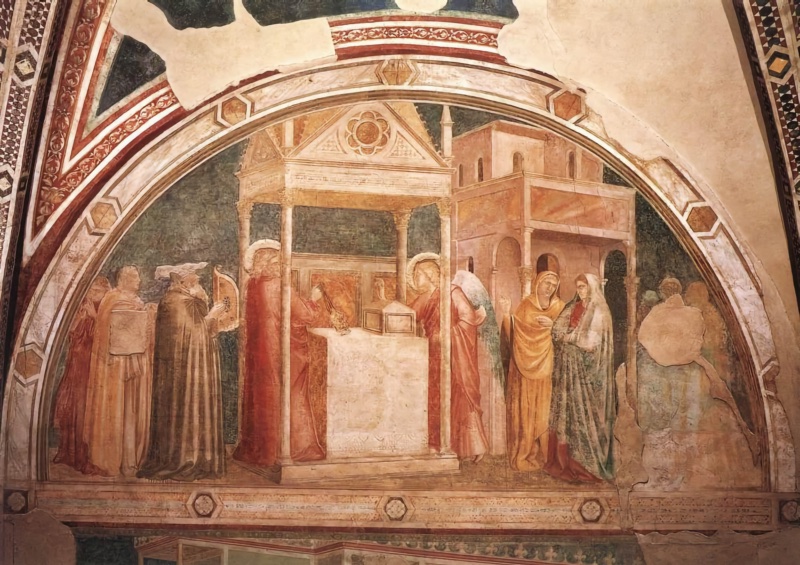
Theologically speaking, Giotto depicts the episode from Luke 1:5–25, in which the archangel Gabriel announces to Zechariah, an elderly and childless priest, the birth of John the Baptist, “prophet of the Most High God” and forerunner of the Messiah. The image of Zechariah depicted in the temple, while serving at the altar, points to the continuity between the Old and New Testaments: the sacrificial worship of the Temple finds its eschatological culmination in John the Baptist, for the Baptist is the one “who prepares the way of the Lord” and points directly to Christ.
Zacharias’s reaction—depicted as initially recoiling in suspicion at the announcement—expresses the human difficulty in accepting God’s action, but his subsequent meekness and the ensuing muteness (which Giotto will develop in other scenes of the chapel) mark the priest’s transformation from unbeliever to silent witness of grace. In this sense, the scene introduces several themes dear to fourteenth-century theology: the gratuitousness of divine grace, shame transformed into dignity (Zacharias and Elizabeth, elderly and barren, become the parents of a prophet), and the presence of God in an ordinary moment, embedded within the liturgical worship of the Temple.
In Giotto’s narrative, John the Baptist is not merely an individual saint but a typological figure linking the two walls of the chapel: on the left, the Baptist, prophet and forerunner; on the right, John the Evangelist, interpreter and revealer of the Apocalypse. The announcement to Zechariah is thus the first link in a double “chain” of salvation: on the one hand, the baptismal and penitential preaching that prepares the way for the Messiah; on the other, the apocalyptic revelation of the one who comes “like a Lamb” offered for the world.
The architectural presence of the Temple, with its clear volumes and rigorous structure, suggests an idea of sacred order and “holy” space, where the divine word interrupts the priestly routine but inserts itself into it without destroying it. This tension between earthly order and the irruption of the supernatural reflects the Augustinian and Thomistic conception of history, in which providence is fulfilled within visible history, without abolishing it.
The Peruzzis, powerful Florentine bankers, chose John the Baptist and John the Evangelist as the chapel’s patron saints, likely also because of the coincidence of their liturgical feasts (the birth of the Baptist and the Assumption of the Evangelist), as noted in Jacopo da Varagine’s Legenda Aurea. This choice is not merely a devotional preference but a symbolic act: associating one’s family with two “Lukas-like” saints—prophets of revelation and restoration—means presenting it as a mediator of order, justice, and truth—foundational values for a banking elite operating on an international scale.
The decorative bands dividing the scenes enclose ten hexagons with portraits of small heads which, according to many scholars, may depict members of the Peruzzi family as independent “commissioners,” not in a posture of prayer before the saints. This iconographic innovation is theologically significant: while traditionally patrons are depicted in an attitude of prayer and thus of total dependence, the presence of the Peruzzis as portraits integrated into the decorative scheme suggests their active and almost “liturgical” participation in the sacred narrative, as if to say that the family is part of the historical continuity of salvation, guardian of memory and devotion.
The Peruzzi Chapel, with its stories of John the Baptist and John the Evangelist, is a theological microcosm where the birth of John marks the definitive entrance of the messianic age, and the vision of Patmos indicates its final fulfillment. For the Peruzzi family, this space becomes both a place of family memory (especially with the tomb of Vincenzo Peruzzi, Gonfaloniere of Florence, on the side wall) and a visual manifesto of their identity: an elite that identifies with the narrative of grace, the history of salvation, and the culture of aristocratic discretion.
In summary, Giotto’s Annunciation to Zechariah in the Peruzzi Chapel is not merely a depiction of a Gospel episode, but a theological nexus linking human barrenness to the fruitfulness of grace, the ancient Temple to the proclamation of the New Covenant, and a powerful family of bankers to the history of redemption.
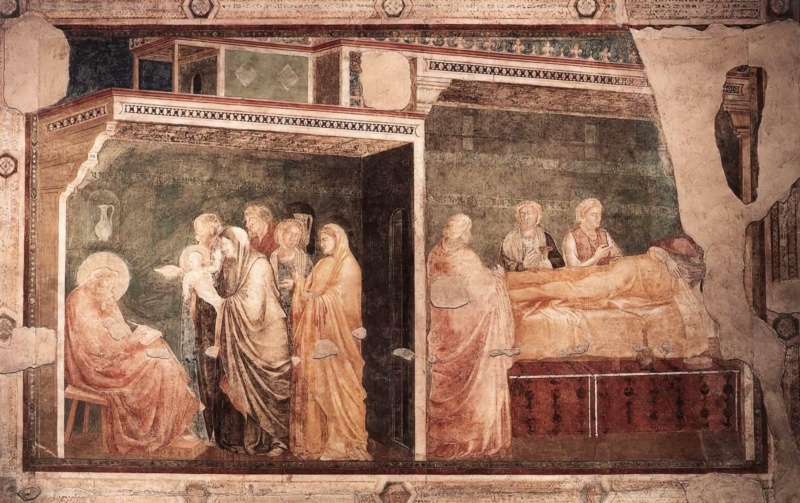
The lower right panel depicts the birth of John the Baptist, while on the left, Giotto combines the scene of the naming of the child—with the mute Zechariah writing the name “John” on a tablet—in accordance with the angel’s announcement as recounted in the apocryphal Gospels and hagiographic tradition (especially Jacopo da Varagine’s Legenda Aurea). This blending of birth and the bestowal of the name underscores that, for medieval theology, the name is not merely a sign but indicates a vocation: John is “the one spoken of by God,” that is, the forerunner of Christ, the herald of the Kingdom who prepares for the Baptism of the Lord. The scene of the bed where Elizabeth nurses him, with the women bustling about and the one bearing a chalice as a gift, evokes the theme of hospitality and blessed fertility, but also—in a spiritual sense—the idea of a domestic “altar,” almost a small baptistery, where John’s life foreshadows Christian Baptism. The presence of Zechariah writing the name, with his gaze turned toward the child, becomes an act of silent “profession of faith”: the mute priest, who had doubted the angel, now recognizes the divine plan, and the name becomes the seal of the grace that transforms him physically (his mouth will reopen with the preaching in the desert).
On the highest level of medieval theology, John the Baptist is the bridge between the Old and New Testaments, the prophet who points to Christ (“Behold the Lamb of God”) and who inaugurates Christian Baptism. His birth, blessed by God and narrated in a concise and solemn manner by Giotto, prepares the way for Jesus’ baptism in the Jordan, which will later become the theological center of the Baptism of the Lord in the Scrovegni Chapel: there, baptism is a Trinitarian revelation, an epiphany of the Son consecrated by the Father and the Spirit.
In the Peruzzi Chapel, the birth and naming of John are not merely hagiography, but an “icon of grace”: Elizabeth’s home becomes a place of election, where the divine promise is fulfilled against all human logic (barrenness, old age). This pattern—the miracle of birth, the revealed name, the silence that dissolves into prophecy—is the theological prototype of the Christian who, in Baptism, receives a new name and becomes a member of the body of Christ, a participant in the same baptismal vocation. Giotto constructs the scene within a complex interior architecture, featuring coffered ceilings, arches, and columns, which transform Elizabeth’s house into an almost liturgical microcosm. The perspective and arrangement of the figures, positioned to create depth while maintaining a strong sense of frontality, transform the space into a “sacred scene” where divine history penetrates the domestic world; this echoes the medieval logic whereby the church is the mystical body, and the Christian home the workshop of salvation.
The child’s bed, positioned in alignment with the scene of the naming, serves as the true dramatic center: birth is the “first step” on the path toward Baptism, and the home becomes a place of spiritual initiation even before the person reaches adulthood. This theme is consistent with contemporary Florentine devotion to Baptism—central to the Florence Baptistery—and with the pedagogical function of the frescoes, which educate the patron and the faithful in understanding Christian life as a “baptismal path.”
The presence of a figure in the foreground, often identified as a servant carrying a chalice but who can be interpreted symbolically as a “holy herald,” refers to a medieval ideology of female lineage: Elizabeth and her descendants are part of a chain of holiness linking the Virgin and the community of the faithful. In this sense, John’s birth becomes a model of spiritual, not merely biological, fruitfulness: the family gazing at the child is called to reproduce the same inner disposition of faith and receptivity to the revealed word.
The Peruzzi Chapel was commissioned by a wealthy family of Florentine bankers and merchants who established themselves politically and socially in the early 14th century. The choice of John the Baptist as the chapel’s principal saint is no accident: the Baptist is the saint of “conversion,” purification, and justice—key figures for an elite seeking to legitimize its wealth and influence as instruments of divine providence.
Furthermore, the presence in the ornamental bands dividing the scenes of small heads that may depict the Peruzzis—portrayed as independent figures rather than kneeling before the sacred figure—is a very strong sign: the family inserts itself into the theological cycle as a “co-witness” to the history of salvation. This is not a simple self-portrait, but a theology of patronage: the Peruzzis are part of the divine order, sharing the same “election” that chose John the Baptist, and their physical presence in the fresco cycle becomes a sign of sacramental participation in the history of the Church.
In this way, the birth and calling of John are not merely a biblical episode, but a mirror in which the Peruzzi family recognizes itself as the “new home of the Spirit,” called to live its life—including its economic and political life—under the sign of baptismal justice.
The choice of John the Baptist, together with John the Evangelist in the same chapel, responds to a specific devotional connection: the feast of the birth of the Baptist and that of the Ascension of the Evangelist are linked in the calendar and in symbolism, and the Legenda Aurea brings them together in a unified narrative. This link makes the Peruzzi cycle a complete “journey of salvation”: from the prophetic announcement (John the Baptist) to the evangelical revelation (John the Evangelist), both witnesses to the word of Christ.
For the Peruzzi family, active in a city increasingly marked by tensions between civic power, the papacy, and the empire, this iconography offers a model of “public” holiness: holiness is not merely a hermit’s life, but also civic engagement, economic responsibility, and the protection of justice, as exemplified by John the Baptist himself, who does not shy away from confronting the political elite of his time.
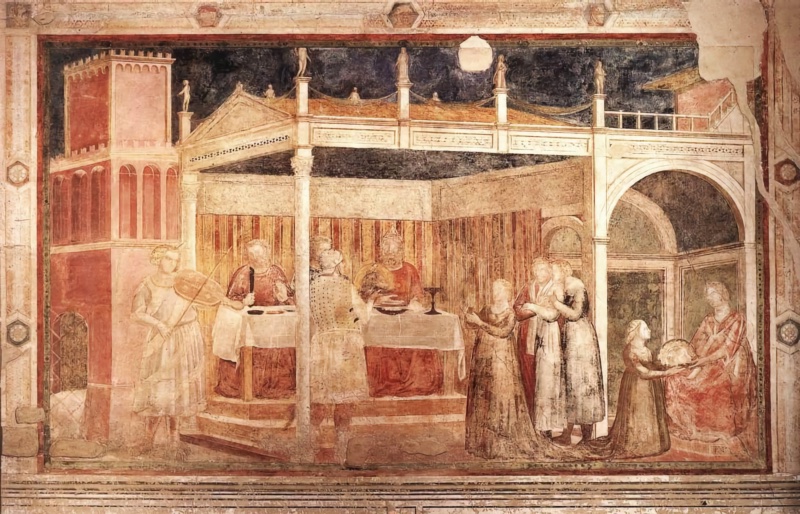
Scenes such as the Feast of Herod and the presentation of John the Baptist’s head draw inspiration from the Synoptic Gospels (Matthew 14:6–12 and Mark 6:21–29) and were often interpreted in the Middle Ages as examples of a malevolent ludus: earthly power, intoxicated by pleasure and vanity, becomes an instrument of evil. Giotto emphasizes this idea not so much through the raw violence of the beheading (which is depicted in another panel) as through the contrast between the sumptuous feast and the horrific gesture of the gift-reception: the head of John the Baptist is presented to Herod as a platter, reduced to an object of consumption.
Theologically, John the Baptist is the last of the prophets, the forerunner of Christ, who “prepares the way” and points to Christ’s presence in the world. His mockery, his frivolous condemnation, and his killing in the context of a banquet aim to emphasize that divine revelation is rejected by worldly power, heedless of the message of conversion and justice. In this sense, Herod’s banquet becomes an anti-sacrifice: instead of an offering to God, it is a gruesome offering to human desire, while the head of the Baptist, symbolically, is the seal of truth that is severed by the violence of power.
Giotto sets the scene within an open architectural space, featuring a hall reminiscent of a Florentine palace, yet devoid of any true sacred solemnity: it is a theater of the world, not of grace. The clear geometry of the arches, pillars, and thrones, combined with the frontal positioning of the protagonists, creates a composition in which every gesture is unambiguous: Herod, the hand that withdraws, the dignitaries covering their faces, the executioner presenting the head, Salome pointing it toward Herodias.
This gestural apparatus, typical of the mature Gothic style and the Giotto tradition, serves to “read” the guilt: the severed head becomes an object that Herod must accept, almost as if sin were something tangible passing from hand to hand. Medieval theology insisted that sin never remains neutral but creates an echo in the world and in the community; the sight of the Baptist’s head, displayed at court, becomes an image of the soul that rejects prophecy and abandons itself to pride and vengeance. In the Peruzzi Chapel cycle, the Feast of Herod is an integral part of a narrative that, along the north wall, spans from Zechariah’s annunciation to the birth and martyrdom of John the Baptist, up to his spiritual “assumption” or his glory in the afterlife. This scheme, which links the birth, public life, and death of the Baptist, allows us to interpret Herod’s banquet not as an isolated episode, but as the culminating moment of his prophetic mission: the truth extends even unto death, because the world rejects it.
In this sense, the banquet, together with other scenes, forms an iconography that can be read as a theological prelude to the figure of Christ: if the Baptist is destroyed by earthly power, the Crucified One—who will be at the center of Franciscan theology in the very same Basilica of Santa Croce—is its fulfillment. The figure of John, “the greatest born of woman,” thus becomes a model of fidelity to the word of God, which the Christian is called to follow, even at the cost of his own life. The Peruzzi Chapel was founded by Donato di Arnoldo Peruzzi, one of the most powerful Florentine bankers, and housed Giotto’s first commission at Santa Croce. His nephew Giovanni di Rinieri Peruzzi commissioned the cycles of St. John the Baptist and St. John the Evangelist, thus creating a program that intertwines the city’s patron saint, the family’s patron saint, and Franciscan theology.
St. John the Baptist was the patron saint of Florence; St. John the Evangelist was the namesake of many important figures in the Peruzzi family, and his cycle is precisely located on the other wall of the chapel. This dual presence, combined with the choice of a Franciscan basilica, allows the chapel to be interpreted as a hub of relationships: the family links itself to the memory of Francis, to the city of Florence, and to the house of God, projecting its own memory into spiritual eternity. Theologically, Herod’s banquet serves as a critical mirror for secular power: the scene shows what a worldly banquet becomes when governed by desire, pride, and vengeance, rather than by charity and justice. For a family like the Peruzzis, tied to banks, markets, and city politics, the message is implicitly twofold: a life of luxury and public banquets can turn into a “banquet of Herod” if they are not guided by virtue and conversion.
In the Franciscan context, which extols poverty and simplicity, the scene of Herod’s banquet can be read as a warning to the patricians who approach the basilica for devotion and prestige: it is possible that the commission itself was conceived as an act of humility and recognition of one’s own fragility before God, especially for a family whose lineage and wealth could easily breed pride.
In the ornamental frieze separating the scenes, some polygons are occupied by small heads, often interpreted as portraits of members of the Peruzzi family. If this interpretation is correct, it is one of the earliest Italian examples in which the patrons appear in the form of “autonomous” portraits, without being depicted in a posture of prayer before a saint. This innovative choice underscores the family’s awareness of being part of sacred history: the Peruzzis are not merely devotees, but actors participating in the narrative through their visual memory. Herod’s banquet, floating beneath this frieze, can thus be read as a warning placed at the feet of the ancestors, urging them not to repeat the errors of Herod and Herodias, but to convert their wealth and power into a means of salvation.
The south wall
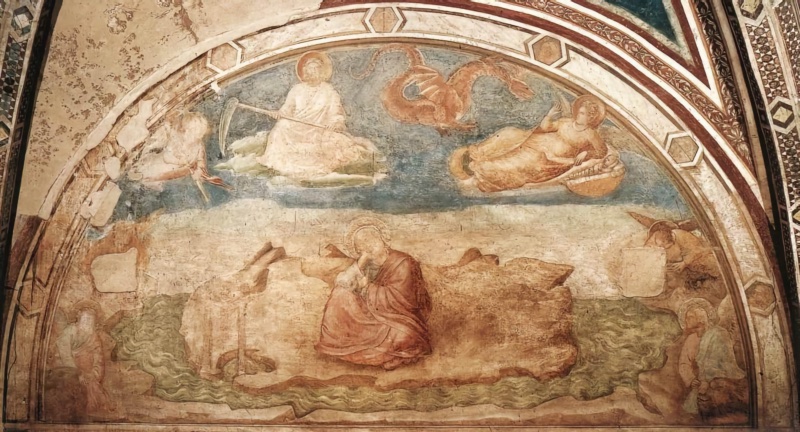
The painting is the first scene in the cycle depicting Saint John the Evangelist, flanked by the cycle of Saint John the Baptist dedicated to the Peruzzi family itself, and should be interpreted both as an “apocalyptic vision” and as a statement of dynastic memory and identity.
The Peruzzi Chapel was a family enterprise: built thanks to a bequest in the will of Donato di Arnoldo Peruzzi in 1299 and later decorated by Giovanni di Rinieri Peruzzi, who commissioned Giotto to paint the cycle of St. John the Baptist and St. John the Evangelist. St. John the Evangelist was the patron saint of Giovanni Peruzzi, the principal patron, and thus his figure becomes a personal and dynastic symbol.
The presence of two Johns—the Baptist and the Evangelist—is no coincidence: the Baptist is the patron saint of Florence and of St. Francis, while the Evangelist is the patron saint of the donor. This pairing creates a sort of theological and civil “double protection”: on one hand, the city and the Franciscan Church; on the other, the individual patron and his descendants. The Vision of Patmos, therefore, is not merely an image of John as the author of the Apocalypse, but also a scene legitimizing the patron: the family’s spiritual capital is thus “imagined” as participating in the divine mystery.
In the ornamental bands of the chapel, with the ten hexagons containing small heads, one can recognize a sort of “early” depiction of members of the Peruzzi family as patrons, not kneeling before the sacred figure but depicted in independent portraits. This mode of representation is innovative: patronage is no longer merely humility before the saint, but a “visible” presence within the theological body of the church, as if the family were inscribed in the very history of redemption.
For the Peruzzi family, one of the city’s most influential banking families, this system of representation allows for the union of mercantile ethics and Franciscan spirituality: the accumulation of wealth is justified by its investment in works of piety, in which family members do not disappear but are instead visible as subjects of grace. The Vision of Patmos, therefore, also becomes a “theater” in which the saint intercedes and the family recognizes itself as part of a holy people, awaiting the final kingdom.
In summary, Giotto’s Vision on the Island of Patmos is a powerful theological image: it portrays the eschatological revelation as the result of a life of holiness and a Church on a journey, in accordance with a Franciscan-Augustinian sensibility. At the same time, for the Peruzzi family, the scene serves as a symbolic guarantee of their belonging to the “heavenly city”: the commission is thus interpreted as an act of faith that, through the figure of St. John the Evangelist, links the dynastic memory to the history of salvation.
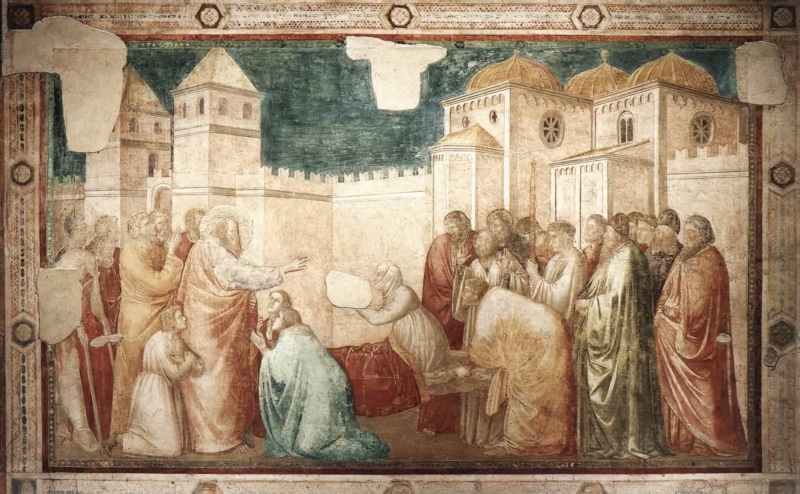
Giotto’s fresco The Resurrection of Drusiana, located in the Peruzzi Chapel of Santa Croce in Florence (c. 1318–1322), depicts an episode from the Stories of Saint John the Evangelist and portrays a “miraculous” resurrection scene that holds a dual theological and symbolic significance: on the one hand, it reaffirms Christ’s power over death; on the other, it serves as a promise of resurrection for the commissioning family. In the context of a funerary chapel, this scene becomes a true spiritual program of salvation and otherworldly glory for the Peruzzi family.
The scene draws on the Golden Legend by Jacobus de Voragine: St. John the Evangelist, upon entering Ephesus, encounters the funeral procession of Drusiana, a God-fearing woman connected to his community, and raises her from the dead by invoking the name of Christ. From a theological perspective, Giotto does not merely illustrate a “miracle of resurrection,” but emphasizes its continuity with the resurrection of Christ: John’s action is made possible only because he is the bearer of apostolic authority and the power of Christ, who triumphs over death. The scene, therefore, serves as a foreshadowing of his own future bodily resurrection, anticipating the Easter promise precisely within the space of the tomb and the funeral chapel.
Giotto organizes the composition around a solid, almost theatrical architecture, which frames the group around the bier and focuses attention on the gesture of John’s hand as he calls Drusiana back to life. The crowd’s reactions are varied and realistic: astonishment, horror, and discomposed gestures, which underscore the spiritual tension between the world of death and the irruption of divine power. This emotional variety is not merely a naturalistic exercise but serves to highlight the transformation wrought by the miracle: death is literally “suspended,” and human life is restored in view of an eternal destiny.
Drusiana is not a canonized saint, but a faithful and virtuous woman, who in hagiographic tradition is rewarded with resurrection precisely because she followed the example of John and the Christian life. By choosing this figure rather than a martyr or an apostle, Giotto offers a theological model well-suited to the lay patronage: the Florentine citizen who, by maintaining charity and faith, can hope not only for an enlightened earthly life but also for a glorious resurrection.
For the Florentine merchant class, such as the Peruzzi family, this means that salvation is not only the result of exceptional acts of holiness, but also of consistency between faith, social life, and civic responsibility. The chapel houses cycles depicting St. John the Baptist and St. John the Evangelist, that is, two figures who herald Christ and his coming, both in a baptismal sense and in an eschatological sense.
Drusiana’s Resurrection fits into this framework as a moment of “awakening” that anticipates both personal resurrection and the general resurrection of the dead, precisely in the space designated for the Peruzzi family’s burial. From a theological perspective, the chapel thus becomes a place where Death is “watched over” by the constant presence of John the Evangelist, symbol of the Word of God that conquers final death. The Peruzzi, a powerful banking family allied with the City-State and the Valois, commissioned this chapel from Giotto to express at once social status, piety, and spiritual ambition. The scene of the resurrection of a faithful and ordinary woman could be interpreted as a model for the family members, including the laypeople: their wealth and political role were worth nothing unless connected to a consistent Christian life and generous patronage of the Church.
In this sense, Drusiana’s resurrection becomes a theological commitment: if the family maintains justice, charity, and devotion, it may hope for its own resurrection, visually celebrated precisely in the chapel bearing their name. In the decorative bands of the narrative scenes, Giotto inserts ten small heads in medallions that many scholars interpret as portraits of members of the Peruzzi family.
Unlike traditional depictions of kneeling patrons, here the Peruzzis are shown in independent, almost “imperial” portraits, placed on an ornamental band surrounding the stories of John. In the figurative language of the time, this means that the family is directly inserted into the circuit of grace and sacred history: their presence is an integral part of the cycle’s theological program, not merely its external patron.
The choice of John the Evangelist, linked to a message of love and communion, allows the Peruzzis to balance their image as bankers and powerful figures with a critical acceptance of earthly wealth. In the Resurrection of Drusiana, it is not economic power that brings life back, but the word of an apostle obedient to Christ: the family’s glory is thus reflected in, but does not replace, divine power. Thus, the chapel serves as a “theological document”: wealth can serve the Church and family memory, but final salvation depends on faith, charity, and fidelity to the Word of Christ proclaimed by John.
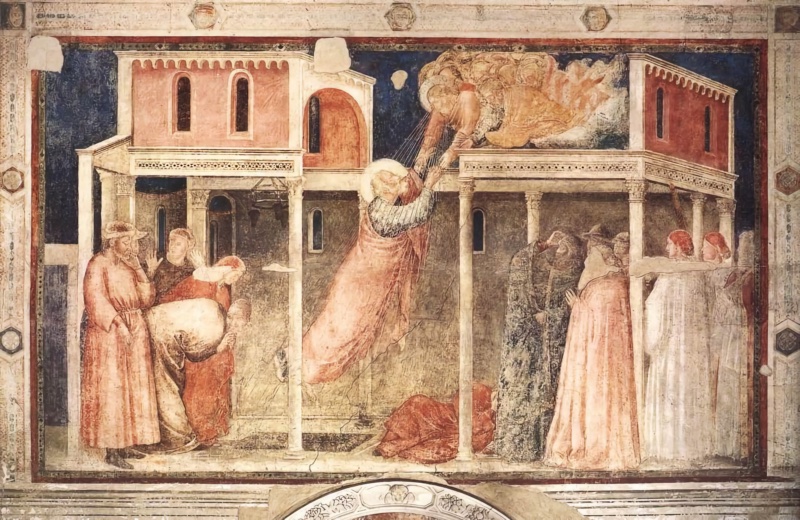
The scene depicts the saint’s assumption into heaven, in which John the Baptist is welcomed by Christ and a procession of angels, while below him a crowd of onlookers gathers, likely including members of the commissioning family. Below is an analysis from a theological perspective and regarding its symbolic significance for the Peruzzi family.
The Ascension of Saint John the Evangelist is part of the cycle on the Stories of Saint John the Baptist and Saint John the Evangelist that Giotto created for the Peruzzi Chapel, largely following the iconography transmitted by Giacomo da Varazze’s Golden Legend. Although the Baptist is the only saint who, according to medieval tradition, does not have a canonical “ascension” in the Christological-Mariological sense, the scene plays on a very powerful theological image: the assumption into the afterlife of a saint who has already participated in advance in the life of Christ and his prophecy.
In this sense, Giotto transforms a liturgically celebrated birth and “return” (the birth of the Baptist and the Ascension of the Evangelist both coincide on the feast day of June 24, according to the Golden Legend) into an image of spiritual triumph, in which the saint, already dead, is welcomed directly by Christ into heaven.
From a theological perspective, the composition emphasizes the interpersonal relationship between Christ and the saint: St. John is depicted in clear eye contact with the Savior, suspended by golden rays that envelop him like a supernatural energy. This direct contact underscores the theme of contemplatio and visio beatifica, that is, the vision of God as the ultimate reward of a life of holiness, which reinforces the chapel’s eschatological message: death is not an end, but a “transition” toward a transfigured dimension of light and glory. The strong presence of light and a spatial hierarchy (earth/heaven) reaffirms the Augustinian and Thomist vision of history as a movement toward God, which finds a widely accepted formulation in early 14th-century Florentine theology.
Giotto employs a figurative language that, while realistic, is rich in symbolic meaning. Christ appears above, on a cloud, with a gesture of welcome and blessing that recalls traditional Christological motifs (Deesis, Christ the Judge, Pantocrator), yet rendered in a more “human” manner than the Byzantine figure. Saint John, on the other hand, is depicted in the act of ascension, with open arms and his gaze fixed on Christ: this movement is almost that of a soul detaching itself from the earthly body to be taken up, a foreshadowing of an experience of salvation that theological tradition also associates with the soul of the faithful. The crowd of onlookers below the scene, horrified or amazed, serves as a system of visual “mediation” for the devotee: their expressions of astonishment, fear, and reverence emotionally convey the supernatural event and invite the viewer to inner participation.
This aspect is very much in line with the Augustinian and Franciscan theology of contemplatio as a mystical experience open even to the laity, which Giotto translates into images of strong psychological engagement. The spatial distinction between earth (architecture, church, people) and heaven (Christ, angels, light) serves to visualize the ontological hierarchy between creation and the Creator, a central idea of Western medieval theology.
The Peruzzi Chapel was funded by the noble Florentine banking family, the Peruzzis, who owned a burial chapel in the left arm of the southern transept of Santa Croce. The choice of the two saints John—the Baptist and the Evangelist—is highly significant, because their joint feast day on June 24 was an important occasion for Florentine aristocratic and entrepreneurial families, who were always keen to link their name to a solemn liturgical commemoration. In this context, Giotto’s decoration becomes a theological and social “memorial”: the chapel is not merely a burial site, but a space of remembrance where the family’s prestige is linked to the sanctity and the divine word embodied in the two saints. In the cycle of stories about John the Baptist and John the Evangelist, the Peruzzi family appears in an innovative way: within the ornamental bands dividing the scenes, ten hexagons with small heads appear, which many scholars identify precisely as portraits of family members.
It is one of the earliest examples in which the patrons are not depicted kneeling before the saint, but as independent portraits, almost “linked” to the sacred narrative through formal and iconographic proximity. This device imbues the family’s presence with theological significance: their image is not merely a sign of ostentation, but a form of visual “participation” in the holiness of the saints, as if to signify that their very existence and wealth find legitimacy in their spiritual proximity to canonical figures and the word of God. For the Peruzzi family, commissioning a cycle of this caliber from Giotto meant aligning themselves with a logic typical of the Florentine economic elite between the 12th and 14th centuries: wealth had to be “reinvested” in devotional works that attested to piety and social function.
The choice of Giotto, an artist already associated with Franciscan commissions and a strong theological background, underscores the desire to link their image to a “modern” spirituality that is nonetheless deeply rooted in tradition, uniting a new natural sensibility with the centrality of salvation and justice.
From a theological perspective, the presence of the scene of the Ascension of St. John in the context of a funerary chapel transforms death into a theme of eschatological hope rather than mourning. The Peruzzi family, rooted in the chapel through their portraits, places itself in a line of continuity with the saint: their future death will be seen as a passage toward the very glory that Giotto depicts in the sky of the Baptist.
This mechanism of “identification” is not only visual but also theological: by participating in the liturgical commemoration of June 24 and in the contemplation of the cycle, the family participates in an almost sacramental way in sacred history and the promise of salvation.
The Peruzzi Altarpiece
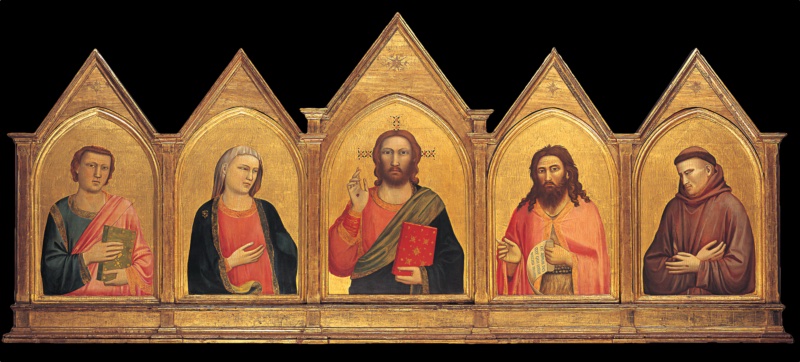
Giotto’s Polittico Peruzzi (Peruzzi Polyptych) is a five‑panel altarpiece of Christ Blessing flanked by the Virgin Mary, John the Evangelist, John the Baptist, and Francis of Assisi, executed in tempera and gold on panel around 1318–1322 for the Peruzzi family chapel in Santa Croce, Florence, and now housed in the North Carolina Museum of Art in Raleigh. The work is generally regarded as a product of Giotto’s later, mature phase, conceived in the master’s studio and carried out with the assistance of collaborators, yet grounded in his compositional and iconographic program. Structured as a Gothic polyptych with cusped arches over each panel, the altarpiece links the Peruzzi family’s Franciscan‑oriented patronage with the devotional imagery centered on Christ, the Virgin, and the two Johns, while the presence of Saint Francis underscores the chapel’s ecclesiastical and dynastic context.
In the context of Franciscan patronage in Santa Croce, Giotto’s work acquires an additional layer of theological and civic significance, tying the imagery of redemptive compassion and apostolic mission to the self‑image of merchant families such as the Peruzzi. His altarpieces, including the Peruzzi Polyptych, function as both devotional objects and status symbols, mediating between the sacred and the urban economy through carefully chosen saints and compositional arrangements. The interaction of these factors—Giotto’s personal idiom, workshop practice, and the patron’s religious and social agenda, renders the Peruzzi Polyptych an exemplary case of early fourteenth‑century Tuscan panel painting. Then, as now, Giotto’s work has been scrutinized through both formal and contextual lenses, with recent scholarship emphasizing the ways his fresco cycles and altarpieces respond to the religious culture and political tensions of early‑Guelph1 Florence.
The Peruzzi were one of the most powerful banking dynasties in early fourteenth‑century Florence, deeply embedded in networks of international finance and ecclesiastical patronage, and their chapel in Santa Croce reflects both their wealth and their desire to align themselves with the Franciscan order. Santa Croce, under Franciscan administration, provided a privileged space for elite families to commission chapels that combined monastic devotion with familial commemoration, often directed toward the afterlife and the intercession of saints. The Peruzzi chapel, dedicated to the lives of John the Baptist and John the Evangelist, was enveloped by fresco cycles that dramatize themes of witness, martyrdom, and apostolic continuity, reinforcing the family’s ecclesiastical and civic identity.
Within this larger decorative scheme, the altar polyptych functioned as the focal point of the chapel, mediating between the viewer’s physical presence and the heavenly realm staged on the wall. The decision to include both John the Baptist and John the Evangelist, alongside Mary and Francis, constructs a program that links the Baptist’s prophetic preparation of Christ with the Evangelist’s apostolic witness and the Franciscan charism of poverty and reform. This grouping also nods to the Franciscan presence in Santa Croce, where Francis himself is venerated as the second apostle of Christ’s Church, thereby investing the Peruzzi with an aura of spiritual nobility.
The Peruzzi’s patronage thus reflects a broader pattern in which Florentine mercantile families negotiated their moral standing through visible acts of piety, using Giotto’s art to project an image of themselves as both pious and powerful. The Peruzzi Polyptych, originally placed above the altar, became a permanent visual surrogate for the liturgical drama enacted beneath it, transmuting the eucharistic sacrifice into an image of eternal benediction. In this context, the altarpiece’s later disassembly and dispersal—subsequently reconstructed in the Kress collection—attest to the shifting fortunes of the Peruzzi and the changing tastes of collectors, even as the work’s iconographic integrity has been painstakingly re‑established. At the level of narrative, the polyptych does not present a continuous story in the manner of the fresco cycles but rather a static constellation of saints, each embodying a particular aspect of the Christian economy of salvation.
Narrative content and saintly figures
The central panel of the Peruzzi Polyptych presents Christ Blessing, his right hand raised in the gesture of benediction and his left supporting the Book of the Gospels, which in his iconography signals the authority of the Word and the continuity between Old and New Testaments. His frontal pose and frontal gaze establish an immediate, almost confrontational relationship with the viewer, turning the altar into a site of divine presence and personal accountability. Flanking him are, to the proper left, the Virgin Mary and John the Evangelist, and to the proper right, John the Baptist and Francis of Assisi, each arranged in bust‑length format against a uniform gold ground.
The Virgin, positioned adjacent to Christ, embodies the Theotokos, the mother of God, her presence underscoring the Incarnation and the mystery of divine maternity. John the Evangelist, often associated with the Fourth Gospel’s mystical theology and the image of the beloved disciple, reinforces the theme of spiritual intimacy with Christ. John the Baptist, as the forerunner of Christ, introduces the motif of prophecy and baptismal purification, while his presence in a Franciscan context also resonates with the tradition of penitential preaching and social critique. Francis of Assisi2, whose figure is closely linked with the Franciscan order and the chapel’s patronage, stands as a living embodiment of evangelical poverty and apostolic mission, completing the altarpiece’s theological program.
The altarpiece’s narrative coherence is thus not linear but thematic, assembling key figures in the drama of salvation—from the Baptist’s preparation, through Mary’s consent and John’s witnessing, to Francis’s imitation of Christ—to form a single devotional tableau. Each saint is rendered with a distinct facial type and expression, allowing viewers to differentiate their roles while maintaining a unified visual rhythm across the five panels. The absence of a shared narrative setting or landscape background emphasizes the timeless, eternal quality of this assembly, distancing them from the temporal events of the fresco cycles and locating them instead in a heavenly realm.
Compositional and thematic unity
Despite the formal discretion of the imagery, the Peruzzi Polyptych coheres thematically through the repeated emphasis on Christ’s centrality and the saints’ roles as mediators and witnesses. The spatial arrangement is symmetrical, with Christ’s larger scale and central position visually dominating the smaller, flanking figures, yet the distances between them are carefully calibrated so that each panel retains its own iconic autonomy. The gold background, shared by all five panels, acts as a unifying device, dissolving architectural and spatial differences and reinforcing the otherworldly character of the scene.
The altarpiece’s composition also reflects a shift toward frontality and clarity, characteristic of Giotto’s later phase, where narrative density gives way to a more concentrated, hierarchically ordered arrangement. This re‑ordering of pictorial space aligns with contemporary liturgical and theological concerns, particularly the desire to make the altar visible and comprehensible to a congregational audience. The mirroring of gestures—such as the upward‑directed attention of the flanking saints toward Christ—further strengthens the sense of a unified devotional field, in which the viewer is invited to participate.
Thematic unity is also achieved through the interplay of individual saints’ attributes and their collective association with different modes of witnessing: prophetic, maternal, apostolic, mystical, and reforming. Saint Francis, as a relatively recent saint at the time, introduces a note of contemporary holiness, linking the Peruzzi’s patronage to the living charisma of the Franciscan order. The altarpiece thus functions as a visual contract between the patrons and the divine, promising the saints’ intercession in exchange for financial and spiritual investment in the chapel. The polyptych’s subsequent history, including its dismemberment and international dispersal, introduces a further, unintended layer of narrative, as the work migrates from its original devotional context into the domain of the art museum and the global art market.
Stylistic features of Giotto’s later phase
Giotto’s style in the Peruzzi Polyptych is often described as a refinement of the monumental language he developed in the Arena Chapel and the Franciscan frescoes, but now tempered by the constraints of panel format and workshop participation. The figures are rendered with a compact, solid volume, their bodies defined by broad, simplified forms rather than by intricate surface detail, and their drapery folds are treated as deep, sculptural recesses that emphasize weight and direction. This sculptural conception of the human form reflects a continuing preoccupation with mass and plasticity, but it is adapted here to the more intimate, frontal orientation of the altarpiece.
The restrained palette, dominated by deep reds, blues, and earth tones, heightened by gilded highlights, contributes to the work’s solemnity and clarity, avoiding the ornamental exuberance of some contemporary Sienese altarpieces. Giotto’s use of tempera allows for precise modeling of facial features, especially in the eyes and mouths, which become focal points of psychological expression even within the relatively static bust‑length format. The modesty of the setting and the lack of narrative incident place greater emphasis on the physiognomy and gesture of the saints, aligning stylistic means closely with devotional intent.
Compared with the fresco cycles in the Peruzzi chapel, the polyptych exhibits a certain degree of schematic simplification, particularly in the rendering of hands and drapery, which suggests that assistants may have executed substantial portions of the painting under Giotto’s supervisory design. Nevertheless, the overall coherence of the composition and the consistency of the facial types indicate that the master’s hand remained decisive in the conception and key passages, especially in the heads of Christ and possibly in Saint Francis and John the Baptist. The stylistic imprint of Giotto’s later period—more elongated, graceful figures, a greater emphasis on gesture, and a more nuanced handling of drapery—can be read here as part of a broader evolution in his work rather than as an isolated experiment.
Facial expression and psychological depth
The faces of the saints in the Peruzzi Polyptych are among the most expressive elements of the work, demonstrating Giotto’s capacity to convey inner states even within a compact iconographic formula. Christ’s visage combines serenity with a solemn, almost solemn distance, his eyes directed outward toward the viewer, inviting contemplation and judgment. The Virgin’s countenance is marked by a gentle, contemplative melancholy, reflecting both her role as intercessor and the foreknowledge of Christ’s suffering.
John the Evangelist’s face is often noted for its softer, youthful features, suggesting a more intimate and affectionate relationship with the divine, while John the Baptist’s more rugged, ascetic visage emphasizes his role as a prophet of penance and austerity. Francis of Assisi, rendered with a slightly more idealized, serene expression, embodies the ideal of the holy mendicant, combining humility with unwavering devotion. The subtle variations in gaze, brow, and mouth carving distinguish each saint’s spiritual character, allowing viewers to discern different modes of sanctity within a single, unified composition.
The limited space of the bust‑length format concentrates attention on facial features, making details such as the tilt of the head, the depth of the folds around the eyes, and the articulation of the lips crucial instruments of expression. Giotto’s handling of these details reflects a sensitivity to physiognomy that anticipates later Renaissance interests in portraiture, yet remains firmly embedded in the conventions of devotional imagery. The psychological depth he achieves is thus not merely individualistic but typological, aligning each face with a specific theological or moral archetype. This synthesis of naturalism and type underpins the altarpiece’s enduring impact, even after its removal from its original liturgical setting.
Drapery and volumetric articulation
The drapery in the Peruzzi Polyptych follows Giotto’s mature vocabulary of deep, rhythmic folds that model the figures as if carved in stone, yet with a sense of organic movement. Broad vertical pleats alternate with diagonal cascades, creating a dynamic interplay between areas of light and shadow that accentuate the volumes of chest, hips, and shoulders. Even in the reduced format of the bust‑length panels, Giotto and his workshop exploit drapery to suggest the presence of hidden bodies beneath the garments, reinforcing the sense of corporeal solidity.
The handling of the fabrics is both economical and emphatic, with fewer fine details than in some earlier works, but greater clarity in the organization of folds and highlights. This simplification reflects the practical demands of production in a busy workshop, yet it also contributes to the work’s solemn, monumental effect. The use of gilded lines and hatched strokes to indicate the edges of garments adds a decorative element without compromising the overall emphasis on mass.
Compared with the more dynamic, flowing drapery of the Peruzzi fresco cycles, the panel’s textiles are somewhat more static, as befits their frontal orientation and cultic function. The schematic treatment of certain folds, such as those in the Virgin’s mantle or Francis’s habit, points to the involvement of assistants, yet the underlying principles of volumetric logic remain consistent with Giotto’s design. In this way, the drapery functions simultaneously as a formal device and as a theological signifier, the weight and solidity of the folds reinforcing the weightiness of the saints’ spiritual roles. The result is a style that is at once restrained and expressive, attuned to the devotional purpose of the altarpiece.
Color, gold ground, and material presence
The color palette of the Peruzzi Polyptych is dominated by a restrained scheme of reds, blues, and earth tones, set against an extensive gold ground that visually anchors the entire composition and elevates its devotional charge. Deep vermilion accents Christ’s robe and the Book of the Gospels, reinforcing both his status and his centrality within the Christian economy of salvation, while darker reds and ochres are used for the Virgin and John the Baptist to convey solemnity and penitential gravity. Blues and greenish‑earth hues appear in underpaint and minor details, providing subtle tonal contrast that enhances the sculptural modeling of the figures without distracting from the overall hieratic clarity.
The gold ground itself is not merely decorative but iconographically significant, evoking the divine light and the heavenly realm that separates the saints from the earthly worshippers below the altar. Applied in leaf over carefully prepared bole layers, the gold creates a luminous, reflective surface that responds to candlelight and movement in the chapel, animating the static imagery and reinforcing its liturgical function. Halos and selected architectural details within the cusped arches are further embellished with incised gold patterns, introducing a delicate play of line and texture that balances the monumental solidity of the figures.
The restrained palette serves a didactic as well as aesthetic purpose, directing the viewer’s attention to facial expression and gesture rather than to intricate ornamentation. Earth tones and muted reds communicate a sense of gravity and humility, aligning with the Franciscan emphasis on poverty and sincerity, while the strategic use of bright vermilion in Christ’s garments underscores his unique role as the source of divine blessing. The juxtaposition of these sober tones with the radiant gold creates a visual metaphor for the transformation of the material world into the spiritual realm, a central theme in fourteenth‑century devotional art.
Spatial organization and architectural framing
The Peruzzi Polyptych is divided into five vertical panels, each framed by a cusped Gothic arch and separated by narrow vertical borders, creating a rhythm of discrete yet interconnected niches that evoke an architectural façade or tabernacle. This arrangement transforms the altarpiece into a micro‑architecture, with each saint inhabiting a kind of painted cell that parallels the vaulted bays of the Peruzzi chapel itself. The horizontal beam beneath the arches and the vertical tracery along the edges of the panels reinforce the sense of an enclosed, sanctified space, distancing the viewer from the sacred figures while still inviting visual penetration.
The central panel, slightly larger in scale, is visually emphasized by its placement and the proportional balance of the flanking pairs, which are arranged in a symmetrical order: Mary and John the Evangelist on the left, John the Baptist and Francis on the right. This symmetry reflects contemporary taste for ordered, hierarchical compositions, yet Giotto’s subtle variations in pose and gesture prevent the arrangement from becoming rigidly schematic. The gold ground, shared across all panels, functions as a unified spatial field, eliding the gaps between the niches and suggesting that all five saints inhabit the same eternal realm. The architectural framing also echoes the Gothic aesthetic of Santa Croce, situating the altarpiece within the broader architectural and decorative program of the church. The pointed arches recall the shape of the church’s windows and portal, establishing a visual continuity between the painted and built environments. At the same time, the altarpiece’s compact scale and vertical emphasis make it readable from a distance, meeting the practical needs of a congregational audience while retaining an intimate, almost portrait‑like quality at close range.
Gestural language and devotional engagement
Gesture in the Peruzzi Polyptych is carefully calibrated to mediate between the viewer and the sacred figures, turning the altar into a site of visual address and spiritual exchange. Christ’s raised right hand, palm outward in the classical benedictory sign, simultaneously blesses the viewer and asserts his authority as the divine judge, while his left hand stabilizes the Gospel book, reinforcing the centrality of the Word. The Virgin’s hands, typically folded in gentle prayer or held in a modest gesture of intercession, direct the viewer’s attention back toward Christ, underscoring her role as mediator between humanity and the divine.
John the Evangelist may be shown with one hand resting lightly on his chest or raised in a gesture of testimony, emphasizing his function as the apostolic witness to the incarnation. John the Baptist, in his more austere pose, often gestures toward Christ or holds symbolic attributes such as a scroll or cross, linking his prophetic mission to the fulfillment embodied in the central figure. Francis of Assisi, as the embodiment of evangelical poverty, is likely rendered in a stance of reverent contemplation, with hands folded or extended in a gesture of humility and receptivity.
These gestures operate within a carefully controlled register of movement, avoiding the dramatic action of the fresco cycles in favor of a more contemplative, inward‑looking mode. The economy of gesture, combined with the frontal orientation of the figures, invites the viewer into a sustained, meditative encounter rather than a fleeting narrative glance. At the same time, the inscribed interaction among the saints—each looking toward or implicitly responding to Christ—creates a closed devotional circuit that frames the worshipper’s participation as a continuation of the saints’ collective witness.
Workshop participation and attribution
While the Peruzzi Polyptych is traditionally attributed to Giotto, modern scholarship recognizes that substantial portions of the work were executed by assistants under his supervisory direction, reflecting the collaborative nature of his later studio. The differences in the quality of the modeling, particularly in the hands and drapery of some flanking saints, as well as a certain schematic uniformity in the secondary figures, suggest the involvement of multiple hands, albeit operating within a coherent design program. Giotto’s authorship is most convincingly located in the central panel of Christ Blessing and possibly in the faces of John the Baptist and Saint Francis, where the psychological depth and plastic certainty approach the master’s autograph style.
The centralized planning of the altarpiece—its iconographic program, the proportional relationships between the panels, and the overall compositional rhythm—confirms Giotto’s decisive role as designer, even if the physical execution was partially delegated. This mode of workshop practice was common in early fourteenth‑century Florence, where major altarpieces were produced on tight schedules and within economic constraints that required the division of labor. The Peruzzi Polyptych therefore stands not only as a document of Giotto’s personal style but also as a case study in the organization of a large Florentine workshop during the height of his fame.
Recent technical and art‑historical studies, drawing on stylistic analysis and comparative work with the Peruzzi and Bardi chapel frescoes, have helped refine the attribution of individual panels, although definitive proof of each hand remains elusive. The recognition of workshop participation does not diminish the altarpiece’s significance; on the contrary, it illuminates the practical realities behind what appears on the surface as a unified, autograph creation. In this light, the Peruzzi Polyptych becomes a crucial node in the network of Giotto‑related production, linking his panel painting with the monumental frescoes that define his legacy.
Liturgical and devotional function
Within the original context of the Peruzzi chapel, the polyptych functioned as the visual and spiritual focal point of the altar, mediating between the eucharistic sacrifice enacted upon it and the celestial realm represented behind it. Its elevated position ensured that Christ and the saints were visible from a distance, enabling the uneducated laity to participate in the liturgy through image and gesture even when the words of the Mass were unintelligible. The altarpiece thus operated as a didactic device, reinforcing doctrinal themes such as the Incarnation, the Trinity, and the intercessory power of the saints.
The choice of saints, Mary, the two Johns, and Francis, created a typological constellation that linked Old Testament prophecy, the Gospel, apostolic witness, and contemporary holiness into a single devotional field. This arrangement encouraged viewers to see the Peruzzi family’s patronage as embedded within a continuous chain of divine favor, extending from the Baptist’s preparation of Christ to Francis’s imitation of the crucified Savior. The altarpiece’s frontal orientation and clear, legible figures made it particularly suitable for private devotion and votive prayer, allowing individual worshippers to fix their gaze on a specific saint while remaining within the encompassing presence of Christ.
Over time, the liturgical function of the Peruzzi Polyptych has been partially displaced by its role as a museum object, yet its original devotional intent remains legible in its composition and iconography. The decision to reconstruct the altarpiece in the Kress collection and to display it in a single ensemble, rather than as isolated panels, reflects an ongoing scholarly and curatorial interest in restoring its original context and meaning. In this reconstructed condition, the Peruzzi Polyptych continues to function as a window into early fourteenth‑century Florence, where art, faith, and commerce converged in the production of sacred images.