Meo da Siena
Meo da Siena, more properly Meo di Guido da Siena, was born in Siena on an unknown date, and the only secure familial fact is that he was identified as the son of a man named Guido. He is securely documented in Perugia on 10 January 1319, while his date of death, place of death, and cause of death are not recorded; the Galleria Nazionale dell’Umbria summarizes him as dead before 1334, whereas some sources underline that the date and place of death remain unknown.
Family
Meo’s biography begins with uncertainty, and that uncertainty is itself historically significant. The scholarly literature states plainly that his date of birth is unknown and that he was a painter originally from Siena, active in the first decades of the fourteenth century. The same source identifies him only through a patronymic formula, “Meo di Guido da Siena,” which ties him to a father named Guido without solving the larger problem of the family’s exact identity. Even at the most basic biographical level, therefore, his family history survives in documentary fragments rather than in a continuous narrative.
The paternal question has been central to the historiography of Meo because the 1319 document calls him the son of “the late Guido, painter of Siena.” From the time of Mariotti onward, some scholars identified this Guido with the celebrated author of the signed Maestà in San Domenico at Siena. Milanesi accepted that hypothesis while also recognizing the anachronism of the famous date 1221 and associating the father with Guido di Graziano, documented in the late thirteenth century. Yet the scholarly literature emphasizes that the problem remains open because more than one Sienese painter named Guido was active around the turn of the thirteenth and fourteenth centuries.
This unresolved paternal identification matters because it affects how one imagines Meo’s early formation. If his father was indeed a practicing painter, Meo’s training may have begun within a workshop environment structured by family transmission, as was common in medieval Italy. If, however, the name Guido cannot be securely attached to a known master, the evidence obliges us to keep the notion of direct inheritance hypothetical rather than certain. In other words, family and workshop cannot be neatly separated in his case, but neither can they be confidently fused.
The scholarly literature offers no reliable information about Meo’s mother, siblings, marriage, or children. That silence should not be mistaken for proof that such relations did not exist, but it does mean that they cannot be reconstructed from the available record. The 1319 Perugian catasto documents property ownership, not a full domestic biography, and it tells us more about civic status than about household structure. As a result, Meo’s family remains visible only at the narrow point where genealogy intersects with professional designation.
The most revealing substitute for a fuller family portrait is the artist’s repeated identification as Sienese. In the Montelabate polyptych, the signature “MEUS SENENSIS” gives regional belonging a public, almost heraldic value. That formula does not tell us who his relatives were, but it does show that origin functioned as a cultural credential before Perugian patrons. In Meo’s case, family history survives less as private narrative than as a compressed statement of lineage, city, and craft.
Meo as Bartolomeo Guarnieri?
A long-standing strand of the historiography identifies Meo da Siena with a painter otherwise known as Bartolomeo Guarnieri. The hypothesis rests on the conjunction of two documentary traces: a Sienese master named Guido Guarnieri — also recorded in variant spellings as Guido Gratiani or Guido Graziani — who is attested in connection with Perugia around 1319, and the patronymic formula “Meo di Guido da Siena,” which names Meo as the son of a Sienese painter called Guido. If these two Guidos are one and the same person, then Meo’s full civic name would be Bartolomeo Guarnieri, with “Meo” as the contracted form of Bartolomeo and “di Guido” confirming the paternal line.
The credit for articulating this chain of inference belongs primarily to Crowe and Cavalcaselle, whose narrative of Sienese and Umbrian painting introduced “Guido Guarnieri of Siena” as a figure associated with a large altarpiece for the Montelabate Abbey. Their reconstruction was later condensed and repeated in short reference entries, which present the onomastic sequence — Guido Guarnieri as father, Bartolomeo or Meo as son — as a working identification rather than a proven genealogy. Modern guides such as the Guide artistique de la Province de Sienne follow this convention, listing the painter as “Meo da Siena, also known as Bartolomeo Guarnieri or Meo da Guido da Siena.”
The identification is nonetheless a scholarly reconstruction rather than an explicit medieval attestation. No surviving document spells out in a single formula “Bartolomeo Guarnieri, son of Guido Guarnieri”; the link depends on reading the patronymic of the 1319 Perugian catasto against the surname recorded by Crowe and Cavalcaselle, and on reconciling the oscillating spellings — Guarnieri, Gratiani, Graziani — that reflect the instability of medieval transcription rather than distinct individuals. Reference summaries accordingly retain expressions such as “may be” and “is also known as” to signal the inferential character of the equivalence. Until a document surfaces that unambiguously unites the name Bartolomeo, the patronymic Guarnieri or Graziani, and the Sienese origin in a single record, the identification of Meo da Siena with Bartolomeo Guarnieri will remain probable but unconfirmed.
Patronage
The center of Meo’s activity was Perugia, and the scholarly literature stresses that most of the works generally accepted as his are concentrated there. This concentration is not accidental, because the same source describes him as probably the most sought-after painter of altarpieces in Perugia between the second and fourth decades of the Trecento. Such a profile implies sustained relationships with ecclesiastical patrons rather than isolated commissions. His patrons were therefore not marginal actors in his career, but the very matrix within which that career became legible.
The most important of these patrons was the Benedictine abbey of Santa Maria di Valdiponte, known as Montelabate. The scholarly literature notes that several works by Meo and his circle were located there, and it explicitly interprets this concentration as evidence of a special bond with that commission. The signed Montelabate polyptych originally belonged to a larger and highly suggestive ensemble of images within the abbey church. Gardner, as summarized in the scholarly literature, even proposed that this commission may have been the reason for Meo’s arrival in Perugia around 1318–1319.
Another major patronal nexus formed around the Benedictine abbey of San Pietro in Perugia. The scholarly literature reports that the double-sided painted retable now in Frankfurt was identified by Gardner as the old high-altarpiece of that abbey. The same source records the long debate over the kneeling donor placed at the feet of the enthroned Virgin, first recognized as Abbot Ugolino di Nuccio da Montevibiano and more recently reinterpreted as the earlier abbot Ugolino Vibi Guelfoni da Gubbio. This donor portrait shows that Meo’s patrons could demand works that joined institutional liturgy, individual commemoration, and highly visible display.
Dominican patronage also enters the record, though less transparently. The scholarly literature states that the pentaptych no. 25 came from the Perugian church of San Domenico. Yet the same entry remarks that the absence of a Dominican representative among the surviving figures creates doubts about whether San Domenico was its original destination. This case is instructive because it reveals how provenance, iconography, and patronal identity do not always align cleanly in fragmented medieval altarpieces.
A related but distinct commission concerns the triptych now in the Museo della Cattedrale of Perugia. The scholarly literature identifies the work simply by its present location and subject, while a Perugian guide says that it was probably commissioned for San Domenico Vecchio and still retains its original frame. If that provenance is accepted, the triptych would further confirm Meo’s close integration into the devotional institutions of the city. Even where the patron’s personal name is lost, the work still points to a concrete institutional setting and a liturgical function.
Finally, patronage in Meo’s career was not limited to abbots and convents, because one of his panels preserves evidence of an individual donor image. On panel no. 24, originally part of a larger dossal from Santa Maria della Misericordia, the scholarly literature notes the fragmentary presence of a donor or donoress beside the central group. This detail suggests that Meo’s clientele could include more localized and perhaps more personal forms of devotion alongside major monastic commissions. His patronage system was thus layered, ranging from large Benedictine foundations to urban churches and from collective institutions to individualized votive presence.
Painting style
The scholarly literature states that Meo was unanimously regarded from the time of Cavalcaselle onward as a painter of Ducciesque formation. That judgment places him firmly within the Sienese tradition of refined line, controlled sacred decorum, and gold-ground panel painting. His art is therefore not provincial in origin, even if it later became deeply rooted in Perugia. Instead, it represents the transfer of a Sienese pictorial language into an Umbrian devotional market.
The Montelabate polyptych is the clearest monument of his mature stylistic ambition. The Galleria Nazionale dell’Umbria describes it as a great altarpiece machine with thirty-five figures arranged in two registers. It further notes that the structure looks to the polyptych by Pietro Lorenzetti for the Pieve of Arezzo and above all to Simone Martini’s polyptych for Santa Caterina at Pisa, both completed around 1320. Meo’s style is thus inseparable from his command of increasingly complex polyptychal architectures.
At the level of figural invention, the Galleria remarks on a tension between repetition and individuation. It observes that the uniformity of facial types and the repetitiveness of many poses are redeemed by especially characterized physiognomies, such as the thick-haired Saint John the Evangelist and the almost orientalizing features of Saint Emilian. This judgment is important because it captures both the limits and the strengths of Meo’s painting. He could rely on standardized devotional formulas while still introducing selective accents of vivid personality.
The central Marian image in the Montelabate polyptych also reveals the theological intelligence of his style. The Virgin’s hand points downward in a gesture that the museum explicitly connects with the Byzantine Hodegetria type. At the same time, that gesture directs the beholder’s eye toward the inscription containing the painter’s name, thereby linking sacred authority, image reading, and artistic authorship. Meo’s style is therefore not only formal but also rhetorical, guiding devotional attention through gesture and text.
The scholarly literature allows one to trace stylistic development across his surviving panels. Boskovits placed panel no. 24 very early, perhaps as far back as 1310 or before, while later scholars generally dated panel no. 23 after the signed polyptych and closer to the later 1320s. Whether or not one accepts those exact dates, the sequence implies a painter capable of adapting old Sienese habits to changing Perugian expectations. Style in Meo is therefore historical rather than static, even if the chronology remains debated.
The scholarly literature also stresses the importance of Meo’s relationship with the Perugian environment itself. It notes that later works such as panel no. 23 and the Frankfurt retable seem to reflect a dialectical exchange with local artistic culture. The same source adds that connections have been observed between Meo and the workshops of illuminators active in Perugia. His painting style should therefore be read as an urban synthesis in which Sienese inheritance met Umbrian habits of image making.
The traditional critical view, again summarized in the scholarly literature, considered Meo immensely influential in early Trecento Perugia while often judging him an artist of only moderate stature. That mixed verdict is revealing rather than dismissive. It suggests that his style succeeded less through startling originality than through reliability, intelligibility, and adaptability to altarpiece production. In that sense, his pictorial language answered the practical and devotional needs of a broad patronal market with unusual effectiveness.
Artistic influences
Duccio di Buoninsegna stands at the beginning of any serious account of Meo’s artistic inheritance. The scholarly literature explicitly calls Meo a painter of Ducciesque matrix, and that formulation is more than a generic label. It means that the fundamental grammar of his art was shaped by the Sienese cult of elegant surface, lucid sacred hierarchy, and measured emotional tone. Even after his move to Perugia, Meo never ceased to work within that Sienese horizon.
The scholarly literature also records the critical recognition of a relationship with Segna di Bonaventura. This connection is important because Segna represents a particular branch of post-Duccio painting in which inherited formulas are reworked for smaller devotional and ecclesiastical contexts. In Meo, the comparison helps explain the balance between sweetness of type and relative compositional conservatism. The influence is best understood not as imitation of a single picture, but as participation in a broader Sienese visual climate.
Pietro Lorenzetti is another crucial reference point, and the museum page makes that influence concrete in structural terms. The Montelabate polyptych is said to look to Pietro’s polyptych for the Pieve of Arezzo in the organization of the great altarpiece machine. That observation shows that influence on Meo could be architectural as much as figural. He learned from major Sienese models how to orchestrate multiple sacred presences within a coherent monumental frame.
Simone Martini belongs to the same conversation, though with a different inflection. The scholarly literature lists Simone among the artists whose activity has been seen in relation to Meo’s art, and the Galleria specifically compares the Montelabate structure to Simone’s polyptych for Santa Caterina in Pisa. From Simone, Meo seems to have absorbed above all the prestige of coordinated multi-panel design and the elevated finish expected of major ecclesiastical commissions. Yet Meo remains less courtly and more functional, translating high Sienese models into a Perugian register of devotional accessibility.
A final set of influences comes from beyond named Sienese masters. The scholarly literature notes that several scholars have proposed Meo’s knowledge of the painted cycles at Assisi, and it also remarks on his relation to Perugian workshops of manuscript illuminators. The museum page, for its part, points to the Byzantine Hodegetria formula in the Virgin of Montelabate. Meo’s art should therefore be seen as a meeting point between Sienese panel painting, Umbrian monumental decoration, local illumination, and durable Byzantine iconographic memory.
Travels
The only fully secure geographical axis of Meo’s life runs from Siena to Perugia. The scholarly literature identifies him as Sienese by origin and records that, by 10 January 1319, he had already become a Perugian citizen. On that date he enrolled in the catasto of Porta San Pietro and declared ownership of a house in the parish of San Silvestro as well as land partly planted with vines at Mugnano or Megnano in the contado. These details show not a passing visit, but a measurable insertion into the social and economic fabric of Perugia.
The chronology of his arrival, however, remains debated. The scholarly literature notes a wide scholarly range, extending from the opening of the century to the final years of the second decade. Gardner’s view, as reported there, links the Montelabate commission with Meo’s move to Perugia and places that transition around 1318–1319. Boskovits, by contrast, thought that Meo may have been in the city by 1310 or even earlier, especially in light of the early dating proposed for panel no. 24.
Within the Perugian orbit, Meo’s movements can be inferred from the distribution of his works and properties. Montelabate, San Pietro, Santa Maria della Misericordia, San Domenico, and the cathedral museum all map a network concentrated in and around Perugia. The catasto record adds Mugnano or Megnano to that geography, suggesting that his activities and possessions extended into the contado as well as the city proper. His travels, insofar as they are recoverable, appear to have been tied closely to commission sites rather than to a demonstrative career of courtly wandering.
Beyond Umbria, the evidence becomes far more uncertain. The scholarly literature accepts the damaged frescoes at San Paolo a Monticelli near Perugia as a persuasive addition to his corpus, but it treats his supposed direct participation in the frescoes of the Sacro Speco at Subiaco as debated and doubted by many scholars. That caution matters, because it prevents us from constructing an inflated itinerary on the basis of stylistic resemblance alone. For the present state of evidence, Meo’s travels are best understood as the movement of a Sienese-trained painter who established himself in Perugia and radiated outward only within a limited central Italian field.
Works
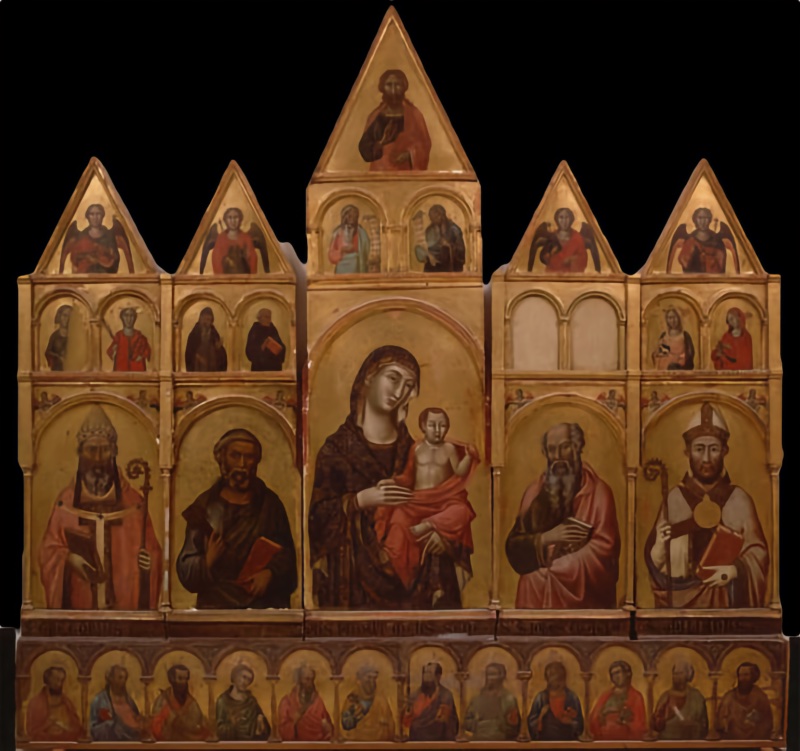
Originally, this polyptych adorned the high altar of the Abbey of Santa Maria di Valdiponte (Montelabate), near Perugia.
The polyptych is organized into two main registers with pointed pinnacles and a lower predella, featuring a total of about 35 figures arranged symmetrically within a Gothic framework of trefoil-shaped cusps and ogival arches decorated in gold. At the center of the upper register, the Virgin and Child Enthroned (Madonna Odigitria) dominates, with her right hand pointing downward toward the child and the artist’s signature “MEUS SENE[N]SIS” below; on either side, monumental saints such as St. Gregory the Great (on the left, wearing a dalmatic decorated with embossed silver), St. John the Evangelist (with thick hair), St. Emilian the Bishop (with Oriental features), St. Anthony the Abbot, and St. Benedict (on the right). Angels, prophets, and Christ giving the sign of blessing appear in the upper pinnacles; the lower predella depicts the Twelve Apostles in half-length portraits (from St. James to St. Jude), while saints such as St. Agnes, St. Mary Magdalene, St. Martha, and St. Catherine of Alexandria emerge from the lower sides. This modern reconstruction reflects historical disassemblies (late 18th century and 1919 restorations), with the original woodwork lost and parts occasionally assembled incorrectly.
Executed in tempera on panel, with gold leaf applied in gouache over red bolo for the backgrounds and in mission style on the decorated vestments; the halos are stamped and engraved with cuneiform motifs. Embossed silver elements on a red background adorn St. Gregory’s dalmatic and the moldings; the overall surface is rich in gold and filigree details, typical of Sienese Gothic.
The overall dimensions of the reassembled polyptych measure approximately 246 x 236 cm, as indicated in specialized sources. The individual panels vary in size: the central panel (Madonna) is approximately 242 cm in height, the principal saints are 84 cm high, the blessing Christ is 56.6 cm high, the female saints are 31 cm high and 41.5 cm wide, and the predella and apostles are proportionally smaller.
Inspired by the polyptychs of Simone Martini (St. Catherine, Pisa) and Pietro Lorenzetti (Pieve d’Arezzo, ca. 1320), it displays uniformity in facial types but vivid characterizations, with Byzantine influences in the Virgin and independent Sienese reinterpretations. The only signed work by Meo, documented in Siena from 1319 and in Perugia until 1334, it is fundamental for dating his stylistic development in the second decade of the 14th century.
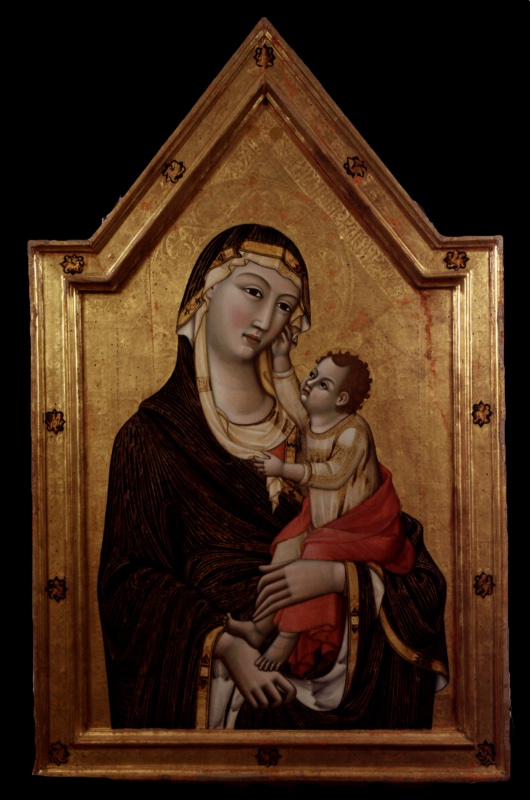
Painted in tempera on a large panel, the altarpiece is set within an ogival frame decorated with punched motifs, typical of Sienese Gothic style, which culminates in a triangular pediment that emphasizes the sacred verticality. The background is covered with gold leaf embossed with floral and geometric motifs, creating an ethereal aura that symbolizes divine incorporeality and separates the sacred plane from the earthly one. The composition is centered on the Virgin seated in majesty on a barely sketched throne, with the Child in her lap; the ogival shape of the frame guides the gaze upward, evoking spiritual ascent.
The Madonna, depicted as the Virgin of Tenderness (Eleousa), tenderly embraces the Christ Child, whose faces draw close in an intimate gesture that humanizes the divine figure—a Sienese innovation derived from Byzantine models and Duccio. The Child, with his right hand in a gesture of blessing (dextra dextrarum), blesses with his fingers, foreshadowing his redemptive mission, while his right foot rests on his Mother’s wrist, symbolizing the impending Passion.
This work exemplifies the spread of the Sienese school in Umbria during the early 14th century, serving as a bridge between Byzantine-influenced Romanesque and mature Gothic styles, and influencing local painters such as the Master of San Pietro. Originally placed in an abbey setting, it invited the faithful to meditate on the Theotokos as a compassionate mother and intercessor, reflecting the Augustinian theology prevalent in the monasteries. Today, at the National Gallery of Umbria in the Palazzo dei Priori, it continues to bear witness to the cultural syncretism between Tuscany and Umbria, and is invaluable for studying the evolution of Marian iconography during the Gothic period.

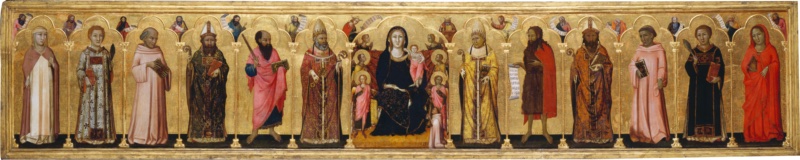
The work is a diptych (an altarpiece painted on both sides).
Originally from the high altar of the Church of San Pietro in Perugia, this polyptych reflects the late Gothic Sienese style as adapted in Umbria, with influences from Duccio di Buoninsegna, and displays a symmetrical and hierarchical composition typical of medieval iconography. The elongated horizontal structure, almost processional in nature, emphasizes the collective solemnity of the sacred figures against a gold background—a symbol of divine eternity—created with stamped gold leaf and vivid tempera and oil colors.
On this side, Christ the Judge is enthroned in the center in majesty, wearing a red tunic and blue mantle, with one hand raised in blessing and the Gospel in the other, surrounded by angels who sing and sway rhythmically, while the Twelve Apostles flank him standing, six on each side, identifiable by iconographic attributes: Peter with keys, Paul with a sword, John with a vial of poison, etc. The figures of the apostles, in colorful robes (red, blue, green, yellow), are arranged in static yet elegant poses, with punched halos and borders decorated with floral and geometric motifs, creating a visual rhythm that guides the eye from the center to the sides. This scheme derives from the Byzantine tradition of the Christus Triumphans, adapted to the Sienese Gothic style with sinuous lines and refined gilding, emphasizing ecclesial unity under Christ.
The other side depicts the Virgin Mary enthroned with the Infant Jesus on her lap; she blesses with her right hand while holding a book or a fruit, surrounded by angel musicians, twelve saints (or prophets in some panels), and the donor, Abbot Ugolino, kneeling in a white Benedictine habit at the foot of the throne. The saints, relics owned by the monastery of San Pietro, wear precious garments with curved folds and oriental-style details, such as Persian motifs on the edges, highlighted in modern analyses as evidence of Middle Eastern influences. The symmetrical composition, with the Virgin in Byzantine hieraticism yet Sienese sweetness, symbolizes Marian intercession, with the Child in a blessing gesture that foreshadows the Passion.
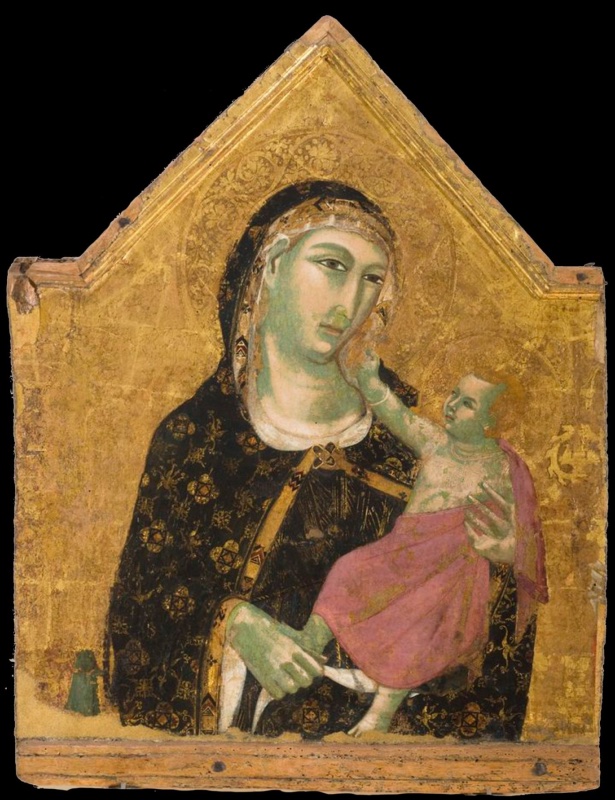
The image depicts the Virgin Mary seated or in half-length, holding the Infant Jesus in her lap, enveloped in an aura of maternal tenderness typical of the iconography of the Sienese Maestà of the early 14th century. The Madonna wears a black mantle adorned with golden floral or geometric motifs, with a white veil framing her oval face and elongated eyes, while the Child, either nude or draped in pink-red fabric, blesses with his right hand and holds a small object (perhaps a fruit or a book) in his left, gazing toward his mother. The background is burnished gold stamped with delicate decorative motifs, framed by an original triangular cusp, an element indicating its role as a side or cusp panel of a larger polyptych, perhaps dedicated to saints or angels in the adjacent compartments. This composition emphasizes the theme of the Theotokos (Mother of God), with the infant Christ as Savior, an iconographic shift from the Christus Triumphans to the more human Christus Patiens, common in the Umbrian-Sienese Romanesque-Gothic transition.
Executed in tempera on poplar panel (likely two or three planks joined together), the work features a ground of chalk and animal glue, over which red-bolus gold is applied for the background, incised with a burin to create luminous effects and refined textures. The colors include azurite for the garments, organic red lacquers, and white highlights on the Virgin’s mantle, bound with egg emulsion, a technique typical of the Sienese International Gothic style. The original frame, with poly-lobed panels decorated with chimeras and fantastical figures, echoes contemporary Perugian miniatures (such as the choir books of San Domenico), attesting to Meo’s integration into the Umbrian workshop after his arrival from Siena. The state of preservation is good, despite restorations, allowing one to appreciate the fine engraving and gilding.