Marino di Elemosina
The artist knowwn as Marino d’Elemosina is a very sparsely documented Umbrian painter, active in Perugia in the first quarter of the fourteenth century and known with certainty from a single large Marian altarpiece and a brief archival notice. His exact date and place of birth, as well as the date and cause of his death, are not recorded in surviving sources; on strictly documentary grounds we can say only that he is attested in Perugia between about 1309 and 1313.
Sources and biographical limits
Modern scholarship on Perugian medieval painting converges on the fact that Marino appears in the records as a painter “documented in Perugia from 1309 to 1310,” without any accompanying information about his family, training, or origins. The Galleria Nazionale dell’Umbria, which now preserves his principal work, summarises his profile simply as “Marino d’Elemosina, active in the first quarter of the fourteenth century; documented in Perugia, 1309–1310,” underscoring the narrowness of the evidentiary basis. A Treccani entry on Perugia’s artistic life in the Duecento and Trecento notes Marino among the painters active around the civic building campaigns and restoration projects of the early fourteenth century, again without supplying personal data beyond his presence in the city.
Because no baptismal, testamentary, or guild records have yet been linked securely to him, any statement about his year or place of birth remains conjectural; at most, historians infer that a painter documented around 1310 would likely have been born in the later decades of the thirteenth century, probably within the orbit of Perugia or its contado. Similarly, there is no documentary trace of his last years, so neither the date nor the circumstances of his death can be established; the only secure terminus post quem is the execution of his Maestà around 1313, after which the archival trail falls silent. In what follows, therefore, “biography” must be understood in an extended sense: a reconstruction of Marino’s social and artistic circumstances rather than a life narrated through individual events, always distinguishing firmly between documented facts and contextual hypotheses.
Family and social background
No surviving document mentions Marino’s parents, marital status, or kin, and there is no evidence that any relative of his appears among Perugia’s known painters or miniaturists of the period. The patronymic “d’Elemosina” has sometimes been read as a sobriquet rather than a true family name, perhaps alluding to charitable activity or to a confraternal affiliation, but no archival source explicitly explains or confirms this interpretation. The signature on his Maestà, Marinus P., on the sword of Saint Paul, read as Marino da Perugia, connects him to the city in professional terms, yet even here scholars disagree whether the painter of the panel should be equated with the miniaturist Marino d’Elemosina or with another Marino, such as Marino di Oderisio, head of the painters’ guild in 1318.
Given this silence, scholars approach Marino’s family background indirectly, by analogy with better-documented Perugian painters of the same milieu, who typically belonged to the urban artisan class and were integrated into the guild system that regulated workshops and commissions. The fact that Marino could be entrusted with both restoration work in the Palazzo dei Priori and the execution of a prestigious altarpiece for a major abbey suggests that he enjoyed a recognised professional standing, which usually depended on workshop networks and client relationships cultivated across generations, even if the names of his own masters and descendants are lost. For an artist active in this sphere, family identity was often intertwined with participation in lay confraternities and in parish communities; yet, in Marino’s case, any specific affiliation—whether to a devotional sodality, to a quarter of the city, or to a lineage of painters—remains beyond our current documentary reach.
Patrons and institutional context
The clearest glimpse of Marino’s patrons comes from his association with two powerful institutions: the commune of Perugia and the abbey of San Paolo di Valdiponte, later known as the Badia Celestina at Civitella Benazzone. A Treccani synthesis of Perugia’s civic enterprises records that in 1310 a painter named Marino d’Elemosina was paid for restoration work on painted decorations in the Palazzo dei Priori, aligning him with the team of artists who maintained and updated the imagery of this emblematic civic complex. Such a commission presupposes recognition by communal authorities and situates Marino within the visual propaganda of the Perugian republic, which used frescoes and panel paintings to articulate civic identity, the cult of local saints, and allegiance to the papacy.
Even more important for understanding his patronage is the great altarpiece Madonna in trono col Bambino tra i santi Paolo, Pietro Celestino e quattro angeli, painted around 1313 for the high altar of the abbey church of San Paolo di Valdiponte. The panel, a large cusped tempera on panel now in the Galleria Nazionale dell’Umbria, is explicitly linked in museum catalogues to that abbey, indicating that the original patrons were the monastic community and its superior, who sought an imposing Marian image flanked by their titular saint, Paul, and a monastic prelate traditionally identified as Saint Peter Celestine.
Modern research has nuanced this Celestinian identification: while the right-hand monk saint has often been read as Pope Celestine V, the abbey itself did not belong to the Celestine congregation in the early Trecento, and the epithet “Celestina” for the house in fact dates only from the late sixteenth century, when it passed to the Congregazione di San Giorgio in Alga and its blue-habited canons. The altarpiece nonetheless shows that Marino’s clientele extended beyond the city’s civic apparatus into the world of reformed Benedictine monasticism, an environment attentive both to theological content and to the prestige value of imported or updated pictorial idioms.
Patronage debates also touch on Marino’s possible activity as a miniaturist for the Perugian cathedral of San Lorenzo, since some early scholarship conflated him with the so‑called Primo maestro dei corali di San Lorenzo, an anonymous illuminator of choir books whose style shares certain traits with the Maestà. More recent art history tends to distinguish the panel painter Marino d’Elemosina from this miniaturist, while nonetheless recognising that both operated within the same ecclesiastical patronage circuits—cathedral chapter, monasteries, and confraternities—that fostered a tight interplay between large-scale panel painting and luxury manuscript production. In all these cases, Marino appears as an artist serving institutional patrons rather than private lay commissioners, reflecting the dominant structure of the Umbrian art market around 1300, in which civic bodies and religious houses were the primary arbiters of taste and style.
Painting style
Because Marino’s oeuvre is essentially restricted to a single securely attributed panel, stylistic assessments focus on the Madonna in trono col Bambino tra i santi Paolo, Pietro Celestino e quattro angeli, whose authorship is guaranteed by the signature “Marinus P.” on Saint Paul’s sword. Catalogues and scholarly syntheses describe the work as a Maestà-type image in which the enthroned Virgin and Child dominate the central field, flanked by the two standing saints and attended by angels, against a gold ground, in a format that mediates between late Duecento dossals and the emerging polyptych structures of the early Trecento. Treccani’s discussion characterises Marino’s manner here as “less academic, more expressive and descriptive,” linking it to the contemporaneous Perugian miniature tradition and to currents arriving from Siena and from the fresco cycles at Assisi.
Within this framework, Marino’s figures are understood to balance residual Byzantine hieraticism, visible in the frontal rigidity of the Madonna and the solemn symmetry of the composition, with a growing interest in psychological nuance and narrative detail, particularly in the expressive heads and the careful description of garments and liturgical attributes. Scholars situate his palette and ornamental vocabulary in relation to the broader renewal of Umbrian painting on the Assisi–Perugia–Gubbio axis, where the pathos-inflected linearity of Giunta Pisano and his followers was being reworked under the impact of Cimabue’s Assisi frescoes and the more volumetric, emotionally complex language of early Giotto. Marino’s style, as reconstructed from the Maestà, thus appears as a hybrid: on the one hand indebted to the refined colour harmonies and elegant silhouettes associated with Sienese artists such as Duccio, already active in Perugia by the first decade of the century; on the other, open to the stronger plastic modelling and intensified drama that would come to mark Giottesque currents in Umbria.
Artistic influences
The Treccani synthesis of Umbrian painting around 1300 explicitly lists Marino d’Elemosina alongside the Maestro del Farneto and the so‑called Espressionista di Santa Chiara as exponents of a new phase in regional art, one in which Giunta Pisano’s Italo‑Byzantine crucifixes and Cimabue’s Assisi frescoes were progressively reinterpreted through Giotto’s innovations and, later, through the example of Pietro Lorenzetti. Within this constellation, Marino’s Maestà has been read as manifesting both a lingering attachment to the linear elegance and surface patterning characteristic of late Duecento painting and an incipient responsiveness to Giotto’s emphasis on bodily weight, spatial coherence, and affective interaction among figures. The work’s affinities with contemporary miniatures—for instance in the treatment of ornamental borders and in the delicate, descriptive handling of faces and draperies—also point to the influence of local illuminators, whether or not Marino himself practised the art of the codex.
Sienese influence reaches Marino not only through Duccio’s Madonna dei domenicani, painted for San Domenico in Perugia and now a centrepiece of the same museum room as Marino’s panel, but also through the Montelabate polyptych and other works by Meo di Guido, which introduce into the Umbrian context a courtly refinement of pose and a softening of facial types. At the same time, the broader climate of civic building and sculptural decoration, most notably the Fontana Maggiore and the works associated with Fra’ Bevignate, Nicola and Giovanni Pisano, and Arnolfo di Cambio, provided models for a classicising yet expressive figuration to which Marino’s more descriptive mode responds in an attenuated, painterly key. His position is therefore best understood not as that of an isolated master but as one node in a dense network of visual exchange linking panel painting, mural cycles, sculpture, and manuscript illumination across central Italy in the decades around 1300.
Travels and geographic horizon
No surviving document records any journey undertaken by Marino d’Elemosina; there are no contracts that place him outside Perugia, nor any signatures securely ascribed to him in other cities. Nonetheless, the stylistic hybridity of his Maestà, combining Sienese refinements with lessons drawn from Assisi and the Umbrian Giottesque, strongly implies at least indirect exposure to works in those centres, whether through personal travel, through the circulation of drawings and workshop models, or through the presence in Perugia of artists trained elsewhere. In particular, the proximity of his altarpiece to Duccio’s Madonna dei domenicani and to Meo di Guido’s panels in the Galleria Nazionale makes it highly likely that Marino’s visual horizon included both Sienese and Assisan exempla, which, in the absence of photographic reproductions, would normally have been studied in situ.
The mention of Marino in discussions of Umbrian painted crosses “at the time of Giunta and Giotto” further suggests that he belongs to a generation of painters for whom pilgrimage, mendicant networks, and the movement of patrons between Assisi, Perugia, Gubbio, and smaller centres like Montelabate and Civitella Benazzone created fluid channels for stylistic diffusion. While we cannot trace his itinerary in detail, the fact that his one secure commission comes from an abbey outside the city proper indicates that he worked at least within the broader contado, and that his practice intersected with the rural monastic world as well as with the urban commune. Any more precise map of his travels—whether to Siena, to Florence, or beyond—would go beyond what the sources allow; for the moment, his “geography” must be reconstructed as a stylistic rather than a biographical one, charted through the visual dialogues his sole surviving panel establishes with the art of neighbouring centres.
Works and iconography
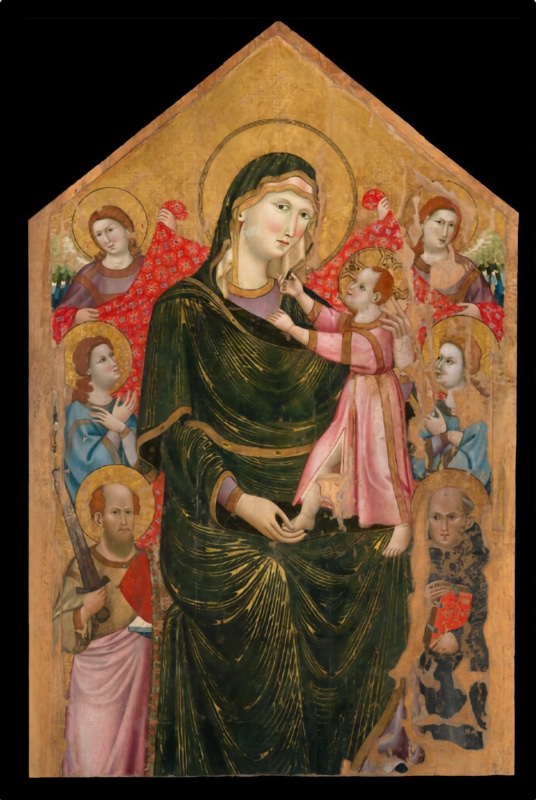
The monumental altarpiece, distinguished by its exceptional pictorial quality and refined chromatic sensibility, was commissioned for the ancient abbey of San Paolo di Valdiponte, situated near the Castello di Civitella dei Benazzoni within the municipal territory of Perugia. Originally founded by the Cistercians, the abbey was incorporated into the Celestine congregation circa 1295. The cuspidate panel, which has been trimmed at the lower register and consequently reduced from its original dimensions, depicts the enthroned Madonna and Child — the latter rendered in the Bambino marciante typology — flanked by two angels bearing a red veil with gold embroidery, while two additional angelic figures attend in adoration.
In the lower zone, the composition includes Saint Paul and a monastic saint traditionally identified as Saint Peter Celestine, elected to the pontificate in 1294 under the name Celestine V. While papal vestments constitute the most prevalent iconographic convention for his representation, a more archaic tradition persists in which the saint appears in the habit of a Benedictine monk, clad in a rough or dark tunic and depicted with the characteristically unbearded physiognomy associated with his earlier iconographic type.
A terminus post quem of 1313, or shortly thereafter, is proposed on the basis of the nimbus surrounding Pietro Celestino, whose canonization occurred in that year and whose halo would not have been iconographically admissible prior to that date.