Maestro di Panzano
( 25% )
Identity and Scholarly Reconstruction
The Maestro di Panzano, also known in the scholarly literature as the Maestro del Trittico di Panzano, remains one of the more intriguing anonymous painters active within the Sienese cultural sphere during the second half of the fourteenth century. Like so many of his contemporaries in the Italian Trecento, he did not sign his works, and no documentary record has survived to provide his given name, exact birth date, or legal identity. The convention of naming anonymous masters after their most celebrated surviving work is a long-established practice in Italian art historiography, and it was the eminent connoisseur Bernard Berenson who, in 1930, definitively isolated this painter’s hand from the broader corpus then attributed to Paolo di Giovanni Fei, thereby constituting him as an independent artistic personality.
Berenson recognized that a group of works previously absorbed into Fei’s corpus displayed consistent formal characteristics that were sufficiently distinct to warrant a separate attribution, anchoring the new convenzione in the triptych of the Mystic Marriage of Saint Catherine with Saints Peter and Paul preserved in the parish church of San Leolino in Panzano in Chianti, Tuscany. The toponym “Panzano” thus came to designate not a place of birth but a place of artistic legacy, a practice entirely standard in Trecento scholarship, where geography of production frequently substitutes for biographical data.
Subsequent scholarship, particularly the contributions of Federico Zeri, whose catalogue entries at the Fondazione Zeri in Bologna remain indispensable, further refined and expanded the attributed corpus. The French art historian D. Boucher de Lapparent offered a dedicated study of the master in the Revue du Louvre in March 1978, providing the most sustained monographic treatment before the consolidation of Zeri’s findings.
The painter is documented, insofar as an anonymous master can be said to be “documented”, through works datable between approximately 1360 and 1400, placing his creative maturity firmly within the third quarter of the fourteenth century and its immediate aftermath. A pivotal chronological anchor is provided by a signed and dated panel of the Madonna with Child between Saints Ansanus and Lawrence of 1382 in the Museo Civico e Diocesano in Montalcino, which definitively confirms his activity in that decade.
His place of birth cannot be established with documentary certainty, though the stylistic evidence, the geographic distribution of his works across the Sienese contado and the Val d’Arbia, and his evident training in the tradition of Luca di Tommè strongly suggest formation within or closely adjacent to the city of Siena during the 1340s or early 1350s. The date of his death is equally unrecorded; by convention, and in accordance with the latest datable works, scholars place the terminus of his activity around the very end of the fourteenth century or the opening years of the fifteenth.
Family and Social Formation
The anonymity that enshrouds the Maestro di Panzano extends entirely to his family origins, a circumstance that is by no means exceptional for a craftsman operating within the Sienese guild system of the mid-Trecento, where personal identity was habitually subordinated to corporate and professional belonging. The painter would have been born into a social milieu shaped by the profound upheavals of the mid-fourteenth century, most devastatingly by the Black Death of 1348, which annihilated perhaps one-third to one-half of the urban population of Siena and left the city’s workshop culture structurally transformed for generations.
In such a context, family continuity within the artisan classes was precarious, and the transmission of craft knowledge from father to son was frequently interrupted, leading painters to seek formation across multiple workshops and masters rather than within strictly hereditary lineages. The social stratum from which painters such as the Maestro di Panzano typically emerged was that of the middling urban artisan class, neither noble nor destitute, where families maintained modest property, engaged in the textile or leather trades, and viewed entry into the painters’ guild (Arte dei pittori) as a legitimate path to professional respectability and civic participation. It is reasonable to hypothesize that the master’s family had connections to the commercial networks of the Sienese contado, given the distribution of his works in towns such as Panzano in Chianti, Montalcino, and the broader area of the Val d’Arbia, territories that were closely integrated with Siena’s economic hinterland through agricultural contracts, small-scale trade, and ecclesiastical patronage circuits.
The training of a painter in Trecento Siena typically began in early adolescence, between the ages of ten and fourteen, when a boy would enter a workshop as an apprentice (garzone) and begin the long education in panel preparation, pigment grinding, gold leaf application, and figure drawing that would occupy a decade or more before independent commissions became attainable. The family’s role in such an arrangement was primarily contractual: parents or guardians negotiated the terms of apprenticeship with a master painter, exchanging their son’s labor for instruction, board, and a modest stipend, with the understanding that professional competence would eventually translate into economic independence.
Within the workshop hierarchy, the future Maestro di Panzano would have progressed from preparatory tasks, mixing gesso for panel grounds, grinding lapis lazuli and malachite, gilding haloes under supervision, to increasingly autonomous responsibilities in figure painting and drapery execution as his skills matured. The family background, though irrecoverable in its specific details, would have instilled in the painter the Sienese cultural identity that is so legible in his artistic output: a deep reverence for the elegance and refinement cultivated by the school of Duccio di Buoninsegna and transmitted through Simone Martini and the Lorenzetti brothers, inflected by the immediate example of Luca di Tommè. Whether the master married, had children, or founded his own workshop dynasty is unknown; the absence of any apprentice consistently associated with his hand suggests either that he worked in relative isolation or that his workshop was absorbed into a larger enterprise upon his death. The family unit, in sum, must be understood less as a recoverable biographical fact than as a structural category that situates the master within the broader social fabric of late-Trecento Sienese artisan life, a fabric woven from guild obligations, neighborhood solidarity, religious confraternity membership, and the seasonal rhythms of agricultural and commercial Tuscany.
Patronage Networks and Ecclesiastical Commissions
The patronage context within which the Maestro di Panzano operated was typical of the minor ecclesiastical and civic commissions that sustained the middle tier of the Sienese painting profession during the second half of the Trecento, a period in which the great private banking dynasties had been weakened by financial collapse and plague mortality, and in which parish churches, rural oratories, and mendicant convents emerged as the principal engines of artistic production.
The master’s most celebrated commission, the triptych of the Mystic Marriage of Saint Catherine with Saints Peter and Paul in the parish church of San Leolino at Panzano in Chianti, derives from an ecclesiastical context characteristic of the Florentine-Sienese border zone, a territory where local landowning families, rural clergy, and itinerant merchants collaborated in funding devotional images for their parish churches as acts of collective piety and individual commemoration. San Leolino itself is a Romanesque church of ancient foundation, and its artistic commissions in the later Trecento reflect the broader rural phenomenon of the rinnovamento of church furnishings that followed the demographic and economic recovery of the 1360s and 1370s, as communities that had survived the worst ravages of the plague sought to reaffirm their devotional life through investment in new altarpieces.
The commission of the triptych at San Leolino was almost certainly mediated by the local ecclesiastical authorities, the parish priest acting in concert with prominent families of the popolo grasso whose commemorative interests shaped the choice of saints depicted in the lateral panels. The Fondazione Zeri catalogue records a further important work, the Annunciation with Saints Nicholas of Tolentino and others, which belongs to a commission type associated with Augustinian Hermits who venerated Nicholas of Tolentino, canonized in 1446 but already the subject of intense popular devotion in the Sienese and Florentine territories throughout the late Trecento.
This painting demonstrates that the master’s clientele was not confined to secular parish churches but extended to the mendicant orders, whose building programmes and continuous need for altar furnishings provided a steady stream of work for painters throughout central Italy. The dated panel of 1382 in Montalcino, the Madonna with Child between Saints Ansanus and Lawrence, points to the patronage of a civic institution or a local confraternity in that hilltop town, since the inclusion of Saint Ansanus, the apostle of Siena, signals a specifically Sienese devotional identity that would have resonated with Montalcino’s political and cultural alignment with its metropolitan city. The Walters Art Museum triptych, the Madonna and Child Enthroned with Saints, dated by the museum to approximately 1380–1400, was presumably commissioned for a private chapel or altar, and its subsequent migration into the American collection, acquired by the Walters through bequest in 1931, illustrates the complex journey that small devotional altarpieces undertook from their original ecclesiastical settings into nineteenth- and twentieth-century collections.
The Matthiesen Gallery triptych, which juxtaposes the Madonna in Majesty with the Road to Calvary, the Crucifixion, and the Annunciation in tondo, represents another commission type oriented toward private or semi-private devotional use, possibly by a lay confraternity or a wealthy merchant family maintaining a private oratory. The inclusion of the Road to Calvary in a Maestà triptych is, as the Matthiesen Gallery catalogue notes, an unusually rare iconographic choice, which may reflect the specific devotional preferences of the commissioning patron, perhaps a member of a confraternity devoted to the Passion of Christ, rather than any generic workshop formula. Across all these commissions, one observes the consistent social profile of the master’s clients: rural parish clergy, minor urban confraternities, mendicant friaries, and private families of the prosperous merchant class, all operating within the devotional economy of the late-Trecento Sienese contado.
Painting Style
The painting style of the Maestro di Panzano is characterized by a distinctive blend of elegant Sienese linearism and a warm, intimate figure style that distinguishes him clearly from the more monumental idioms prevalent in Florentine painting of the same period. His works consistently display what the Matthiesen Gallery catalogue describes as a “graceful and rather humorous” quality, an apt formulation that captures the peculiar blend of spiritual gravitas and gentle human tenderness that animates his sacred figures.
This quality is most evident in the treatment of the Christ Child, who appears in several works grasping his mother’s veil or gesturing with a characteristically lively informality, recalling the convention, noted also in the work of Paolo di Giovanni Fei, of the Child holding his own foot, a motif traceable to earlier Ducciesque and Lorenzettian prototypes. The Virgin figures in the master’s panels consistently display an elongated, gently swaying elegance derived from the Sienese maniera codified by Simone Martini, with finely delineated facial features, high foreheads framed by the traditional blue maphorion, and hands of extraordinary delicacy rendered with thin, tapered fingers.
The palette is characteristically warm and luminous, favoring rich carmines, deep ultramarine blues, and the radiant gold of punched and tooled haloes, all laid against gilded grounds that create an otherworldly, hieratic atmosphere consistent with the devotional function of the altarpieces. The gold grounds are treated with considerable technical sophistication: the punching patterns, geometric rosettes, star-shaped stamps, and interlocking lozenges, are executed with a precision that reflects familiarity with the goldsmiths’ techniques practiced in the Sienese workshops of the mid-fourteenth century, a tradition going back to Simone Martini’s own celebrated introduction of punzonatura into panel painting. In compositional terms, the master favors the triptych format with a central Maestà and lateral saint panels, a structure inherited from the workshop traditions of Duccio and the Lorenzetti and refined by Luca di Tommè into a format particularly suited to the smaller churches and private oratories that constituted his principal market.
The architectural throne in his Maestà compositions reflects an awareness of the spatial experiments of Pietro Lorenzetti, with steps receding into pictorial depth and angels disposed laterally in attitudes of reverent presentation, though the master never pursues the full implications of Lorenzettian spatial illusionism, preferring instead to maintain the decorative surface values characteristic of the Sienese tradition. The lateral saint panels in his triptychs are painted with particular care: each saint stands on a shallow ground, identified by his or her attribute, and the figures are endowed with a psychological presence, a slight turn of the head, a direct engagement with the viewer’s gaze, that goes beyond the purely formal requirements of the iconographic type.
The drapery in all the master’s works is rendered with a flowing, curvilinear elegance that draws on the tradition of Simone Martini’s late style, with gold-highlighted folds creating rhythmic patterns of light and shadow that enhance the overall decorative splendor of the panel. The predella panels documented in the Italian national catalogue (catalogo dei beni culturali) show, in the San Michele arcangelo, Madonna, Cristo, San Giovanni evangelista fragment, a horizontal narrative competence, figures disposed across shallow space, their gestures coordinated to communicate theological relationships, that demonstrates the master’s ability to operate across scales from the monumental to the intimate. In sum, the painting style of the Maestro di Panzano represents a late-Trecento synthesis: deeply rooted in the aristocratic elegance of the Sienese tradition, enriched by the naturalistic experiments of the Lorenzetti, and inflected by the particular warmth and informality that characterize the post-plague generation of Sienese painters, who sought to bring devotional images into closer emotional communion with their audiences.
Artistic Influences
The most immediate and decisive influence on the Maestro di Panzano was that of Luca di Tommè, the Sienese master active between approximately 1355 and 1389, whose workshop practices and formal solutions provided the direct template from which the Maestro di Panzano departed and against which his independent manner must be measured. The scholarly literature, particularly the JSTOR study on Luca di Tommè’s influence on three Sienese masters, explicitly identifies the Maestro del Trittico di Panzano as one of three artists active between 1360 and 1380 whose work demonstrates a sustained and profound engagement with Luca’s idiom, absorbing his characteristic handling of volume, his approach to the Virgin’s facial type, and his compositional solutions for multi-figure triptychs.
Behind Luca di Tommè, however, stands the far larger shadow of the entire Sienese tradition as it had been constituted by Duccio di Buoninsegna, the founding figure of Sienese painting, whose Maestà of 1308–1311 established the formal grammar of the enthroned Virgin as Queen of Heaven that would persist throughout the Trecento as the dominant pictorial convention for sacred images in the Sienese sphere. The influence of Simone Martini is legible in the master’s predilection for sinuous linear rhythms, refined color harmonies, and the punched gold grounds that were one of Martini’s most influential technical innovations, transforming the material surface of the panel into a shimmering field of precious light. Pietro Lorenzetti’s spatial experiments, particularly his articulation of the architectural throne as a structure with genuine three-dimensional recession, provided the Maestro di Panzano with a set of compositional tools that he deployed selectively, as seen in the receding steps and architecturally framed throne of his Maestà compositions, which consciously recall Lorenzettian prototypes without fully committing to their spatial radicalism.
The influence of Ambrogio Lorenzetti, Pietro’s younger brother, is perhaps less immediately obvious but equally significant: Ambrogio’s capacity to animate subsidiary figures, the angels flanking the Virgin’s throne, the minor saints in the lateral panels, with a gentle humanity and psychological differentiation that transcends the purely iconic is precisely the quality that gives the Maestro di Panzano’s work its distinctive “graceful and rather humorous” character noted by modern scholarship.
Travels and Geographic Reach
The geographic distribution of the Maestro di Panzano’s surviving works provides the primary evidence for reconstructing the scope of his travels and the range of his professional activities, in the absence of any documentary evidence of itinerant contracts or workshop accounts. The works attributable to his hand are concentrated in a roughly triangular territory defined by Panzano in Chianti to the north, Montalcino to the south, and the broader Sienese contado in between, a zone that corresponds precisely to the cultural and economic hinterland of Siena as it extended northward toward the Florentine border and southward into the Val d’Arbia and the Val d’Orcia.
The triptych at San Leolino in Panzano in Chianti, which gives the master his name, represents a northward excursion into territory that was politically contested between Florence and Siena throughout the fourteenth century, suggesting that the master was willing and able to negotiate the political and administrative boundaries that divided the Tuscan landscape and to seek commissions wherever ecclesiastical or civic patronage was available. The dated panel of 1382 in Montalcino, the southernmost of the securely attributed works, indicates that by this date the master was traveling a distance of approximately eighty kilometers from Panzano, covering a territory that encompassed multiple political jurisdictions and ecclesiastical administrative units, and that his reputation was sufficiently established to attract commissions from civic patrons in a town of significant strategic and cultural importance. The presence of works in the collection of the Walters Art Museum in Baltimore and in the holdings of the Matthiesen Gallery in London speaks not to the master’s personal travels but to the subsequent dispersal of Trecento altarpieces through the art market of the nineteenth and twentieth centuries, a process through which small devotional panels were separated from their original altars and entered private and institutional collections across Europe and North America, carrying with them the traces of a creative intelligence that had never traveled beyond the confines of Tuscan Christendom.
Principal Works and Their Content
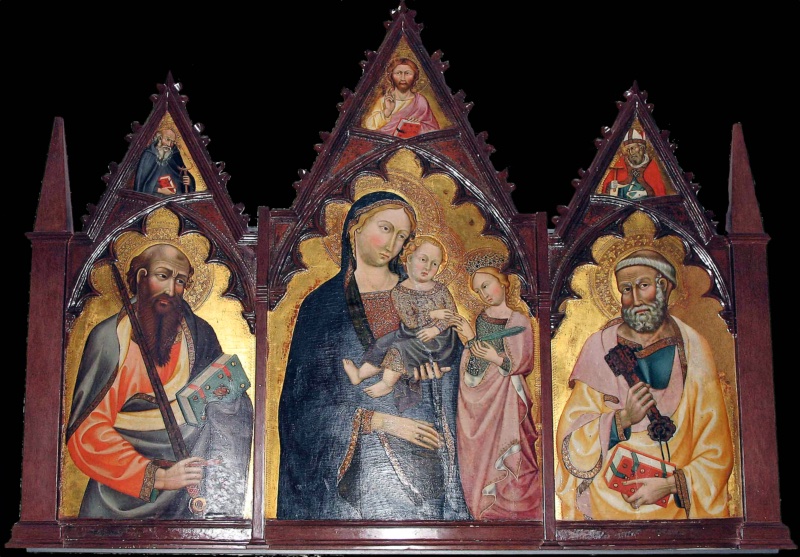
The most important surviving work by the Maestro di Panzano, and the one from which he derives his conventional name, is the Triptych of the Mystic Marriage of Saint Catherine with Saints Peter and Paul, conserved in the parish church of San Leolino, Panzano in Chianti, Tuscany. The central panel presents the Mystic Marriage of Saint Catherine of Alexandria, a scene in which the Christ Child, seated on his mother’s lap, reaches forward to place a ring on the finger of the kneeling Catherine, a gesture of divine betrothal that had become one of the most popular subjects of Sienese devotional painting in the wake of Catherine’s surge in veneration during the late Trecento.
The flanking panels depict Saints Peter and Paul in their traditional roles as the twin pillars of the apostolic Church: Peter stands to the left holding his keys, Paul to the right bearing his sword and epistles, both rendered with the hieratic dignity and psychological presence characteristic of the master’s mature style. The composition is unified by the gilded ground, which dissolves spatial distinctions and asserts the otherworldly register of the sacred narrative, while the three figures’ eyes are coordinated to create a circuit of devotional address between the painted subjects and the worshipping viewer. This triptych was the founding document of the artist’s critical identity and remains the indispensable reference point for any attribution to his hand.
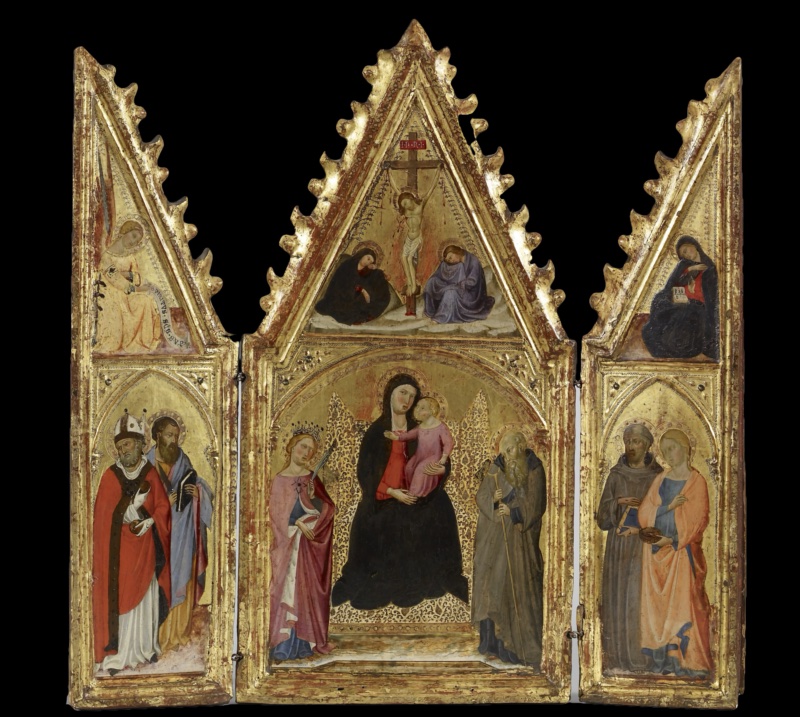
The Madonna and Child Enthroned with Saints in the Walters Art Museum in Baltimore is one of the master’s most fully preserved works and serves as the principal basis for the Zeri catalogue entry dedicated to him. The central panel presents the enthroned Virgin in the tradition of the Maestà, her blue maphorion draped over a red undergown, the Christ Child seated on her left knee and raising his right hand in benediction while his left holds a symbolic object, the whole composition framed by flanking angels in attitudes of adoration. The lateral saints, identifiable through their attributes, are disposed with the elegant containment and psychological immediacy that distinguish the master’s figure style from the more schematic treatments found in workshop productions of the period. The Walters acquired this panel through the bequest of 1931, and it has since been one of the museum’s most significant examples of late-Trecento Sienese devotional painting.
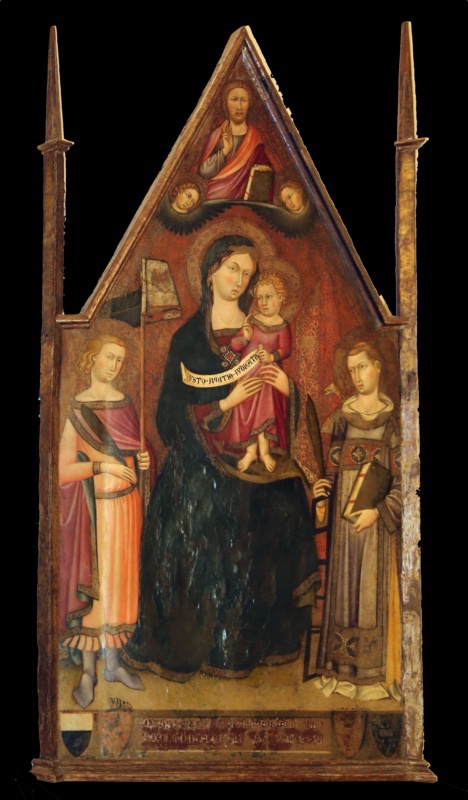
The Madonna with Child between Saints Ansanus and Lawrence, now in the Museo Civico e Diocesano in Montalcino, is unique within the master’s attributed corpus in bearing a date — a circumstance that makes it the chronological anchor of his entire career and the primary evidence for his activity in the 1380s. Saint Ansanus, the first martyr-apostle of Siena who is shown holding the Sienese flag as his attribute, was one of the most venerated saints in the Sienese religious calendar, and his inclusion in this panel signals the work’s deep rootedness in Sienese civic piety and its commission by a patron, whether institutional or private, with strong Sienese cultural allegiances even in the context of Montalcino, a town that had maintained close political ties to Siena throughout the communal period. Saint Lawrence, the deacon-martyr identified by his gridiron, occupies the right panel and provides the work’s second hagiographic identity, possibly reflecting the dedication of the chapel or altar for which the triptych was originally commissioned. The panel is also accompanied by a small figure of the Redentore benedicente fra due cherubini — the Blessing Redeemer between two cherubim — which occupied a secondary register within the original complex.
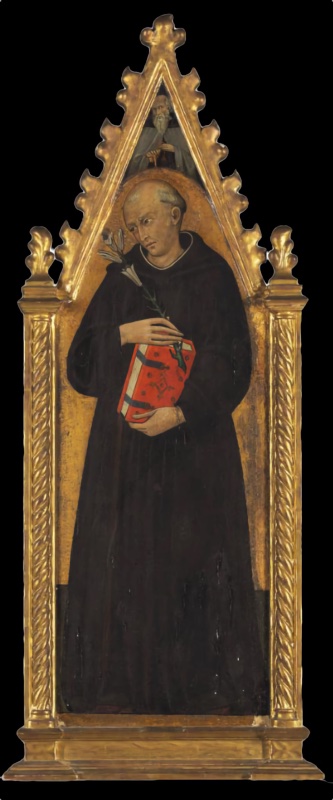
The Saint Nicholas of Tolentino panel housed in the Middlebury College Museum of Art in Middlebury, Vermont, represents a single standing saint figure that originally formed part of a larger polyptych, now disassembled. Nicholas of Tolentino, the Augustinian friar canonized in 1446 but already venerated as a miracle-worker and intercessor throughout the late Trecento, stands in the frontal posture traditional for single-saint panels, dressed in the black habit of the Augustinian Hermits and holding the lily of purity, his gaze directed slightly downward in an attitude of humble contemplation. The scale of the panel and its format as a single standing figure suggest its origin as part of an elaborate multi-panel altarpiece commissioned for an Augustinian friary, where Nicholas would have occupied one of the lateral positions flanking a central Maestà or Christological subject. The inclusion of a saint not yet formally canonized in a major altarpiece commission speaks to the intensity of popular and institutional devotion to Nicholas within the Augustinian order, which actively promoted his cult throughout central Italy during the second half of the Trecento.
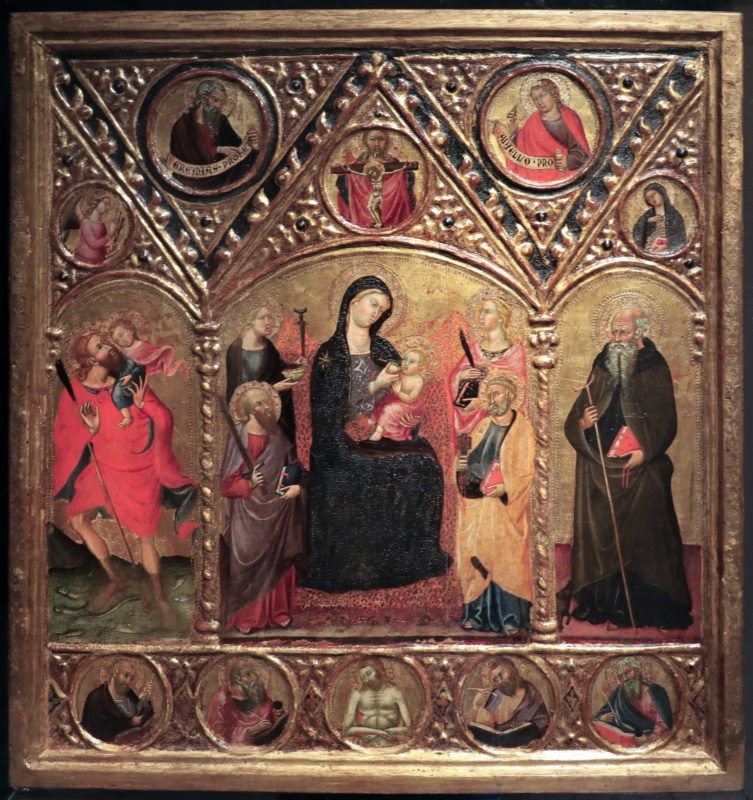
The Piccola Maestà — Madonna con Bambino in trono con San Giovanni Battista, Sant’Antonio Abate, San Pietro e Santa Caterina d’Alessandria, recorded in the Italian national catalog of beni culturali, represents a smaller-scale devotional image that combines the enthroned Virgin and Child with four flanking saints drawn from the most popular hagiographic canon of the period. Saint John the Baptist, as the Precursor and patron of many Tuscan cities, occupies a position of honor; Saint Anthony Abbot, founder of Christian monasticism, appears with his bell and his characteristic gesture of blessing; Saint Peter asserts the apostolic authority of the Roman Church; and Saint Catherine of Alexandria, the royal martyr of the philosophical tradition, closes the composition with her wheel of martyrdom. The work may have been commissioned for a private domestic altar or for a small confraternal chapel, and its intimate scale distinguishes it from the larger altarpieces destined for high altars and public liturgical use.