Maestro di Tressa
The Maestro di Tressa was an anonymous Italian painter active in Siena between approximately 1215 and 1240, widely recognized as the most significant artistic personality of the first half of the thirteenth century in the Sienese school. His conventional name derives from the small church of Santa Maria a Tressa, located in the countryside near Siena, from which one of his most important works originates.
Identity and the Problem of Anonymity
The figure known to art history as the Maestro di Tressa does not appear in any documentary record by name, and his identity remains one of the most tantalizing unsolved questions in the study of early Italian painting. The conventional designation, a so-called notname, or name of convenience, was established by the American scholar Edward B. Garrison in his foundational 1949 study of Italian Romanesque panel painting, in which he grouped five related works of early Duecento Sienese production under this single artistic personality.
Garrison’s attribution rested on formal and stylistic criteria rather than any archival evidence, and subsequent scholarship has largely confirmed and refined his grouping, recognizing the Maestro di Tressa as the inaugural figure of the Sienese pictorial tradition. The artist worked in a cultural environment that, like much of central Italy in the early thirteenth century, was navigating the competing pulls of the residual Romanesque tradition and the expanding influence of Byzantine pictorial conventions, and his works represent an extraordinary synthesis of these two tendencies. Because no birth record, guild document, contract, or testament has ever been associated with him, all biographical reconstruction must proceed through the indirect evidence of the works themselves and through the broader cultural history of Siena in the decades following the year 1200.
Family and Social Origins
The complete absence of documentary evidence makes it impossible to identify the Maestro di Tressa by name, still less to reconstruct his familial circumstances with any precision; what follows is therefore a carefully reasoned interpretation of the social and professional milieu from which an artist of his evident training and sophistication would most plausibly have emerged. In the Siena of the early thirteenth century, the practice of painting was transmitted within family workshops organized along craft guild lines, in which sons apprenticed with fathers, nephews with uncles, and skills were regarded as proprietary knowledge passed across generations.
Given the high technical level of execution visible in the 1215 Paliotto del Salvatore, the oldest dated work of the Sienese school, it is virtually certain that the Maestro di Tressa had undergone a lengthy and demanding apprenticeship, almost certainly initiated in childhood and spanning at least a decade. The sophistication of his gilding techniques, the confident use of the pastiglia relief method for decorative halo details, and the assured management of complex multi-scene compositions all point to an artist who had absorbed his craft within a well-established workshop tradition, rather than one who was self-taught or working in isolation.
The geographic context of Siena itself is also relevant: the city’s rapidly growing wealth in the early Duecento, driven by its banking families and its position along the Via Francigena, created robust patronage networks that could sustain professional painters of considerable ambition, and the Maestro di Tressa’s career reflects precisely this kind of institutional support. The workshop in which he trained was almost certainly influenced by contacts with Rome and possibly with Byzantine craftsmen working in Tuscany, as the iconographic and technical features of his paintings suggest exposure to models that went beyond any purely local tradition. It is plausible, though unverifiable, that he had family connections to the ecclesiastical institutions of Siena, perhaps a brother or father in minor orders, since the commissions he received were exclusively religious in character and suggest an intimacy with the liturgical and devotional requirements of the Sienese church.
The dossale he produced for the church of Santa Maria a Tressa implies a working relationship with a rural religious community, suggesting either family ties or a professional network that extended beyond the urban center into the Sienese contado. His work’s consistency of vision across more than two decades of activity, from 1215 to approximately 1240, implies a stable workshop organization and likely a small group of collaborators or assistants who were themselves trained within a familial or quasi-familial professional structure. The artist’s death is presumed to have occurred sometime in the second half of the thirteenth century, though the precise date and cause remain unknown; given the chronology of his surviving works, which appear to cease around 1240, it is possible he died in that decade, perhaps in late middle age, or that his workshop simply ceased to receive commissions as newer stylistic currents, brought to Siena by Coppo di Marcovaldo and others, rendered his manner less fashionable.
Patrons and Institutional Contexts
The patronage structure that sustained the Maestro di Tressa was firmly rooted in the ecclesiastical institutions of Siena and its surrounding territory, and the character of his commissions reveals a close relationship with the highest levels of Sienese religious life. His earliest and most formally ambitious surviving work, the Paliotto del Salvatore of 1215, was almost certainly commissioned for a major altar, most likely in the context of a significant Sienese religious institution, possibly the cathedral chapter or a powerful Benedictine community in the vicinity of the city. The prominent inscription running along the frame of the Paliotto, which carries the date of November 1215, implies a patron of sufficient prestige and institutional confidence to wish to commemorate the work’s creation in permanent form, a practice more characteristic of monastic or canonical commissioners than of private lay donors. The iconographic program of the Paliotto itself, which centers on the blessing Redeemer surrounded by the symbols of the four Evangelists and flanked by scenes of the Miracle of the Cross of Beirut and the Legend of the True Cross, reflects a sophisticated theological agenda that would have required the active collaboration of a learned ecclesiastical adviser, almost certainly the patron himself or a representative of his community.
The Madonna dagli occhi grossi, datable to approximately 1225, was commissioned for the high altar of Siena Cathedral, and its patronage therefore connects the Maestro di Tressa directly to the Opera del Duomo, the institution responsible for the construction and furnishing of the cathedral, and through it to the bishop and the canons of the chapter. This commission was of extraordinary civic significance: the panel became the focal image of Sienese civic piety, and it was before this very work that the citizens of Siena, led by the podestà Bonaguida Lucari, made their collective vow on the eve of the Battle of Montaperti in September 1260, entrusting the safety of the city to the Virgin. The transformation of this painted panel into the object of a public, politically charged act of devotion testifies to the extraordinary authority that the Maestro di Tressa’s image came to exercise in the collective imagination of medieval Siena, an authority that far outlasted the period of its creation and that made its commissioner, whoever he may have been, a figure of lasting importance in the city’s sacred topography.
The Madonna di Tressa, now in the Museo Diocesano di Siena, was commissioned for the small rural church of Santa Maria a Tressa in the Sienese contado, suggesting that the artist’s reputation extended beyond the urban center and that rural religious communities sought out his workshop for works intended for intimate devotional use. The Chigi Saracini Madonna col Bambino, datable to approximately 1240 and now preserved in the collection of that noble Sienese family, documents the extension of patronage for the Maestro’s work into the sphere of the Sienese urban aristocracy, whose members combined piety with a desire for prestigious artistic commissions as markers of social distinction. The two panels with Storie di san Giovanni Battista, whose current location is unfortunately unknown but which formed part of a larger dossale, attest to the participation of a patron devoted to the cult of the Baptist, perhaps a confraternity, a hospital, or a canonical community under his protection. Across all his documented commissions, it is notable that the Maestro di Tressa appears to have worked exclusively for ecclesiastical or quasi-ecclesiastical patrons, with no evidence of secular civic commissions of the kind that would become common later in the Duecento, a circumstance that further underscores the degree to which his career was embedded in the devotional infrastructure of the Sienese church.
Painting Style
The painting style of the Maestro di Tressa constitutes one of the earliest and most coherent visual languages in the history of the Sienese school, combining the formal severity of the late Romanesque tradition with selective appropriations from Byzantine pictorial culture in a synthesis that is entirely his own. His figures are characterized by a pronounced frontality, bodies presented full-face to the viewer, with minimal lateral movement or spatial recession, that derives directly from the hieratic conventions of Byzantine icon painting, though filtered through the more robust, less dematerialized sensibility of the central Italian Romanesque.
The faces of his Madonnas are among the most immediately recognizable features of his style: large, almond-shaped eyes set wide apart (a characteristic that earned the cathedral panel its popular name, Madonna dagli occhi grossi, or “Madonna of the Large Eyes”), a long and narrow nose, and a small, firmly closed mouth that conveys an expression at once severe and interior. The gold ground that fills the background of all his surviving panels is not merely decorative but theologically functional, evoking the uncreated light of the divine sphere and removing the sacred figures from any terrestrial spatial context; the handling of this gold surface shows considerable technical mastery, with punched and incised decorative patterns in the halos and borders that add tactile richness without detracting from the image’s essential luminosity.
His use of color is carefully calibrated and decidedly non-naturalistic: deep crimsons and lapis-blue tones dominate the drapery, applied in flat, broad fields modulated by a system of linear highlights, fine white or gold lines scratched into the surface, that create the impression of volumetric form without recourse to the kind of tonal gradation that would become central to the Florentine tradition. The compositional structure of his multi-figure panels reveals a rigorous bilateral symmetry that speaks to a decorator’s instinct for visual order: flanking angels and saints are typically disposed in mirrored pairs, creating a stable, centralized arrangement that reinforces the hierarchical primacy of the central image. In his narrative scenes, most fully developed in the lateral panels of the Paliotto del Salvatore, the Maestro di Tressa demonstrates a capacity for sequential storytelling that draws on the Byzantine tradition of hagiographic illustration, organizing the episodes in registers that read from left to right across the surface of the panel.
The architectural settings within these narrative scenes are rendered as flat, schematic backdrops, simplified arcades and crenellated towers rendered in gold and red, that function as symbolic indicators of location rather than as attempts at spatial illusionism. The treatment of the human body throughout his oeuvre maintains a consistent degree of two-dimensionality: limbs are slightly elongated, hands are large and expressive with individually articulated fingers, and the fall of drapery creates a rhythmic pattern of parallel folds that across all his works reads as a personal stylistic signature. Perhaps the most significant technical innovation visible in his panels is the use of the pastiglia technique for three-dimensional decorative relief, particularly in the halos and crowns of his principal figures; this method, which involved building up raised areas of gesso paste beneath the gold leaf, added a sculptural dimension to what would otherwise have been a purely flat surface and created striking plays of light and shadow across the gilded areas.
Artistic Influences
The artistic influences that shaped the Maestro di Tressa’s visual language are multiple and can be traced across the broad geography of Mediterranean Christianity in the late twelfth and early thirteenth centuries. The most pervasive and immediately identifiable influence is the Byzantine tradition, transmitted to central Italy through multiple channels: through portable icons brought by merchants and pilgrims along the Via Francigena, through mosaics encountered in Rome and other southern Italian centers, and through the presence in Tuscany of Greek-speaking craftsmen employed in the decoration of churches and monastic buildings. The formal characteristics of Byzantine icon painting, the frontal figure, the hierarchical scaling of sacred persons, the suppression of illusionistic depth in favor of a gold ground, the system of linear highlights on drapery, are all present in his work, though they have been assimilated rather than simply imitated, acquiring a more robust corporeality and a stronger sense of material weight than is typical of purely Greek examples.
The Romanesque tradition of central Italy provided a counterweight to the dematerializing tendency of Byzantine art, grounding his figures in a more concrete, less abstracted physical presence; this influence is most visible in the treatment of drapery, which has the thick, sculptural quality of carved stone rather than the flickering, linear delicacy of Byzantine manuscript illumination. The great Romanesque altar panels of the Roman tradition, cross-shaped and rectangular retables associated with Lazio and Umbrian workshops active in the late twelfth century, provided direct compositional models for the multi-scene format of the Paliotto del Salvatore, particularly in the arrangement of narrative episodes around a central iconic image. The influence of Roman Early Christian and Paleo-Christian art is also detectable, particularly in the iconography of the mandorla surrounding the blessing Christ in the Paliotto, a motif with deep roots in the visual theology of the early medieval West and in the tradition of the Maiestas Domini as developed in Carolingian and Ottonian illuminated manuscripts.
Travels and Geographic Horizons
Any reconstruction of the Maestro di Tressa’s travels must be understood as inferential, since no itinerary or personal document has survived to testify directly to his movements; nonetheless, the internal evidence of his works makes a compelling case for journeys beyond Siena. The sophistication of his Byzantine iconographic vocabulary goes well beyond what could have been absorbed from second-hand models or imported objects alone, and strongly suggests direct visual experience of Byzantine or Byzantine-influenced art in situ, whether in Rome, in the Benedictine centers of southern Tuscany, or possibly in contact with Greek-speaking craftsmen working in central Italy. Rome, with its extraordinary accumulation of Early Christian, medieval, and Byzantine mosaics in the major basilicas, would have been the single most important destination for any ambitious painter working in central Italy in the early thirteenth century, and the Via Francigena, which passed through Sienese territory, made the journey from Siena to Rome relatively straightforward.
The iconographic program of the Paliotto del Salvatore, and in particular the inclusion of the rare scene of the Miracle of the Cross of Beirut, a theme with specific connections to Eastern Christian devotional practice, implies knowledge of models that were unlikely to have circulated widely in Tuscany and suggests access to a broader iconographic repertoire that may have been acquired through travel or through contact with a well-stocked ecclesiastical library. The close relationship between the Maestro di Tressa’s style and the Florentine proto-Byzantine tradition, as documented by scholars working in the lineage of Garrison’s research, suggests at minimum a familiarity with artistic production in Florence and in the Benedictine centers of the Arno valley, contact that might have been established through journeys undertaken for specific commissions or through the movements of works and craftsmen across the Tuscan landscape.
Principal Works
The Savior Blessing and Stories of the True Cross
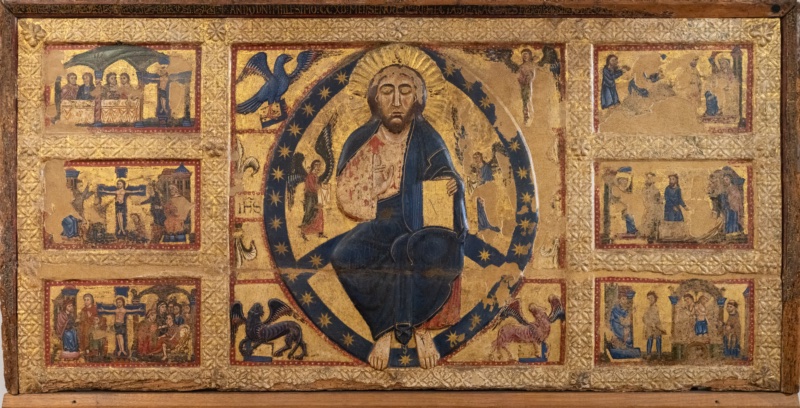
The work has a still archaic and solemn composition: at the center is the Blessing Redeemer within a mandorla, surrounded by the symbols of the four evangelists, while six narrative scenes are arranged on either side. The panel appears to imitate a precious liturgical object made of wrought metal, but it is actually crafted from painted wood with a refined use of gold and shades of blue that accentuate its sacred character.
Its function is not entirely certain: it has been interpreted both as an altar frontal and as an altarpiece placed above the altar table, but in any case, it must have served a significant liturgical and devotional purpose. The iconographic program combines the glorification of Christ with episodes linked to the Passio imaginis, the True Cross, and the martyrdom of Saint Alexander, in connection with the dedication of the Abbey of San Salvatore e Alessandro in Fontebuona.
The figurative language remains very close to Byzantine culture and the Tuscan Romanesque style: frontal figures, very clear hierarchies, eloquent gestures, intense gazes, and proportions that are sometimes uncertain. It is precisely this apparent simplicity that is important, because the painting does not aim for naturalism, but rather to convey a theological and liturgical truth through highly symbolic images.
The side scenes can be read as two distinct cycles: on the left, the legend of the Crucifix of Beirut; on the right, the legend of the discovery of the True Cross and the martyrdom of Saint Alexander.
1. Banquet of the Jews in the Presence of the Crucifix
The opening scene of the Beirut cycle depicts a group of Jews at a table with the Crucifix placed in the same space, as an object that is “present” but not yet attacked. The arrangement is typically Romanesque: frontal, seated figures arranged in sequence, with the table serving as an organizing horizontal line and the Crucifix interrupting this linearity as a vertical and sacred element. The iconographic interest lies in immediately presenting the relationship between the sacred image and the profane use of space: the image of Christ is treated as a “background” object, yet placed in such a position as to guide the faithful’s gaze toward the future conflict. In theological terms, the scene is almost a prelude: it shows the initial indifference toward the image of Christ, preparing the transition to guilt (the outrage) and then to the miracle. For the medieval believer, this familiarity with the Crucifix in the domestic space was also a warning regarding responsibility toward sacred images: being exposed to the figure of Christ implies a choice between veneration and contempt.
2. The Outrage Against the Crucifix
The second scene makes the sacrilegious act explicit: the Jews no longer merely ignore the image, but insult and wound it. From a compositional standpoint, the Master of Tressa accentuates the contrast by arranging the persecutors dynamically around the cross, with broad, clearly legible gestures, while the Crucifix remains rigid, facing the violence head-on, in accordance with a figurative grammar still rooted in the Byzantine tradition. The narrative does not indulge in graphic details, but emphasizes a few essential gestures: the weapon aimed at the body of the painted Christ, the movement of the arm, the direction of the gazes, which transform the space into a place of judgment. Doctrinally, the equivalence between an offense against the image and an offense against the person of Christ is reaffirmed: the crucifixion is “renewed” in the iconoclastic attitude, and the faithful are invited to recognize in the veneration of images not a mere worship of the object, but a respect due to the prototype. In an early 13th-century Sienese context, this scene also functions as a stance against all forms of iconoclasm, narratively re-proposing the theological achievements of the councils regarding the use of images.
3. The Miracle of the Bleeding Image and the Healing
The third panel is the climax of the Beirut legend: blood mixed with water flows from the wounded image, producing a miracle of healing. The painter, in his archaic syntax, concentrates the pathos in the detail of the blood flowing from the image toward the sick person: the line connecting the Crucifix to the ailing body is the true theological axis of the scene. Visually, we are not faced with naturalism, but with a symbolic device: the blood flowing from a simulacrum confirms that the image truly shares in the power of the prototype, becoming almost a “visual relic.” The healing makes evident the connection between faith, image, and salvation: the offender is refuted by the very image which, far from being an inert idol, manifests the mercy of Christ. For a believer standing before the altarpiece during the liturgy, this scene reinforced the legitimacy of the veneration of images, but at the same time reminded them that the image demands a proper and devout relationship, lest one be “judged” by the power it conveys.
4. Saint Helena Questions the Jews (beginning of the Legend of the True Cross)
Moving to the right side, the narrative shifts to the Discovery of the Cross: Saint Helena, mother of Constantine, questions the Jews to discover the place where the True Cross is buried. The Master of Tressa places Helena in a dominant position, enthroned or otherwise elevated, while the Jews are arrayed before her, often with gestures indicating speech, refusal, or reticence, according to formulas typical of judicial iconography. Iconographically, the scene marks the transition from the “miraculous” legend of Beirut to the “historical” story of the Cross: it is no longer a miraculous image, but the discovery of the very wood of the Passion, through an almost inquisitorial search. In theological terms, Helena is a figure of Ecclesia questioning the Synagogue in search of the authentic signs of salvation; the dialogue is asymmetrical, because Christian truth is already possessed, but requires the “historical” and material confirmation of the discovery. Given the original context of the altarpiece (Ss. Salvatore and Alessandro), this scene links the veneration of the Cross to imperial authority and the official tradition of the Church, reinforcing the value of the relics and their images.
5. The Test of the True Cross
The next scene traditionally depicts the test by which, among several crosses found, the true one is recognized, often through the resurrection of a dead person or the healing of a sick person. Although the 13th-century rendering is simplified, the core is clear: a figure lying down or ill, Helena or another character applying the Cross to the body, and the moment of return to life or healing that confirms the relic’s authenticity. Compositionally, the Master of Tressa constructs the scene in a didactic manner, with the Cross in a central position or at least clearly visible, so that the believer’s eye can immediately identify the object of the demonstration. Doctrinally, the passage is crucial: the Cross is not true merely by tradition, but because it manifests an objective, verifiable power that distinguishes it from the others; the theology of the relic is based here on an “experimental” criterion, recounted in narrative form. On a liturgical level, the scene justifies the veneration of relics and, by extension, the value of the altars and furnishings that house them: the painted image on the altarpiece, placed near the actual relics, visually shares in their prestige and power.
6. Saint Alexander (with Évence) in the furnace
The final scene completes the program with the martyrdom of Saint Alexander (and, according to the sources, Saint Evence with him), thrown into the furnace. The iconography of the furnace draws on the biblical repertoire (the three youths in the furnace), but here it is applied to a martyr linked to the patronage of the church in Provenienza, thereby connecting the universal history of the Cross with local memory. The figures of the martyrs, while remaining stylized, are depicted within the architectural structure of the furnace, often with the flames rendered by linear and repetitive motifs, while their bodies remain composed and somewhat unnaturalistic, bearing witness to an inner peace that prevails over physical violence. Theologically, this scene serves as a sort of “seal” of the cycle: after the trial of the Cross, the cult continues in the martyrdom of the saints, who in turn become living signs of Christ’s victory over death, just as the Cross is a material sign of Redemption. In terms of interpretation, the faithful viewing the altarpiece perceive a coherent narrative: a sacrilegious yet miraculous image, the Cross rediscovered and tested, a saint dying for Christ; together, these elements construct a path of meditation on the relationship between visible signs, faith, and witness—even unto blood.
Madonna with the Big Eyes
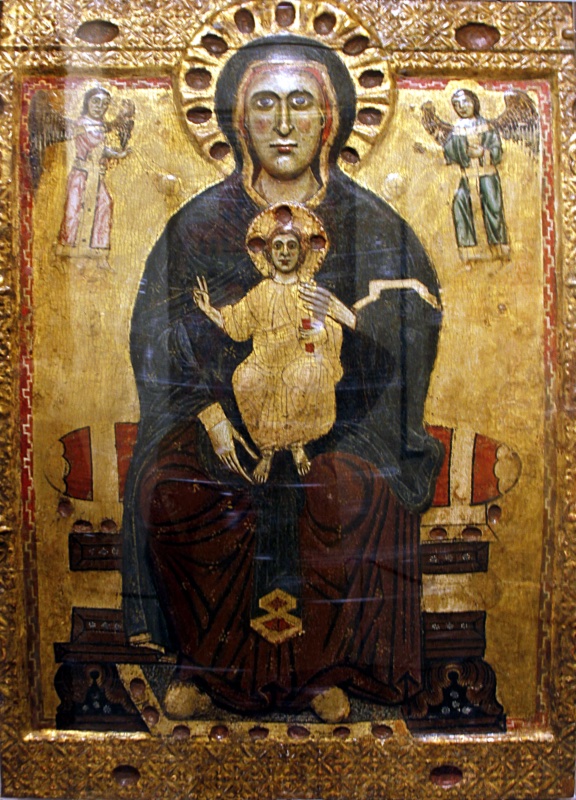
The Madonna with Large Eyes by the Master of Tressa offers a rich iconographic interpretation rooted in the Byzantine tradition and adapted to the Sienese context of the early 13th century, where the Virgin is not only a mother but also a spiritual guide for the faithful. Her central role as Odighitria – “She Who Shows the Way” – emerges from the gesture of her right hand reaching toward the Infant Jesus, presented as salvation and the way for humanity, an Eastern iconography that prioritizes didactic and devotional function over narrative aspect.
The Madonna is depicted seated on a simple wooden throne, with a platform slightly tilted in intuitive perspective to suggest depth, while the dark blue mantle quilted with gold and the white veil on her head emphasize heavenly royalty and purity. The frontal face, with large eyes fixed on the viewer, creates a direct and hypnotic connection, typical of Eastern icons to invoke the divine presence and mercy, tempered by an expression of human compassion that foreshadows Sienese Gothic developments. The popular name “the one with the big eyes” derives not so much from the size of the eyes as from the circular ex-votos that were once hung around the face, a symbol of popular gratitude for graces received.
Jesus, blessing with his right hand (thumb, ring finger, and little finger bent; index and middle fingers extended to form the Christogram), holds the Book of the Law in his left hand, embodying the Word made flesh and the fulfillment of the Scriptures. Dressed in a golden tunic and red mantle—the colors of the divine and of sacrifice—he is portrayed in an adult and regal posture (Christus Rex), with his gaze turned toward his Mother, reinforcing the symbiotic bond between the two and the theological idea of the Incarnation as the path to redemption. The gold background, achieved with gold leaf over tempera bubbles, symbolizes the eternal and the invisible, isolating the sacred figures from the earthly world to emphasize their transcendence.
Originally part of a larger altarpiece with Marian scenes on the sides (now lost), the work stood on the high altar of the Duomo, the focal point of the Sienese vow of 1260 prior to Montaperti: the citizens, led by the podestà Bonaguida Lucari, prostrated themselves before it, entrusting Siena to the Virgin, linking the icon to victory and civic devotion. This protective and thaumaturgical function explains the frontal composition and the penetrating gaze, designed for an immediate visual dialogue with the community, in line with the Marian theology of the time, which viewed Mary as Mediatrix and Advocate. Within the Sienese artistic landscape, it anticipates Duccio’s “Maestà,” evolving from a Byzantine icon into a more accessible and narrative image.
Madonna di Tressa
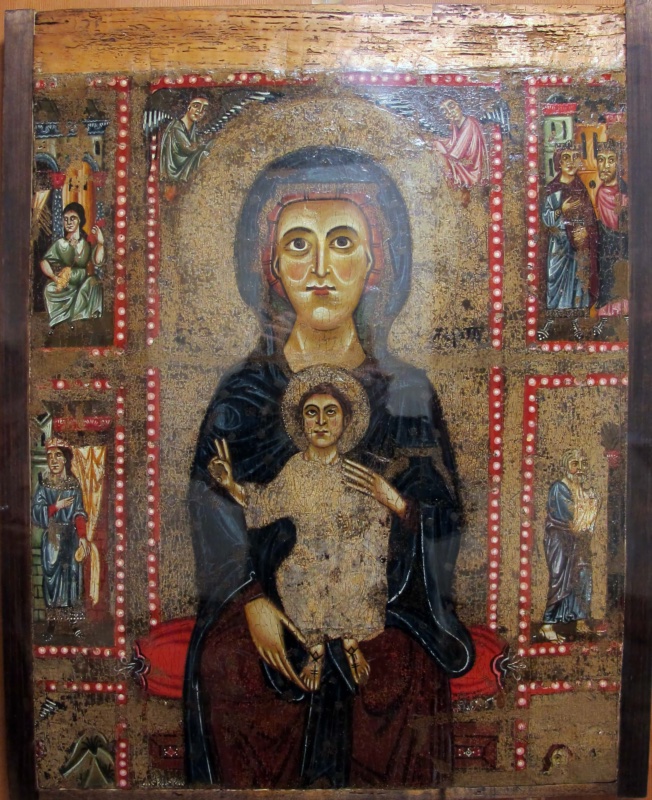
The Madonna of Tressa is a seminal work by the Master of Tressa, a Sienese painter active in the first half of the 13th century. It dates to around 1230–1240 and is executed in tempera and gold leaf on wood; its current dimensions are 75.5 × 56.5 cm due to later trimming. Originally from the church of Santa Maria in Tressa, outside Porta San Marco in Siena, and now housed in the Diocesan Museum of Siena, it represents one of the earliest examples of 13th-century Sienese painting, with evident Byzantine and Romanesque influences, but also hints at innovations from Lucca, such as those of Berlinghiero Berlinghieri. The work, likely conceived as an altarpiece (perhaps for Siena Cathedral), now displays a worn gold ground and extensive gaps: the Virgin on the throne is truncated at the midpoint of her legs, while the six side panels depicting scenes from Mary’s life are mutilated by about two-thirds, rendering some figures partial yet still recognizable.
At the center dominates the Virgin Mary seated on a throne, facing strictly forward in a solemn pose typical of the Byzantine tradition, holding the blessing Child in her lap, depicted as a small ancient philosopher wrapped in a toga and sandals. This composition accentuates the divine solemnity through large, three-dimensional eyes, defined by shadow lines beneath the brow ridges and on the nose, with garments freely decorated in vivid colors and sharp Romanesque borders. The technique of tempera on gold creates an effect of luminous sacredness, although deterioration has compromised part of the original plasticity, revealing affinities with the contemporary Madonna with Large Eyes by the same artist.
The frontal rigidity and the absence of relief or inlaid decorations indicate a stylistic evolution toward more modern forms compared to contemporary Sienese painted crosses, such as those at Sant’Antimo or San Pietro in Villore.
The six figures on the sides, arranged symmetrically flanking the Madonna, depict episodes from the life of Mary and the Child in medallions or damaged panels, following the Marian cycle typical of 13th-century altarpieces to emphasize popular devotion. These scenes, drastically cut away, nevertheless retain clear iconographic details despite the gaps, and serve to theologically contextualize the centrality of the Virgin as Theotokos. Their fragmentary state reflects the reuse of the work in subsequent frames, a common practice in 13th-century Sienese altarpieces.
From the six partially legible scenes emerge: the Annunciation, with the angel Gabriel facing Mary in a gesture of divine greeting; the Visitation, the meeting between Mary and Elizabeth with expressive gestures of recognition; the Flight into Egypt, the Holy Family traveling on a donkey to escape Herod. They continue with the Adoration of the Magi, the Kings offering gifts to the Child; the Presentation of Jesus at the Temple, with Simeon recognizing the Savior; and a sixth indecipherable scene, perhaps another Marian episode such as the Nativity or the Wedding at Cana, given the thematic orientation. These narratives, rendered with stylized figures and emphatic gestures, illustrate the Infancy cycle of Christ for a devout audience, integrating Eastern iconography with local Sienese elements.
The damage has preserved mainly the upper parts, allowing identification through canonical poses and symbolic attributes, such as the lily of the Annunciation or the incense of the Magi. This narrative scheme emphasizes the role of the Virgin Mary as mediator, consistent with the work’s original liturgical function.
Madonna and Child with Angels and Saints
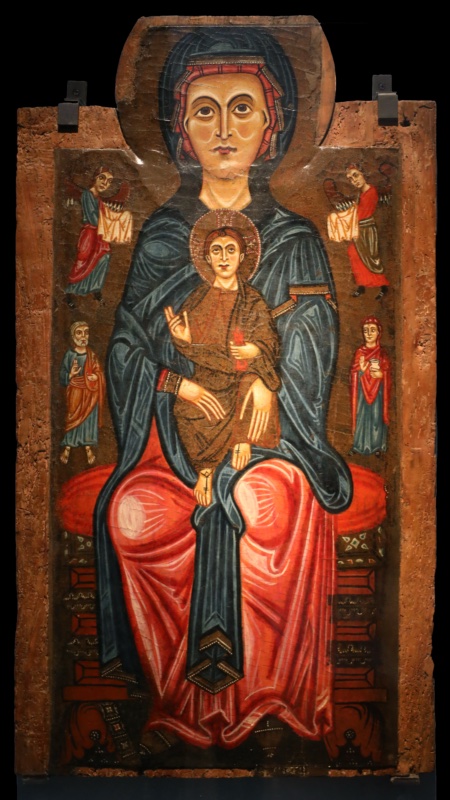
The composition is strictly frontal: the Virgin sits high upon a tiered wooden throne, with the Marriage of Christ symbolically evoked by her outstretched hand holding the Child. The original background is silver, now darkened or repainted—a rare feature that lends the image special value and, moreover, explains why so few such silver backgrounds have survived. The rendering of the folds, the stylized drapery, and the frontal composition recall the Sienese tradition of the late 14th and early 15th centuries, influenced by Emilian models (Berlinghiero Berlinghieri) and featuring a more sculptural articulation of the body compared to the older Madonnas by the Master of Tressa.
At the center, as always, the Madonna and Child dominates; the Child rests in her lap in a more “familiar” pose compared to the artist’s earlier Madonnas. The Virgin has an elongated face, raised eyes, clean lines devoid of shading, intense colors, and overlapping planes, in keeping with the iconic synthesis characteristic of the Master of Tressa. The Child is depicted in a solemn manner, with an upright posture and gestures that emphasize his role as Christ-King rather than as a domestic infant.
The sides of the throne are occupied by secondary figures, arranged vertically:
- at the top, two angels, slender and graceful in appearance, who are likely holding the shroud or a symbolic veil, foreshadowing Christ’s future tomb; their presence serves to reinforce the theological message of the Madonna Deipara, mother of the Redeemer.
- at mid-height, two standing saints, generally identified as Anne and Joachim, parents of the Virgin Mary. These saints are depicted in a strictly frontal pose, with drapery decorated by clear lines superimposed on the folds, reminiscent of the typical striations found in Lucca models attributed to the Berlinghieri and Emilian schools.
Angels and saints are not mere ornaments but actively participate in the construction of the sacred representation: the angels emphasize the “heavenly” character of the image, while Anne and Joachim, as the Virgin’s ancestors, reinforce the idea of Davidic descent and the holiness of Mary’s family. Their placement along the throne’s side panels creates a symmetrical and solemn iconographic composition, reflecting the devotional needs of the Sienese community and a strong continuity with the Italo-Byzantine tradition, filtered through Lombard and Emilian models.