Anselmo (Anselmus Dedalus alter)
The sculptor who signs himself Anselmus “Dedalus alter” is one of the very few twelfth‑century Lombard artists whose name is preserved directly by an inscription on a surviving monument. His authorship is attested on reliefs from the now‑destroyed Porta Romana of Milan, today largely conserved in the Museo d’Arte Antica of the Castello Sforzesco, which commemorate the refortification of the city after the devastations inflicted by Frederick Barbarossa. Modern scholarship treats Anselmus and his colleague Girardus, who likewise signed the ensemble, as distinct from the better‑documented Campionese masters active in Modena and elsewhere, and identifies them as Milan‑based sculptors working in the third quarter of the twelfth century. Beyond the epigraphic self‑identification and the stylistic profile of the Porta Romana reliefs, however, no medieval narrative or documentary source provides biographical information such as date or place of birth, family background, travels, or circumstances of death, and these aspects therefore remain unknown.
Documentary evidence and identity
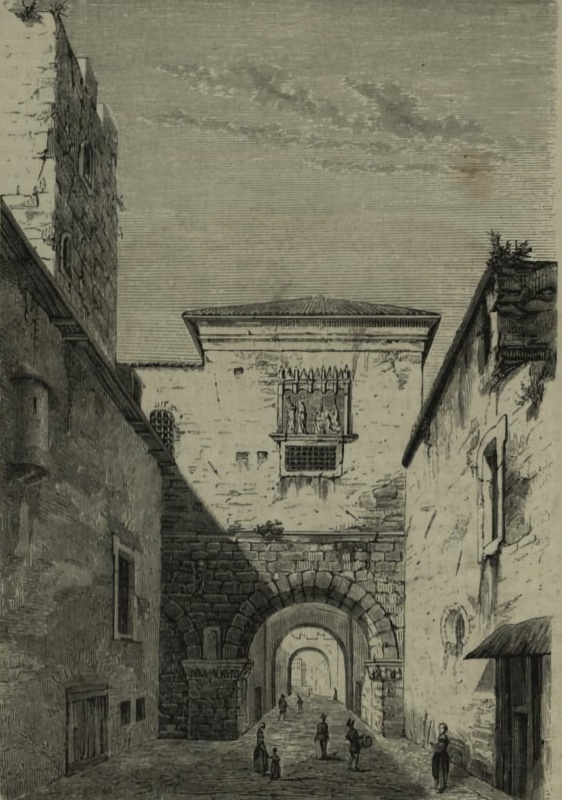
The principal primary sources for Anselmus are the Latin inscriptions carved on the reliefs of Porta Romana, fragments of which are preserved and transcribed in epigraphic collections and modern catalogues. One inscription, running along the architectural member above one of the narrative friezes, reads Hoc opus formavit Anselmus Dedalus alter, by which the sculptor proclaims that “Anselmus, a second Daedalus, formed this work.” A second inscription on another portion of the reliefs states Istud sculpsit Girardus pollice docto, identifying his collaborator Girardus and praising his “skilled thumb,” that is, his learned hand as a carver. These formulae are cited already in early modern antiquarian literature on Milan and were exhaustively collected by Vincenzo Forcella in the nineteenth century, thereby securing the reading of alter against earlier misinterpretations as a toponym.
The standard scholarly literature summarizes the state of research by defining Anselmus and Girardus as sculptors active in Milan in the second half of the twelfth century whose names are transmitted exclusively by the inscriptions on the Porta Romana reliefs. The same entry notes that a Girardus de Mastegnianega, documented on the so‑called “lastra dei Consoli” associated with the gate and dated 1171, is generally identified with the Girardus of the signature and has been proposed as designer of the gate and perhaps of the entire communal circuit of walls, although this remains a hypothesis based on name‑identity rather than an explicit medieval statement. A later entry on Anselmo da Campione in the standard reference literature explicitly warns against confusing the Campionese master—active as architect and sculptor in Modena and other Emilian and Lombard sites—with the “rough” sculptor of Porta Romana, whose signature reads Anselmus Dedalus alter and whose style and sphere of activity are different. No surviving document external to the monument itself mentions Anselmus by name, so his identity is reconstructed solely from these epigraphic and stylistic data.
Family and personal background
There is no extant medieval source that records Anselmus’s parentage, place of origin, or social status, and modern authors therefore refrain from assigning him a biography in the conventional sense. Earlier antiquarian writers at times inferred a provenance from Alzate on the basis of a misreading ale instead of alter in the inscription, but this reading has been definitively rejected by later epigraphists and by Novati, who restored the correct form alter and thereby removed any secure link between the sculptor and a specific locality. The prosopographic dossier assembled for Girardus de Mastegnianega, which connects him to the design and execution of the gate and the communal walls, has no parallel for Anselmus, whose name appears only in the proud but isolated comparison with Daedalus. In the absence of notarial acts, guild records, or necrologies mentioning him, it is impossible to establish whether Anselmus belonged to a family of masons, to the milieu of Comacine or Campionese workshops, or to another social grouping altogether, and current scholarship acknowledges this lacuna explicitly. Consequently, any attempt to reconstruct his family circumstances, apprenticeship, or domestic life would go beyond the evidence provided by twelfth‑century documents and must be regarded as speculative, and is therefore not pursued in serious academic literature.
Patrons and civic context
While the sculptors remain elusive as individuals, the patrons and historical circumstances of Porta Romana are more clearly documented in narrative and archival sources relating to the communal rebuilding of Milan after Barbarossa’s destruction. The standard scholarly literature situates the construction of Porta Romana beginning in 1171, in the context of the refortification works that followed the return of the Milanese to their city in 1167 and the consolidation of the Lombard League. The surviving reliefs depict, among other scenes, the return of the exiled citizens to Milan and the procession of the troops of the Lombard League, led by a frater Iacobus bearing a processional cross and banner towards a schematic representation of the city, flanked by the names of allied communes such as Cremona, Brescia, and Bergamo. These iconographic choices make clear that the programme was conceived as a visual proclamation of communal identity and of the alliance that enabled Milan’s rebirth, and that the gate functioned simultaneously as a fortification and as a monumental narrative of civic history.
The scheda of the Lombardy cultural heritage database for the relief Sant’Ambrogio scaccia gli Ariani da Milano attributes the work to Anselmus, dates it to 1171, and lists the consuls of Milan as patrons, confirming the close link between the sculptures and the communal magistracies responsible for the reconstruction. In the relief, Saint Ambrose, vested in episcopal insignia and accompanied by a cleric with a processional cross, drives away a line of eighteen figures—men, women, and children—identified by inscriptions as Arians and, in another epigraph, linked to a traditional episode in which Ambrose allegedly deprived the Jews of their synagogues. This combination of civic and ecclesiastical themes suggests that the sculptural decoration articulated a political theology in which Milan’s recent liberation from imperial oppression was viewed through the lens of Ambrose’s legendary defence of orthodoxy and of the city against religious “others.” The explicit naming of the consuls as commissioners in at least one of the fragments underscores that the initiative and funding for the programme came from the communal government, even if individual clerics such as frater Iacobus also figure prominently within the iconography.
Sculptural works and style
The surviving sculptural corpus securely associated with Anselmus consists of portions of the narrative friezes and architectural members from Porta Romana that bear his signature or that can be linked to him on stylistic grounds within the same ensemble. According to the standard scholarly literature, the reliefs originally occupied the impost cornices of the twin arches of the gate, flanking a central pier, and were partially concealed when one of the arches was walled up in the fourteenth century, before the entire gate was demolished in 1793. Subsequent relocation to a nearby façade and, in 1895, to the civic museums at Castello Sforzesco, has fragmented the original narrative sequence, but enough elements remain to reconstruct a coherent iconographic programme. The reliefs on the central pier, attributed respectively to Girardus and Anselmus, depict on one side the return of the Milanese citizens to their city, and on the other the procession of the Lombard League troops led by frater Iacobus towards a schematic cityscape labelled with the names of Milan and its allies.
On the right‑hand impost, a separate relief assigned to Anselmus or to his workshop shows Saint Ambrose expelling the Arians from Milan, a scene that develops from the flank towards the front of the pier and is accompanied by explanatory inscriptions. The Lombardy heritage scheda describes Ambrose, in mitre and episcopal vestments, striking one of the departing heretics with a scourge or staff while the group of expelled figures—eighteen in number—includes men, women, and children, suggesting the collective, civic dimension of their banishment. The iconography, as recent studies have stressed, is unusual for the period and may have contributed to the later development of the widespread image of Ambrose as a militant bishop armed with a scourge, though the relief itself predates the codification of that iconographic type in the fourteenth century. Within the ensemble, Anselmus’s hand is characterized, in the standard scholarly formulation, by an accentuation of volumetric modelling and by an archaizing compositional conception in which figures are rigidly aligned, in contrast to the more fluid narrative and finer plastic articulation attributed to Girardus.’s formulation, by an accentuation of volumetric modelling and by an archaizing compositional conception in which figures are rigidly aligned, in contrast to the more fluid narrative and finer plastic articulation attributed to Girardus.
Modern scholarship has often judged the Porta Romana sculptures, together with related works such as the processional relief of the Virgin “Idea” from Santa Maria Beltrade and the architrave of San Celso, as evidence of a decline in the figurative language of Milanese sculpture in the later twelfth century. Nevertheless, careful comparison of the inscriptions and carving has led authors such as Carotti and Binaghi Olivari to distinguish multiple hands within the ensemble and to recognize qualitative differences between Anselmus and Girardus, as well as possible collaborators. In particular, the stylistic “gap” noted between the two signed masters, together with variations in letter forms between different tituli, has been used to argue for a complex workshop organization on the site, reflecting typical medieval practices of collaboration and division of tasks rather than a simple hierarchy of master and subordinate. These observations reinforce the impression that Anselmus, while perhaps less refined than Girardus, occupied a significant role in the conception and execution of the sculptural programme as a whole.
Artistic influences and milieu
Because no written twelfth‑century source explicitly states Anselmus’s training or influences, any discussion of his artistic milieu must rely on stylistic comparison with contemporaneous Lombard and Emilian sculpture and is presented in modern literature as scholarly interpretation rather than documentary fact. The scholarly literature suggests affinities between Anselmus’s work and the reliefs of the pulpito of Sant’Ambrogio in Milan, while proposing connections between Girardus and the capitals of San Michele in Pavia, thereby situating the Porta Romana team within a broader network of sculptural production in the region. More generally, the reliefs are commonly placed within the context of the so‑called Lombard Romanesque, whose architectural and sculptural forms developed between the late eleventh and twelfth centuries in Lombardy, Emilia, and adjacent areas, and which is exemplified by major monuments such as the rebuilt basilica of Sant’Ambrogio and the cathedrals of Modena and Parma.
At the same time, scholars emphasize that Anselmus’s style, with its rigidly aligned figures and somewhat archaic compositional schemes, contrasts with the more classicizing and narrative richness of masters like Wiligelmo at Modena or the Campionese sculptors active on other Lombard sites, reinforcing the distinction drawn in the scholarly literature between Anselmus “Dedalus alter” and Anselmo da Campione. In this sense, the invocation of Daedalus in the signature is less a precise indication of stylistic lineage than a rhetorical flourish aligning the sculptor with an ancient paradigm of inventive craftsmanship, a topos that appears elsewhere in medieval and early modern self‑presentations of artists. The comparison is therefore significant primarily as evidence of a growing sense of artistic self‑consciousness among twelfth‑century sculptors operating within communal building sites, rather than as a literal clue to Anselmus’s training or geographic origins. Within the limits imposed by the sources, it is thus possible to situate Anselmus in a milieu shaped by communal patronage, Lombard Romanesque architectural experimentation, and emerging forms of artistic self‑representation, without attributing to him specific journeys or workshop affiliations that the documentation does not support.
Travels and geographic activity
No charter, contract, or narrative source from the twelfth or thirteenth centuries records Anselmus’s presence outside Milan, and the current consensus of scholarship is that his securely attributable activity is confined to the Porta Romana reliefs and possibly to closely related Milanese works. The scholarly literature underscores that the reliefs of Porta Romana were conceived explicitly to celebrate the refortification of the city and the role of the Lombard League, a context that suggests a primarily local function and audience for the sculptures. Given this strong civic orientation, it is plausible that Anselmus’s main, or perhaps only, documented professional engagement was within the communal building site of Milan in the years following the return of the exiles, but this remains an inference from the absence of contrary evidence rather than a positive statement in any medieval text. For this reason, modern authors avoid ascribing to him activity in other centres, and the attempts to link him to Campionese or Comacine itinerant traditions are framed as hypotheses about workshop organization in northern Italy rather than as established facts about his personal itineraries.
The older misreading of the inscription as Hoc opus formavit Anselmus de Ale led some antiquarians to assign the sculptor a provenance from Alzate, thereby implicitly constructing a trajectory from that locality to Milan, but the correction of the reading to alter has removed this slender basis for reconstructing his geographic origins. In the absence of further inscriptions or archival traces, it is not possible to know whether Anselmus ever worked on other gates, churches, or civic monuments either within or beyond Milan, and responsible scholarship therefore limits itself to the works that can be directly connected to his name or hand. Accordingly, there is no documentary evidence for travels comparable to those documented for some later medieval and Renaissance artists, and any narrative of journeys or foreign commissions for Anselmus would necessarily exceed what the twelfth‑century sources allow.
Corpus of works and present locations
Frieze: The return of the Milanese to the city
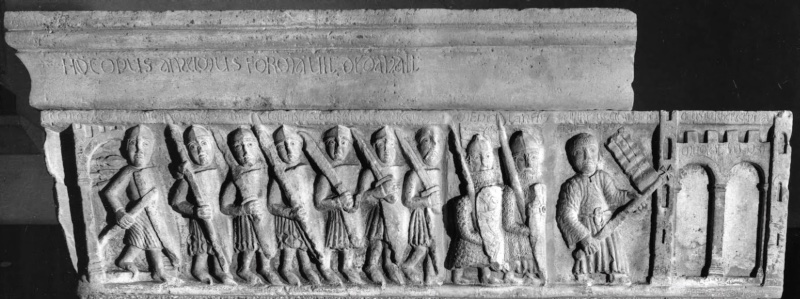
The frieze depicting the return of the Milanese to the city following its destruction in 1162 by Frederick Barbarossa is a bas-relief carved around 1171 for the Porta Romana gate in Milan’s city walls; it is now housed in the Museum of Ancient Art at the Sforza Castle. This work, signed by Anselmo as Hoc opus formavit Anselmus Dedalus alter, bears witness to the city’s rebirth following imperial humiliation, celebrating the victory of the Lombard League and Milan’s civic identity.
The sculpture is part of the atmosphere of reconstruction following the siege and devastation of Milan in 1162 by Frederick Barbarossa, culminating in the Peace of Constance in 1183, which recognized municipal autonomy. The Porta Romana, erected in 1171 on the inner circle of the walls (demolished in 1793), served as a fortified entrance on the Naviglio, a symbol of resilience: the reliefs commemorate not only the citizens’ return in 1167, but also events such as Saint Ambrose driving out the Arians and Friar Iacopo leading the allied troops. This frieze, part of a larger cycle, reflects a municipal “politics of memory,” where art served to forge a collective identity against the empire, assimilating trauma into spiritual and political victory.
The bas-relief, originally placed on the impost frame of the gate’s right arch, depicts a triumphal procession: figures in medieval garb, on horseback and on foot, bearing lances and banners, march toward Milan, symbolizing the return of the refugees after exile. Anselmo divides the space into narrative registers: on the left, a knight leads the group; in the center, animals (lions or horses, symbols of strength) and figures in celebratory poses emerge; while on the right, the city is schematically evoked with towers. The iconography emphasizes the collective—women, children, warriors—to represent the community’s rebirth, with details such as draped garments and expressive gestures evoking collective joy in the aftermath of disaster.
The style reflects late-Romanesque Lombard sculpture from Milan, featuring stocky, volumetric figures, rigid drapery, and frontal compositions that emphasize narrative symbolism over naturalism. Anselmo favors a compositional archaism, with figures rigidly juxtaposed and an emphasis on plastic relief, while Girardo introduces greater fluidity and finesse, perhaps influenced by Niccolò-style models from Pavia or Milan. This qualitative “decline” compared to High Romanesque art, due to commemorative urgency, nonetheless employs military iconography (weapons, processions) to promote the Lombard League, with roots in the pulpit of Sant’Ambrogio.
This work is a “place of memory” for Milan: it celebrates the defeat of Barbarossa (perhaps symbolized elsewhere in a derisive form), reinforcing civic pride during a period of municipal expansion. Its preservation at the Castello Sforzesco, following transfers in 1793 and 1895, makes it a paradigmatic example of how medieval art served politics, even influencing later narratives such as the portals of the Duomo.
Frieze: Saint Ambrose driving the Jews out of Milan
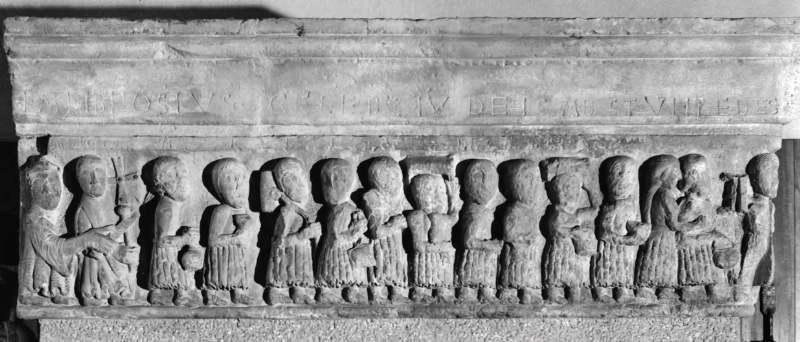
The scene depicts Saint Ambrose, bishop of Milan in the 4th century, driving the Arians out of the city. The iconographic program draws on a real episode from the saint’s life, his struggle against the Arian heresy supported by Empress Justina, to allude to the challenge posed by Milan against Frederick Barbarossa and his allies, who are the true “Arians” of the 12th century. It is a typically medieval use of the figure and the allegory: the biblical-patristic past becomes a mirror of the political present.
Saint Ambrose is depicted on the left side of the frieze, in full pontifical regalia: miter on his head, cope, and crosier in hand. The saint is preceded by a cleric carrying a processional cross, and strikes with a whip the last of a procession of eighteen figures, men, women, and children, who are fleeing to the right in a compact line. It is a strictly horizontal and narrative composition, read from left (the triumphant saint) to right (the fleeing enemies), with a processional structure that is mirrored but inverted compared to the relief depicting the return of the Milanese.
This frieze has exceptional iconographic significance: it is the first known depiction of Saint Ambrose with the staff, an attribute that in the 14th century would become the canonical identifying feature of the patron saint of Milan. The sculptor was likely inspired by the Discourse Against Aussentius, in which Ambrose evokes Christ’s expulsion of the merchants from the temple, thereby drawing a theological parallel between Jesus and the bishop. This iconographic innovation is thus one of the most significant in Lombard Romanesque sculpture, with a lasting impact on the Ambrosian figurative tradition.
The frieze bears two inscriptions. The first, in the upper band, is an inscription that states the subject of the scene: + AMBROSIUS CELEBS IUDEIS ABSTULIT EDES, that is, “Ambrose the celibate took the houses (the synagogues) from the Jews”, referring to a specific episode in the saint’s life, namely Ambrose’s order to destroy the synagogues in Callinicum in 388 AD, an episode that earned him criticism even from Emperor Theodosius.
The second, on the strip above the frieze, reads: + S(AN)C(TU)S AMBROSIUS E ARRIANI, which, in its expanded form: “Sanctus Ambrosius e(icit) Arriani”, that is, “Saint Ambrose drives out the Arians”, directly identifies the narrative subject of the scene and serves as the title or caption of the bas-relief.
These two epigraphs are not mere titles: they construct a superimposed double anti-imperial allegory. The “Arians” of the 4th century allude to the followers of the heresy espoused by Empress Justina, but in the context of 1171 they clearly evoke the Germans of Frederick Barbarossa, branded as heretics or schismatics—enemies of both the faith and Milan’s autonomy. The mention of Jews and synagogues adds a further layer of propaganda: Ambrose appears here as an unyielding defender of the civitas christiana, whose heavenly patronage legitimizes the military actions of the Lombard League. For the history of Lombard Romanesque sculpture, the coexistence of these two inscriptions on a single architectural monument is an exceptional example of the political use of medieval epigraphy.
The style is characterized by the same stocky figures and compressed relief already observed in the procession frieze, but with an even harsher and more schematic execution, which has led some scholars to attribute it not directly to Anselmo but to one of his workshop collaborators. The figures are tightly packed together, with little space between them, creating an effect of a moving mass that emphasizes the collective expulsion rather than the individuality of the figures. Recent studies, such as those by Saverio Lomartire, propose a date in the mid-12th century based on the depiction of Ambrose in pontifical vestments with a miter, a feature not documented in Milan before that period.
Frieze: Friar Jacopo leads the allied troops toward Milan
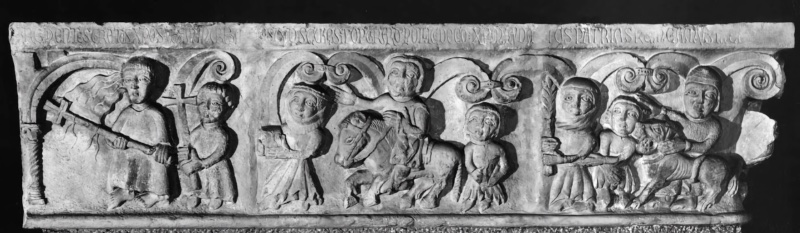
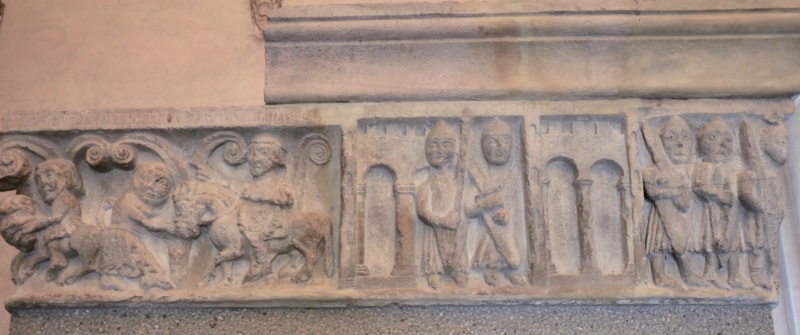
The frieze unfolds horizontally as a narrative bas-relief clearly inspired by classical art in its continuous frieze composition, yet deeply Romanesque in the stylistic rendering of the figures. The scene depicts Friar Jacopo, a religious figure who served as a spiritual and military leader, at the head of allied troops from Cremona, Bergamo, and Brescia, marching toward Milan. The figures are arranged in a processional line, with the combatants in the foreground depicted in full armor, followed by soldiers equipped with helmets, large shields, lances, and swords, while one section of the composition also features an archaic-style falchion.
The relief is the work of sculptors whose names appear in the inscriptions on the work itself: among them are Anselmo and Girardo, Lombard sculptors active in the second half of the 12th century. The style reveals a mature Romanesque sculpture: the figures are compact, with solid volumes and schematic drapery, featuring a linear narrative typical of municipal stone cycles in northern Italy. The quality of the marble and the precision of the inscriptions suggest a high-level workshop, likely linked to the craftsmen working on the construction sites of contemporary Lombard cathedrals.
The upper band of the frieze bears a Latin inscription that runs the entire length of the relief. The image shows a partial reading: DE MESR[O] EN[…] OST[…] […] ANGYP[…] KROS[…] OIRR[…] O PULC[…] COM […] ENDAL[…] LOS PATRIAS RE[…] CATIAR[…], whose legibility is compromised by the deterioration of the stone.
The frieze of Frate Jacopo is to be read in close relation to the other reliefs on the gate. Together, these elements form a coherent narrative cycle celebrating civic resistance, solidarity among the Lombard communes, and the divine protection granted to Milan through its heavenly bishop.
Memorial Stone of the Milanese Consuls
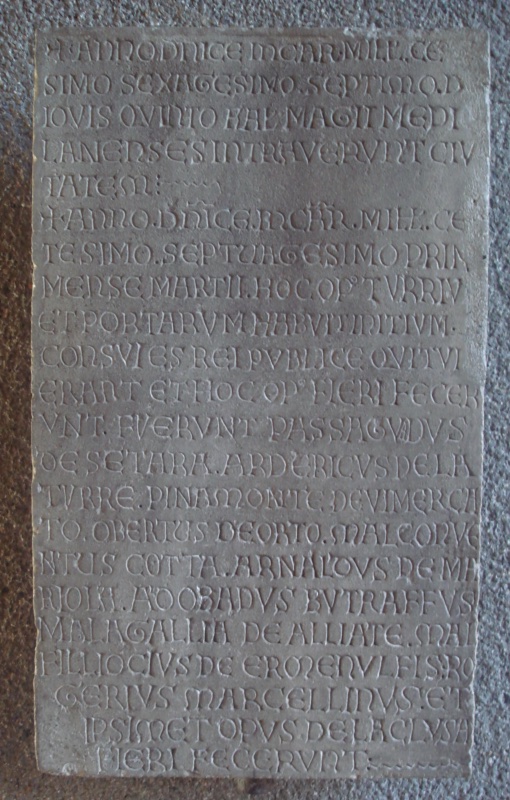
On the plaque, the consuls commemorated the return of the Milanese to the city on May 5, 1167, and celebrated its rebirth with the construction of the gate, which began on March 1, 1171.
The full inscription reads, in essence:
Anno Domini MCLXVII, die Iovis, V kal. Maii, Mediolanenses reversi sunt in Mediolanum a destructione quam fecit Fredericus imperator. Et anno Domini MCLXXI, kal. Martii, incepta est haec porta sub consulibus…, that is: ”In the year of our Lord 1167, on Thursday, May 5, the Milanese returned to Milan from the destruction wrought by Emperor Frederick. And in the year of our Lord 1171, on March 1, construction of this gate began under the consuls…”, followed by the list of the ten consuls in office who had decreed its construction, among whom the names of the sculptors Anselmo and Girardo also appear.
The plaque is exceptional because it also mentions the name of the architect of the walls, Gerardo di Mastegnianega, a rarity for the 12th century, when builders almost always remained anonymous. The entire Porta Romana project represents the first explicit celebration of the city’s history in Milanese sculpture, and the frieze depicting the return of the Milanese and the guidance of Friar Jacopo constitutes one of the oldest examples of narrative sculpture with historical-civic content in Italy.