Maestro di Pedret
The Maestro di Pedret is the conventional designation assigned by art historians to an anonymous Romanesque fresco painter — or, more precisely, to the most gifted member of a workshop of itinerant artists — active in the Pyrenean region straddling present-day Catalonia and southern France between approximately the last two decades of the eleventh century and the early decades of the twelfth. The name derives from his most celebrated surviving decorative cycle, the frescoes of the pre-Romanesque church of Sant Quirze de Pedret in the Berguedà region of Catalonia, a modest but iconographically remarkable building whose painted programme elevated the unknown master to canonical status within the history of European Romanesque art.
Origins and the Problem of Identity
The precise date and place of birth of the Maestro di Pedret are irrecoverable from the documentary record, as is the case with the vast majority of medieval artists who worked before the age of signed and dated artworks. No notarial document, episcopal register, monastic chronicle, or contractual instrument bearing a name unambiguously linked to this painter has yet come to light, and it is unlikely that such evidence will ever be found. His artistic biography was, in the fullest sense, a scholarly construction: the American historian Chandler Rathfon Post first formulated the concept of a “Master of Pedret” between 1930 and 1941 in his monumental History of Spanish Painting, drawing sustained comparisons between the Pedret frescoes and contemporaneous mural programmes in northern Italy. Post’s hypothesis was subsequently developed and refined by the Catalan art historian Josep Gudiol i Ricart, who in 1950 articulated the definition of the master as the leading figure of a cohesive team of travelling painters, closely related to the fresco workshops that, during the eleventh century, revitalized Byzantine formulas across northern Italy. The scholarly consensus that gradually emerged from this foundational historiography treated the Maestro di Pedret as emblematic of a broader phenomenon of artistic migration across the Pyrenees, a movement facilitated by the dense network of pilgrimage routes, ecclesiastical reform, and monastic connection that bound Catalonia to Lombardy throughout the eleventh and twelfth centuries.
Family and Workshop
The question of the master’s family background and personal formation must be addressed within the conceptual framework appropriate to medieval artistic production, where individual identity was almost invariably subsumed within the collective identity of a workshop, a guild-like association, or a travelling bottega. The Maestro di Pedret did not operate in biographical isolation: the surviving visual evidence strongly suggests that the painted programmes attributed to him were the product of a coordinated enterprise, within which at least one highly distinctive hand — probably that of the master himself — can be separated by connoisseurial analysis from the contributions of assistants and collaborators. His probable origins, as inferred from stylistic comparison, lie in the orbit of the Lombard school of mural painting, which flourished with extraordinary vitality in the region of northern Italy that encompassed the lakes of Como and Varese, the Ticino valley, and the Lombard plain.
The hypothesis of a Lombard provenance implies that the master received his early training within a northern Italian milieu, where the traditions of Carolingian and Ottonian monumental painting had merged with the surviving currents of early Christian and Byzantine iconographic culture to produce a richly codified decorative vocabulary. This formative environment would have been transmitted through a master-apprentice relationship of the kind normative in medieval craft practice, where technical knowledge, compositional schemas, and iconographic models were passed from one generation of practitioners to the next within a quasi-familial structure.
The workshop that he led or contributed to appears to have been of sufficient size and organizational complexity to undertake the simultaneous decoration of multiple ecclesiastical sites scattered across a wide geographical area. Within the group, the master’s role was almost certainly that of the designer of the principal figurative programmes, the executor of the most demanding passages of facial characterization and drapery, and the supervising authority responsible for the overall chromatic and compositional coherence of each cycle. The collaborators who worked alongside him, possibly including younger painters trained in the same Lombard tradition, were responsible for subordinate passages such as ornamental borders, decorative friezes, and background architectural elements, as well as for the repetitive apostolic and prophetic figures that populate the lower registers of several apses.
The linguistic and cultural distance separating Lombardy from Catalonia would not have represented an insuperable obstacle for a workshop accustomed to operating at the intersection of multiple cultural territories: itinerant master builders and painters from Lombardy were a familiar presence throughout the First Romanesque building campaigns that transformed the ecclesiastical landscape of Catalonia during the late tenth and eleventh centuries. The geographic mobility inherent in the workshop’s activity suggests that its members shared a common professional identity that transcended local attachment, defining themselves not by their relationship to a fixed place of origin but by their mastery of a specialized technical and iconographic repertoire that could be deployed wherever ecclesiastical patronage required. Whether the master himself was the natural-born son of a Lombard painter, or instead an artistically gifted individual who entered a pre-existing workshop as a young apprentice, remains a matter of conjecture; the visual evidence does not permit us to resolve this question with any confidence. What is certain, however, is that his formation endowed him with a depth of technical knowledge and a breadth of iconographic culture that place him unmistakably at the summit of his craft, far above the level of mere provincial craftsmen, and that the workshop tradition in which he was formed was itself the product of generations of accumulated expertise.
Patrons and Ecclesiastical Commissioners
The patronage network within which the Maestro di Pedret and his workshop operated was defined primarily by the great ecclesiastical reform movement of the eleventh century and by the parallel process of Christian territorial reconquest that was reshaping the political geography of the Iberian peninsula during this period. The most powerful individual patron associated with the master’s activity was Arnau Mir de Tost1, a Catalan nobleman of Urgell who served as viscount of Àger and who played a decisive role in extending the Christian frontier southward toward the Ebro valley.
The foundation of Sant Pere d’Àger was a calculated act of aristocratic piety and political legitimization, designed to establish the permanent presence of Christian institutional culture within a recently reconquered territory, and the commission of monumental fresco decoration for its apse was integral to this programme of ecclesiastical investment. The iconographic programme designed by the Maestro di Pedret for the collegiate shich is dominated by large-scale figures of the Apostles Thaddeus and James, rendered in a hieratic frontal posture that commands attention from a considerable distance, responded directly to the symbolic needs of a patron who wished to place his personal foundation under the protection of the most venerable apostolic authority.
A second significant patron connected to the workshop’s activity was the Countess Lucía, who governed the county of Pallars Sobirà between 1084 and 1090 following the death of her husband, Count Artal I2, and whose figure appears in the fresco cycle of Sant Pere de Burgal in the guise of a donor offering a votive candle. The identification of this woman with the painted donor figure has been widely accepted in the scholarship, not only because it provides a plausible chronological anchor for the Burgal cycle — dateable on this basis to the period between 1084 and 1090 — but also because it illuminates the central role that aristocratic women played in the patronage of Romanesque ecclesiastical art throughout the Pyrenean region during this period.
The monastic community of Santa Maria de Cap d’Aran, dependent upon the bishopric of Comminges in the French department of Haute-Garonne, constituted a third major institutional patron of the workshop, commissioning the elaborate programme of fresco decoration for the apse of the monastic church whose principal surviving elements are now preserved in the collection of The Cloisters at the Metropolitan Museum of Art in New York. The cathedral of Saint-Lizier in the Ariège department of southern France, which belongs to the earliest phase of the master’s documented activity, was almost certainly commissioned by the local diocesan chapter or bishop, reflecting the broader interest of the French Pyrenean church in the renewal of ecclesiastical decoration during the decades following the Gregorian Reform.
The church of Santa Maria d’Àneu, situated in the upper Noguera Pallaresa valley and constructed in the eleventh century according to architectural models closely related to Lombard Romanesque schemes, was presumably commissioned by the monastic community or local ecclesiastical authority responsible for the site, whose deliberate choice of an unusually elaborate and theologically sophisticated iconographic programme suggests the involvement of a learned patron capable of directing the visual argument of the decorative cycle. Throughout this geographically dispersed patronage network, the common thread is a shared commitment to the values of the Gregorian Reform: the elevation of ecclesiastical dignity, the visual assertion of the authority of the Church in recently consolidated Christian territories, and the deployment of monumental painting as an instrument of theological instruction and devotional intensification for both literate and illiterate audiences.
Painting Style
The pictorial language of the Maestro di Pedret represents one of the most distinctive and immediately recognizable contributions to Romanesque monumental painting in all of Europe, and its peculiarities of form, color, and expressive character have long occupied a central place in the historiography of eleventh- and twelfth-century art. At the most fundamental level of technique, the master was a consummate practitioner of the buon fresco method, applying his pigments directly onto freshly laid plaster in a manner that required both speed of execution and precise preliminary planning.
The fresco ground was enriched through the systematic application of tempera in the passages of highlight and luminous accent, a technique that allowed the master to achieve a degree of tonal refinement — particularly in the modeling of faces and drapery folds — that pure fresco could not have provided. His chromatic range was exceptionally broad and carefully calculated: it encompassed carmine, cinnabar, red ochre, yellow ochre, raw and burnt sienna, lapis blue, black, and white, deployed not as local colors applied uniformly within a contour but as elements of a complex coloristic system in which individual hues were frequently mixed and modulated to achieve a wide spectrum of intermediate tones.
The resulting color harmonies are among the most sophisticated produced by any European painter of the Romanesque period, combining the warm resonance of the ochre-and-cinnabar range with the cool luminosity of blue and white to create visual fields of extraordinary intensity that impose themselves upon the viewer even across the large spatial distances characteristic of apsidal decoration. The drawing system underlying the master’s figurative compositions is equally distinctive: far from the rigid geometric schematism that characterizes much provincial Romanesque figure painting, his contours are fluid, expressive, and animated by a quality of spontaneous calligraphic energy that endows even the most hieratically conceived figures with a vivid sense of individual presence.
The faces painted by the master are among the most psychologically penetrating in the entire Romanesque repertoire, characterized by large, wide-open eyes that gaze outward with an intensity at once devotional and unsettling, by strongly pronounced brow ridges that reinforce the impression of concentrated spiritual energy, and by finely modeled noses and mouths that depart from Byzantine stereotype in the direction of individual physiognomic observation. Drapery is treated with a remarkable degree of rhythmic elaboration: garments fall in heavy, parallel folds punctuated by sharp angular breaks and energetic linear passages that convey the weight of the fabric while simultaneously creating decorative surface patterns of considerable visual richness.
The figural compositions are organized according to the hierarchical principles standard in Romanesque apsidal decoration, with the most sacred figures occupying the highest and most central positions within the hemicycle, but the master consistently subverts the tendency toward rigid symmetry that characterizes less gifted practitioners, introducing subtle asymmetries of pose and glance that animate the sacred assembly with a sense of living participation. His treatment of fantastical and visionary subjects — above all the Riders of the Apocalypse at Pedret, depicted astride magnificent birds in a passage of extraordinary inventive freedom — reveals a dimension of the master’s art that goes beyond the faithful transmission of iconographic models and approaches something that can legitimately be called personal artistic imagination. The overall effect of a decorative programme by the Maestro di Pedret is one of commanding monumental authority combined with an intimacy of expressive address that is rare in the art of his time: the frescoes speak simultaneously to the theological intellect of the learned patron and to the devotional sensibility of the illiterate faithful, fulfilling the dual mandate of Romanesque church decoration with a completeness seldom achieved by his contemporaries.
Artistic Influences
The formation of the Maestro di Pedret’s pictorial language cannot be understood in isolation from the broader artistic geography of the Mediterranean world in the late eleventh century, and specifically from the complex interaction between the surviving traditions of Byzantine court art, the revitalized mural painting of Carolingian and Ottonian northern Europe, and the distinctive regional synthesis that had developed in northern Italy during the preceding decades. The most fundamental and pervasive of his influences was the Italo-Byzantine tradition of monumental painting, which had maintained an unbroken presence in northern Italy throughout the early medieval period and which underwent a significant renewal during the tenth and eleventh centuries under the stimulus of Ottonian imperial patronage and direct contact with the artistic culture of Constantinople.
Within this broader Italo-Byzantine tradition, the most immediate and specific sources of comparison for the Maestro di Pedret’s art are the surviving fresco cycles of the Lombard and Ticino regions, particularly the decorations of San Vincenzo a Galliano, San Pietro al Monte a Civate, and San Carlo a Prugiasco in the Canton Ticino. The parallels between the Pedret frescoes and these Lombard monuments are sufficiently close in terms of compositional organization, facial typology, drapery conventions, and chromatic vocabulary, to justify the conclusion that the master either trained directly within one of the workshops responsible for these Lombard cycles or inherited their formal solutions through the intermediary of a closely related workshop tradition.
The iconographic programme of the Pedret cycle itself reveals the assimilation of a considerable body of early Christian and Byzantine theological imagery, including such unusual motifs as the Seraphim purifying the lips of prophets with burning coals, which derive from the Book of Isaiah and point to a familiarity with the full range of the exegetical and visionary literature available in monastic libraries of the period. The inclusion of distinctly Milanese saints, above all San Pietro di Alessandria, apparently the object of a specific local cult in the Milan area, and the Milanese martyrs Gervase and Protase within the iconographic programmes of both Sant Quirze de Pedret and the related cycles constitutes one of the most compelling pieces of evidence for the Lombard provenance of the workshop, since these figures would have been unfamiliar to a Catalan painter working within a purely indigenous tradition.
The presence of references to the Iron Crown of Monza, a symbols of the Lombard kingdom woven into the decorative friezes of Sant Pere de Burgal, reinforces the same conclusion and suggests that the master and his collaborators carried with them not merely a repertoire of visual forms but a living memory of the political and devotional culture of their region of origin. The influence of the Ottonian manuscript illumination tradition, which had disseminated across Europe through monastic networks and pilgrimage routes, is also detectable in the master’s treatment of evangelist symbols and in certain passages of his ornamental vocabulary, particularly in the use of interlaced geometric motifs that recall the decorative repertoire of the Reichenau school. It is important to emphasize, however, that the Maestro di Pedret was not a passive transmitter of received models: the Lombard and Byzantine influences that shaped his formation were subjected to a process of personal creative transformation that resulted in a pictorial language of unmistakably original character, one capable of generating what modern scholarship identifies as the “Pedret Circle” — a constellation of related decorative programmes executed by artists working directly or indirectly under the master’s influence.
Travels and Geographic Itinerary
The documentary invisibility of the Maestro di Pedret is to some degree compensated by the eloquent testimony of the works themselves, which when read as a geographically ordered sequence provide the outlines of an artistic itinerary of remarkable scope and ambition. The reconstruction of this itinerary, proposed in its essential features by Post and Gudiol and subsequently refined by Alcolea i Gil and by Marta Pagès Paretas, suggests that the master’s activity began in the French Pyrenees, specifically at the cathedral of Saint-Lizier in the present-day department of Ariège, which preserves fragmentary but stylistically significant painted remains that are widely regarded as the earliest surviving work attributable to the workshop.
Saint-Lizier, known in antiquity as Lugdunum Convenarum and subsequently as a Visigothic episcopal see, was in the late eleventh century the center of a prosperous diocesan community whose bishop was closely connected to the network of ecclesiastical reform that linked southern France to Catalonia and to Rome, and the commission of monumental fresco decoration for the cathedral represented both an act of liturgical renewal and an assertion of the diocese’s participation in the artistic culture of the wider Mediterranean world. From Saint-Lizier, the workshop appears to have moved eastward and southward across the Pyrenees, entering the territories of the county of Pallars Jussà, where the collegiate church of Sant Pere d’Àger — founded by the powerful nobleman Arnau Mir de Tost — provided the occasion for what is believed to be among the earliest Catalan commissions executed by the master.
The chronological sequence of the Catalan sites visited by the workshop is not entirely secure, but the prevailing scholarly opinion holds that after Àger the master proceeded to the Vall d’Àneu, where he decorated the church of Santa Maria d’Àneu with a complex visionary programme, and then to the adjacent Vall d’Aran, where the monastic church of Santa Maria de Cap d’Aran near Tredòs provided the occasion for the creation of what is arguably the master’s most internationally celebrated composition — the Virgin and Child in Majesty with the Adoration of the Magi and the Archangels, now installed in The Cloisters of the Metropolitan Museum of Art in New York. The final stage of the workshop’s documented activity appears to have been concentrated in the Berguedà region of Catalonia, where the pre-Romanesque church of Sant Quirze de Pedret received the most elaborate and iconographically complex of all the surviving cycles, a programme that encompasses the apse with the Pantocrator and the Riders of the Apocalypse, the lateral absidioles with scenes of the Wise and Foolish Virgins and the personification of the Church, and various narrative scenes in the nave including the Sacrifice of Abraham and the Martyrdom of Saints Quiricus and Julitta. The geographic breadth of this itinerary — encompassing sites in France, the Aragonese Pyrenees, and the Catalan counties of Pallars, Aran, and Berguedà — is consistent with the documented practices of Lombard itinerant workshop culture during the First Romanesque period, in which teams of craftsmen moved systematically between regions under construction, responding to patterns of ecclesiastical demand that were themselves shaped by the broader dynamics of monastic reform, aristocratic piety, and territorial reconquest.
Death
The Maestro di Pedret, like so many anonymous medieval masters, vanishes from the historical and artistic record without any documented indication of the date or circumstances of his death. The absence of securely attributable works beyond the early twelfth century, combined with the gradual dissolution of the stylistic coherence identifiable as the “Pedret style” into the work of the broader workshop circle that continued his tradition, suggests that the master was no longer active after approximately 1110–1120.
Whether his cessation of activity was caused by death, by the dissolution of the workshop following the completion of its Catalan commissions, by a return to his presumed region of origin in northern Italy, or simply by the absence of further documented patronage, cannot be determined from the surviving evidence. The cause of his death — if indeed he died rather than retired or returned northward — is entirely unknown; for a craftsman of his period and profession, death might plausibly have resulted from any of the numerous epidemic diseases, injuries, or age-related conditions to which people of the early twelfth century were chronically exposed, but all such speculation remains without evidentiary foundation. What endures is the extraordinary legacy of his painted programmes, which continued to inspire a rich tradition of Catalan Romanesque painting well into the twelfth century and which today, distributed among the collections of the Museu Nacional d’Art de Catalunya, the Museu Diocesà i Comarcal de Solsona, and The Cloisters of the Metropolitan Museum of Art in New York, rank among the supreme achievements of European medieval art.
Most Important Works
The Wise and Foolish Virgins
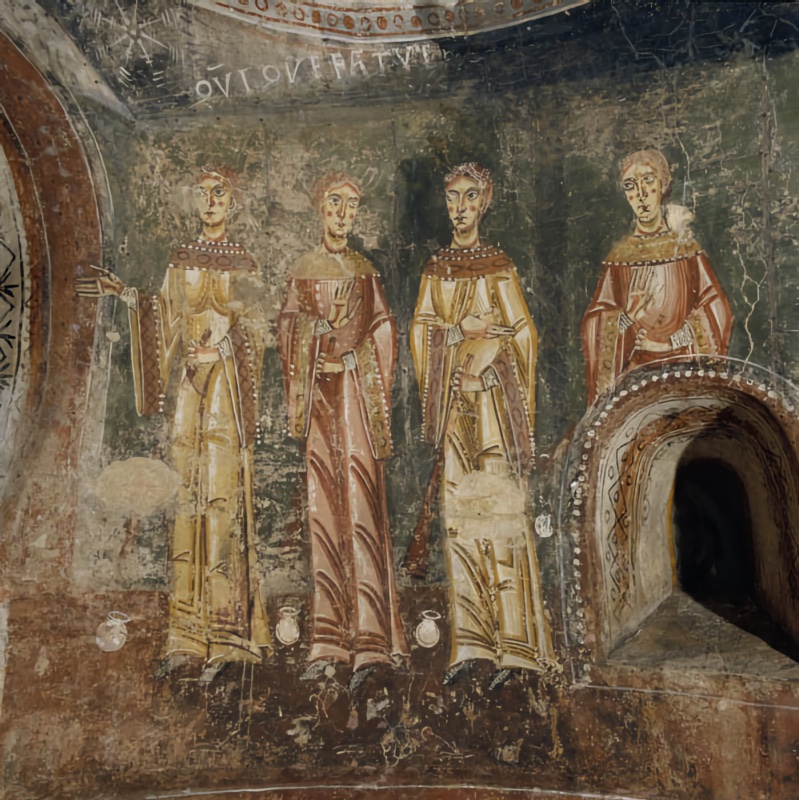
The image depicts a very solemn and stylized Romanesque scene, featuring female figures in frontal poses, arranged within an apse niche and organized in a symmetrical pattern. The colors are vivid yet subdued, with a predominance of reds, ochres, blues, and blacks, and the composition retains the solemn character typical of 12th-century Catalan painting.
The figures appear elongated, with schematic faces and restrained gestures, more symbolic than narrative. The robes fall in linear, decorative folds, while the ornamental borders and Greek or pseudo-Greek inscriptions reinforce the impression of an archaic and cultured pictorial language.
The work belongs to the tradition of the so-called Master of Pedret or his circle, and displays a taste for frontal composition, compositional order, and a certain solemn monumentality. The painting is a fresco transferred to canvas, now in the Museu Nacional d’Art de Catalunya in Barcelona, and is dated to between the late 11th and early 12th centuries.
The scene is often linked to the parable of the Wise and Foolish Virgins, although in this preserved fragment the iconographic identification is not always immediately apparent at first glance. In any case, the emphasis lies less on the narrative and more on the representation of a sacred presence, in keeping with a sensibility typical of the Romanesque period.
Mural decoration of the central apse: The Apocalypse
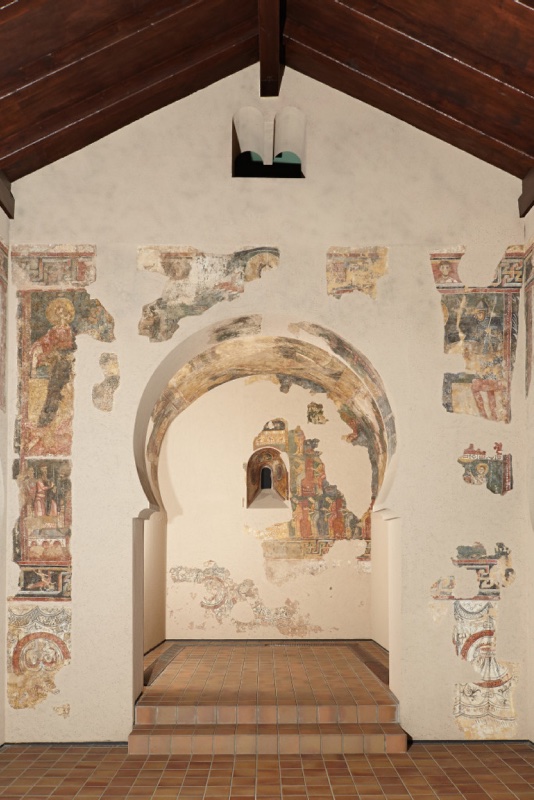
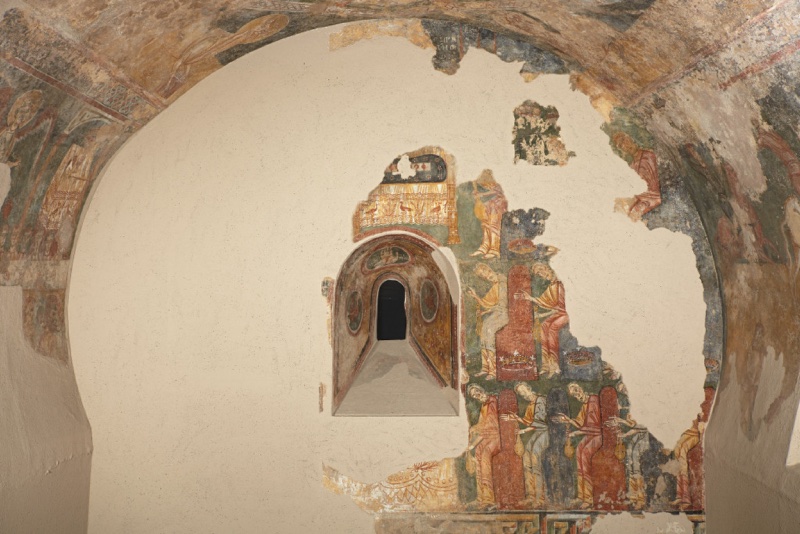
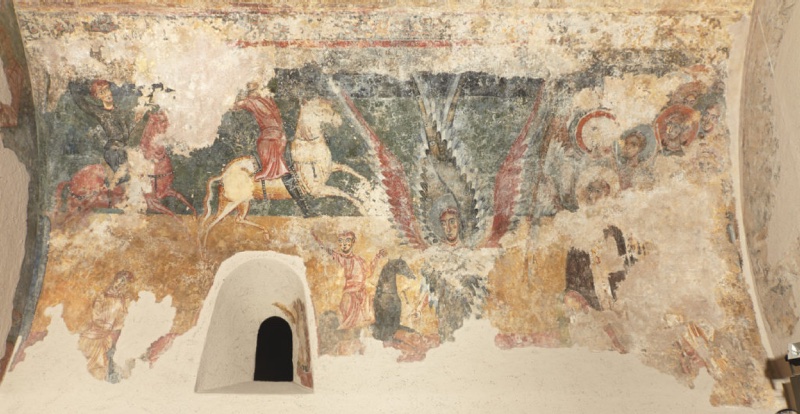
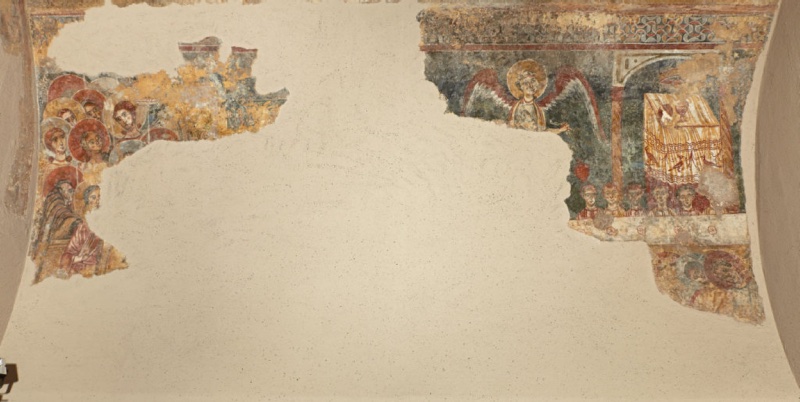
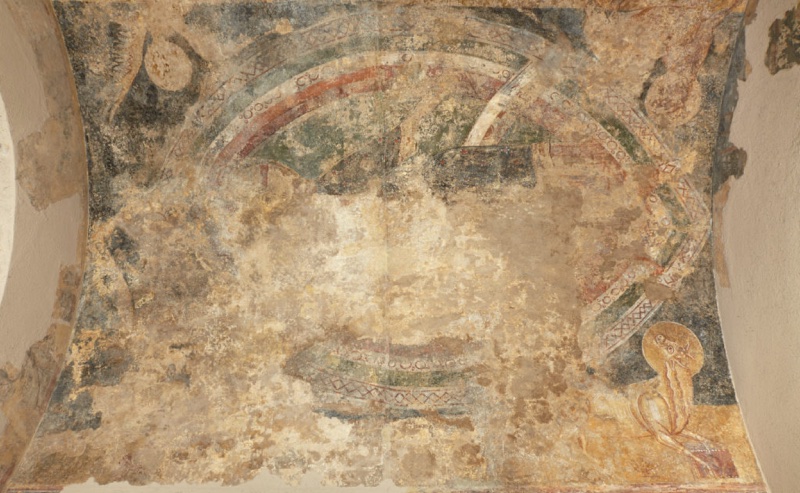
The work is organized into a continuous narrative cycle illustrating episodes from the Book of Revelation, with a hierarchical arrangement typical of the Romanesque style: Christ in the central mandorla dominates the scene, surrounded by angels, the four living creatures, and the twenty-four elders, while apocalyptic visions such as the seven seals, the trumpets, and the beasts unfold on either side. The figures are stylized, with slender bodies and solemn faces, framed by arches and geometric mandorlas that create a rhythmic and symmetrical pattern, emphasizing divine order against eschatological chaos.
Depth is absent, replaced by an absolute frontal perspective that projects the viewer into an eternal liturgical time; the colors, though faded from the transfer, retain earthy tones (ochre, Pompeian reds, olive greens) with golden and black accents for the outlines, evoking the Lombard and Byzantine traditions filtered through Mozarabic influences.
At the center stands the figure of Christ the Judge, blessing with his right hand and holding the sealed book with his left, surrounded by the Gospel symbols (lion, bull, eagle, angel) that symbolize cosmic totality. On the lower registers, dynamic scenes emerge: John the Evangelist receives a revelation from an angel; the horsemen of the Apocalypse gallop with swords and scales; while the Woman clothed with the sun flees into the desert, pursued by the dragon.
This interpretation is not merely narrative but didactic, intended for an illiterate monastic or parish audience, where every symbol (the beast from the sea, Babylon the Great) warns against sin and promises God’s final victory.
Executed in true fresco, the painting uses lime for deep adhesion to the wall, with dry details for inscriptions and chrysography (gold lettering on a dark background), revealing a mastery of volumetric modeling despite the stylistic abstraction. Attributed to the Master of Pedret—an anonymous painter active between the late 11th and early 12th centuries—it reflects a cultural syncretism: echoes of Carolingian painting, Lombard influences, and an emphasis on apocalyptic iconography common in Hispanic Beatus manuscripts, such as those from Liébana.
The work, removed from the church of Pedret (Cercs, Berguedà) and restored, bears witness to the role of Catalan apses as “Bibles of the poor,” where the wall becomes a screen for eschatological liturgy.
The Virgin and Child in Majesty and the Adoration of the Magi
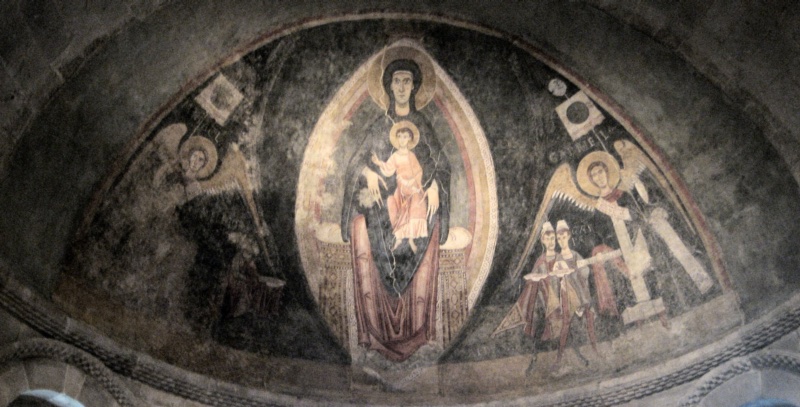
The fresco cycle originally adorning the apse of the monastic church of Santa Maria de Cap d’Aran near Tredòs in the Vall d’Aran was detached in the early twentieth century and subsequently acquired by the Metropolitan Museum of Art in New York, where it was installed as a centrepiece of the medieval collection at The Cloisters. The composition of the hemicycle is organized around the majestic figure of the Theotokos — the Virgin and Child in Majesty — enthroned at the summit of the apse in a position that, in most Romanesque programmes, would have been occupied by Christ Pantocrator, a choice that reflects the strong Marian devotional culture of the Pyrenean monasteries that patronized the workshop.
Flanking the enthroned Virgin and Child are the three Magi, shown approaching from the viewer’s left with offerings and wearing distinctive conical headgear of a type also encountered at Saint-Lizier, providing one of the clearest formal connections between the two sites and strengthening the hypothesis of a single workshop’s involvement in both commissions. The Magi are in turn accompanied by the Archangels Michael and Gabriel, each bearing a standard and a scroll inscribed with the names Peticius and Postulacius — unusual designations not found in standard angelological texts that may reflect a local devotional tradition specific to the Aran valley.
In the cylinder of the apse below the hemicycle, fragmentary remains of figures identifiable as Saints Peter and Paul survive, while the triumphal arch preserves a circular medallion bearing the image of the Holy Spirit and the figures of the Milanese martyrs Gervase and Protase, whose presence in this remote Pyrenean monastery constitutes one of the strongest arguments for the Lombard provenance of the workshop.
Epiphany of Christ
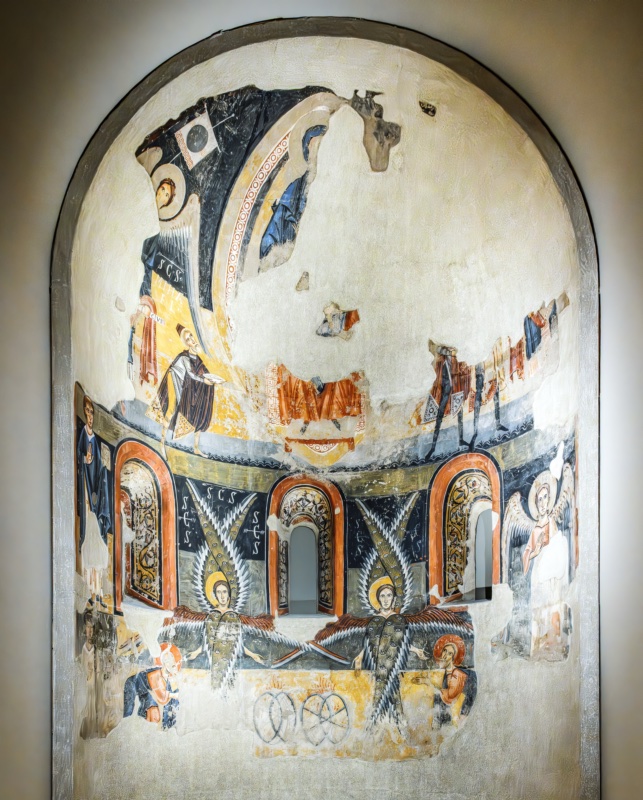
The frescoes that originally decorated the central apse of the three-naved church of Santa Maria d’Àneu, in the upper Noguera Pallaresa valley, were removed and transferred to the Museu Nacional d’Art de Catalunya in Barcelona during the great campaign of rescue and preservation organized by the Junta de Museus between 1919 and 1923. The frescoes employ the traditional dry fresco technique, enriched with tempera highlights to create effects of relief and brilliance. The color palette is vast and sophisticated: carmine, cinnabar, red and yellow ochre, sienna, blue, black, and white, often mixed to achieve harmonious tones and depth. The imposing dimensions envelop the entire apse basin and the cylinder, creating a visual immersion for the faithful during the liturgy.
The apse basin is dominated by the Epiphany, with Christ in Majesty between the archangels Michael and Gabriel, symbolizing divine revelation. The cylindrical body of the apse unfolds an extraordinary visionary sequence directly inspired by the prophetic books of the Old Testament: two spinning wheels of fire (the ophanim of Ezekiel), two six-winged Seraphim whose feathers are covered with eyes, and the purification of the lips of two prophets — one certainly identifiable as Isaiah, the other possibly Ezekiel — with burning coals taken from the heavenly altar.
This programme, which has no precise iconographic parallel in surviving Romanesque painting and which presupposes familiarity with the full visionary tradition of Old Testament prophecy, points to the involvement of a learned ecclesiastical advisor capable of formulating an ambitious theological programme that the master then translated into visual form. At the lateral extremities of the apsidal cylinder, an archangel on the right and two unidentified clerics on the left, each bearing a book, complete the composition with a note of ecclesiastical decorum that counterbalances the intense visionary quality of the central imagery.
Apostles from Àger: Thaddeus and James
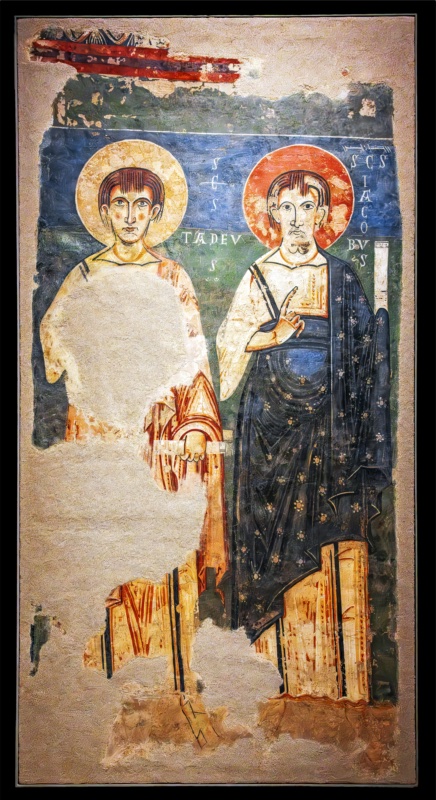
The fragmentary but extremely fine painted remains preserved from the collegiate church of Sant Pere d’Àger, the foundation of the Catalan nobleman Arnau Mir de Tost, are today housed at the Museu Nacional d’Art de Catalunya in Barcelona and represent the most historically documented of all the sites associated with the master’s activity. Of the original apsidal decoration, which must have been among the grandest of all the programmes executed by the workshop given the architectural ambition of the collegiate building, only a representation of the Apostles Thaddeus and James has survived in a condition adequate for stylistic analysis. The two apostles are presented in a standing, frontal posture of hieratic authority, rendered with a formal grandeur and a quality of facial characterization that belong unmistakably to the master’s own hand rather than to a workshop assistant, suggesting that this commission received the personal attention of the leading artist.
The faces of the two figures are among the most compelling in the entire Pedret corpus: beneath their massive halos, the apostles gaze outward with an expression that combines the impersonal solemnity of the Byzantine icon with a degree of individual psychological presence that is distinctly the master’s own contribution. The choice of Thaddeus and James as the principal figures of the apsidal programme, in a church founded by a warrior-nobleman active in the front line of the Reconquista, may carry specific devotional connotations related to the cult of Saint James of Compostela and to the apostolic legitimization of the Christian military enterprise in Spain.
Christy in Majesty (Pantocrator)
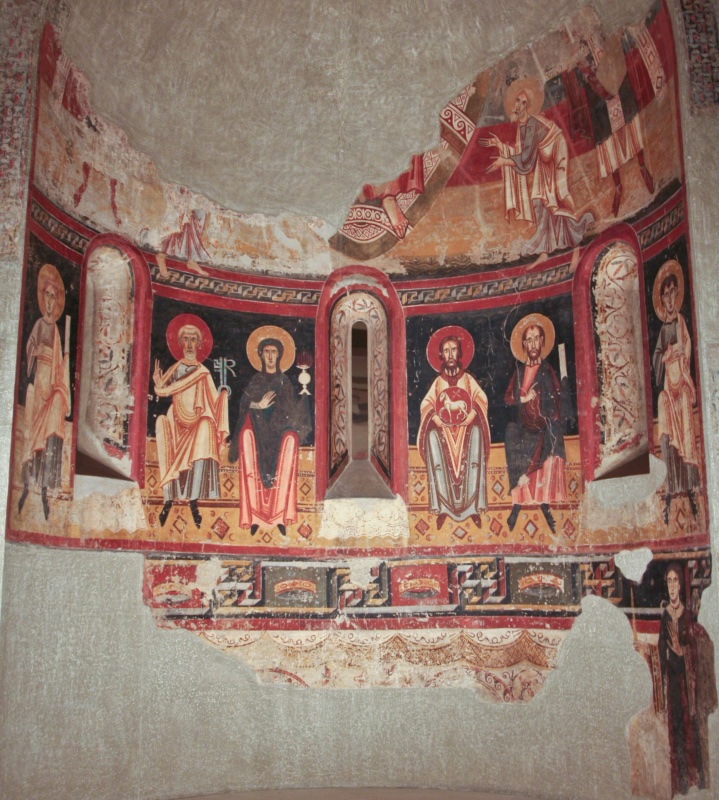
The paintings at Sant Pere de Burgal are generally dated after 1095, a time when the Master of Pedret had already reached full artistic maturity and was working in close connection with other cycles in the Àneu region and the Berguedà-Pallars area. This context reflects the widespread circulation of iconographic models and Lombard and Provençal influences within the Catalan Pyrenean valleys, with a particular focus on Gregorian liturgy and visual theology.
Originally, the paintings decorated the central three-nave apse of the priory of Sant Pere de Burgal, which still retained, in part, a wooden roof and the appearance of a small monastic foundation. Today, at the MNAC, the cycle has been reassembled in the form of a “circle” or ring of walls, with the apse vault at the center, where a large figure of the Pantocrator appears within a mandorla, surrounded by scenes of the Seated Virgin, prophets, saints, and patrons.
The theological fulcrum of the cycle is the transcendent presence of Christ, embodied by the Pantocrator in a mandorla dominating the vault, with the rigorous and frontal majesty typical of Pyrenean Romanesque painting. On either side appear prophets and, in some fragments, archangels, while the lower band of the apse features a procession of saints and ecclesiastical figures, with the seated Virgin and various apostles and saints, including Saint Peter, Saint Paul, Saint John the Baptist, and others.
A particularly interesting element is the presence, in some panels, of Countess Lucia, the historical patron, depicted as an offerer holding a candle, in a devout posture before the Virgin or Christ—a clear indication of the cycle’s memorial and votive function.
The Master of Pedret employs a true fresco technique, with layers of tempera in the highlights and details, and a wide range of pigments: cinnabar, carmine, red and yellow ochre, sienna, blue (local aerite), black, and lime white. This use of color creates a very vivid, almost “theatrical” image, with strong contrasts between human skin, garments, and halos, and great attention to the rhythm of the contours and the synthesis of the forms.
The figures are monumental and frontal, gazing directly at the viewer, yet the Master incorporates touches of expressive realism: intense faces, marked hand gestures, and folds in the garments that suggest a certain sense of physical solidity. In certain details (such as the crowns or symbolic attributes), references to Lombard models can be observed, for example the Iron Crown of Monza, which leads many scholars to suppose a direct familiarity with the art of northern Italy or even an itinerant origin for the artist.
The program at Sant Pere de Burgal serves as a visual compendium of Christian theology, with Christ Pantocrator at the top, the Virgin and the saints on the middle level, and the commissioning prophets at the bottom, in a sort of hierarchy linking heaven, the church, and the monastic/lay community. Many elements—such as the wheels of fire, the eyed seraphim, and the prophets purified by embers—evoke an iconography inspired by prophetic and apocalyptic texts, emphasizing spiritual purification and the centrality of the revealed Word.
In the context of a small abbey community along the Noguera de Ribagorça river, the Sant Pere de Burgal cycle is not merely decoration, but a tool for visual theological education, for reinforcing ecclesiastical authority, and for celebrating the memory of the founders and patrons.
The Sant Pere de Burgal cycle is considered one of the central points in defining the “Master of Pedret” as a critical convention, alongside the frescoes of Santa Maria d’Àneu, Sant Quirze de Pedret, and Sant Pere d’Àger. Precisely for this reason, the fragments from Burgal on display at the MNAC constitute a sort of key to understanding the circulation of Lombard models, the unity of the figurative language of the Pyrenees, and the echo of a monastic culture deeply rooted in Gregorian theology.
-
Arnau Mir de Tost (c. 1000 – after 1072) was a Catalan nobleman from the County of Urgell, Lord of Llordà and Viscount of Àger, and a key figure in the Reconquista of the eleventh century. Born around 1000 in Tost, in Alto Urgell, he was orphaned at a young age and taken in by the court of Count Ermengol II. His father Miró, lord of Tost Castle, died fighting the Arabs when Arnau was still a minor. In 1031 he married Arsenda, with whom he purchased the rights to Llordà Castle from the count, a fortified base on the border with the Caliphate of Córdoba that he expanded into an offensive outpost. From Llordà he conquered the Conca Dellà, pushing the frontier of Urgell as far as Montsec, and in 1034 successfully stormed the alcazaba of Àger, a key point in the Andalusian defensive system (the Tagr). Despite Muslim counteroffensives in 1041 and 1048, he definitively reconquered Àger in 1047, becoming viscount and assuming responsibility for repopulating the devastated frontier territory. At the height of his power he controlled over thirty castles and agricultural settlements, extending his domains from Solsonès to the upper Noguera, the western Montsec, and the Sió valley. He also served the Count of Barcelona, Ramon Berenguer I, in the conquest of Camarasa and Cubells, and supported the Barbastro Crusade of 1064. Following the death of Ermengol III in 1066 while defending Barbastro, Arnau assumed the regency of Urgell for the young Ermengol IV. He managed a primitive chancellery with the scribe Vidal, introducing the convenientia (contractual agreement) into western Catalonia, and negotiated successfully with the Holy See: through Arsenda's donations, Pope Nicholas II granted the canonry of Àger independence from the bishops of Urgell. He founded and fortified the collegiate church of Sant Pere d'Àger, which survives on a hill above the town. From his marriage to Arsenda two daughters survived to adulthood: Valença, married in 1055 to Ramon V of Pallars Jussà, and Letgarda, married in 1067 to Ponç Guerau of Cabrera, Viscount of Girona, who inherited the viscounty of Àger; his sons died prematurely. His will of 1072 mentions ninety-six chess pieces of rock crystal in an abstract Islamic style — the oldest known in Europe — inherited from Arsenda in 1068, a testament to cross-border cultural exchange. He made a pilgrimage to Santiago de Compostela and perhaps also to the Holy Land. He died after 1072; a monument commemorates him at Foradada near Montsonís.
↩ -
Artau I (Latin: Artallus or Artaldus; Catalan: Artau; Spanish: Artal or Artallo; d. 1081 or 1082) was Count of Pallars Sobirà from 1049 until his death, the second son of Count William II of Pallars Sobirà and Stephanie, daughter of Ermengol I of Urgell. He succeeded his older brother Bernard II, who died without heirs in 1049. Before September 1050 he married Constance, with whom he had Artau II (his heir), Ot (future Bishop of Urgell), and William. Around 1057–1058, following the death of Constance, he married Lucía of La Marche, sister of Almodis de la Marche and endowed her with four castles in addition to her dowry. His reign was dominated by conflicts with his cousin Raymond IV of Pallars Jussà over control of castles and lands along the Noguera Pallaresa; to strengthen his defensive and offensive capacity he built the fortresses of Montcortés, Peramea, Bresca, and Baén. Relations with Raymond were regulated through a series of convenientiae: in 1064 Artau ceded a castle as collateral for future negotiations; in 1067 a further agreement involved the monastery of Santa Maria de Lavaix and surrounding villages; around 1080 additional agreements mediated by Sancho Ramírez of Aragon assigned Talarn and Salás to local magnates on either side of the river. He also had tensions with Ermengol III of Urgell and Arnau Mir de Tost, resolved through agreements regarding Salás, Llimiana, and Mur between 1052 and 1054. As a patron of the monastery of Santa Maria de Gerri he made donations in 1050, 1059, 1068, and 1070, in which year he also founded the sacristy of Gerri with Abbot Arnau. He died between 1081 and 1082; Artau II assumed the title as early as 1080 and co-ruled with his mother Lucía until approximately 1115.
↩