Roger of Helmarshausen
Roger of Helmarshausen stands as one of the most remarkable figures in the artistic culture of the twelfth-century Holy Roman Empire, combining in his single person the roles of Benedictine monk, master metalworker, and systematic theorist of the applied arts. Born around 1070, most likely in the cultural orbit of the Meuse valley, he carried forward the rich technical legacy of Mosan goldsmithing and transformed it through contact with Rhenish and Saxon monastic networks. His career, centred primarily on the abbey of Helmarshausen in Saxony, produced portable altars of extraordinary refinement that remain benchmarks of Romanesque ecclesiastical metalwork. Equally significant is his probable authorship of the De diversis artibus, a systematic treatise on the crafts of painting, glasswork, and metalwork that represents the most comprehensive technical manual to survive from the medieval period. Through both his objects and his writings, Roger articulated a vision of the craftsman as theologian and of manual skill as a form of spiritual service, shaping the intellectual self-understanding of medieval artisans for centuries.
Family background
The precise biographical details of Roger of Helmarshausen’s family remain beyond documentary recovery, a circumstance common to nearly all medieval craftsmen who left no notarial records and whose lives are reconstructable only through the objects they produced. The name Rogerus situates him within the Germanic cultural sphere of the late eleventh century, suggesting a family that was Latinophile in its ecclesiastical orientation while Germanic or Francophone in its vernacular identity. Scholarly consensus, informed by the affiliations implied both by his workshop connections and by the internal evidence of his treatise, places his origins broadly in the cultural arc stretching from the Meuse valley westward into the Lower Rhine and Westphalia. The Meuse region was among the most economically and culturally dynamic zones of the Holy Roman Empire in the eleventh century, its prosperity built on the navigational advantages of the river and on the patronage of a dense network of episcopal sees and wealthy abbeys. It is in this environment that Roger’s earliest formation would have taken place, whether within a monastic school directly or in the orbit of a craftsman’s family that maintained close ties to ecclesiastical institutions. Entrance into a Benedictine house at a relatively early age was not unusual for the sons of free craftsmen or minor holders of land who recognized the monastery as the surest path to education and professional advancement. While nothing is known of his parents’ names or occupations, the sophistication of his Latin prose in the De diversis artibus implies an education of considerable rigour, consistent with training in a major Benedictine scriptorium rather than a village parish school. The dedication of his treatise, in which he presents himself as a humble monk sincerely concerned with the spiritual value of the crafts, reflects a monastic personality fully formed by the rhythms of Benedictine life and shaped by patristic reading and liturgical immersion. In the absence of genealogical documentation, the family of Roger of Helmarshausen must be understood primarily as an intellectual and institutional family—the community of monks, teachers, and fellow craftsmen who collectively constituted his formative world. This social and cultural matrix, rather than any traceable line of biological descent, was the true inheritance that shaped his identity as an artist and thinker.
Roger’s entry into monastic life most likely occurred during childhood or early adolescence, as was customary within the Benedictine tradition, which accepted oblates—boys offered to the monastery by their families—as a normal component of community formation. The De diversis artibus reveals a man immersed in patristic literature, acquainted with the writings of Augustine, Gregory the Great, and Origen, an erudition that could only have been achieved through sustained study within a well-stocked monastic library. His early training as an illuminator, which internal evidence of the first book of the treatise strongly suggests, would have been conducted under the supervision of a monastic master who combined instruction in letters with instruction in the preparation of pigments and the ruling of parchment. The monastery in which this formation took place remains a matter of scholarly debate; the most persuasive hypothesis, advanced by Dodwell and others, connects Roger’s early career to Stavelot Abbey in the Ardennes, one of the great imperial abbeys of the Meuse-Rhineland zone. At Stavelot, Roger would have been integrated into a community whose spiritual and intellectual life was inseparably bound to the production of liturgical objects of the highest quality, reinforcing the theological framework that underpins his later treatise. The De diversis artibus preface invokes the biblical figure of Bezalel, the craftsman divinely appointed to furnish the Tabernacle, and this typological self-positioning reflects the profound integration of artistic vocation and religious identity that monastic formation had instilled. Within this institutional family, friendships and mentorships formed the affective bonds that sustained creative development; Roger almost certainly worked as junior collaborator under a master goldsmith before assuming independent direction of workshop projects. The collective character of monastic artistic production means that the “family” most relevant to understanding Roger is not biological but institutional—a brotherhood defined by shared rule, shared liturgical practice, and shared technical inheritance. The Benedictine principle of ora et labora, prayer and work, was not merely a regulative formula for Roger but the structural logic of his art, in which manual craft was understood as itself a form of prayer and each technical operation bore a potential spiritual significance. This understanding of labour as sanctified activity would prove the generative premise of the De diversis artibus, lending his technical instructions a moral and theological resonance that distinguishes them from all earlier craft manuals.
Within the monastic workshop environment, Roger’s closest relationships were those forged with fellow craftsmen who shared his technical expertise and spiritual formation, relationships that were legally and spiritually those of brothers rather than merely professional colleagues. The collaborative nature of medieval ecclesiastical metalwork meant that no single object was the product of a solitary genius; portable altars, shrines, and gospel covers emerged from coordinated labour in which specialists in enamelling, engraving, casting, and assembly worked under a directing master. Roger’s probable role as that directing master at Helmarshausen is suggested by the consistency of style across a group of objects attributed to the abbey, a consistency that implies central artistic supervision rather than parallel individual efforts. The craftsmen who worked alongside him would have been monks of varying seniority and technical specialization, forming a workshop community whose internal hierarchies mirrored those of the monastery itself and whose collective output reflected the accumulated knowledge of several generations. The De diversis artibus itself can be read as a form of fraternal instruction, written not for an abstract future readership but for the practical guidance of the very brothers and apprentices who shared Roger’s workshop and who needed systematic access to the techniques he had mastered. In addressing his treatise to a “brother,” Roger articulates a vision of craft transmission as an act of charity within the monastic community, offering his accumulated knowledge as a gift that mirrors the divine generosity celebrated in the theological prefaces to each of its three books. The concept of fraternal charity that governs the social world of the Benedictine monastery thus permeates Roger’s professional relationships, giving them a moral texture that biographical accounts focused exclusively on technical achievement tend to overlook. Among the brothers closest to Roger in the workshop context, we might imagine specialists in cloisonné and champlevé enamel, men who had trained in the Mosan tradition and who brought to Helmarshausen techniques that Roger then integrated into his own distinctive synthesis. The transmission of technical knowledge within this fraternal community also implies a pedagogy of close observation and graduated responsibility, in which younger brothers were entrusted with preparatory tasks before being allowed to execute the more demanding elements of a commission. Roger’s legacy within Helmarshausen was therefore both artistic and pedagogical, shaping not only the objects produced during his lifetime but the technical capacities and aesthetic standards of the generation that succeeded him.
The social fabric of early twelfth-century Helmarshausen was shaped by the abbey’s status as an imperial foundation with strong connections to the Saxon aristocracy, giving the monastic community a social character that mixed learned clergy and artisanally skilled monks from diverse regional and social origins. Within this milieu, Roger occupied a position of considerable prestige, his reputation as a goldsmith conferring on him a visibility within ecclesiastical networks that extended far beyond the local community and brought external commissions that reflected well on the institution as a whole. The relationship between a celebrated craftsman-monk and his abbot was one of the characteristic social bonds within the monastery; the abbot served simultaneously as spiritual father, institutional superior, and intermediary patron, negotiating commissions with external clients and ensuring that the workshop’s output aligned with the community’s spiritual mission. Roger’s own relationship with the successive abbots of Helmarshausen is undocumented in detail, but the continued investment of the community in his workshop implies sustained institutional support that would have required abbatial confidence in his reliability as well as his artistry. Beyond the immediate monastic community, the social network within which Roger functioned included canons of cathedral chapters, episcopal dignitaries, and members of the Saxon nobility who supported ecclesiastical institutions and gave commissions to their workshops. The patronage relationships that brought Roger commissions from Paderborn Cathedral were mediated through precisely such social bonds, linking the monastic craftsman to the episcopal hierarchy through a network of mutual obligations and shared spiritual purpose. The lay brothers and servants who assisted in the practical aspects of workshop production—stoking furnaces, preparing raw metals, maintaining tools—formed the lower stratum of Roger’s working environment and remind us that even the most spiritually elevated craft production rested on a foundation of unglamorous physical labour. The market networks through which Helmarshausen obtained precious metals, gemstones, and coloured glass included merchants from the Rhenish and Moselle valleys, creating economic ties that bound the monastic community to wider commercial circuits and occasionally brought Roger into indirect contact with the cosmopolitan culture of trading centres. These contacts, though often invisible in the monastic record, provided conduits for the importation of materials and artistic influences that enriched Roger’s technical vocabulary and gave his work its characteristically synthetic quality. Taken together, the various social relationships that constituted Roger’s world—fraternal, abbatial, episcopal, commercial—formed a dense network of obligation and exchange that was, for all practical purposes, the family within which his artistic identity was formed and sustained.
The institutional family formed by Helmarshausen Abbey left a legacy that extended well beyond Roger’s own lifetime, as the technical and aesthetic traditions he established continued to shape the abbey’s artistic production throughout the twelfth century and into the thirteenth. The Evangeliar Heinrichs des Löwen (Gospel Book of Henry the Lion), executed at Helmarshausen between 1175 and 1188, attests to the extraordinary vitality of the illumination tradition that Roger had helped to develop, demonstrating how craft knowledge transmitted within a monastic family could generate increasingly refined achievements across successive generations. This multigenerational transmission of artistic skill and aesthetic standards represents one of the most distinctive features of medieval monastic culture, in which the institutional continuity of the abbey provided a stable framework for the accumulation and refinement of technical knowledge over time scales impossible in commercial workshops.
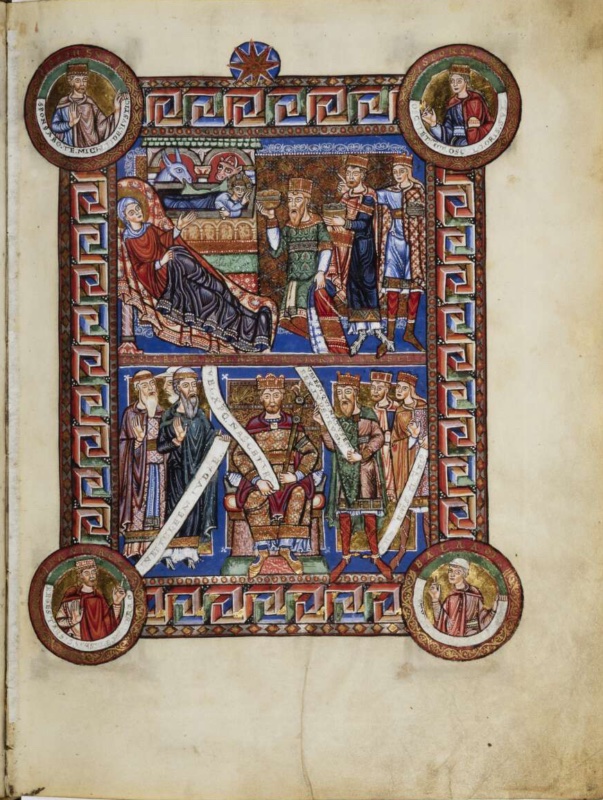
Roger’s own contribution to this process was both direct, through his personal teaching and the objects he produced, and indirect, through the De diversis artibus, which provided a written codification of technical knowledge that could be consulted by craftsmen who had never met its author. The treatise’s widespread circulation throughout medieval Europe means that Roger’s institutional family ultimately extended to every scriptorium and goldsmith’s workshop where his text was read and applied, a virtual community of practitioners united by engagement with his written teaching. The concept of family in Roger’s world was therefore simultaneously biological (in its absence), institutional (in its monastic form), professional (through workshop relationships), and textual (through the community of readers constituted by his treatise), a multiplicity that modern biographical categories tend to flatten into a single register. The enduring influence of Helmarshausen as an artistic centre in the twelfth century reflects the strength of the institutional structures Roger helped to create and the quality of the human relationships he sustained within his monastic community. That the abbey attracted a commission as prestigious as the Gospel Book of Henry the Lion more than half a century after Roger’s death testifies to the reputation he had established and the standards he had set, which continued to recommend Helmarshausen to discerning patrons long after his own hand had ceased to work. The family Roger built was therefore, in the most meaningful sense available to a celibate monastic craftsman, an artistic dynasty—a lineage of skill and vision transmitted not through blood but through teaching, example, and the accumulated authority of a distinguished workshop tradition. It is this institutional family, imperfectly documented and yet unmistakably present in the evidence of the objects themselves, that constitutes the most important biographical context for understanding the life and work of Roger of Helmarshausen.
Patronage
The patronage relationships that defined and sustained Roger of Helmarshausen’s artistic career were rooted in the complex institutional structures of the Benedictine reform movement and the political culture of the Salian and early Hohenstaufen Empire, which regarded ecclesiastical art as an instrument of both spiritual edification and dynastic prestige. Roger’s probable formation at Stavelot Abbey placed him within a patronage environment of exceptional quality, as Stavelot was an imperial abbey whose endowments and connections gave its workshop access to the finest materials and the most ambitious commissions available in the Meuse-Rhineland zone. Imperial abbeys like Stavelot occupied a unique position in the patronage hierarchy of the medieval church, owing their allegiance directly to the emperor rather than to local bishops, which gave them a degree of institutional autonomy that fostered artistic experimentation and the maintenance of high technical standards. The abbots of such institutions acted as de facto patrons of the arts within their houses, directing the creative energies of their craftsman-monks toward projects that served both the liturgical needs of the community and the broader devotional purposes of the imperial network of which they formed part. Roger’s early development within this environment gave him an understanding of patronage as a structured relationship in which the artist served not merely an individual client but an institutional mission that encompassed liturgical use, theological expression, and the projection of ecclesiastical authority. The commissions he would later receive from episcopal and ducal patrons were shaped by this foundational understanding, which disposed him to approach each work as a contribution to a larger devotional programme rather than as an isolated aesthetic achievement. The material resources available at Stavelot—gold, silver, coloured glass, and high-quality enamels imported through Meuse trade networks—provided Roger with experience of working at the highest material register, a training whose effects are visible in the technical ambition of the works subsequently attributed to him at Helmarshausen. The political context of Mosan patronage in the late eleventh century was shaped by the ongoing Investiture Controversy, which heightened the symbolic importance of ecclesiastical art as a marker of institutional identity and theological position, lending commissions a polemical dimension beyond their immediately devotional function. Roger’s sensitivity to this political context is evident in the iconographic choices visible in his mature works, which consistently foreground the spiritual authority of the Church and the sanctifying power of liturgical objects in ways that align with the reform agenda of his institutional patrons. The Stavelot period thus established the template for all of Roger’s subsequent patronage relationships: an artist of high technical reputation serving ambitious institutional clients within a network of shared religious and political values.
Roger’s period of activity at the monastery of St. Pantaleon in Cologne, datable to approximately 1100–1107, brought him into contact with a markedly different patronage environment—the sophisticated world of Rhenish cathedral and collegiate patronage that centred on the archbishopric of Cologne. Cologne was in the early twelfth century the most important ecclesiastical centre of the Holy Roman Empire north of the Alps, its archbishops exercising metropolitan authority over a vast territory and maintaining direct connections with both the imperial court and the papacy. The artistic commissions issued under archiepiscopal patronage in Cologne were correspondingly ambitious, demanding the highest levels of technical skill and iconographic sophistication, and the city’s workshops therefore attracted the most capable craftsmen from across the Rhineland and Meuse regions. St. Pantaleon, a royal foundation with strong ties to the Ottonian dynasty, offered Roger a working environment in which the standards of imperial Ottonian art remained a living presence, preserved in the abbey’s collection of earlier luxury objects and sustained by the expectations of its patrons. The commissions Roger received or participated in during this period would have brought him into direct professional contact with the upper echelons of Rhenish ecclesiastical society, including canons, abbots, and possibly archiepiscopal officials whose aesthetic demands he learned to satisfy. This exposure to the Cologne patronage environment broadened Roger’s technical and iconographic range, introducing him to a tradition of large-scale liturgical metalwork—shrines, reliquaries, and altar frontals—that exceeded in ambition the more intimate scale of Mosan portable altars. The Rhineland patrons who commissioned objects from the St. Pantaleon workshop brought to their commissions a visual culture shaped by exposure to Italian and Byzantine importations that circulated through Cologne’s active trade networks, thereby challenging Roger to incorporate a wider range of visual references into his compositional thinking. The relationship between workshop craftsmen and Rhineland patrons was mediated through a sophisticated protocol of negotiation in which iconographic programmes were developed in collaboration with clerical advisors and the material specifications of objects were determined by the liturgical functions they were to serve. Roger’s experience of this collaborative process in Cologne refined his understanding of how the patron’s theological intentions could be translated into visual form without sacrificing the integrity of the craftsman’s technical vision. This reciprocal relationship between patron and artist, in which clerical learning and craft skill were equally indispensable to the achievement of the finished work, became the model for all of his subsequent dealings with ecclesiastical clients and is reflected in the respectful tone of the De diversis artibus prefaces.
The most documentable patronage relationship of Roger’s career connects him with Bishop Henry II of Werl of Paderborn, who commissioned from the Helmarshausen workshop the portable altar of Saints Kilian and Liborius that remains the most securely attributed work in the entire corpus associated with Roger’s name. Henry II of Werl, who occupied the see of Paderborn from 1084 to 1127, was a prelate of considerable political experience and religious ambition, whose sustained efforts to enhance the liturgical furnishings of his cathedral church reflect a sophisticated understanding of the role of artistic patronage in constructing episcopal authority. Paderborn was a see of particular significance within the political geography of Saxony, its cathedral housing the relics of Saint Liborius and enjoying the prestige conferred by its associations with Charlemagne’s missionary campaigns to the Saxons, a historical identity that gave its artistic commissions an aura of dynastic and ecclesiastical legitimacy. The commission of a portable altar dedicated to Saints Kilian and Liborius—the patron saints of Würzburg and Paderborn respectively—reflects Henry’s deliberate cultivation of relic-based patronage networks that bound together different dioceses within a shared devotional identity under his episcopal leadership. The choice of Helmarshausen as the source for this commission indicates that Roger’s reputation had by this point extended well beyond the abbey’s immediate geographical vicinity, reaching the episcopal court at Paderborn through the networks of recommendation and reputation that connected major ecclesiastical institutions across Saxony. The formal relationship between bishop and workshop implied by this commission was one of client and acknowledged specialist, in which the bishop specified the iconographic programme while Roger and his colleagues determined the technical means by which these requirements would be satisfied. The resulting altar demonstrates the success of this collaborative arrangement in producing an object of exceptional quality that served simultaneously as a liturgical instrument, a devotional focus, and a monument to the spiritual ambitions of its patron. A second portable altar from the abbey of Abdinghof in Paderborn, also attributed to the Helmarshausen workshop, further documents the sustained relationship between Roger’s production and the patronage environment of this Saxon bishop’s cathedral city. The multiple connections between Helmarshausen and Paderborn that these commissions imply suggest an ongoing patron-workshop relationship of a kind common in the medieval world, where satisfied clients regularly returned to trusted craftsmen for subsequent commissions rather than seeking novelty elsewhere. Henry II of Werl thus emerges as the most significant named patron in Roger’s career, his commissions providing the material basis for our understanding of what Helmarshausen metalwork at its best looked like and how its distinctive qualities were produced.
Beyond the external episcopal commissions that are most visible in the surviving documentary and material record, Roger’s workshop also served the internal liturgical needs of Helmarshausen Abbey itself, producing objects for the community’s own use that are now largely lost or unidentifiable in museum collections. This internal patronage, exercised collectively by the monastic chapter under abbatial direction, constituted a steady source of commissions that maintained the workshop’s technical expertise between the more prestigious external projects that punctuated Roger’s career. The liturgical life of a major Benedictine abbey demanded a continuous supply of well-made objects—book covers, reliquary containers, portable altars, censers, chalices, and patens—each of which required the kind of skilled labour that Roger’s workshop could provide. The abbot’s role as internal patron gave the workshop a degree of institutional security unusual for medieval craftsmen, ensuring a regular income of commissions that did not depend on the variable favour of external clients and allowed for the long-term planning necessary for ambitious artistic projects. This institutional security is reflected in the confidence and technical ambition of the works attributed to the Helmarshausen workshop, which demonstrate the freedom of craftsmen who could afford to take the time necessary to achieve the highest standard of which they were capable. The abbot’s understanding of the spiritual value of the crafts would have been reinforced by Roger’s own theological reflection on the subject, as expressed in the De diversis artibus prefaces, which articulate a vision of artistic labour as a form of prayer fully consistent with the Benedictine motto of ora et labora. The patronage relationship between Roger and his abbot was therefore not merely economic but theological, grounded in a shared conviction that the creation of beautiful objects for liturgical use was itself a form of worship and a contribution to the spiritual life of the wider community of the faithful. This theological dimension of internal monastic patronage distinguished it fundamentally from the more commercially negotiated commissions represented by the Paderborn altars, giving the objects produced for Helmarshausen’s own use a quality of devotional intimacy perceptible in the character of their workmanship. The internal commissions of the abbey also allowed Roger to experiment with technical innovations that might not have been acceptable to more conservative external patrons, using the community’s own liturgical objects as a testing ground for approaches that could later be deployed in higher-profile commissions. The community of Helmarshausen thus functioned simultaneously as Roger’s institutional home, his primary patron, and his most sympathetic audience, a combination of roles that created conditions uniquely favourable to the sustained creative development visible across the arc of his career.
The patronage networks available to Roger of Helmarshausen extended beyond the ecclesiastical sphere to encompass the lay nobility of Saxony, whose donations to religious institutions and enthusiasm for costly liturgical objects made them an important indirect source of artistic commissions throughout the Romanesque period. While direct evidence of Roger’s personal dealings with Saxon nobles is lacking, the prestigious character of the commissions his workshop received from episcopal clients implies familiarity with the social and aesthetic expectations of the high aristocracy who stood behind many of those clients as donors and intercessors. The portable altar form that Roger developed was particularly well suited to noble patronage, as its intimate scale and portability made it appropriate both for private devotional use and as a gift to a favoured ecclesiastical institution, allowing lay nobles to participate in the liturgical life of the church through the medium of costly donated objects. The Saxon ducal court, which would later commission the Evangeliar Heinrichs des Löwen from Helmarshausen’s scriptorium, was already in Roger’s lifetime a major force in the cultural life of northern Germany, its patronage of ecclesiastical art reflecting the political ambitions of the Welf dynasty within the complex dynamics of imperial politics. Roger’s awareness of this ducal horizon, even if it did not translate into direct commissions during his own career, would have shaped his understanding of the market for luxury ecclesiastical objects and the aesthetic expectations of the most demanding patrons of his era. The networks of noble patronage also provided channels for the distribution of Roger’s workshop’s output beyond the immediate vicinity of Helmarshausen, as objects given by bishops to noble donors or presented as diplomatic gifts circulated across the empire, carrying the reputation of their maker to new audiences. The intersection between monastic and aristocratic patronage cultures in twelfth-century Saxony created a distinctive aesthetic environment in which the highest standards of craftsmanship were demanded and the theological sophistication of iconographic programmes was understood and appreciated by clients capable of recognizing their intellectual content. Roger’s ability to satisfy the expectations of patrons operating in this sophisticated cultural environment reflects his exceptional formation and the breadth of his cultural horizons, which extended from technical workshop knowledge through theological learning to an awareness of the political and social functions that luxury art objects were called upon to perform. The support of lay nobles, though mediated through ecclesiastical institutions rather than expressed as direct personal commissions, thus formed an important structural element of the patronage system within which Roger worked, contributing to the material basis that sustained his workshop and extended his artistic influence. Understanding the full scope of Roger’s patronage therefore requires attention to this layered structure of support in which monks, abbots, bishops, cathedral chapters, and lay nobles all played distinct but interconnected roles within a system whose effective operation depended on the maintenance of trust and reputation across all its levels.
The patronage relationships that Roger had established at Helmarshausen outlasted his personal career, creating an institutional framework within which the abbey’s workshop continued to attract prestigious commissions throughout the second half of the twelfth century. The Evangeliar Heinrichs des Löwen, commissioned by Duke Henry the Lion and his wife Matilda of England around 1173–1175 and completed by 1188, represents the culmination of this institutional legacy, demonstrating how the patronage networks Roger had helped to build could generate commissions of still greater ambition a full generation after his death. The fact that Henry the Lion, the most powerful lay prince of his era in northern Germany, chose to commission this extraordinary manuscript from Helmarshausen rather than from any other scriptorium in the empire is the clearest possible testament to the reputation Roger’s workshop had achieved under his direction. The ducal commission brought Helmarshausen into the orbit of the highest patronage available in the twelfth-century Holy Roman Empire, connecting the abbey’s monastic craftsmen with the cultural ambitions of a dynasty that aspired to compete with imperial prestige in the domain of artistic production. The iconographic complexity of the Gospel Book, which includes an elaborate programme of dedication miniatures celebrating Henry and Matilda as Christian rulers in the tradition of Carolingian royal patronage, reflects a level of engagement with questions of dynastic legitimacy and political theology that Roger had helped to make possible by establishing Helmarshausen’s reputation as a centre of theological as well as artistic sophistication. The commissioning process for the Gospel Book presumably involved extensive negotiation between the ducal court and the abbey, with learned monks advising on the iconographic programme and the workshop masters determining the technical means of realization—precisely the collaborative model of patron-artist relationship that Roger had helped to develop and institutionalize at Helmarshausen. The material resources devoted to the production of the Gospel Book—including gold, silver, precious stones, and the finest quality parchment—reflect the almost unlimited financial patronage that a great secular prince could command, creating conditions for an artistic achievement that no purely ecclesiastical commissioner could have funded. Roger’s own career had prepared Helmarshausen to receive and satisfy precisely this kind of ambitious noble commission, by establishing the technical competencies and institutional reputation that made the abbey credible as a workshop capable of executing the most demanding project available in twelfth-century European art. The patronage legacy of Roger of Helmarshausen thus extends from his own documented commissions from Bishop Henry II of Werl to the extraordinary late twelfth-century achievement of the Henry the Lion Gospel Book, forming a continuous arc of institutional development that he had initiated and whose later developments are inconceivable without his foundational contribution. No assessment of Roger’s place in the history of medieval art can be complete without this long-term view of patronage, which reveals how individual artistic achievement, institutional development, and the cultivation of relationships with discerning clients combined to produce one of the most distinguished artistic traditions in the cultural history of the medieval Holy Roman Empire.
Artistic style
The artistic style of Roger of Helmarshausen is characterized by a synthesis of exquisite technical precision and profound theological intentionality that distinguishes his work from that of all contemporary Romanesque metalworkers and locates him at the intersection of Mosan craftsmanship and emerging Rhenish-Saxon artistic culture. His approach to gold and silver objects is fundamentally architectural in conception, treating the surface of each artefact as a structured field in which figure, ornament, and inscription are organized according to hierarchical principles that reflect the theological order they are intended to embody. The portable altars attributed to his workshop exhibit a consistently high standard of technical execution in which engraved lines are cut with exceptional clarity and regularity, champlevé enamel cells are prepared with geometric precision, and the relationship between polished and worked metal surfaces is calibrated with evident conscious intent. This technical control is not an end in itself but serves a visual rhetoric in which the gleam of gold and the chromatic intensity of enamel are deployed to create effects of sacred splendour appropriate to objects whose function is the celebration of the Eucharist and the veneration of relics. The figures in Roger’s compositions are rendered in a stylized manner that draws on Byzantine models while adapting them to a distinctively Western sensibility—elongated in proportion, frontal in orientation, and clothed in draperies whose linear patterns convey spiritual intensity rather than bodily movement. Faces are characterized by large, symmetrically placed eyes, high foreheads, and small, tightly set mouths, a physiognomic type that reads as an index of contemplative interiority rather than of worldly personality, directing the viewer’s attention toward the spiritual condition the figure embodies rather than toward any specific individual likeness. The handling of hands is particularly distinctive in Roger’s work, as fingers are elongated and articulated with a care that reflects both technical virtuosity and theological attention to gesture as the primary means by which sacred figures communicate their roles and relationships within a divine narrative. The setting of figures within architectural frames—arched niches, colonnaded arcades, and framing bands of inscribed text—creates a spatial ordering that is simultaneously compositional and doctrinal, placing each figure within a hierarchy of Christian significance that the educated viewer would have been able to read as readily as a written text. The integration of Latin inscriptions into the visual field of Roger’s objects is consistently handled with a refinement that reflects his dual identity as calligrapher and metalworker; the letter forms are modelled with the same precision as the figurative elements, and the placement of text participates in the overall compositional rhythm rather than being subordinated to the function of mere identification. This unified treatment of figure, ornament, and inscription as equal participants in a single visual argument reflects a conception of the art object as an integrated theological statement, a vision that Roger articulates explicitly in the De diversis artibus and demonstrates repeatedly in the objects attributed to his hand.
Roger’s handling of metal surfaces reveals a mastery of contrast and texture that is fundamental to the visual effect of his work, exploiting the different optical qualities available within the goldsmith’s repertoire to create surfaces whose complexity rewards sustained contemplation. The opposition between burnished and matted gold surfaces—between areas whose luminosity shifts with the viewing angle and areas of stable, luminous radiance—creates a visual rhythm that animates the object without resorting to high relief, maintaining the calm authority appropriate to liturgical use. The precise control of depth in engraved and niello-inlaid passages allows Roger to achieve gradations of tone within a medium that resists tonal modulation, using the play of light within incised furrows to suggest the volumetric presence of figures whose overall treatment remains essentially linear. The champlevé enamel inserts that punctuate the metal surface function as chromatic accents that intensify the spiritual drama of the figurative compositions, the vivid blues, greens, and whites of the glass frit creating moments of pictorial luminosity within a predominantly metallic visual field. Roger’s enamel palette is relatively restrained compared to that of some contemporary Mosan workshops, favouring a limited range of hues applied with maximum saturation rather than the more varied and optically complex combinations found in, for example, the work of Godefroid de Claire. This restraint reflects an aesthetic preference for unified effects over picturesque variety, consistent with a compositional logic that subordinates individual elements to the hierarchical organization of the whole. The precious and semi-precious stones incorporated into some of the portable altars attributed to his workshop serve both symbolic and optical functions, their translucency or opacity chosen to complement the metallic and enamel elements in ways that enhance the object’s claim to sacred splendour. The inscribed borders that frame the major surfaces of Roger’s objects serve not only as textual and iconographic elements but as visual devices that define and contain the pictorial field, giving each composition a clarity of boundary that reinforces its claim to be understood as a complete and authoritative theological statement. The physical interaction between the object and the liturgical light of the altar environment—candle flame and daylight filtered through stained glass—would have transformed the static surfaces of Roger’s metalwork into dynamic fields of shifting luminosity, lending his compositions an experiential dimension that still photographs inevitably flatten. Understanding Roger’s stylistic achievement therefore requires attention to its performative context, in which the physical properties of his materials collaborated with the conditions of liturgical use to create an experience of sacred beauty inseparable from the act of worship.
Roger’s approach to narrative in his figural compositions displays a remarkable economy of means, reducing scenes from sacred history to their essential participants and gestures while preserving the theological complexity that distinguishes the best medieval religious art from its merely decorative counterparts. The narrative programmes of the portable altars attributed to his workshop draw primarily on New Testament Christology, presenting episodes from the life and Passion of Christ alongside images of those saints to whom the relevant altar is dedicated, creating a doctrinal structure in which historical narrative and hagiographic exemplum reinforce each other. The ordering of figures within these programmes follows a hierarchical rather than a chronological logic, placing the most theologically central figures—Christ in Majesty, the Crucified, the enthroned Virgin—in the most prominent positions and surrounding them with apostles, evangelists, and saints in a disposition that maps the celestial hierarchy onto the physical surface of the object. This hierarchical ordering is not, however, static: the internal dynamic of Roger’s compositions is sustained by the directed gazes and gestures of secondary figures, which draw the viewer’s attention toward the central image and create a visual circulation that keeps the eye moving through the entire compositional field. The treatment of the Crucifixion in Roger’s work exemplifies his approach to narrative concentration: Christ is depicted as the Christus triumphans, erect and open-eyed on the cross, his posture communicating the paradox of the suffering God who triumphs in his death, a theological position that the engraved line and the geometry of the composition sustain with calm authority. The flanking figures of the Virgin and Saint John, whose grief and witness frame the central image, are rendered with a controlled emotional expressiveness in which sorrow is visible in the curvature of the body and the angle of the gaze rather than in exaggerated facial contortion, reflecting a characteristically Romanesque aesthetic of restrained spiritual intensity. Roger’s handling of the iconographic programme of the portable altar as a whole demonstrates his understanding of how different scenes and images could be arranged to create a cumulative theological argument, each element contributing to a coherent meditation on the Redemption that the liturgical use of the object would reinforce and elaborate. The inscription of doctrinal content within the compositional arrangements of his objects—through the placement of tituli, the selection of epistolary texts in borders, and the careful assignment of symbolic attributes—reflects the exegetical habits of mind that his monastic formation had instilled and that the De diversis artibus articulates at the level of explicit theoretical reflection. Roger’s narrative style thus operates simultaneously at a technical level of elegant surface organization and at a theological level of systematic doctrine, the two dimensions inseparably intertwined in a manner that reflects his dual identity as craftsman and monastic scholar. It is precisely this integration of aesthetic beauty and theological content that has led subsequent scholars to identify Roger’s work as among the most fully achieved expressions of the Romanesque ideal of the liturgical art object as a form of sacred writing in precious materials.
One of the most distinctive features of Roger’s figural style is his treatment of drapery, which subordinates the representation of bodily volume to an elaborate system of linear patterning whose decorative energy and theological associations are inseparably combined. The drapery folds in his engraved figures do not, in general, attempt to describe the weight and movement of actual fabric; rather, they deploy a vocabulary of curved, nested, and forked linear patterns that create a sense of spiritual animation independent of any naturalistic reference to physical bodies in motion. This linearism, which has analogues in Ottonian ivory carving and Byzantine manuscript illumination, serves the theological purpose of directing the viewer’s attention to the spiritual condition of the depicted figure rather than to the physical form that the drapery clothes. The control of linear rhythm in Roger’s drapery passages is consistent across his attributed works, suggesting a systematic approach to this element of his compositional vocabulary that was taught and transmitted within the workshop rather than varied according to individual inspiration. The integration of drapery patterns with the overall surface organization of his objects is exemplary in its consistency: the linear rhythms of the drapery contribute to the larger compositional rhythm of each surface panel, creating a coherent visual texture that relates figures to ornamental borders and to each other with a precision that reflects sustained compositional thought. The relationship between the linear handling of drapery and the calligraphic quality of Roger’s inscriptions is no accident: both reflect the same underlying aesthetic preference for disciplined linear precision as the primary vehicle of visual meaning, consistent with a formation in which calligraphic excellence and figurative skill developed together under monastic supervision. In the treatment of larger figures on the main surfaces of his altars, Roger occasionally allows his drapery patterns to take on an intrinsic decorative interest that momentarily competes with the narrative or symbolic function of the figure itself, producing areas of extraordinary visual richness that reward close study independently of their doctrinal significance. This tension between the decorative and the symbolic in Roger’s drapery treatment is one of the productive ambiguities of his style, creating objects that can be appreciated as pure exercises in refined formal organization while simultaneously operating as transparent vehicles for theological content. The influence of Roger’s linear drapery style on subsequent Romanesque metalwork in northern Europe was considerable, contributing to the widespread adoption of similar conventions in Westphalian and Lower Rhenish workshops that remained active into the thirteenth century. The persistence of this influence testifies to the canonical status that Roger’s stylistic achievements acquired within the broader tradition of north European ecclesiastical metalwork, establishing norms of figurative representation whose authority outlasted the specific historical circumstances of their creation.
Alongside his figural achievements, Roger’s contribution to the development of Romanesque ornamental vocabulary deserves particular attention, as the decorative elements of his work—interlaced bands, inhabited vines, geometric filling patterns, and pseudo-kufic borders—display an inventiveness and formal discipline that make them as distinctive as his figurative style. The interlace patterns that appear in border zones and transitional areas of his altars derive ultimately from Insular metalwork and manuscript illumination, filtered through the Carolingian adaptation of these forms and transformed by Roger’s preference for geometric regularity over the more sinuous complexity of Hiberno-Saxon prototypes. The inhabited vine scroll, in which paired animals, birds, and occasionally human figures emerge from curling foliage to create self-contained vignettes within the ornamental field, appears in Roger’s work as a sophisticated compositional device that mediates between purely abstract decoration and the explicitly figurative content of the main panels. These inhabited scroll forms carry symbolic valences in the medieval iconographic tradition—the vine of John 15, the Tree of Jesse, the generative abundance of paradise—that align them with the theological arguments of the figurative programmes they frame, creating a unity of doctrinal content at all levels of the compositional field. Roger’s geometric filling patterns, used to create textured backgrounds in both figural panels and ornamental borders, demonstrate a command of abstract surface organization that recalls the systematic approaches of Carolingian carpet pages while adapting them to the smaller scale and higher material value of goldsmith’s work. The precision required to execute these patterns in metal, where each line must be cut cleanly and irreversibly into the surface, places extreme demands on the craftsman’s concentration and manual control, and Roger’s consistent success in this domain reflects exceptional technical training and extensive practice. The pseudo-kufic ornamental elements that appear in some objects attributed to the Helmarshausen workshop reflect the awareness of Islamic decorative systems that had reached northern Europe through the importation of luxury textiles and through intermediary contact with regions where Christian and Muslim artistic cultures coexisted. The aesthetic appeal of kufic-derived ornament for Christian artists lay partly in its formal beauty and partly in its exotic status, which lent objects that incorporated it an air of cosmopolitan sophistication consistent with the claim to universal cultural authority that the best Romanesque ecclesiastical art aspired to embody. The relationship between figurative and ornamental elements in Roger’s work is governed by a principle of mutual reinforcement in which neither is subordinated to the other: ornament reinforces the doctrinal content of figures by aligning with their symbolic valences, while figures lend theological weight to ornamental passages that might otherwise read as purely decorative. This principle of reciprocal enrichment between figure and ornament, consistently realized in the portable altars attributed to Roger’s workshop, constitutes one of the defining characteristics of his mature style and represents a significant contribution to the development of Romanesque compositional theory.
The De diversis artibus must be considered not only as a practical manual for medieval craftsmen but as a key document for understanding Roger’s own artistic style, in that its explicit discussions of aesthetic choices—of colour, proportion, and the relationship between materials and spiritual effect—articulate the theoretical basis from which his practical work proceeded. The first book of the treatise, devoted to materials and techniques for panel painting and manuscript illumination, reveals a concept of colour that is fundamentally symbolic rather than optical: colours are chosen for their associations with spiritual states and theological categories rather than for their capacity to represent the appearance of physical objects under natural light. The second book, dealing with the art of glass, discusses the creation of windows not merely as a technical problem of cutting and leading coloured glass but as a theological enterprise in which the play of coloured light through solid material becomes a metaphor for the illumination of the human mind by divine wisdom, a conception that directly informs the chromatic choices visible in the enamel work of the altars. The third and most technically detailed book, on metalwork, provides a systematic account of the techniques involved in casting, chasing, engraving, niello inlay, champlevé enamelling, and the setting of stones, offering a level of practical instruction that implies first-hand mastery of all these techniques. The aesthetic preferences expressed in the metalwork book—for precise linear engraving over modelled relief, for restrained chromatic harmony over vivid colour contrast, for the integration of inscriptions into visual designs rather than their relegation to subsidiary positions—correspond closely to the stylistic characteristics observable in the Helmarshausen altars. This concordance between theoretical preference and practical achievement is one of the strongest arguments for the identification of Roger with the author who presents himself as “Theophilus Presbyter” in the prefaces, since it is hard to imagine two different individuals of the same period reaching independently the same synthesis of technical accomplishment and aesthetic sensibility. The theological framework within which Roger discusses the production of art objects—as a form of divine service, as an expression of Solomonic wisdom, as a participation in the creative activity of God—provides the intellectual context within which his stylistic choices became not merely aesthetic preferences but principled theological positions. The restraint and discipline of his ornamental style can be understood in the light of the treatise’s critique of frivolous ornamentation and its insistence that the craftsman’s goal is always the enhancement of devotion rather than the display of virtuosity for its own sake. The De diversis artibus thus confirms and interprets what the altars embody: a vision of sacred beauty as disciplined form in the service of theological content, in which technical mastery and spiritual intentionality are inseparable aspects of the same unified artistic act. Reading the treatise alongside the objects, and the objects alongside the treatise, reveals a coherence between theory and practice that is both intellectually impressive and artistically defining, establishing Roger as among the most self-consciously reflective artistic personalities of the Romanesque period.
Within the broader context of twelfth-century Romanesque metalwork, Roger’s stylistic innovations represent a significant advance in the integration of figural, ornamental, and textual elements within the confined surfaces of portable liturgical objects, establishing compositional solutions that influenced Westphalian and Lower Rhenish workshops for several generations. The particular combination of Mosan technical refinement with a Romanesque figural vocabulary more inflected toward monumental clarity than toward the painterly fluency of the Meuse tradition’s finest manuscript illuminators constitutes the most distinctive aspect of Roger’s stylistic contribution, a synthesis difficult to achieve and not often equalled in subsequent production. His influence on the illuminators of the Helmarshausen scriptorium—visible in the figural style, ornamental vocabulary, and compositional principles of the Gospel Book of Henry the Lion sixty years after his death—demonstrates the capacity of a single master’s stylistic vision to shape institutional production across an extended time span through the transmission of techniques, models, and aesthetic standards. The wider impact of Roger’s innovations on Romanesque metalwork in Saxony and Westphalia is less easily documented but can be inferred from the appearance of similar compositional and ornamental solutions in objects produced at centres whose craftsmen presumably had access to Helmarshausen’s output either directly or through intermediary workshops. Roger’s most enduring stylistic legacy may lie in the demonstration that the portable altar, a relatively modest format compared to the great reliquary shrines of the Meuse tradition, could sustain a programme of iconographic and ornamental complexity equal to any object in the Romanesque repertoire. This elevation of the portable altar to a vehicle of major artistic ambition was one of Roger’s most significant contributions to the development of medieval decorative arts, shaping the expectations of subsequent patrons and craftsmen who worked within this format and extending its possibilities in directions that Roger had first made visible. The technical innovations recorded in the De diversis artibus—including early references to oil painting techniques and detailed accounts of enamel preparation—represent contributions to the broader history of European art that extend beyond the specifically Romanesque context and have implications for understanding the development of later medieval and early Renaissance painting practices. Roger’s role as a technical innovator is therefore as significant as his role as a stylistic one, and the two dimensions of his achievement are mutually reinforcing: technical innovations extended his expressive range, while stylistic ambitions drove the search for new technical solutions. The relatively small number of objects securely attributable to Roger’s own hand, as opposed to his workshop more broadly, reflects the collaborative character of medieval craft production and the difficulty of isolating individual contributions within a tradition that valued collective achievement over individual signature. What the surviving objects clearly demonstrate, however, is a stylistic personality of exceptional coherence and originality, whose integration of formal beauty with theological depth established Helmarshausen as one of the supreme centres of metalwork production in the Romanesque Holy Roman Empire.
Artistic influences
The primary artistic influence on Roger of Helmarshausen was the Mosan tradition of ecclesiastical metalwork and manuscript illumination that had developed in the Meuse valley over the preceding two centuries and that provided the technical foundation and aesthetic framework from which his own innovations departed. Mosan art, associated above all with the workshops of Liège, Namur, Stavelot, and the dependent abbeys of the Ardennes, had reached a zenith of refinement in the late eleventh century, producing liturgical objects—gospel covers, reliquaries, portable altars, and baptismal fonts—of extraordinary technical accomplishment and iconographic sophistication. The technical hallmark of this tradition was champlevé enamel: the technique of excavating cells in a copper or bronze surface and filling them with coloured glass frit before firing, which allowed for the creation of vivid chromatic surfaces whose interaction with the surrounding metal could be controlled with great precision. Roger’s mastery of this technique, evident in the enamel panels of the Paderborn altars, reflects an early formation in a workshop where Mosan enamelling methods were practiced at the highest level, presumably Stavelot or an institution in close contact with the Stavelot tradition. Beyond the purely technical, the Mosan tradition provided Roger with an iconographic vocabulary of Byzantine-influenced figure types, compositional formulae for narrative panels, and a hierarchical approach to the organization of theological content within the visual field that remained fundamental to his mature work throughout his career. The influence of Mosan manuscript illumination, and particularly of the Stavelot Bible and related luxury manuscripts produced in the region in the early twelfth century, can be detected in the figural style of Roger’s metalwork, which shares with these manuscripts an approach to human form characterized by elongated proportions, stylized drapery, and a preference for frontal orientation in the principal figures. The Mosan tradition’s characteristic synthesis of Byzantine figural conventions with Western ornamental preferences—particularly the integration of Carolingian interlace and foliate motifs with Byzantine-derived figure types—informed the synthetic character of Roger’s own style, which achieved a new level of formal integration within a related set of aesthetic parameters. The specific contribution of the Stavelot workshop to Roger’s formation can be inferred from the close stylistic and technical correspondences between objects associated with Stavelot and those attributed to the Helmarshausen workshop, suggesting a direct transmission of models, techniques, and compositional principles between the two institutions. The intellectual culture of Mosan monasticism, with its emphasis on the theological dimensions of artistic production and its cultivation of the craftsman-scholar as an ideal ecclesiastical personality, provided the philosophical framework within which Roger’s synthesis of technical mastery and theological reflection became possible. The Mosan heritage was therefore not simply a technical tool kit for Roger but a comprehensive cultural formation that shaped his understanding of what art was for, what it could achieve, and what demands its production placed on the craftsman’s spiritual as well as technical capacities.
Byzantine artistic influence penetrated the Rhineland and Meuse regions through multiple channels in the eleventh and early twelfth centuries, including imported luxury objects, manuscripts brought to northern Europe by returning pilgrims and diplomats, and the activity of Greek craftsmen who occasionally worked in western courts. The elongated figure type, the stylized treatment of physiognomic features, the use of hierarchical scaling to indicate theological importance rather than spatial position, and the preference for gold grounds that dissolved material space in luminous transcendence—all fundamental characteristics of Roger’s figural style—derive ultimately from Byzantine prototypes progressively absorbed and transformed by Mosan and Rhenish workshops over the preceding two centuries. The iconic, frontally oriented figure of Christ enthroned in Majesty, which appears in various forms on Roger’s altars and in the illustrations of the De diversis artibus, reflects the Pantokrator type of Byzantine monumental art, mediated through a sequence of western adaptations that progressively domesticated its hieratic authority within more intimate, object-scale formats. The influence of Byzantine enamel technique, and particularly of cloisonné enamel—in which thin metal partitions create cells for glass frit on a precious metal base—is visible in the ambition and refinement of Roger’s champlevé work, suggesting that he was aware of Byzantine objects even if he worked primarily within the western champlevé tradition. The interest in surface materiality as a theological metaphor—in which the precious nature of gold and the luminous quality of enamel and gemstones are understood as visible analogues of divine splendour—reflects a Byzantine theological aesthetic absorbed by western craftsmen through contact with liturgical objects and church decoration in a Byzantine mode. Italo-Byzantine art, encountered through the importation of manuscript illuminations and ivory carvings from southern Italy and Sicily, where Norman patrons sustained workshops combining western and eastern artistic traditions, also contributed to the inflection of Roger’s figural style, introducing a slightly warmer and more dynamic treatment of figure types than purer Byzantine models might have encouraged. The iconographic programme of the Anastasis (Harrowing of Hell) and the Maiestas Domini, both standard elements of Byzantine theological art appearing in Roger’s compositional repertoire, were transmitted to northern European workshops through manuscript models that circulated within ecclesiastical networks, ensuring consistency of iconographic tradition across the broad geographical area of western Christianity. Roger’s theoretical engagement with these influences, evident in his discussion of colour symbolism and the spiritual properties of materials in the De diversis artibus, demonstrates that he understood Byzantine aesthetic principles not merely as visual conventions to be imitated but as expressions of a theology of sacred beauty that he had absorbed and made his own. The selective appropriation of Byzantine models that characterizes Roger’s work—taking what served his spiritual and aesthetic purposes and setting aside what did not—reflects the confident cultural intelligence of an artist who knew his own tradition well enough to enrich it without being overwhelmed by admiration for its sources. Byzantine influence in Roger’s work is therefore best understood not as a matter of direct copying but of principled selective engagement, in which eastern aesthetic theology and western craft tradition were synthesized at a level of sophistication that neither purely Byzantine nor purely western tradition could have achieved independently.
The Ottonian artistic tradition, which had dominated the production of luxury ecclesiastical objects in the Holy Roman Empire from the mid-tenth century to the early decades of the eleventh, provided Roger with an immediate and authoritative model of how the ambitions of imperial patronage could be joined to the technical capabilities of monastic workshops in the creation of objects worthy of the highest liturgical functions. Ottonian gospel covers, with their intricate ivory panels and precious-metal frames, manuscript illuminations distinguished by dramatic colour contrasts and bold compositional decisions, and golden crosses and reliquaries of monumental conception established standards of technical and aesthetic achievement against which all subsequent Romanesque liturgical art measured itself. The compositional clarity of Ottonian figural art—its preference for large, clearly differentiated figures set against architecturally organized backgrounds, its use of gold leaf and luminous colour as markers of sacred significance, and its integration of inscriptions as integral compositional elements—left deep traces in Roger’s own approach to surface organization. The relationship between Roger’s work and the Ottonian tradition passed through the intermediate stage of the Cologne School of the late eleventh century, whose ivory and metalwork production preserved and elaborated Ottonian compositional conventions while incorporating new influences from Byzantine and Mosan sources. The period Roger spent at St. Pantaleon in Cologne gave him direct access to Ottonian objects preserved in the treasuries of Cologne’s great churches, providing him with first-hand experience of works that embodied the imperial tradition at its most technically accomplished. The Carolingian tradition, further removed in time but still palpably present in surviving objects and in the architectural monuments that gave those objects their original setting, contributed to Roger’s formation through Ottonian intermediaries and through surviving luxury objects from the Carolingian period housed in major church treasuries. The Carolingian revival of classical figural conventions, which had introduced greater attention to bodily volume and drapery movement into earlier medieval art, left traces in Roger’s work as a slightly greater volumetric presence in his figures and a more consciously architecturalized handling of compositional space. The intellectual culture of the Carolingian Renaissance, with its conviction that the arts served the reform of Christian civilization and its vision of the craftsman as a participant in the divine work of creation—a vision articulated above all in the Libri Carolini—provided philosophical precedents for the theological framework of the De diversis artibus that Roger almost certainly drew upon consciously. The canon of Carolingian and Ottonian works that circulated in Roger’s world as models of aspiration constituted an invisible standard that shaped his own ambitions and those of the patrons who commissioned his work. Roger’s achievement can therefore be understood in part as a creative synthesis of the Carolingian-Ottonian legacy with the Mosan technical tradition, producing a style that honoured the imperial aesthetics of his predecessors while advancing their achievements through new technical refinements and deeper theological reflection.
The close relationship between metalwork and manuscript illumination in the medieval workshop tradition means that Roger’s artistic formation must be considered in relation to the illuminated books produced at Stavelot, Helmarshausen, and related institutions, whose compositional and iconographic conventions interacted continuously with those of the goldsmiths’ workshop. The De diversis artibus makes clear that Roger was himself a practitioner of manuscript illumination as well as of metalwork, discussing techniques of page preparation, pigment mixing, and figure drawing from the perspective of an insider rather than a theoretical observer. The figural style of the Helmarshausen illuminated manuscripts that preceded and followed his active period reflects a consistent aesthetic clearly related to his metalwork, suggesting a common source of visual models and a common set of compositional principles operating across both media. The influence of manuscript illumination on his metalwork is most visible in the compositional structure of his narrative panels, which adopt the framed vignette format characteristic of illustrated manuscripts and organize their figures with the narrative clarity appropriate to a medium designed for sequential reading. The treatment of inscribed text within Roger’s compositional schemes shows the influence of calligraphic traditions specific to manuscript production, with letter forms modelled with a precision and elegance that reflects training in the scriptorium as well as in the goldsmith’s workshop. The iconographic models for Roger’s figurative programmes were transmitted primarily through illustrated manuscripts circulating within networks connecting the major scriptorium centres, providing stable visual references for scenes from sacred history and for the typological correspondences between Old and New Testaments. The ability to read and apply these models intelligently required not only access to the manuscripts themselves but a comprehensive theological education that would allow for the selection and combination of relevant types in the creation of coherent programmatic wholes—a capacity that Roger demonstrates in the sophisticated iconographic organization of his portable altars. The ability to read and apply these models intelligently required not only access to the manuscripts themselves but comprehensive theological education that would allow for the selection and combination of relevant types in creating coherent programmatic wholes. The reciprocal influence between metalwork and manuscript illumination in Roger’s institutional context is perhaps most eloquently demonstrated by the Gospel Book of Henry the Lion, whose illuminations reflect metalwork compositional conventions while its figural style and ornamental vocabulary were in turn influenced by the metalwork tradition Roger had established at Helmarshausen. Roger’s dual identity as illuminator and metalworker was therefore not an exceptional personal achievement but an expression of the institutional culture that Helmarshausen cultivated under his direction, a culture in which the boundaries between artistic disciplines were maintained as technical distinctions without being elevated into barriers to aesthetic cross-fertilisation.
The ornamental vocabulary available to Roger of Helmarshausen was enriched by sources lying beyond the immediate Christian artistic tradition, including the decorative systems of Islamic art that penetrated northern Europe through multiple channels in the eleventh and twelfth centuries. Luxury textiles, ivory carvings, and metalwork objects produced in Islamic courts and workshops were imported into Europe through trade routes centred on Venice, Amalfi, and the Norman kingdoms of Sicily and southern Italy, where they entered the collections of wealthy ecclesiastical institutions and secular nobles whose aesthetic responses to their formal sophistication influenced the tastes of northern patrons. The geometric precision and abstract patterning of Islamic ornament—its capacity to create richly complex surface effects from the systematic variation of relatively simple basic units—offered European craftsmen a model of decorative sophistication that complemented and challenged the organic complexity of Insular interlace. Elements that can be traced to indirect Islamic influence appear in the pseudo-kufic border ornaments and some of the geometric filling patterns of works attributed to the Helmarshausen workshop, where their exotic character would have been perceptible to educated viewers as a marker of cosmopolitan cultural awareness. The late antique and classical heritage, mediated through Carolingian and Ottonian revivals rather than directly encountered in ancient survivals, contributed to Roger’s ornamental vocabulary through the acanthus leaf, the inhabited vine scroll, and the architecturalized framework of colonnaded arcades within which individual figures were typically set. These classical decorative elements carried ideological as well as formal significance in the context of Romanesque imperial art, signalling continuity with the Roman tradition and participation in the cultural authority that the Holy Roman Empire claimed by virtue of its self-presentation as the legitimate heir of Roman civilization. Roger’s integration of classical decorative references within his overall ornamental vocabulary was therefore not primarily an aesthetic preference for antique forms but a participation in the imperial cultural politics of his era, in which the use of classical motifs reinforced the claim of the objects he created to take their place within a tradition of universal significance. The synthesis of Insular, Carolingian, Byzantine, and Islamic decorative influences that characterizes Roger’s ornamental style at its most complex reflects a cultural awareness broader than that attributable to any single local tradition or institutional affiliation. The De diversis artibus itself provides evidence of this breadth of cultural awareness, discussing Eastern methods of pigment preparation alongside western glassworking techniques and Byzantine enamel procedures in a way that reveals a practitioner who understood his craft as an international enterprise rather than a purely local tradition. The richness of Roger’s artistic influences, drawn from a remarkably wide cultural horizon and synthesized within a coherent aesthetic vision governed by consistent theological principles, represents one of the most significant dimensions of his achievement and one of the strongest arguments for his status as the preeminent ecclesiastical metalworker of the early twelfth-century Holy Roman Empire.
Travels
The reconstruction of Roger of Helmarshausen’s geographical itinerary must proceed largely by inference, since no document records his movements with the specificity required for a definitive biographical account, and the conclusions scholars have reached are based on a combination of stylistic analysis, institutional connections, and the broader patterns of career mobility characteristic of talented monastic craftsmen in the Romanesque period. The most widely accepted hypothesis places Roger’s early formation at Stavelot Abbey in the Ardennes, an institution whose artistic traditions are closely enough related to those of his mature work to suggest direct dependence rather than merely parallel development. A journey from the Meuse region—where his origins are plausibly located on the basis of the stylistic affinities between his work and the Mosan tradition—to Stavelot would have been modest in geographical terms but transformative in cultural significance, as Stavelot represented one of the most prestigious centres of artistic activity in the entire western world at the end of the eleventh century. The roads and river routes connecting the Meuse valley with the Ardennes were well-travelled in this period, maintained by the commercial and ecclesiastical traffic that linked the prosperous episcopal cities of the region with their dependent monastic institutions, and the journey would have been readily accomplishable for a young monk travelling under institutional protection. At Stavelot, Roger would have encountered the accumulated artistic heritage of two centuries of imperial patronage, including Carolingian and Ottonian luxury objects preserved in the abbey treasury, as well as a living workshop tradition in which the most refined techniques of Mosan metalwork and manuscript illumination were practiced by craftsmen of considerable ability. The experience of this formative environment, and the works it placed before his eyes as models of aspiration, shaped Roger’s aesthetic ambitions and established the standards against which he measured his own developing competence throughout his subsequent career. The possibility of more extensive travel during this early period—to other Mosan centres such as Liège, Dinant, and Namur, or to cathedral cities like Cambrai and Tournai that stood at the intersection of different regional artistic traditions—cannot be excluded, as monastic craftsmen frequently undertook study trips to related institutions. Such travels would have broadened Roger’s awareness of the diversity of approaches available within the general Mosan tradition and enriched his sense of the compositional and technical possibilities open to a craftsman working at its advanced edge. The internal evidence of the De diversis artibus, which displays awareness of a remarkably wide range of artistic techniques including some more closely associated with Rhenish than with Mosan practice, confirms that Roger’s formation was not confined to a single institution but encompassed a broader range of workshop experience. The Meuse-to-Stavelot trajectory thus represents the first and most formative stage of a geographical itinerary that would eventually carry Roger from the artistic heartland of eleventh-century Europe to a new institutional home in Saxon Germany where he would achieve his greatest works.
Roger’s period of residence and activity at the monastery of St. Pantaleon in Cologne, datable on documentary grounds to approximately 1100–1107, represents the second major geographical stage of his career and brought him into a cultural environment significantly different from that of the Mosan abbeys in which his formation had been conducted. Cologne was in the early twelfth century among the largest and most cosmopolitan cities in northern Europe, a centre of international trade whose connections with northern Italy, England, and the Baltic sustained a flow of goods and persons that made it one of the most culturally diverse environments available to an artist seeking to expand his horizons. The city’s extraordinary concentration of ecclesiastical institutions—including the cathedral, the collegiate churches of St. Gereon, St. Ursula, and St. Aposteln, and the major abbeys of St. Pantaleon and Gross St. Martin—created an unparalleled density of high-quality liturgical objects, treasuries, and active workshops within a relatively small geographical area. For Roger, residence in this environment would have meant exposure to Ottonian luxury objects of the first rank preserved in the Cologne treasuries, to Byzantine imports circulating through the city’s trade networks, and to the work of contemporary craftsmen from different regional traditions drawn to the city by its economic vitality. The monastery of St. Pantaleon itself had strong royal connections, having been founded by Empress Theophanu, the Byzantine princess who had married the Ottonian emperor Otto II, and this foundation history gave its treasury a distinctive character combining imperial Ottonian objects with Eastern influences reflecting the founder’s origin. Roger’s exposure to this extraordinary collection would have provided him with unparalleled access to the Byzantine aesthetic at its most refined western expression, reinforcing and deepening the understanding of Eastern art he had begun to develop through the Mosan tradition’s engagement with Byzantine models. The broad range of workshops operating in Cologne would also have offered Roger opportunities for engagement with craftsmen from different regional traditions, exchanges through which technical knowledge, iconographic models, and aesthetic preferences circulated in ways that enriched all participants. The documentary evidence placing Roger at St. Pantaleon connects him to a commission for the monastery itself, suggesting that his residence involved sustained engagement with the community and probably included regular workshop activity alongside the monks he joined in their liturgical and intellectual life. The transition from Cologne to Helmarshausen, accomplished in 1107 following the transfer of the relics of Saint Modoald from Trier to the Saxon abbey, brought Roger to his final and most productive institutional home, carrying with him the accumulated art-historical experiences of three distinct regional traditions—Mosan, Meuse-Ardennais, and Rhenish. The geographical trajectory from the Meuse to Stavelot to Cologne to Helmarshausen thus describes an arc of progressive northeastward movement from the heartland of the Mosan tradition toward the Saxon cultural sphere, a movement that positioned Roger at the intersection of multiple artistic traditions and enabled the synthetic achievement that his mature work represents.
Once settled at Helmarshausen, Roger’s movements were most likely confined to the relatively limited geographical area of Saxony and Westphalia, as the increasing demands of his workshop leadership and the monastic obligation of stabilitas loci would together have militated against extended journeys outside the region. The connections between Helmarshausen and Paderborn documented by the altar commissions imply regular contact—whether personal or through intermediaries—between Roger and the episcopal court at Paderborn, a journey of manageable length along routes that connected the Saxon monasteries with the cathedral city. The broader network of Saxon monastic institutions—including Corvey, Werden, and Essen, whose abbeys were among the most significant artistic centres of the region—provided a context for the circulation of artistic models and technical knowledge within which Roger’s workshop participated, whether through the movement of monks, the exchange of manuscript models, or the inspection of objects passing through trade networks. The possibility of journeys to Trier, which held the relics of Saint Modoald whose transfer to Helmarshausen in 1107 had brought Roger to the abbey, cannot be excluded, as the connections between the two institutions implied by this transfer would have created ongoing reasons for contact and exchange. Lower Saxony in the early twelfth century was a region of considerable artistic vitality, with workshop centres at Hildesheim, Halberstadt, and Brunswick producing objects of high quality that Roger would at the very least have been aware of through reputation and that he may have encountered in person during visits connected with his workshop’s commissions. The connection between Helmarshausen and the later ducal patronage of Henry the Lion, which extended throughout Henry’s political domain in Saxony and Bavaria, suggests that the abbey maintained awareness of and connections with artistic centres distributed across a wide geographical area of northern Germany. Roger’s probable awareness of the extraordinary works being produced at Hildesheim under the earlier patronage of Bishop Bernward—whose bronze column and golden antependium for St. Michael’s were among the supreme achievements of Ottonian metalwork—would have been mediated by the circulation of reputation, by the copying of models, and possibly by direct inspection of the objects. The Saxon pilgrimage networks that connected the region’s major sanctuaries, including the shrine of Saint Liborius at Paderborn to which Roger contributed objects, would have provided additional occasions for travel and encounter with the diverse artistic traditions of the region. The annual gatherings of abbots and clergy for synods and episcopal visitations brought Roger into contact with representatives of institutions across the Rhineland and Saxony, creating opportunities for the exchange of commissions and artistic knowledge even without formal journeys to distant centres. Roger’s world, while geographically more concentrated than that of his formative years, was thus not intellectually isolated; the networks of communication and exchange that connected Helmarshausen to the broader cultural world of the twelfth-century Holy Roman Empire kept him informed of developments elsewhere and sustained his workshop’s engagement with the continuous evolution of Romanesque artistic culture.
The question of whether Roger of Helmarshausen ever undertook journeys beyond the German-speaking world—to Rome, to Constantinople, to the Holy Land—cannot be definitively answered on the basis of currently available evidence, but it is a question worth raising in light of the breadth of cultural reference visible in both his objects and his treatise. A journey to Rome would have brought Roger into contact with the surviving monuments of early Christian and late antique art, with the Byzantine mosaics of the major basilicas, and with the active workshops producing liturgical goldsmithing for the papal curia, any of which might have deepened and extended the visual culture he had formed in the Meuse and Rhineland. The awareness of papally approved iconographic programmes and the interest in early Christian typological systems visible in the De diversis artibus could be explained by access to manuscripts containing relevant material, but a personal encounter with the Roman monuments would have had a different and more direct formative impact. The theoretical discussions in the treatise of stained glass techniques, including methods of preparation and colouring more closely associated with Italian and Burgundian workshops than with those of northern Germany, have led some scholars to suggest that Roger had access to information about Italian or southern French practices, possibly through direct observation. A pilgrimage to Rome or to Santiago de Compostela—the two most frequented destinations of northern European pilgrims in this period—would have provided natural occasions for encounters with artistic traditions different from those of the Mosan and Rhenish world, and such pilgrimages were by no means uncommon among learned monastic clergy in the early twelfth century. The intellectual curiosity evident throughout the De diversis artibus, manifested in its systematic investigation of materials and techniques from diverse traditions, is consistent with the outlook of a man who regarded travel as an opportunity for learning and who was prepared to seek out artistic knowledge wherever it could be found. Even if Roger never traveled beyond Germany, the objects and manuscripts that circulated through the networks he participated in brought the wider world of Mediterranean and Islamic art to him, providing a form of vicarious travel whose effects on his artistic formation were real even if their exact nature is difficult to specify. The combination of direct travel to Stavelot and Cologne with the more diffuse experience of cultural contact mediated through the movement of objects, persons, and manuscripts within the networks of the twelfth-century church produced an artist of remarkable cultural breadth who synthesized a wider range of influences than any purely local formation could have provided. The legacy of Roger’s travels—actual and intellectual—is visible in every aspect of his mature work, from the Mosan technical foundations on which it rests to the Byzantine aesthetic philosophy that informs its treatment of sacred imagery, and from the Ottonian compositional conventions that structure its visual organization to the Islamic and classical decorative elements that enrich its ornamental vocabulary. Roger of Helmarshausen was, in sum, a thoroughly cosmopolitan figure in the deepest sense available to a twelfth-century Benedictine monk: a craftsman whose art drew on the full cultural inheritance of the medieval West and whose intellectual reach encompassed not only the traditions he himself had encountered but the broader history of craft knowledge that it was his ambition to preserve and transmit.
Death
Roger of Helmarshausen is recorded in the obituary of Helmarshausen Abbey as having died on 15 February (XV Kalendas Martii) of a year falling after 1125, when his name last appears in connection with a dated document—a range that most scholars place within the decade 1125–1135. The cause of his death is not recorded in any surviving source, which is entirely consistent with the general practice of medieval obituary notation, typically limited to recording names and dates for the purpose of liturgical commemoration rather than biographical narration. The careful notation of his death day in the abbey’s liturgical records reflects the high esteem in which Roger was held by his brothers, who recognized in the specific recording of his passing a duty of commemorative gratitude appropriate to the scale of his contribution to the community’s artistic and intellectual life. As an elderly monk whose career had spanned three or four decades of uninterrupted creative activity in demanding physical media—metalwork, engraving, and enamelling—it is entirely plausible that the natural deterioration of strength and eyesight in advanced age limited his workshop activity in his final years, though no document confirms this conjecture. Roger died at Helmarshausen, surrounded by the objects, colleagues, and liturgical rhythms that had shaped his entire adult life, and his passing within the community he had so profoundly shaped ensured that his memory was preserved through the daily cycle of commemorative prayer within which Benedictine monasticism embedded the names of its distinguished dead.
Major works
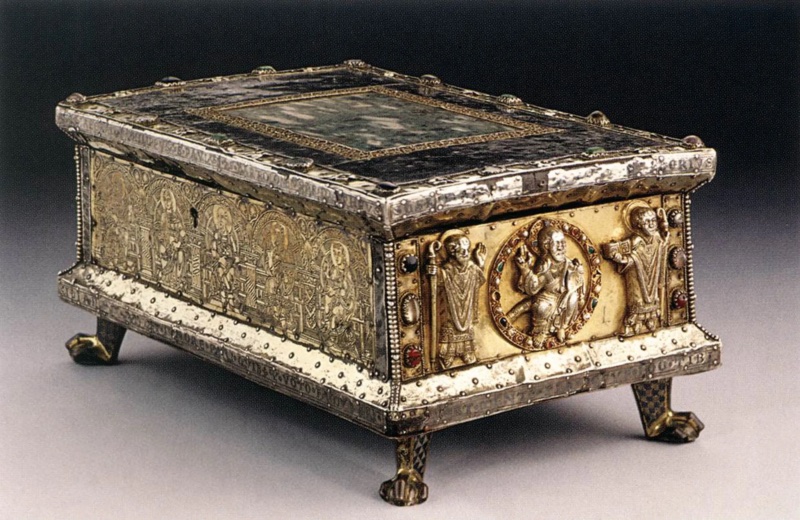
The portable altar of Saints Kilian and Liborius, preserved in the treasury of Paderborn Cathedral and datable to approximately 1120, constitutes the most securely attributed and most important surviving work connected with Roger of Helmarshausen’s name. Commissioned by Bishop Henry II of Werl of Paderborn, the object was intended to serve the double devotional purpose expressed by its double dedication: honouring Saint Kilian, the Irish missionary martyr of Würzburg whose cult linked Paderborn to the wider network of Frankish evangelization, and Saint Liborius, the fourth-century bishop of Le Mans whose relics had been translated to Paderborn in 836 and whose patronal significance for the cathedral church made him the paramount local intercessor. The altar is executed principally in silver-gilt, with champlevé enamel inserts of deep blue, green, and white that create chromatic accents of great clarity against the glowing metallic ground, a surface organization that exemplifies the principles of Mosan-inflected Romanesque goldsmith’s work at their most refined.
The iconographic programme of the upper face centres on a figure of Christ in Majesty (Maiestas Domini) enthroned within a mandorla, his right hand raised in blessing and his left hand bearing the closed book of Revelation; the composition follows Byzantine prototype while adapting it to the intimate scale and physical orientation of a portable altar intended for use in private or small-group liturgical celebration. Flanking the central Maiestas are the figures of Saints Kilian and Liborius, rendered with a stylized elegance characteristic of Roger’s figural manner—elongated, frontally oriented, and clad in draperies whose linear patterning conveys spiritual intensity rather than bodily movement. Inscribed bands frame the major compositional fields, their letter forms cut with the same precision as the figurative elements and integrated into the surface design as active participants in the visual programme rather than as mere labels.
The short ends of the altar carry additional figurative compositions that extend the theological programme of the main face, including representations of other saints within their arched niches that together constitute a compressed image of the heavenly court appropriate to an object that makes present on earth the spiritual realities of the liturgy it serves. The condition of the object, preserved within the Paderborn treasury continuously since the twelfth century, is excellent, allowing modern viewers to appreciate the original chromatic and metallic effects that Roger intended with a clarity rarely available for works of this age. Technical analysis conducted in the late twentieth century confirmed the exceptional quality of the metalwork, identifying alloys and enamel compositions consistent with Mosan workshop practice of the early twelfth century and revealing evidence of sophisticated preparation techniques described in corresponding passages of the De diversis artibus. The altar remains in the treasury of Paderborn Cathedral (Diözesanmuseum Paderborn), where it constitutes the centrepiece of the collection of Romanesque liturgical metalwork and is recognized internationally as one of the masterpieces of its genre.
A second portable altar, also associated with the Helmarshausen workshop and now attributed by many scholars to Roger’s personal production, was commissioned for the Benedictine abbey of Abdinghof in Paderborn and is equally preserved in the Paderborn cathedral treasury. This work, dedicated to the apostles Peter and Paul with additional representations of other apostolic figures distributed across its surface, demonstrates the stylistic consistency that characterizes the Helmarshausen workshop at its height, deploying the same compositional strategies and figural conventions visible in the Kilian and Liborius altar with a comparable level of technical accomplishment. The iconographic programme, centred on images of the princes of the apostles who provided the universal Church with its foundational authority, carries an ecclesiological significance appropriate to a monastic community dedicated to the vita apostolica—the apostolic life—that was the ideal of Benedictine reform in this period. The depiction of the apostles in formal disposition around the central image of Christ reflects a Romanesque version of the Deesis arrangement familiar from Byzantine apses, adapted to the horizontal format of a portable altar and rendered with the precision and stylistic restraint characteristic of Roger’s mature hand. Technical examination of this altar, conducted alongside comparative study of the Kilian and Liborius work, has identified close correspondences in the preparation of enamel cells, the treatment of metal surfaces, and the rendering of figural elements that support a common workshop origin, though the precise degree of Roger’s personal involvement in its execution remains debated. The altar is somewhat smaller than its companion and its overall layout simpler in compositional terms, suggesting either a difference in the budget available to the commissioning patron or the work of an advanced workshop associate rather than Roger himself executing every element under close supervision. The inscriptions framing the compositional fields are cut with the same calligraphic exactitude visible in the Kilian and Liborius altar, reinforcing the attribution to a single workshop environment in which consistent standards of lettering were maintained across different projects. The object’s excellent state of preservation allows a clear view of Roger’s approach to chromatic organization, including his characteristic use of deep blue as the dominant enamel hue, relieved by smaller areas of green, white, and occasional red that create a restrained but richly satisfying colour harmony. The Abdinghof altar was presumably used in the liturgical life of its commissioning institution before the dissolution of the abbey and the transfer of its treasury contents to Paderborn, where it now serves as a companion piece to the Kilian and Liborius work and contributes to the understanding of the Helmarshausen workshop’s range and methods.
The De diversis artibus, known in manuscript tradition under the pseudonym “Theophilus Presbyter” and composed most probably between the late 1090s and approximately 1125, represents Roger of Helmarshausen’s most extensive intellectual legacy and the work through which his influence has been most widely diffused across time and geography. The treatise is organized in three books, each prefaced by a chapter of theological reflection that establishes the spiritual framework within which the subsequent technical instructions are to be understood: book one addresses the preparation of pigments and the techniques of panel painting and manuscript illumination; book two provides a systematic account of the creation and installation of stained glass windows; and book three, the longest and most detailed, covers every major aspect of the goldsmith’s craft from casting and chasing through champlevé enamelling to the setting of precious stones. The prefaces to the three books invoke the tradition of Solomonic wisdom and the biblical precedent of Bezalel, the craftsman whom God endowed with skill for the furnishing of the Tabernacle, establishing a theological genealogy for the author’s own enterprise that presents the writing and reading of the treatise as acts of religious service rather than merely technical instruction. The practical value of the De diversis artibus is demonstrated by the survival of more than sixty medieval manuscript copies, distributed across Germany, France, England, the Low Countries, and Italy, attesting to its continuous use as a workshop manual throughout the middle ages and its recognition by craftsmen and their clerical patrons as an authoritative compendium of technical knowledge. The discussions of enamel preparation in book three, which include detailed accounts of different methods of cell construction, the composition of glass frits for different colours, and the firing temperatures appropriate to various materials, correspond so closely to the technical procedures evident in the Paderborn altars that the identification of Theophilus with Roger has achieved near-consensus among art historians and technical analysts. The references in book one to oil painting techniques represent the earliest known discussion of this medium in western European literature, anticipating by more than two centuries the developments in Flemish painting traditionally credited with its introduction and demonstrating the sophistication of the technical knowledge accumulated in leading Romanesque workshops. The stained glass instructions of book two provide an invaluable window into a medium whose surviving examples are fragmentary, offering technical specifications that illuminate the extraordinary achievements of twelfth-century glaziers in ways that no other contemporary source approaches. The treatise’s framing device—the presentation of craft knowledge as a gift from one brother to another within the monastic community of faith—reflects Roger’s understanding of the purpose of his writing as an act of theological charity, extending the value of his skills beyond his own lifetime and institutional context to all who might benefit from them. The De diversis artibus was rediscovered by western scholarship in the eighteenth century through the investigations of Gotthold Ephraim Lessing, who encountered a manuscript at the Wolfenbüttel library, and the subsequent identification of Theophilus with Roger of Helmarshausen by Ilse Schreiner and others in the twentieth century has transformed understanding of the work from an anonymous technical compendium into the personal testimony of a specific historical craftsman whose surviving objects allow his written account to be read in immediate relationship with his working practice. The treatise is now available in multiple critical editions and translations, including the standard English edition by C. R. Dodwell (1961, revised 1986), and continues to be indispensable for historians of medieval art, technique, and theology alike.
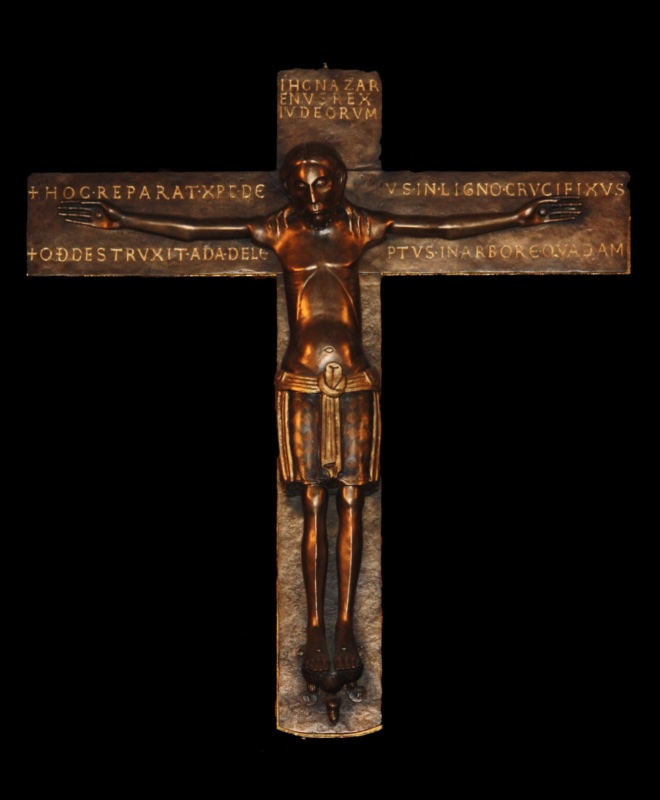
The processional cross preserved in the cathedral treasury of Minden (Domschatz, Minden) represents one of the most significant objects attributed to the Helmarshausen workshop beyond the Paderborn commissions, and its presence in the treasury of a diocese geographically and institutionally distinct from Paderborn testifies to the broad reach of Roger’s workshop within the ecclesiastical networks of Westphalia and Saxony. Executed in silver-gilt with champlevé enamel inserts and cabochon stone settings, the cross belongs to the same material and technical register as the Paderborn portable altars, deploying the same refined control of engraved surfaces, the same chromatic conventions in the enamel palette, and the same integration of inscribed text within the visual field that define the Helmarshausen aesthetic. The front of the cross presents the Crucifixion in the Christus triumphans mode consistently favoured by the Helmarshausen workshop, with Christ erect and open-eyed on the cross flanked, at the terminal medallions of the cross-arms, by figures of the Virgin and Saint John whose elongated proportions and tightly patterned draperies echo the figural conventions of the Paderborn altars. The reverse carries a figure of Christ in Majesty within a central roundel, surrounded by the symbols of the four Evangelists (Tetramorphos) at the four terminals, a programme that places the sacrificial figure of the obverse in theological dialogue with the triumphant Maiestas of the reverse, together constituting a complete theophanic statement appropriate to an object carried at the head of liturgical processions. The execution of the enamel passages, with their characteristic deep blues and greens set within precisely prepared champlevé cells, corresponds closely to the techniques described in the third book of the De diversis artibus, providing further material evidence for the alignment between Roger’s theoretical prescriptions and the workshop practice he supervised. The patronage context of the Minden cross is less precisely documented than that of the Paderborn altars, but the object’s arrival in the Minden cathedral treasury implies either a direct commission from the bishop of Minden or a gift negotiated through intermediary ecclesiastical networks connecting the Halberstadt-Minden diocesan sphere with the Helmarshausen community. The attribution of the cross specifically to Roger’s personal hand, rather than to the wider workshop operating under his direction, remains contested among specialists; the stylistic evidence supports a close proximity to the Paderborn altars without conclusively demonstrating that the same individual executed every engraved and enamelled element. The question of personal attribution is in any case less important than the cross’s function as evidence for the geographical and institutional range of Roger’s influence, demonstrating that Helmarshausen’s artistic production circulated through a patronage network extending across multiple Westphalian and Lower Saxon dioceses. Comparison of the Minden cross with the Paderborn altars reveals a consistent stylistic personality in the treatment of drapery, physiognomy, and ornamental borders, a consistency that reflects either Roger’s sustained personal involvement or the successful transmission of his aesthetic standards to sufficiently skilled workshop collaborators. The cross remains in the Domschatz at Minden, where it forms part of a collection of Romanesque liturgical metalwork whose quality confirms the region’s position as a major centre of ecclesiastical patronage and artistic production in the early twelfth century, and where it is recognized as one of the key documents for understanding the full geographic scope of the Helmarshausen workshop’s activities.